One Stamper Always Wins?

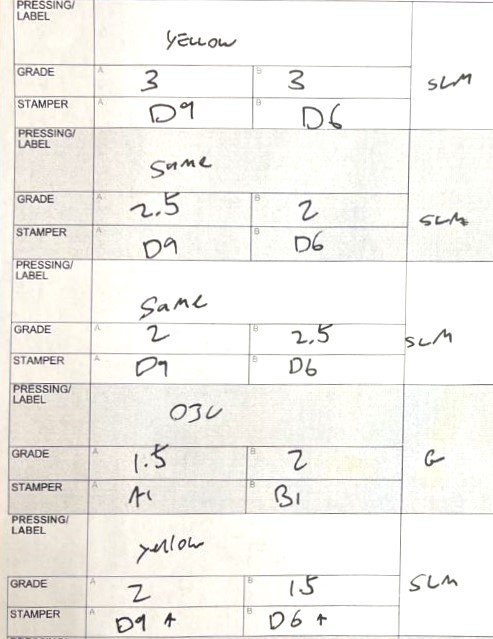
These are records in which one set of stampers always wins the shootout.

We’ve added some context in the commentaries below.

Buy Promos, Don’t Buy Promos — Honestly, Just Make Up Your Mind

Hot Stamper Pressings of Vintage Columbia Albums Available Now

Recently we conducted a shootout for a Columbia recording of jazz fusion music, one that we had auditioned a couple of times before and one for which we knew the music and the general quality of the sound well.

It’s not the record you see pictured. For now we’re keeping the title a mystery, consistent with the idea that we give out lots of bad stampers on this blog, sometimes really bad stampers, but almost never do we give out the good ones.

All the copies we had in our shootout were pressed domestically, and all were mastered by the legendary Robert Ludwig. No Nice Price junk, no imports, none of that crap. We might have made those mistakes in previous shootouts, but having done this shootout a number of times now, we know what works and what doesn’t.

When we do give out the best stampers, as in the case here, we tend to keep the title a mystery. We are not the least bit interested in putting ourselves out of business.

The discussion for today revolves around the idea held by a great many audiophiles that the promo pressings are going to be the best sounding pressings of almost any album they might happen to run across.

And, to be fair, in the case of this mysterious album, they’re potentially right.

Our best sounding copy was a promo pressing.
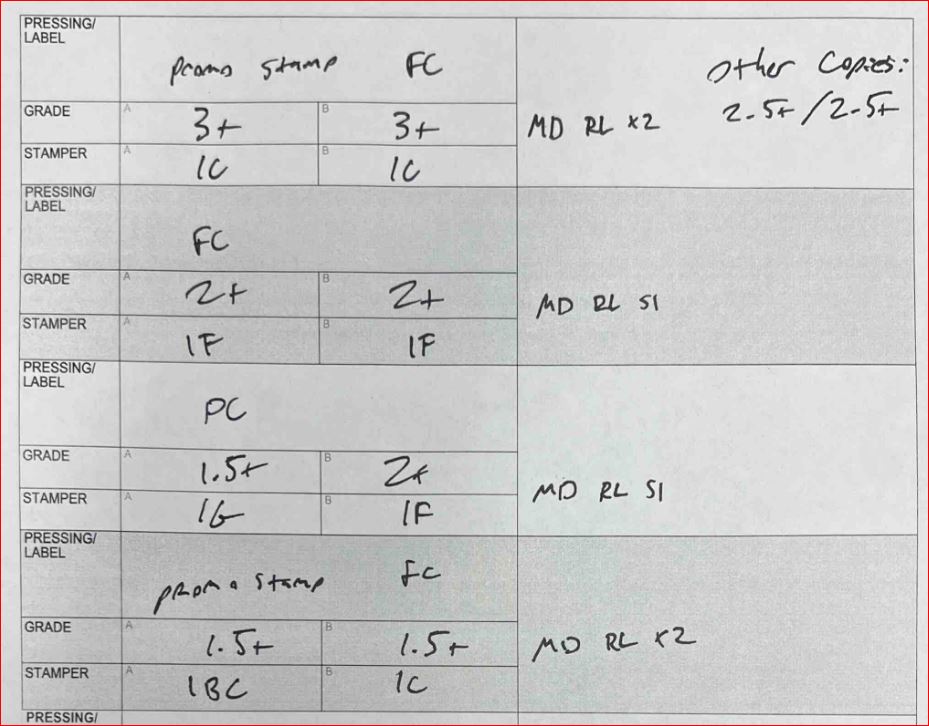
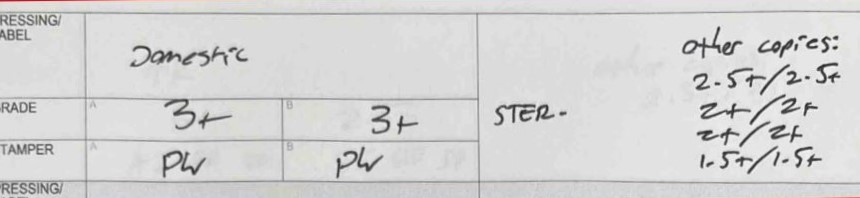
What interests me in these findings is that the other promo copy, the one you see at the bottom of the shootout sheet, earned 1.5+ on both sides. It came in last in the shootout, earning good, not great Hot Stamper grades.

If an audiophile collector were to go to Discogs, find the promo pressings, write down their stampers, and then check them against the copies he owned or might want to buy, he could either find himself with a top quality copy, or a far-from-as-good copy, depending on his luck.

Why one set of stampers sounds so much better than another set, or the same or similar set on a different pressing, is a mystery.

Does anyone have a practical way to get around the unfortunate reality that allows one set of stampers to sound great and the same or a similar set of stampers to sound not much better than decent?

Well, we can’t say there is a practical way, but we do know of an impractical one. We’ve been practicing and refining that one for more than twenty years.

(more…)

On this Wonderful Sounding London, Is Ted Burkett’s 2G Stamper the Way to Go?

Hot Stamper Pressings of Recordings by Decca Available Now

Before we go any further, let me say that the record you see pictured is not the record whose shootout and stampers we are about to discuss.

Yes, that’s right, the stamper numbers you see below belong to a different album.

We’ve lately been giving out much more stamper information than we used to, but for now we are keeping this title close to the vest.

What can we learn about the best sounding pressings of this vintage Decca recording, mastered by Mr. E and Mr. G, both outstanding mastering engineers?

It seems that Mr. G cut the better sounding pressing, our shootout winner as a matter of fact, but I can’t say whether the pressing that won was an original, since there were two differently-mastered Blueback pressings in the shootout, and one of them came in tied for last.

It was actually beaten by two copies of the Whiteback reissue. Those seem to be made from the same stampers as the winning pressing, but are those stampers the earliest or did they come later? Who knows?

Mr E. cut a version of the record that was quite a bit less impressive than most of the others, earning grades of 1.5 on side one and 2+ on side two.

Side one was dry and flat, side two rich but hard. We hear a lot of records with these shortcomings. If you play lots of classical music on vintage vinyl, you should be hearing them too.

And Your Point Is?

(more…)

Why Do the Later Stampers of this Shaded Dog Sound So Much Better than the Earlier Ones?

Hot Stamper Pressings of Living Stereo Recordings Available Now

For RCA classical and orchestral recordings, the earliest pressings on the Shaded Dog label, in stereo, tend to be the best sounding, right? 

Maybe. It’s an open question, at least it is for us when we consider how many exceptions to the rule we’ve run into over the 30+ years we’ve been buying and selling them.

If we tallied all the copies we’ve played and created a very large spreadsheet using the data, perhaps we could give you a better answer than “we don’t know,” but we’ve definitely never tallied them up and have no plans to do so. It sounds to me like a lot of work.

However, in our experience, and contrary to the conventional wisdom, sometimes the higher-numbered pressings are better sounding than the lower-numbered pressings. This is true of the stampers for the Shaded Dog pressings below.

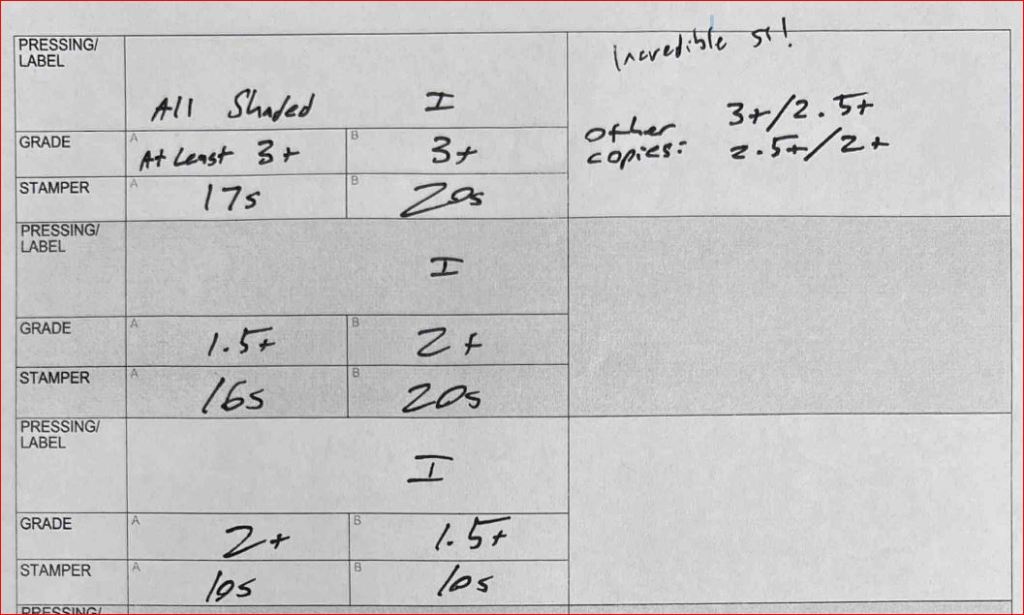
Keep in mind that the stamper numbers you see belong to a different album.

The questions that audiophiles who collect shaded dog pressings should be asking themselves right about now are:

  • Why is 17s/20s consistently better sounding than any copy with any other stampers?
  • Why is the 16s pressing worse sounding than even the worst 17s pressing when they are both Indianapolis pressings only one digit apart?
  • Why does the 20s side two potentially win the shootout with a 3+ grade, but more often only earn a grade of 2.5+ or 2+?
  • And the hardest to stomach of them all are those second-rate 10s stampers. How on earth can they come in last in a shootout against all the copies with higher numbers?

It turns out that the old rule of thumb that the lower-numbered stampers will sound better than the higher-numbered ones is not nearly as reliable as some folks would like it to be.

If it were more reliable, we could all just buy the lowest-numbered stamper copies we could find and know that we had the best available pressing. Then, if we were lucky enough to encounter an even lower-numbered stamper copy, we could buy that one and know that we now had an even better sounding pressing, all without having to play the old “best” one against the new “best” one.

It’s so convenient and logical this way, why would anyone want to bother with a different illogical, inconvenient and obviously counterintuitive method when the other one has so much going for it?

There is only one problem with the idea of collecting the earliest shaded dog pressings in order to secure the best sounding pressings — the fact that the evidence to support such an approach is so spotty. Yes, early stampers win lots of shootouts. No, early stampers do not win all the shootouts, or even a majority of them, judging by a rough calculation using the data from the many hundreds of stamper sheets we’ve created over the years.

Predictions Are Futile

The unfortunate reality we run into is that most of the time we are not able to predict which stampers will win a shootout before we actually sit down to play all our copies.

Although it’s true that there are many pressings in which one set of stampers always wins, the odds are that any particular pressing with those stampers will do well but won’t win, and it sometimes happen that some pressings with those stampers won’t do well at all.

This is why we have to do shootouts, and why you have to do them too, if finding the highest quality pressings is important to you.

Fortunately for readers of this blog, our methods are explained in detail, free of charge.

We’ve also written quite a few commentaries to help audiophiles improve the way they think about records.

I implore everyone who wants to make progress in this hobby to learn from the mistakes we’ve made. There are 146 “we were wrong” listings on the site as of this writing, and we learned something from every damn one of them, painful and costly as those experiences may have been.

(more…)

What Lessons Can We Take from this Columbia Shootout?

Hot Stamper Pressings of Vintage Columbia Albums Available Now

Recently we conducted a shootout for one of our favorite Columbia recordings, one that we had auditioned many times before and for which we knew the music and the general quality of the sound well.

It’s not the record you see pictured.

For now we’re keeping the title a mystery, consistent with the idea that we give out plenty of stamper information on this blog, including some of the worst ones we’ve had the misfortune to run into, but rarely do we feel the need to give out the really good ones. After decades of doing this kind of work, the time and effort that has gone into finding them is beyond calculation.

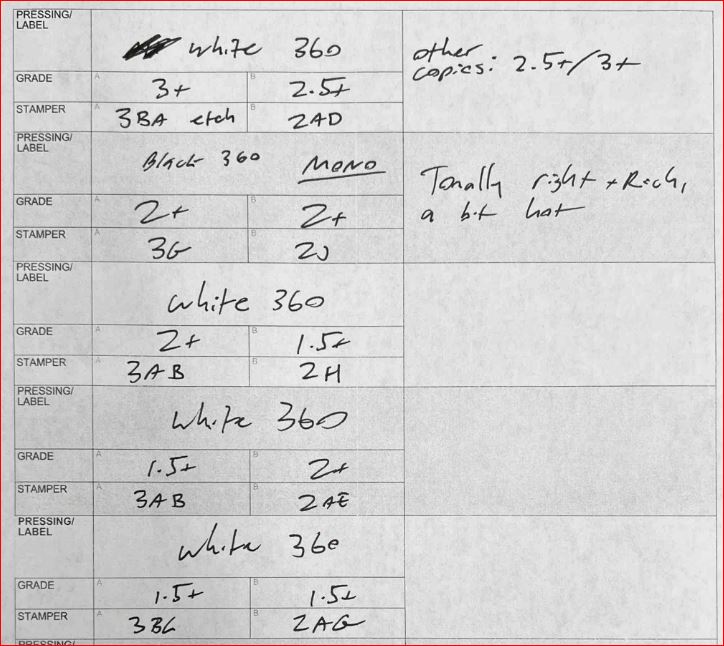
When we do give out the best stampers, as is the case here (3BA baby!), we make a point of keeping the title under wraps.

We are not the least bit interested in putting ourselves out of business.

The discussion for today revolves around the idea held by a great many audiophiles that the original White Print 360 label pressings are going to be the best sounding for any title that was made starting with that label in the early-60s.

(The Black Print 360 mono is an example of the mono labels being a bit behind the times as far as I can tell.)

Note that we did not bother to put any of the 70s Red Label Columbia pressings in the shootout. We’ve been down that road with this title before, and we have yet to hear one worth the vinyl wasted on it.

Columbia, like most labels, seems to have made very little effort with the sound quality of their reissues. Perhaps it was the result of all the bad transistor equipment in the studios by the time the 70s rolled around, but that would be speculation on my part, as well as something that would be very hard to find evidence for one way or the other.

We did find one Monk record that sounded better on the Red Label reissue, and readers of this blog should easily be able to find out which one it is by reading our many reviews for Monk’s recorded output.

We have two new lists for those who would like to know which Columbia labels win shootouts — one for 6-Eye winners and one for 360 Label winners.

What interests me in these findings is the following:

  • Both of our shootout winning copies had the same stampers. Can that really be a coincidence?
  • The shootout winner for side one is 3BA.
  • Two copies with stampers very similar to that one, 3AB, did noticeably worse, 2+ and 1.5+.
  • And the worst of the White Print 360 Label pressings barely earned a Hot Stamper grade at all.
  • They are on the same original label as the other copies, but for some reason they don’t sound as good. Why is that?

If an audiophile collector were to go to Discogs, find a nice clean copy on the early label and buy it, he might find that he know owns a top quality sounding copy, a pretty good sounding copy, or a not-nearly-as-good sounding copy as he’d hoped for, depending on his luck.

And what would he know about the quality of the recording? About that thing that audiophiles and record collectors seem to reference so often, “the master tape,” as if they have any way of knowing about the sound of a tape they have never come into contact with.

Just Assume

If he had a killer 3BA, wouldn’t he just assume that for some reason the recording must be amazing and consider himself lucky to find such a wonderful record to play.

Why one set of stampers sounds so much better than another set, or the same or a similar set on a different pressing, is a mystery, and it’s one that we confidently predict will never be solved.

Does anyone have a practical way to get around the reality that allows one set of stampers to sound great and the same or a similar set of stampers to sound no better than very good, if that?

Well, we can’t say there is a practical way, but we do know of an impractical one. We’ve been practicing and refining that one for more than twenty years.

We just play lots and lots of copies of the albums to find out how they sound.

(more…)

THE Hot Ticket, or Just One of a Bunch of Potentially Hot Tickets?

Hot Stamper Pressings of Rock and Pop Albums Available Now

Below you will find the stamper sheet for a title from a recent shootout we did for a rock record whose name we are not revealing.

You may have noticed that when we give out the stampers for the top copies, we rarely identify the title of the record with those Shootout Winning stampers.

As you can well imagine, our sizable investments in research and development over the course of decades make up a big part of the costs we must pass on to our customers.

I can’t say this title is typical of most of the rock and pop we play, but it’s not all that unusual either.

Obviously, knowing the “right” stamper information in this case gets you in the ballpark, but it won’t help you hit the grand slam home run you want to. To do that you have to clean and play about five copies the way we did.

Hot Stamper shootouts may be expensive, they may be a lot of work, but our experience tells us there is simply no other way to find top quality pressings — the ones that earn the 3+ grades, not the 1.5+ grades.

They might all look the same, but they sure don’t sound the same.

In this particular case, the import pressings we played — the ones we expected to do the best as a matter of fact — had by far the worse sound.  There were a couple of them, there was a domestic reissue, and there were five originals: eight records in total.

Changes for 2024

Beginning in 2024 we decided to make available to our readers a great deal of the pressing information we’ve compiled over the last twenty years, under these headings:

(more…)

The Reissues Consistently Beat the Originals on this Mercury

Hot Stamper Pressings of Mercury Classical Records Available Now

For Mercury classical and orchestral recordings, the original FR pressings on the plum label are the way to go, right? 

In some cases, yes. We talk about how much better the FR pressings for The Firebird are compared to the much more common, and still quite good, M2 reissue pressings here.

The stamper numbers you see below belong to a different album.

The notes for the FR original pressings we played read:

  • Less spacious, more bright and flat.

They’re not bad sounding, they’re just not as good sounding as the RFR reissues, which, incidentally, won the shootout.

We’ve lately been giving out much more stamper information than we used to, but we make it a point to never give out the stamper information for our shootout winners, as finding those very special pressings has been the work of a lifetime and is certainly not something that should be given away for free.

Rules of Thumb

It’s just another one of a number of rules of thumb collectors use (“A method or procedure derived entirely from practice or experience, without any basis in scientific knowledge; a roughly practical method”), one that will sometimes lead you astray if what you are trying to find are not just good sounding pressings of albums, but the best sounding pressings of albums.

Same with reissue versus original. Nice rule of thumb, but it only works, to the extent that it works at all, if you have enough copies of the title to know that you’re not just assuming the original is better. You actually have the data — gathered from the other LPs you have played — to back it up.

Who Knew?

Who knew the recording would sound so much better on the right reissue pressings?

Certainly not us, not until we had done the shootout.

The difference between the way we do things and the way others do them boils down to this: We assumed that the original could be the best, and then we tested that assumption and found out we were wrong.

But the right reissues of this Mercury — again not the ones you see pictured — is indeed an exceptionally good sounding record.

This is why we do shootouts, and why you must do them too, assuming that owning the highest quality pressings is important to you.

(more…)

How Can the Best Stampers Also Be the Worst Stampers?

Hot Stamper Pressings of Contemporary Jazz Available Now

Recently we conducted a shootout for a superb Contemporary recording, one that we had auditioned a couple of times before and one which we felt we knew the music and the quality of the sound well.

It’s not the record you see pictured.

For now we’re keeping the title a mystery, consistent with the idea that we give out lots of bad stampers on this blog, but almost never do we give out the good ones.

Why, you ask?

The cost of discovering the right stampers is usually high, can take decades, and is fundamentally at the heart of how we make our money: by finding amazing sounding pressings with stampers we know to be good, cleaning them up, playing them, and offering those that, for whatever mysterious reasons that no one has figured out, including us, tend to have the best sounding grooves.

This time around we kept track of the stamper numbers for all the pressings we played, something we are making a habit of doing these days and using to highlight discoveries in the sound of the records we play.

In this case, we discovered an anomaly we thought we would bring to the audiophile world’s attention: the fact that the stampers for the best souding pressing were also the stampers for the worst sounding pressing, because they were the stampers for all the pressings.

One copy earned our White Hot Stamper grade, our highest, for its clearly superior sound, and another one earned our lowest Hot Stamper grade of 1.5+. The rest were quite good, in between those two, which is a very common outcome for most of our shootouts: lots of records in the middle of the distribution, some winners at the top and some losers at the bottom.

(more…)

Maybe We SHOULD Start Buying Blue Notes on the Early Labels

Hot Stamper Pressings of Blue Note Albums Available Now
If there are record companies whose fans are extremely particular about the labels of the pressings they prefer, Blue Note has to be right at the top of that list.

The consensus among record collectors seems to be that the early label Blue Notes are practically guaranteed to have the best sound. In top condition they often sell for many thousands of dollars, far more than we have ever charged for any Hot Stamper Blue Note pressing

We are on record as not favoring early labels over later ones, absent the evidence to support such bias, but perhaps there actually are some records you should be buying based on their labels. This one, for example.

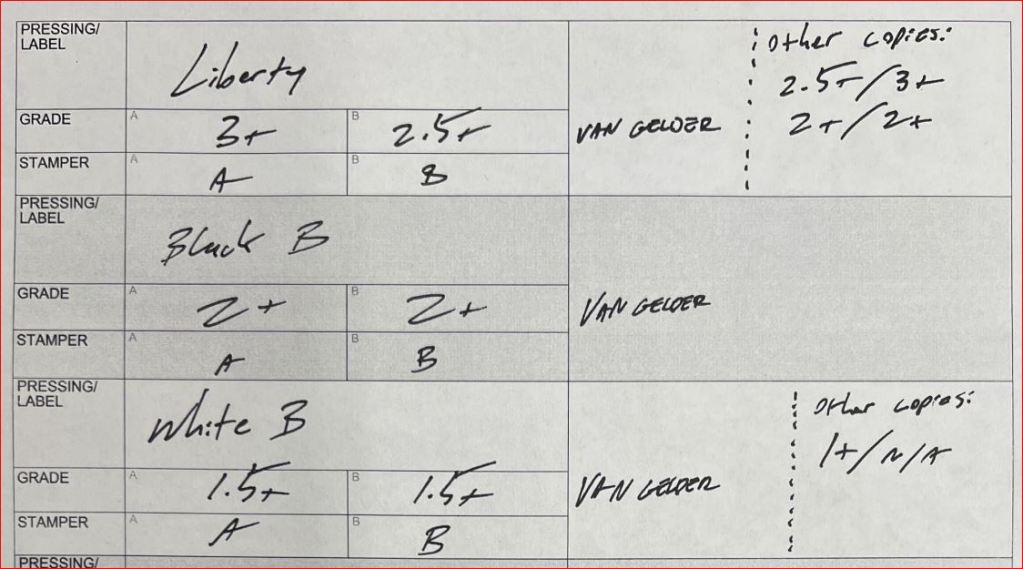
If all the stampers of a title are the same and they’re all cut by Rudy Van Gelder — early labels, middle labels and later labels alike — what do you use to guide you when trying to find the best sounding pressings?

This is precisely the conundrum that an audiophile would be faced with as he goes about trying to find the best sounding pressings of the Blue Note album whose stamper sheet you see below.

This stamper sheet reflects a fairly typical shootout for a Blue Note pressing. It’s hard to find six clean copies no matter what the title is. We probably returned or gave up on half the copies we bought, so we might have had to buy nine in order to shootout six.

(Note that there is nothing on any label after the White B from the 70s. We have never heard any title with an 80s label or later sound worth a damn so we stopped buying them a long time ago.)

Drawing Conclusions

Let’s look at some of the conclusions the typical record collector/audiophile might draw from the information above.

For example:

1.) I have a Blue Note with Van Gelder stamps and it’s decent sounding but I like [fill in the blank with some other pressing] better. Since all the pressings are cut by him, he must not have done a very good job. Thank goodness modern mastering engineer X came along to finally bring out the sound of the master tape that he was not able to do.

That’s an easy one to rebut. The later pressings cut by Rudy are consistently worse sounding than the earlier ones in the case of this title. If you don’t have a big batch to work through, however, you simply have now way of knowing that fact, and therefore whatever conclusions you choose to draw from a too-small pool of pressings are suspect at best.

(more…)

The Music of Leonard Bernstein – White Hot Stampers Revealed!

Hot Stamper Pressings of Music Written or Performed by Leonard Bernstein

Looking to pick up a Hot Stamper locally of The Music of Leonard Bernstein on your own?

Easy — all the best Decca and London copies (British only of course) are 1L on both sides.

I suppose it’s only fair to point out that all the worst copies have 1L on both sides, the reason being that all the copies are 1L on both sides, regardless of how they sound.

And here you thought I was actually being helpful. But we are being helpful. We’re sharing with you an important truth.

Stamper numbers only tell a part of the story. They can be very misleading, in the sense that a little knowledge can be a dangerous thing. To know what a record sounds like you have to play it.

This is a subject near and dear to us here at Better Records, and has been for many decades. We discuss it at length in a commentary you may have seen on the site called The Book of Hot Stampers.

This London Phase 4 British import has some of the most SPECTACULAR sound I have ever heard reproduced from disc. The sound is so BIG and BOLD that it handily puts to shame 95% or more of all the Golden Age Shaded Dogs, London Bluebacks, Mercury Living Presence’s, EMI’s and Decca’s we’ve ever played. If we had a Classical Top 100 list, this record would belong in a Top Ten taken from it, right near the top judging by what I heard when I played it.

If you have a system with the speed, power, and size to play this record properly (yes, you will need all three and a whole lot more), it’s hard to imagine it would not qualify as the best-sounding orchestral recording you’ve ever heard.

Demo Disc barely begins to do it justice. What sound. What music. What a record!

(more…)