Performers

On This Rachmaninoff Title, the Right Reissues Clearly Have the Best Sound

More of the music of Sergei Rachmaninoff (1873-1943)

Until we heard the right later pressings, we had always been disappointed with this TAS List recording, wondering what all the fuss was about. The original Shaded Dog pressings we had played left a lot to be desired. Like many of the old records we audition, it badly lacked both highs and lows, our definition of boxy sound.

Well, now we know.

The earliest Shaded Dog pressings have consistently worse sound than the reissues we offer.

We never offered the record in Hot Stamper form because we didn’t think the sound of the originals was all that impressive, TAS List or no TAS List.

Mystery solved, and truly Hot Stampers have now been made available to the discriminating audiophile.

Harry’s list, as was so often the case, did not provide the information needed to find the pressing that captured all the qualities of the recording the way this one does.

Did Harry have a good later pressing?

Did he have an original and simply liked it more than we did?

Who knows? Like so much in the world of records, it’s a mystery.
(more…)

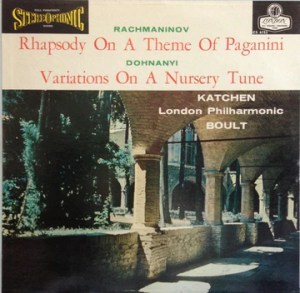
Rachmaninoff / Dohnanyi – Rhapsody On A Theme Of Paganini / Variations On A Nursery Tune / Katchen

More Classical and Orchestral Recordings

  • This early London pressing (the first to ever hit the site) of Katchen and the London Phil’s performance (CS 6153) boasts lush and tubey Shootout Winning Triple Plus (A+++) sound or close to it from first note to last
  • It’s also impossibly quiet at Mint Minus to Mint Minus Minus, a grade that practically none of our vintage classical titles – even the most well-cared-for ones – ever play at
  • The piano is huge and weighty, the strings rich and highly resolving, and the overall presentation is powerful, balanced, dynamic and exciting
  • These sides are doing practically everything right – they’re rich, clear, undistorted, open, spacious, and have depth and transparency to rival the best recordings you may have heard

(more…)

The Violin is a Wonderful Instrument for Tweaking and Tuning

Hot Stamper Pressings Featuring the Violin Available Now
Our review for LSC 2314, with both the Mendelssohn and Prokofiev Violin Concertos, described the wonderful sound we heard on some of the better copies as follows:

As usual for a Living Stereo Heifetz violin concerto recording, he is front and center, with his fingering and every movement of his bow clearly audible, without being hyped-up in the least. (Well, maybe just a bit.)

No violin concerto recording can be considered to have proper Living Stereo sound if the violin isn’t right, and fortunately we found the violin on this copy to be very, very right, with the kind of rosiny texture and immediacy that brings the music to life right in your very own listening room.

Audiophiles who cannot hear what is wrong with the Classic Records repressings of Heifetz’s RCA recordings by the greatest composers who ever lived, including:

may want to seek out a nice — maybe even one that’s not so nice — vintage RCA Shaded Dog of any of his albums, if only to see just how poorly the Classics stack up (with the exception of the LSC 2734, which we have to say, against all odds, is very good).

(more…)

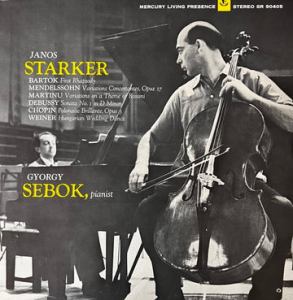
Janos Starker Plays Works By Debussy, Bartok And Others

More Mercury Classical Recordings

  • Starker and Sebok’s virtuoso performances debut on the site with the rich, dynamic, and tubey sound we were hoping for, earning STUNNING Shootout Winning Triple Plus (A+++) grades or close to them throughout this early Plum Label Mercury pressing of SR-90405
  • Both of these sides are big, full-bodied, clean and clear, with a wonderfully present and solid piano, and plenty of 3D space around it
  • The cello is present and immediate, with sound that is remarkably textured, full and harmonically natural
  • Not only is this the best sounding copy we have to offer from our recent shootout, but we are happy to report that the vinyl is reasonably quiet for a vintage Plum Label Mercury stereo pressing

(more…)

Which Is More Important – The Label or the Stamper Numbers?

Hot Stamper Pressings Featuring the Violin Available Now

In this case, since the label is different but the stampers are the same, it’s the label that tells you how good your pressing may — heavy accent on the may — sound.

Lately we’ve been having exceptionally good luck with the early label pressings of many of the London violin concerto records we’ve done shootouts for, especially those performed by Ruggiero Ricci.

However, the notes you see below do not belong to the wonderful Sibelius record pictured here.

They belong to another London record. We give out lots of bad stampers on this blog, but almost never do we give out the good ones. (When we do give out the best stampers, we usually keep the title a mystery, as is the case of the record here. To see the other titles whose Shootout Winning stampers have been revealed, please click here. The list to date is short but not to worry, more are on their way.)

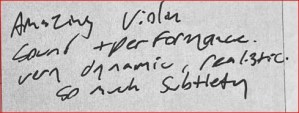
The amazingly good sounding pressing on the early label took the recording to another level. Our shootout notes read:

  • Amazing violin sound and performance.
  • Very dynamic and realistic.
  • So much subtlety.

Scroll down to see out Key Takeaways from this shootout.

(more…)

Suites for Solo Cello on the Later Mercury Label in 2010 – Man Was We Wrong

Hot Stamper Pressings of Mercury Recordings Available Now

UPDATE 2021

The discussion here is for a Oval label copy of Suites for Solo Cello (SR 90370) we reviewed in 2010. These days the Oval label pressings from the early 60s almost never sound very good to us. We no longer buy them and we certainly don’t bother to put them in shootouts.

This record on the Oval Label would be very unlikely to qualify as a Hot Stamper pressing anymore, although we liked it just fine in 2010, as you can see from our old review.

In 2024 we actually put an Oval Label pressing of SR 90370 in a shootout and it did about as poorly as we would have expected. What a waste of time and money. Never again.

(more…)

Liszt / Piano Concertos Nos. 1 and 2 / Kondrashin / Richter

More of the Music of Franz Liszt

  • A vintage Philips import pressing of these Classical Masterpieces that boasts two solid Double Plus (A++) or BETTER sides
  • The finest Liszt 1st and 2nd Piano Concertos we know of for their performances, and unquestionably for sonics (when the sonics are this good)
  • The best pressings of this title are more like live music than any classical recording you own (outside of one of our Hot Stamper pressings, of course; those can be every bit as good) or your money back
  • So big, rich and transparent we guarantee you have never heard a better piano concerto recording

*NOTE: Unlike Concerto No. 1, The Second Piano Concerto opens very quietly, so there will likely never be a vintage pressing of the album that will get that opening to play like a CD. Expect to hear some random ticks, a small price to pay to hear this wonderful performance on top quality analog.

Richter and Kondrashin deliver the finest Liszt 1st & 2nd Piano Concertos we know of, musically, sonically and in every other way. Richter’s performance here is alternately energetic and lyrical, precisely as the work demands. The recording itself is explosively dynamic. The brass is unbelievably full, rich and powerful. You won’t find a better recording of this music anywhere.

Big and rich (always a problem with piano recordings: you want to hear the percussive qualities of the instrument, but few copies can pull it off without sounding thin). We love the BIG, FAT, Tubey Magical sound of this recording! The piano is solid and powerful — like a real piano.

Huge amounts of hall space, weight and energy, this is DEMO DISC QUALITY SOUND by any standard. (more…)

Falla / Ritual Fire Dance – Entremont

More Classical and Orchestral Pressings

  • Philippe Entremont’s delightful 1967 release, here with stunning Nearly Triple Plus (A++ to A+++) grades on both sides of this Stereo 360 pressing – just shy of our Shootout Winner
  • It’s also fairly quiet at Mint Minus Minus, a grade that even our most well-cared-for vintage classical titles have trouble playing at
  • This wonderful pressing is solid and weighty, with less smear, situated in the bigger space, with more energetic performances
  • These sides are big, full-bodied, clean and clear, with a wonderfully present piano and plenty of 3D space around it
  • Some old record collectors (like me) say classical recording quality ain’t what it used to be – here’s all the proof anyone with two working ears and top quality audiophile equipment needs to make the case
  • Dynamic, huge, lively, transparent and natural – with a record this good, your ability to suspend disbelief requires practically no effort at all
  • Here are more than 100 classical and orchestral discoveries we’ve made over the many years we’ve been auditioning records
  • We are happy to share these titles with those whose focus is on the wonderful music and sound they contain, rather than their cost, rarity. collectibility or resale value

(more…)

For Concerto No. 1, This Is the Way the Piano Should Sound

Hot Stamper Living Stereo Classical and Orchestral Titles Available Now
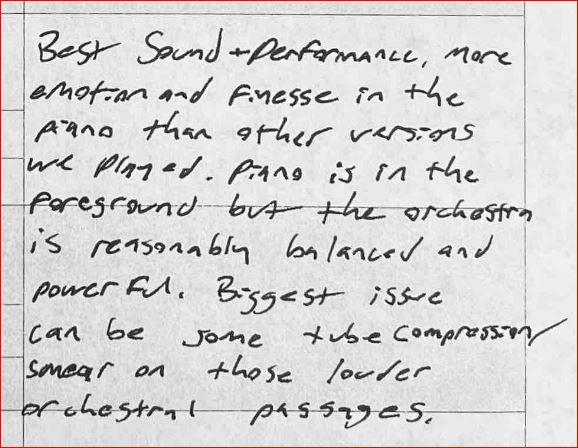
We love the huge, solid and powerful sound of the piano on this recording. This piano has weight and heft. As a result, it sounds like a real piano.

For some reason, a great many Rubinstein recordings are not capable of reproducing those all-important qualities in the sound of the piano.

Those are, as I hope everyone understands by now, the ones we don’t sell. If the piano in a piano concerto recording doesn’t sound solid and powerful, what is the point of playing such a record?

Or, to be more accurate, what is the point of an audiophile playing such a record? (Those of you who would like to avoid bad sounding vintage classical and orchestra records have come to the right place. We’ve compiled a very long list of them precisely for that purpose, and we’ve been adding to it regularly.)

No doubt Kenneth Wilkinson made sure the recording captured the weight of the piano he was listening to as it played all those years ago in the wonderful acoustics of Kingsway Hall.

The strings have lovely Living Stereo (Decca-engineered) texture as well.

As befits a Wilkinson recording from 1961, there is no shortage of clarity to balance out the Tubey Magical warmth and richness.

When you add in the tremendous hall space, weight and energy, this becomes a Demo Disc orchestral recording by any standard.


Notes from a 2024 Shootout

Our notes above point out that:

(more…)

An Amazing Recording Held Back by Truly Awful Mercury Mastering

Hot Stamper Mercury Pressings Available Now

This Mercury 35mm recording was released through Philips after they’d bought the Mercury label back in the 60s.

Philips would go on to release the mostly dreadful Golden Import pressings that were made from all the most famous Mercury recordings, but of course they sounded a great deal more like Philips recordings than Mercury recordings once they had been remastered.

Some things never change. Do you like the sound Steve Hoffman brought to the DCC vinyl releases? You can be sure you will get plenty of that sound and very little of any other. We call that My-Fi. Once we learned to recognize it, something we admit took us longer than it should have, we became ardently opposed to it.

If you think that the right way to remaster records is to make them sound more like you want them to sound and less like the scores of vintage pressings sounded before, you and I are clearly in different camps. (One listen to a Hot Stamper pressing may be all that it takes to get you to switch camps.)

This album was recorded by Robert Fine and Wilma Cozart, then mastered by George Piros, all members of the legendary Mercury team, revered by the audiophile cognoscentias as true giants , and with good reason. We count ourselves among Mercury’s biggest fans.

It is instructive to note that the Philips mastering in this case is dramatically superior to the mediocre Mercury mastering by Robert Fine, which may strike you as counterintuitive, but is nonetheless a fact that cannot be denied once you have played a sufficient number of copies of each version, as we have.

(more…)