Composers

Violin Recordings and the Problem of Smear

Hot Stamper Pressings of Living Stereo Titles Available Now

This Shaded Dog pressing of LSC 2129 had practically no smear on either the violin or the orchestra.

Try to find a violin concerto record with no smear.

We often say that Shaded Dogs, being vintage All Tube recordings, tend to have tube smear.

But what about the 70s transistor mastered Red Label pressings – where does their smear come from?

Let’s face it: records from every era more often than not have some amount of smear.

And we can never really know what accounts for it.

The key thing is to be able to recognize it for what it is.

(We find modern records, especially those pressed at RTI, to be quite smeary as a rule. They also tend to be congested, blurry, thick, veiled, and ambience-challenged. For some reason most audiophiles — and the reviewers who write for them — rarely seem to notice these shortcomings.)

Of course, if your system itself has smear it becomes that much harder to hear the smear on your records.  Practically every tube system I have ever heard had more smear than I could tolerate – it comes with the territory. And high-powered transistor amps are notoriously smeary, opaque and ambience-challenged. Our low-powered, all-transistor rig has no trouble showing us the amount of smear on records, including those that have virtually none.

Keep in mind that one thing live music never has is smear of any kind. Live music is smear-free. It can be harmonically distorted, hard, edgy, thin, fat, dark, and all the rest, but one thing it can never be is smeary.

That is a shortcoming unique to the reproduction of music, and one which causes many of the pressings we sell to have their sonic grades lowered.

(more…)

Bach / Suites For Solo Cello No. 2 & No. 5 / Starker

More of the Music of J.S. Bach

  • An early Mercury label pressing of Starker’s legendary 1963 recording (SR-90370) of Bach’s sublime music for solo cello with solid Double Plus (A++) grades from top to bottom
  • It’s also fairly quiet at Mint Minus Minus, a grade that even our most well-cared-for vintage classical titles have trouble playing at
  • The bass-boosted, muddy, veiled and ambience-challenged sound of the modern Heavy Vinyl remaster is nowhere to be found here
  • I would bet money that whatever version is currently available has plenty of shortcomings along those lines, which may be acceptable to the mid-fi crowd but is positively ruinous on the high-fidelity systems that our customers tend to have (or why on earth would they keep paying these prices?)
  • We are very confidant that it will beat the pants off any Heavy Vinyl reissue because every one of those that we played was opaque, muddy and thick enough to have us crying “uncle” after five minutes
  • Some Mercury pressings from the 50s have absolutely amazing sound – we should know, we’ve played them

(more…)

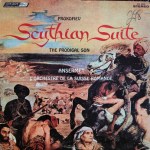
Shootout Winning Stampers for the Scythian Suite Revealed

Hot Stamper Pressings of Orchestral Spectaculars Available Now

When it comes to the Scythian Suite, we’ve decided that there is no good reason to put the Ansermet recordings in our shootouts anymore.

Don’t get me wrong. They are perfectly good records, but the Abbado is a step up both in performance and sound. Our main listening guy summed up the differences of the two recordings this way.

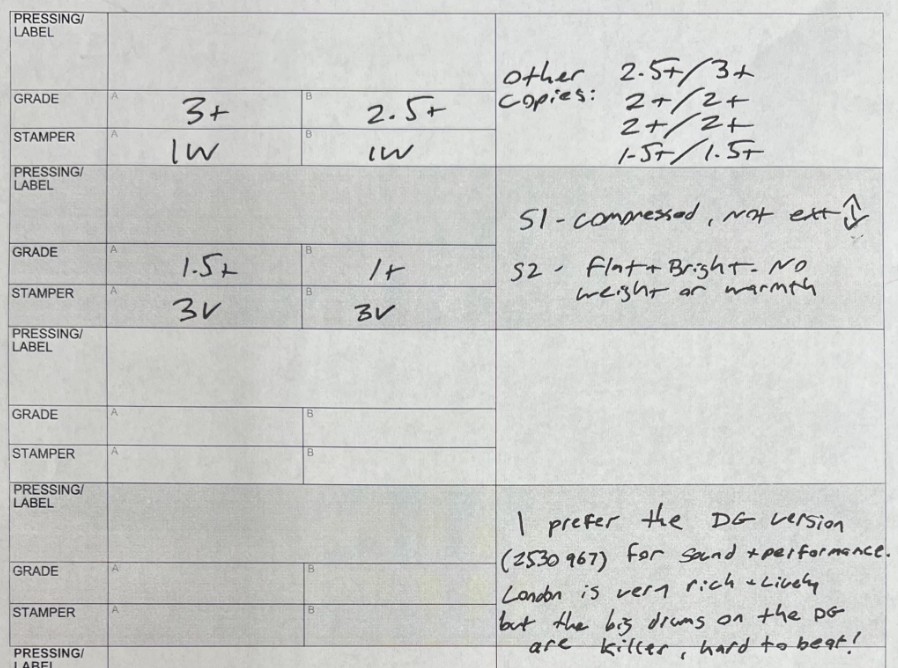
  • I prefer the DG version (2530 967) for sound and performance.
  • The London is very rich and lively but the big drums on the DG are killer, hard to beat!

So, out of the goodness of our hearts, we can now reveal the Shootout Winning stampers: 1W/1W.

However, in the case of CS-6538, knowing the right stampers is not going to get you very far.

You will actually need a pile of copies with those stampers in order to find one worthy of a 3+ White Hot stamper grade.

Obviously, knowing the “right” stamper information in this case gets you in the ballpark, but it won’t help you hit the grand slam home run you were hoping for. To do that you have to clean and play at least six copies the way we did.

(more…)

Tchaikovsky / Saint-Saens – Variations on a Rococo Theme / Cello Concerto in A Minor / Starker

More of the Music of Tchaikovsky

More of the Music of  Saint-Saens

  • This original Plum Label Mercury pressing of Starker’s sublime performances boasts two textured, sweet, and natural Double Plus (A++) or BETTER sides
  • It’s also fairly quiet at Mint Minus Minus, a grade that even our most-well-cared-for vintage classical titles have trouble playing at
  • The cello is present and immediate, with sound that is wonderfully full and harmonically natural on this copy of SR-90409
  • This recording is not your typical dry, bright, nasaly, upper-midrangy Merc – the sound is rich and smooth like a good London, with a big stage and lovely transparency

(more…)

John Williams – The Missouri Breaks (Original Motion Picture Soundtrack)

More Soundtrack Recordings of Interest

  • With two very good Hot Stamper sides, you’ll have a hard time finding a copy that sounds as good as this original UA pressing
  • It’s richer and fuller than the average copy, with notably more presence, and that will be especially true when you compare it to whatever godawful Heavy Vinyl pressing may be currently available
  • This is true of even our lowest-priced, lowest-graded copies – they are guaranteed to sound much better than any pressing you can find on the market today, as well as any pressing you may already own
  • I recall this record being on the TAS list back in the day – it appears to have since dropped off the newer iterations, but we still think of it as a Super Disc
  • “While eschewing the grandiose string arrangements and heroic sweep of the composer’s best-known efforts, it’s nevertheless one of Williams’ most delightful and ambitious scores, applying traditional Western instrumentation like guitar, banjo, and harmonica to melodies rooted in contemporary pop and jazz.”

(more…)

Brahms and Dvorak / Serenades / Kertesz

Hot Stamper Pressings on Decca and London Available Now

This London Whiteback LP (CS 6594) has Super Hot Stamper sound on side two, which is where the Dvorak Serenade for 10 wind instruments, cello and bass can be found. It has lovely space and depth, with dead on tonality and lots of Tubey Magic.

If you love the sound of wind instruments (and who doesn’t? British Band Classics springs immediately to mind as one of the most enjoyable classical recordings I own), then this just may be the classical chamber recording for you.

We reviewed this recording using a single pressing back in 2011. We don’t do things like that anymore, but we have to admit that we often did things that way back then. Everybody else did them that way too, and we see no evidence that they have adopted any of our methods

Until about twenty years ago we had no idea how incomplete and inadequate our understanding of any title could be with only a single copy on hand.  When we began doing shootouts in 2004, immediately it became obvious that only a stack of cleaned pressings allowed us to recognize what a recording’s strengths and weaknesses might be.

More to the point, it offered us the opportunity to clearly identify the best record in the group — the pressing whose superior sound quality stands out above all the others. (We call such records White Hot Stampers and put them in this section if at least one side earns a 3+ grade.)

These “record experiments” taught us many important lessons. The process of playing copy after copy of the same record and detailing the specific differences we heard forced us to become better listeners.

Through this work, carried out over the course of many years, we learned that there is only one way to find better sounding records. Everything else is a guess, just like our review of this London was.

(more…)

Beethoven / Symphony No. 5 – Solti

More Classical and Orchestral Masterpieces

  • This big and lively vintage London pressing of Beethoven’s Masterpiece boasts solid Double Plus (A++) sound or BETTER from top to bottom
  • It’s also fairly quiet at Mint Minus Minus, a grade that even our most well-cared-for vintage classical titles have trouble playing at
  • Good weight to the brass, huge hall space, wonderfully textured string tone – it’s all here and more
  • A top performance from Solti and the Vienna Phil – it’s classic Solti: fast-paced, exciting and powerful
  • This is Beethoven played with gusto – Solti brings this music to life like no other conductor we know of (with the exception of Dorati, perhaps)
  • Watch out for Solti’s later releases for Decca – they usually have an obvious shortcoming which we cannot abide in our classical recordings

We like our recordings to have as many of the qualities of Live Music as possible, and those qualities really come through on a record such as this, especially when reproduced on the full-range speaker system we use. It’s precisely this kind of big, clear, yet rich sound that makes audiophiles prize Decca/London recordings above those of virtually all other labels, and here, unlike in so many areas of audio, we are fully in agreement with our fellow record loving audiophile friends.

(more…)

50 Years Later and What, If Anything, Has Changed?

Audiophile Quality Pressings of Orchestral Music Available Now

In 1975 Klavier licensed and reissued some well-regarded EMI recordings with mastereing by one of our favorite mastering engineers, Doug Sax. They were to be produced here in the states for the domestic audiophile market.

I wrote a long piece many years ago about how ridiculously bad these records sounded. You can find it here.

I just happened to look up the album today to find out what year it had come out (1975) and discovered that back in 2015, when I first wrote about the record, I had somehow ignored the fact that not all the pressings were produced the same way. There was a special version made for a company called Eastern Pacific Sounds, no doubt serving the Asian audiophile market. It differed in ways that will be familiar to the audiophiles of today, even though it came out 50 years ago.

Single Step processing was used for this “Limited Edition” release. The stamper was made from the first generation master and not more than 1,000 were pressed from each stamper. This process allows all records to be of “test pressing” quality. Klavier records are used by many manufacturers and audio specialty shops for demonstrating their equipment.

For the Klavier release of Offenbach Overtures with Fremaux, our current favorite, they managed to produce even fewer pressings per stamper:

Single Step processing was used for this “Limited Edition” release. The stamper was made from the first generation master and not more than 500 were pressed from each stamper. This process allows all records to be of “test pressing” quality.

The problem with this way of thinking about records has always been a lack of evidence to support any of the supposed gains in sound or pressing quality. As with so much of audio and records, no doubt confirmation bias is at the heart of the problem

We did some testing ourselves years ago for the 45 RPM “Very Limited Edition” of Rumours, in which we demonstrated fairly conclusively that no two records sound the same, no matter how few you press from a stamper. (You can read all about it here.)

We discussed the conventional wisdom of buying promos so that you can get “test pressing” quality or something close to it. This also has proven to be of little value.

And now we have “one-step” pressings, some of which have been reviewed on this blog, either by me, Robert Brook or my customers. (This might be a good place to start to learn more about their sound quality, which, as far as we can tell, is consistently dismal.)

(more…)

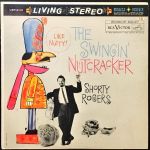
The Not So Swingin’ Nutcracker in Living Stereo

Hot Stamper Pressings of Living Stereo Recordings Available Now

UPDATE 2026

We wrote the commentary you see below about 15 years ago.

We liked the record back then just fine. However, we recently got another couple of copies in and they sounded OK, not great, but what really had aged badly was the music, which was corny and, worst of all, contra the album’s title, definitely did not swing. Don’t waste your money on this one the way we did.

There are many jazz pressings we’ve discovered with audiophile quality sound and enjoyable music, but we reluctantly had to admit that this title should no longer be considered one of them. Live and learn, right?

We hope we can be forgiven for our mistaken bias in favor of a Golden Age title with a cool vintage cover. (And it wouldn’t be the first time.)

Another source of mistaken thinking: The Swingin’ Nutcracker came out in 1960, a year known for a great many other exceptionally good sounding titles produced during the Golden Age of vacuum tube recording. After playing so many wonderful recordings on that label, from that era, we were primed to like it regardless of whatever shortcomings it might have had.

This is why we recommend audiophiles pull titles off their massive shelves and give them a spin from time to time. Some records have simply not stood the test of time as well as others. Some will be better than we remember, some worse.

A wall full of records, most of which have not been played in years, even decades, is not a record collection worthy of the name. It’s better understood as a pile of vinyl that has been doing nobody any good for a very long time and, according to Newton’s Laws of Motion, will continue doing nothing for nobody forever.

(more…)

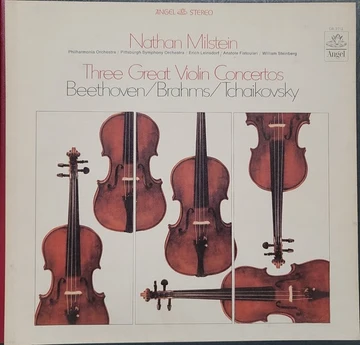
Three Great Violin Concertos / Milstein

       More Hot Stamper Pressings Featuring the Violin

  • Three Great Violin Concertos debuts on the site with roughly Nearly Triple Plus (A++ to A+++) grades on all SIX sides of these vintage Blue Angel Stereo pressings – just shy of our Shootout Winner (sides two and five actually won the shootout)
  • Exceptionally spacious, rich and smooth – only vintage analog seems capable of reproducing all three of these qualities without sacrificing resolution, staging, imaging or presence
  • The immediacy of Milstein’s violin is simply in a league of its own, with some of the sweetest, richest, most “rosiny” violin tone we’ve had the good fortune to hear

(more…)