Composers

The Music of Leonard Bernstein in Glorious Phase IV Sound

Hot Stamper Pressings of Orchestral Spectaculars Available Now

UPDATE 2026

We think that most of what we wrote many years ago in this commentary still holds true. Some maybe not so much (the part about Shaded Dogs and euphonic colorations for example).


Phase IV, Are You Serious?

Yes, absolutely. Allow me to make the case this way. Phase 4 has the life, dynamics, and deep articulate bass not found on most Golden Age recordings. There is no compression to speak of on the album, not on the best copies anyway.

Shaded Dogs may have sweeter strings and more Tubey Magic (which, as anyone who listens to live classical music knows, is mostly a euphonic coloration), but this recording sounds dramatically more like live music than most of them in every way other than soundstaging.

There are of course multiple mics being used, and sometimes they call attention to themselves, but for the most part the stage is wide and deep enough, and the mics far enough from the orchestral sections, that the illusion of a real orchestra in a hall is possible.

The tympani at the back (along with most of the percussion) are especially convincing in this regard. On the copies with the most correct top ends, the triangles and bells are shockingly lifelike, sounding, to my “mind’s ear” exactly the way they do in the concert hall.

(more…)

Dialing in the Anti-Skate with Massed Strings

Hot Stamper Pressings of Orchestral Spectaculars Available Now

I once adjusted my anti-skate while playing this very album, at the time dialing it in to what I thought was a “T.” 

Over the years I’ve found that the best test for fine anti-skate adjustment is massed strings, and not just at the end of a side but right at the part of the record in which the anti-skate has been engaged. This will vary with different arms.

When you have all the rosiny texture, the high-end harmonic extension, the least shrillness and the widest and deepest staging, you are there — assuming that tracking weight, azimuth and VTA are correct as well.

Four variables to mess with admittedly is a bitch, but having the right record to test with is absolutely critical as well. Maybe we should call it five variables.

And if I only had one record to bring to someone’s house in order to evaluate their equipment, this would certainly be a top choice. If you can make this record sound the way it should, your stereo is cookin’. If you are having problems, this record will show them to you in short order.

(more…)

Beethoven & Kodaly / Serenade & Duo / Heifetz, Piatigorsky

Hot Stamper Pressings Featuring the Violin

  • Solid Double Plus (A++) grades or BETTER bring these two wonderful chamber pieces to life on this early Shaded Dog pressing of LSC-2550
  • It’s also fairly quiet at Mint Minus Minus, a grade that even our most-well-cared-for vintage classical titles have trouble playing at
  • The Living Stereo sound is rich and transparent and, unlike a lot of RCA’s chamber recordings, not dry, with tonality that is right on the money
  • The performers are present and the transients of their instruments are not in the least bit smeared, vintage tubes or no vintage tubes in the recording chain

The performers on this recording are Heifetz, violin / Primrose, viola / Piatigorsky, cello.

(more…)

Paganini – Violin Concertos Nos. 1 & 2 / Menuhin

More of the Music of Paganini

  • This vintage EMI pressing of two of the truly great virtuoso/romantic violin concertos boasts a STUNNING Shootout Winning Triple Plus (A+++) side two mated to a solid Double Plus (A++) side one – fairly quiet vinyl too
  • It’s simply bigger, more transparent, less distorted, more three-dimensional and more real than practically all of what we played
  • The best balance of orchestra and soloist we know of for both works, with sound to rival the greatest works for the violin we’ve played

Another remarkable Demo Disc from the Golden Age of Vacuum Tube Recording Technology, in this case 1961, with the added benefit of mastering using the more modern cutting equipment of the ’70s. (We are of course here referring to the good modern mastering of 40 years ago, not the bad modern mastering of today.)

This combination of old and new works wonders on this title as you will surely hear for yourself on this wonderful copy.

The sound of the best copies is transparent, undistorted, three-dimensional and REAL, without any sacrifice in solidity, richness or Tubey Magic. The illusion of disappearing speakers is one of the more attractive aspects of the sound here, pulling the listener into the space of the concert hall in an especially engrossing way. (more…)

Classic Records Got One Thing Right on SR-90006

Hot Stamper Pressings of Orchestral Spectaculars Available Now

The Classic pressing of this famous recording has dreadful sound. Their entire Mercury series was nothing but a disaster. Wilma Cozart was right to give up after the first six titles were completed and then wash her hands of the whole mess.

No audiophile with good equipment and two working ears should have been fooled by the hype swirling around Classic’s Heavy Vinyl pressings, although it seems that plenty of audiophiles were, and, once so fooled, the natural thing to do is for them to double down on their foolishness.

Confirmation bias kicks right in and from then on they will only hear what they allow themselves to hear, even though their head is aching and their ears are close to bleeding. Hurry up and turn down the volume. We’re getting more of the real master tape sound than we can take! Somebody fix what Cozart and Fine screwed up all those years ago!

Can anyone actually have played this pressing more than a handful of times? The originals we buy are often worn out. Is that even possible with a Classic Records pressing? Has it ever happened? Color me skeptical.

Classic Records is right about the performance, however. See for yourself:

Whether you prefer the fabulous bass dynamics and savage paganism of the Scythian Suite, the colorful and captivating sound-portrait of the fairy tale Love for Three Oranges Suite, Dorati’s super-charged readings of these scores are unsurpassed. Acclaimed by critics and audiophiles alike as among the very best of the best Mercury’s, this dramatic and riveting combination of Prokofiev, Dorati and Mercury Living Presence is a sure winner. 

What they are not telling you is that their mastering of the album was dreadful.

If you know the sound of Mercury’s records well, you know that the last thing you would want is a pressing of SR 90006 that could be described by any of the following five words:

(more…)

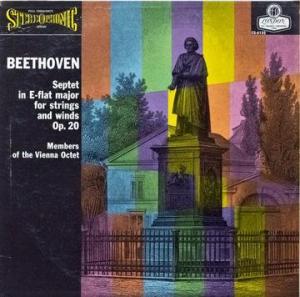
Beethoven / Septet / Members of the Vienna Octet

More of the Music of Beethoven

  • With excellent Double Plus (A++) grades or BETTER on both sides, the sound on this import pressing is classic Decca from 1959 – rich, smooth and completely free of the hi-fi-ish qualities some audiophiles seem to admire by the likes of Reference, Telarc, Wilson and the like
  • It’s also fairly quiet at Mint Minus Minus, a grade that even our most well-cared-for vintage classical titles have trouble playing at
  • Both sides are full, rich, spacious, big and present, with very little smear and a very healthy dose of Tubey Magic
  • At the right level, the level at which these instruments are heard in performance, the sound is tonally right on the money
  • We’ve been raving about this album forever, first on Blueback and on UK Stereo Treasury, and more recently on Ace of Diamonds – all three can be superb

We normally do not put as much effort into finding top quality pressings of chamber music as we do for the large orchestral works favored by audiophiles (or at least the audiophiles who are willing to spend the big bucks to buy our specially-curated records), works such as Scheherazade and The Planets.

However, if more of them sounded as good as this one we would be more than happy to do just that. (more…)

Ravel / Daphnis et Chloé / Monteux

More of the Music of Maurice Ravel

  • Boasting INCREDIBLE Shootout Winning Triple Plus (A+++) grades or close to them throughout, this original London pressing was giving us the sound we were looking for on Ravel’s complete Masterpiece
  • It’s also remarkably quiet at the high end of Mint Minus Minus, a grade that even our most well-cared-for vintage classical titles have trouble playing at
  • The sound is big and rich, lively and open, with an abundance of depth and huge climaxes that hold together
  • The voices in the chorus are clear, natural, separate and full-bodied — this is the hallmark of a vintage Golden Age recording: naturalness
  • We know of no other recording of the work that does as good a job of capturing such a large orchestra and chorus
  • Of course, Monteux is a master of the French idiom – his performance of the complete ballet is definitive in our opinion
  • There are about 150 orchestral recordings we think offer the best performances with the highest quality sound. This record is certainly deserving of a place on that list.

Both sides here are big, with the space and depth of the wonderful Kingsway Hall that the LSO perform in. John Culshaw produced the album, which surely accounts for the huge size and space, not to mention quality, of the recording. The sound is dynamic and tonally correct throughout.

(more…)

Allow Us to Make the Case that Even CDs Have Better Sound than Classic’s Vinyl

brahmvioli_1903_debunk

Hot Stamper Classical and Orchestral Pressings Available Now

The Classic reissue of LSC 1903 is a disaster: shrill, smeary and profoundly unmusical.

In these four words we can describe the sound of the average Classic Records Living Stereo pressing.

The best Heifetz records on Classic were, if memory serves, LSC 2734 (Glazunov), LSC 2603 (Bruch) and LSC 2769 (Rozsa).

They aren’t nearly as offensive as the others, and one is actually quite good. If you can pick one up for ten or twenty bucks, you might get your money’s worth depending, I suppose, on how critically you listen to your classical records.

The CDs are better for all I know. That’s probably the first place to go, considering Classic’s generally poor track record.

(more…)

Violin Recordings and the Problem of Smear

Hot Stamper Pressings of Living Stereo Titles Available Now

This Shaded Dog pressing of LSC 2129 had practically no smear on either the violin or the orchestra.

Try to find a violin concerto record with no smear.

We often say that Shaded Dogs, being vintage All Tube recordings, tend to have tube smear.

But what about the 70s transistor mastered Red Label pressings – where does their smear come from?

Let’s face it: records from every era more often than not have some amount of smear.

And we can never really know what accounts for it.

The key thing is to be able to recognize it for what it is.

(We find modern records, especially those pressed at RTI, to be quite smeary as a rule. They also tend to be congested, blurry, thick, veiled, and ambience-challenged. For some reason most audiophiles — and the reviewers who write for them — rarely seem to notice these shortcomings.)

Of course, if your system itself has smear it becomes that much harder to hear the smear on your records.  Practically every tube system I have ever heard had more smear than I could tolerate – it comes with the territory. And high-powered transistor amps are notoriously smeary, opaque and ambience-challenged. Our low-powered, all-transistor rig has no trouble showing us the amount of smear on records, including those that have virtually none.

Keep in mind that one thing live music never has is smear of any kind. Live music is smear-free. It can be harmonically distorted, hard, edgy, thin, fat, dark, and all the rest, but one thing it can never be is smeary.

That is a shortcoming unique to the reproduction of music, and one which causes many of the pressings we sell to have their sonic grades lowered.

(more…)

Bach / Suites For Solo Cello No. 2 & No. 5 / Starker

More of the Music of J.S. Bach

  • An early Mercury label pressing of Starker’s legendary 1963 recording (SR-90370) of Bach’s sublime music for solo cello with solid Double Plus (A++) grades from top to bottom
  • It’s also fairly quiet at Mint Minus Minus, a grade that even our most well-cared-for vintage classical titles have trouble playing at
  • The bass-boosted, muddy, veiled and ambience-challenged sound of the modern Heavy Vinyl remaster is nowhere to be found here
  • I would bet money that whatever version is currently available has plenty of shortcomings along those lines, which may be acceptable to the mid-fi crowd but is positively ruinous on the high-fidelity systems that our customers tend to have (or why on earth would they keep paying these prices?)
  • We are very confidant that it will beat the pants off any Heavy Vinyl reissue because every one of those that we played was opaque, muddy and thick enough to have us crying “uncle” after five minutes
  • Some Mercury pressings from the 50s have absolutely amazing sound – we should know, we’ve played them

(more…)