Lower Sound Quality Pressings

The ’83 & ’89 Reissues of Music From Big Pink Are Just Awful

Hot Stamper Pressings of the Music of The Band Available Now

Both the pressings of Music from Big Pink mastered by Capitol with the help of the Specialty Record Corporation (SRC) are just awful sounding. They released one in 1983 and another 1989. The notes you see below are for the 1989 pressing.

The overall sound was bright and forced, with edgy vocals. Who wants a Band record that sounds like that? The MoFi CD (from 1989) is better than the MoFi record, but that’s not saying much. I wouldn’t have either one in my collection.

Earlier this year we raved about our amazing sounding Shootout Winner:

  • Here are just a few of the things we had to say about an incredible copy in our notes: “huge and breathy and weighty”…”very rich vox and toms”…”huge and rich and jumping out of the speakers”…”big and rich and spacious”
  • Forget all those vague, veiled, lifeless, ambience-free Heavy Vinyl pressings – this is the Big Pink that The Band recorded!
  • Remember when you used to play the same record over and over, never taking it off the turntable for days at a time?
  • Well here it is – this pressing captures the music in a way that will make repeated plays the joy they are meant to be

(more…)

These Two Return to Forever Albums Didn’t Make the Grade

Hot Stamper Pressings of Jazz Rock Fusion Albums Available Now

Pictured are two Return to Forever albums we auditioned at some point in the past and found unimpressive.

Without going into specifics — our notes are long gone at this point — we’ll just say these two albums suffer from weak music, weak sound, or both, and therefore do not deserve a place in most audiophile collections — unless that audiophile happens to be a huge fan of the band.

My guess is that if these two records are sitting in an audiophile’s collection, they have not been played in many years, if ever. If you own either of these two albums, pull them out and play them.

You may find that making more room on your shelves for records you can actually enjoy is easier than you think.

Our Pledge of Service to You, the Discriminating Audiophile 

We play mediocre-to-bad sounding pressings so that you don’t have to, a free service from your record-loving friends at Better Records.

Having the wherewithal to audition so many records puts us in a unique position to help audiophiles looking for higher quality sound. (Or, more accurately, that small subset of audiophiles looking for the highest quality pressings who also have a great deal of disposable income to devote to them.)

Yes, we have the obvious resources that would be needed: the staff and the budget.

More important than either of those, we came up with a new (sort of) and much more successful (definitely) approach.

(more…)

Don’t Waste Your Money on this Schubert Recording with Munch from 1962

Hot Stamper Pressings of Living Stereo Recordings Available Now

Some audiophiles buy albums based on their labels. For example, this Shaded Dog pressing from the Golden Age of RCA Living Stereo might appeal to a certain kind of audiophile who treasures original LSC pressings.

More than that, he might limit himself to the most sought-after 1S Indianapolis pressings. Hooray! What could be better?

However, many records from this era simply do not sound good, and this is one of them. We have never heard a good sounding copy of LSC 2522, and we’ve played plenty of them over the decades that we’ve been selling Golden Age Classical records.

Are You a Fan?

If you’re a fan of Living Stereo pressings, have you noticed that many of them – this one for example – don’t sound very good?

If you’re an audiophile with good equipment, you should have. But did you? Or did you buy into the hype surrounding these rare LSC pressings and just ignore the problems with the sound?

When vintage RCA Living Stereo records don’t sound good to us, we put them on this list and they go into our hall of shame. We don’t make excuses for them. We call a spade a spade. The same goes for records being made today.

Some audiophiles buy albums based on their labels. For example, this Shaded Dog pressing from the Golden Age of RCA Living Stereo might appeal to a certain kind of audiophile who treasures LSCs on the original label.

More than that, he might limit himself to the most sought-after 1S Indianapolis pressings. Hooray! What could be better?

However, many records from this era simply do not sound good, and this is one of them. We have never heard a good sounding copy of LSC 2522, and we’ve played plenty of them over the decades that we’ve been auditioning Golden Age classical records for sale.

This Shaded Dog might be passable on an old school system, but it was too unpleasant to be played on the high quality modern equipment we use.

There are quite a number of other records that we’ve run into over the years with similar shortcomings. Here are some of them, a very small fraction of what we’ve played, broken down by label.

  • London/Decca records with weak sound or performances
  • Mercury records with weak sound or performances
  • RCA records with weak sound or performances, including many on the coveted Shaded Dog label

(more…)

These Kelly Blue Reissues from the 70s Are a Real Mess

Hot Stamper Pressings of the Music of Wynton Kelly Available Now

Sometimes the 70s reissues of vintage jazz recordings that were made in the fifties, sometimes released with different covers similar to the one you see pictured, have excellent sound.

We know that for a fact because we’ve played some very good ones.

In the case of Kelly Blue, we felt we were obligated to play a few to make sure we were hearing as wide a range of different pressings as possible. We wanted to be sure we were hearing the best sounding pressings regardless of what era they were pressed in. (We’re very open minded that way.)

Here are our notes for the Black Label Riverside Stereo pressing with “1971” stampers:

  • Thin,
  • Dry,
  • Honky,
  • Veiled.
  • Severe stereo spread. (Hard left and right, unmusical this way, players are disconnected.)
  • Grade: 1+ on both sides

The other copy we had was even worse:

  • NFG on side one, side two never played.

The Riverside originals we’ve played in the past, like a lot of other Riverside originals from the 50s, such as those by Thelonious Monk, were uniformly terrible.

And trying to find one in audiophile playing condition is as easy as it sounds.


We’ve auditioned countless pressings like this one in the 38 years we’ve been in business — buying, cleaning and playing them by the thousands. This is how we find the best sounding vinyl pressings ever made.

Not the ones that should sound the best. The ones that actually do sound the best.

If you’re an audiophile looking for top quality sound on vintage vinyl, we’d be happy to send you the Hot Stamper pressing guaranteed to beat anything and everything you’ve heard, especially if you have any pressing marketed as suitable for an audiophile. Those, with very few exceptions, are rarely better than mediocre, and some of them are just awful, with many of the newest releases being the most awful of them all!

(more…)

Monk’s Music on Riverside 9242 Didn’t Make the Grade

Hot Stamper Pressings of the Music of Thelonious Monk Available Now

The Riverside 9242 pressing of Monk’s Music we played recently was very much not to our liking.

In fact, every copy of this record we have ever played sounded terrible. The early pressings sounded bad and the OJC sounded bad.

We give up. We’re cutting our losses. We love Monk, but why on earth would we keep throwing money down this rathole? Our notes for this copy read:

  • Dry (more records with dry sound can be found here), and
  • Bright (more records with bright sound can be found here),
  • Overall grade: No Good

Some reviewers of the audiophile persuasion prefer to review only records that sound good to them and ignore the rest. We think this does the audiophile community a disservice.

Like Consumer Reports, we like to test things. They test toasters, we test records. We put them through their paces and let the chips fall where they may.

They want to find out if the things they are testing offer the consumer good quality and value.

We want to find out if the records we are testing offer the audiophile good sound and music.

It takes a dedicated group of people and a healthy budget to carry out these kinds of tests in large numbers.

No other record dealers, record reviewers or record collectors could possibly have auditioned more than a small fraction of the records that we’ve played. We’ve been looking for the best sounding pressings of the recordings that have stood the test of time for decades. Now, with a staff of ten or more, we can buy, clean and play records at a scale that would be unimaginable for any single person to attempt.

That puts us in a unique position to help audiophiles looking for the highest quality pressings.

Yes, we have the resources, the staff and the budget. More importantly, we came up with a much scientifically reliable approach.

(more…)

In 2004 We Mistaked Finlandia on VICS for a Demo Disc

Hot Stamper Pressings of the Music of Sibelius Available Now

UPDATE 2024

We played a 4S/1S copy of this record, VICS 1069, and thought it sounded terrible.

It was flat and bright with splashy cymbals and crude brass.

Even if we assume the copy we played many years ago could have been much better than this latest pressing — which is doubtful but certainly possible — there is no reason to pursue this version of the album when there are known top quality pressings of this very same performance on Decca.


Our Old Review

DEMO QUALITY SOUND and quiet surfaces too.

I don’t know when I’ve heard this album with better sound. This one may be better than the best Shaded Dog for all I know — it’s that good.

You’ll notice that there is a copy of this very same record on the website for $1.99. That one sounds dull. I don’t think you’ll be able to find a better sounding copy of this record than the pressing we are selling here, because it really is an exceptionally good sounding record. If it weren’t, it would be more like $1.99.

(more…)

This London from 1961 Didn’t Make the Grade

Hot Stamper Classical and Orchestral Imports on Decca & London

1961 just happens to be one of the greatest years for high quality analog recordings. Just check out this amazing group of albums, all recorded or released that year.

This London LP was released in 1961, right in the heart of the Golden Age, so we figured it had a good chance of displaying the kind of relaxed, immersive, smooth, rich, Tubey Magical Decca sound we absolutely cannot get enough of here at Better Records.

As we were preparing to do the shootout with the six copies of CS 6202 we had amassed over the years, we suddenly ran into a big problem.

(Cue sound effect of record being scratched here.)

(more…)

How Good Are the Robert Ludwig-Mastered Pressings of Alchemy?

Hot Stamper Pressings of the Music of Dire Straits Available Now

The best domestic pressings we played, the ones cut by Robert Ludwig at Masterdisk, were simply not competitive with any of the early British LPs.

The evidence is pretty clear that the master tapes stayed in England and that only the British pressings are made from them. If you’ve played as many records as we have, it’s not hard to recognize dubby sound when you hear it.

As a general rule, this domestic pressing will fall short in some or all of the following areas when played head to head against the imported pressings we offer. Much like the records linked here:

(more…)

Capriccio Italien on Classic Records and How Badly I Missed the Boat

More of the Music of Peter Ilyich Tchaikovsky

More of the Music of Nikolai Rimsky-Korsakov

Years ago, around 2005 if memory serves, I played a copy of the Classic Records pressing of LSC 2323 and thought it was pretty good.

I thought it was better than the Shaded Dog copies I had compared it to, which, based on hundreds of other Classic Records titles I had auditioned, was unexpected to say the least.

Little did I know that the Shaded Dog pressings on this title are not remotely competitive with the early reissues.

The best of the Shaded Dog pressings we could find, which just happened to have a 1s side one, came in tied for last with the one 70s Red Seal pressing we thought sounded good enough to make the shootout.

(Some inside baseball: most of the Shaded Dogs and Red Seals were needle-dropped, and all but two were eliminated before the shootout. It takes time and wastes money to clean and play pressings that sound hopeless, so a quick elimination round often precedes the cleaning process.)

Back then it was tough to wrap my head around the idea that a Classic Record classical title could actually be better sounding than a Shaded Dog — it had never happened, so I knew there had to be more to the story.

Finding the time to do the serious investigation of LSC 2323 that would be necessary to get to the bottom of it was not in the cards, so I shelved the project for close to the next twenty years.

The title would have to wait until 2025 to go through a proper shooout, and when it did, naturally the Classic was part of the mix, which is the way we do things here at Better Records. Every record gets the chance to show us what it can do, to be evaluated fairly without the listener having any way to know which pressing is playing.

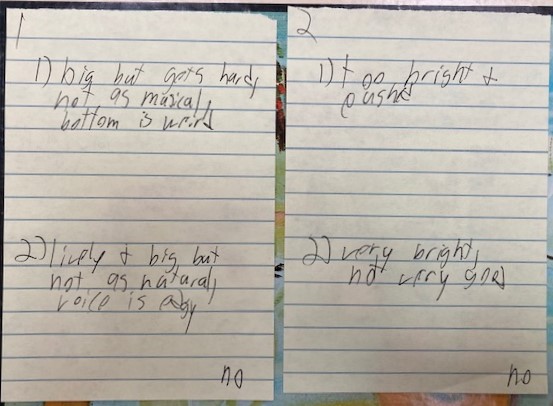
It turns out that side one of the Classic was passable, but side two — the side I had probably never played — was every bit as bad as most of their other classical offerings.

Side One, Second Movement (Tchaikovsky)

  • Big, but bright and compressed
  • Gets loud but opaque and hot
  • Good weight

Side One, First Movement

  • Bright and blurry bells
  • Sort of tubey but a mess
  • Grade: 1+ (passable, but no Hot Stamper)

Side Two (Rimsky-Korsakov)

  • Big but boomy and smeary
  • Brass is edgy and opaque
  • No top end or space
  • Peaks are hot and congested
  • Grade: NFG

To recap: In 2005 I was impressed with Classic’s pressing of LSC 2323. That was only twenty years ago, yet I could not have been more wrong. I thought my stereo was great — I’d owned top quality equipment since 1975 by then — thirty sodding years — so my audiophile credentials would surely dwarf those of the vast majority of forum posters who write about audiophile pressings today. How reliable should we expect their reviews to be?

(more…)

Don’t Waste Your Money on this Famous and Pricey RCA from 1960

Hot Stamper Pressings of Living Stereo Recordings Available Now

The most recent copy we’ve played of LSC 2405 left us feeling underwhelmed. We expected more from such a famous (and pricey!) TAS-Listed Living Stereo record.

In the past we’ve auditioned the Victrola and the Decca SPA reissue, and both seemed to be reasonably good but not quite good enough to offer our customers. We were still looking for a better Fifth Symphony, and paid top dollar for this copy hoping it would be the one to make a shootout possible.

Unfortunately, that was not the case. The sound of this copy was rich but opaque. We would call it no better than passable. It might be a good sounding record on a different pressing, but we doubt it could be a great one, and we really don’t want to spend the kind of money it would take to prove ourselves wrong on that account.

As the best of the RCA pressings demonstrate beyond all doubt, 1960 was a great year for classical and orchestral recordings.

What the modern mastering engineers of today do to such wonderful recordings is another thing altogether. Bernie Grundman remastered this one in the 90s for Classic Records, and we can describe the work he did for them in just four words.

To sum it all up, LSC 2405 is unlikely to sound very good on high quality modern equipment. If your system leans more towards the old school approach — vintage tubes, vintage tables, horn speakers, that sort of thing — then the lack of transparency won’t be nearly as bothersome as it is to us.

(more…)