Dubious Sound I Once Liked

This list contains a sampling of the bad sounding records I used to like. (Not all are bad sounding. Some are just not nearly as good sounding as I thought.)

Through trial and error I learned that they were clearly inferior to other pressings, although at the time I couldn’t have known they were inferior because I hadn’t yet discovered anything better.

Looking back, it’s embarrassing that I used to like these records, but it would be foolish to deny it.

Making mistakes and learning from them is an important aspect of this hobby. Every audiophile on the journey to better sound should have a sizable group of records they left behind a long time ago.

As our stereos and critical listening skills improve, it becomes clear that plenty of records just aren’t as good as we thought they were. These are some of mine.

Comparing the Speakers Corner, MoFi, and a Super Hot Stamper

Hot Stamper Pressings of the Music of The Moody Blues Available Now

One of our good customers had this to say about some Hot Stampers he purchased a while ago. [Bolding and italics added.]

Hey Tom, 

Just thought I’d drop you a line on the two albums I just received yesterday. I had some free time on my hands today so I was able to do some comparisons.

I have an original Days of Future Passed, which sounds about as dull as they come.

I have that reissue I bought from you years ago [no doubt the Speakers Corner Heavy Vinyl pressing] and the MoFi.

The reissue was pleasing to the ear but lacked that lifeforce which makes listening to records so involving.

The MoFi was always my favorite, but with this Super Hot Stamper I was hearing the whole recording studio.

There was a lot more depth and realism which I didn’t hear in the other records.

The Level 42 World Machine was always a fun record to listen to. The CD was just bright and bass heavy, so I bought an import lp off you years ago. It sounded pretty good until you turned it up, then it became so shrill I had to turn it back down.

The Super Hot Stamper sounds great and I can turn it up as loud as I want.

The sound stage is deep and believable which for an 80’s record is a rarity.

That Simply Red Picture Book Super Hot Stamper I purchased last year was a gem also.

Shane

Shane,

Thanks so much for your letter.

If you have an original domestic pressing, you definitely have a dull record. It’s made from a dub tape and sounds smeary and dark. This is, of course, the one we all owned back in the day unless you were one of those crazy people who ordered imported pressings from your local record store and waited weeks if not months for them to show up from across the sea.

The Speakers Corner pressing I used to sell was a good record, not a great one. (It was made from the remixed tapes since the masters had long ago been damaged or lost.)

Like many of their reissues, it was tonally correct, something most Heavy Vinyl pressings could not claim to be.

The MoFi I used to like somewhat. No idea what I would think of it now. Phony up top I’m guessing.  I can’t think of a single Stan Ricker-mastered MoFi title that doesn’t have a boosted top end, so the chances of Days of Future Passed being the exception are remote.

(more…)

Zenyatta Mondatta on Nautilus SuperDisc

More of the Music of Sting and The Police

This commentary was most likely written in the mid-2000s, shortly after we had started to sell Hot Stamper pressings but had to yet to make it our main business, which we did in 2007.

2007 was a long time ago. It was the year we made many breakthroughs. In fact, we made more breakthroughs in that year than in any other in the history of the company, including this singularly important break with the past.


Our Take Back in the Day

And to think we actually used to like the sound of some of these Nautilus pressings!

They suffer from the same shortcomings other Nautilus and Half Speeds in general suffer from — the kind of transparent but lifeless and oh-so-boring sound that we describe in listing after listing.

Three of the Best?

I just did shootouts with three of what I thought were the best Nautilus Half-Speeds: Dreamboat Annie, Ghost in the Machine, and Time Loves a Her0.

None of them sound like the real thing, and especially disappointing was one of my former favorites, the Little Feat album.

On the title track, the Nautilus is amazingly transparent and sweet sounding. There are no real dynamics or bass on that track, so the “pretty” half-speed does what it does best and shines. But all the other tracks suck in exactly the same way Night and Day does. Cutting the balls off Little Feat is not my idea of hi-fidelity.

We put audiophile beaters up for sale every week. Each and every one of them is a lesson on what makes one record sound better than another. If you want a wall full of good sounding records, we can help you make that happen. In fact it will be our pleasure. Down with audiophile junk and up with Better Records. (more…)

A Fun and Easy Test for Abbey Road: MoFi Versus Apple

More of the Music of The Beatles

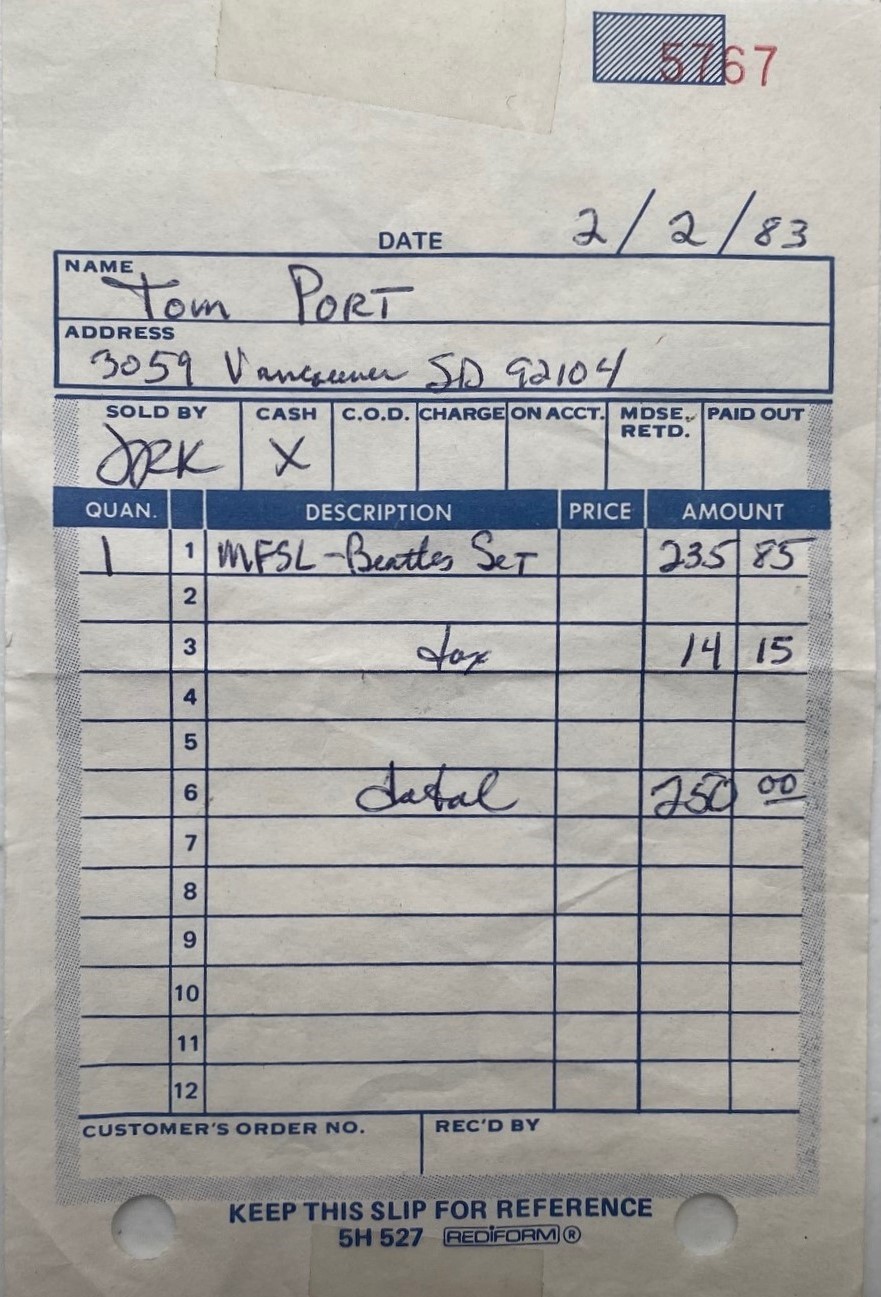
There is a relatively simple test you can use to find out if you have a good Mobile Fidelity pressing of Abbey Road. Yes, as shocking as it may seem, they actually do exist, we’ve played them, but they are few and far between (and never as good as the best Brits).

The test involves doing a little shootout of the song Golden Slumbers between whatever MoFi pressing you have and whatever British Parlophone pressing you have. If you don’t have both LPs, this shootout will be difficult to do.

The idea is to compare aspects of the sound of both pressings head to head, which should shed light on which one of them is more natural and which is more hi-fi-ish sounding.

The Golden Slumbers Test

I’ve come to realize that this is a Key Track for side two, because what it shows you is whether the midrange of your pressing — or your system — is correct.

At the beginning Paul’s voice is naked, front and center, before the strings come in.

Most Mobile Fidelity pressings, as good as they may be in other areas, are not tonally correct in the middle of the midrange.

The middle of the voice is a little sucked out and the top of the voice is a little boosted.

It’s really hard to notice this fact unless one plays a good British pressing side by side with the MoFi.

Then the typical MoFi EQ anomaly become obvious. It may add some texture to the strings, but the song is not about the strings.

Having heard a number of audiophile systems (especially recently) that have trouble getting this part of the spectrum right, it would not be surprising that many of you do not find the typical MoFi objectionable, and may even prefer it to the good British copies. The point I’m belaboring here is that when it’s right, it’s RIGHT and everything else becomes more obviously wrong, even if only slightly wrong.

The Heart of the Midrange

For a while in my record reviewing system many years ago I had a relatively cheap Grado moving magnet cartridge. The midrange of that cartridge is still some of the best midrange reproduction I have ever heard. It was completely free of any “audiophile” sound. It was real in a way that took me by surprise. I played Abbey Road with that cartridge in the system and heard The Beatles sound EXACTLY the way I wanted them to sound.

(more…)

Can You Believe I Actually Used to Like this CBS Half-Speed?

More of the Music of Boston

Reviews and Commentaries for the Music of Boston

Sonic Grade: D

Lack of weight down low — or as we like to call it, lack of whomp factor [1] — is the main reason Half-Speed mastered records so often come up short when played against their real-time-mastered competition. The highs can be good, the mids can be good, but the bottom end is almost always lacking, which is exactly the problem here.

You can be sure that Boston would not have wanted, nor would they have ever been willing to accept, the kind of anemic sound that the CBS Half-Speed delivers.

The CBS is cut clean from a good tape, so it easily beats the bad domestic pressings, of which there are many.

But it doesn’t rock.

What good is a Boston record that doesn’t rock? It’s a contradiction in terms; they’re a rock band.

The band, as well as their amazingly well recorded debut album, have no other reason to exist.

Transparency is a nice quality, but when it comes at the expense of the energy and power of the music, especially down low, then it comes at too high a price, especially for those of us who have full-range systems and like to play them loud.

We talk about the shortcomings of transparent audiophile records here:

(more…)

Witches’ Brew on Classic Records and How Crazy Wrong I Was, Part One

Hot Stamper Living Stereo Orchestral Titles Available Now

Well below the reproduction of the front page of our old catalog you will find the review I wrote in 2007 for the Classic Records’ Heavy Vinyl pressing of Witches’ Brew.

Clearly I did not care for it in the least. In fact, I thought it was one of the worst reissues I’d ever heard, so aggressive, boosted and unnatural it defied understanding that anyone could ever play such a record and not notice how wrong it sounded.

Now when I think about the Classic Records reissue of Witches’ Brew and its awful sound, it’s obviously a modern remastering I could not possibly have liked.

However, in preparing to move to Georgia in 2022, I found myself digging through some old catalogs from the early Nineties. Something I read in one of them chilled me to the bone.

There it was in black and white: my rave review for the Classic Records pressing of Witches’ Brew.

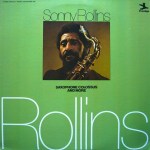
It’s actually on the front page of the catalog, along with at least one other record that I would be mortified to sell today: the OJC pressing of Saxophone Colossus.

(As soon as I find my review in the old catalog for Saxophone Colossus, I will post it. I can hardly believe I wrote it, but I did. I wrote all my catalogs back then. My lack of competence and the guilt associated with my lack of expertise at the time is undeniable. It obviously would be foolish and wrong of me to try to deny any of it, so I don’t.)

Below you will find a commentary from 2007 detailing the shortcomings of the Classic.

I sure had a lot of nice things to say about it in 1994.

I thought my stereo was awesome back then, but it was not nearly as awesome as I thought it was. It was better than any system I had heard in a stereo salon, audio show or friend’s house, but that has to be seen as a pretty low bar, and it may even be lower now than it was back then.

I’ve written a bit about the limitations of my 90s system here.

The Dunning-Kruger effect is real, and I clearly suffered from it.

In 1994 I had been a fairly dedicated audiophile for more than twenty years, and a strongly opiniated audiophile record dealer, one who took pride in curating his vinyl offerings right from the start of the business in 1987.

I thought I knew what I was talking about. Looking back it’s clear I had a lot to learn.

(more…)

Finlandia – Live and Learn

More of the music of Jean Sibelius (1865-1957)

More of the music of Edvard Grieg (1843-1907)

Years ago we noted how much worse the Classic Records pressing of our then current favorite Finlandia sounded when compared head to head with our best RCA Shaded Dog pressings.

We wrote:

Classic Records ruined this album. Their version is dramatically more smeared and low-rez than our good vintage pressings, with almost none of the sweetness, richness and ambience that the best RCA pressings have in such abundance.

Woops.

Turns out the RCA pressing we used to like was not as good as we thought, something we discovered to our chagrin in 2014.

Our current favorite pressing is on a Decca reissue label. Go figure.  When you hear how good this record sounds, you may have a hard time believing that it’s a budget reissue from 1970, but that’s precisely what it is.

Even more extraordinary, the right copies are the ones that win shootouts.

Want to find your own top quality copy?

(more…)

Music from Big Pink on MoFi – Bad Bass Like This Is Just Annoying

Hot Stamper Pressings of Music by The Band Available Now

In 2012 the “new” MoFi put out another remastered Big Pink. Since their track record at this point is, to be honest, abysmal, we have not felt the need to audition it.

It’s very possible, even likely, that they restored some of the bass that’s missing from so many of the originals.

But bad half-speed mastered bass — poorly defined, never very deep and never punchy — is that the kind of bass that would even be desirable?

To us, it is very much a problem. Bad bass is just plain annoying.

Fortunately for all, it is a problem we have to deal with much less often now that we’ve all but stopped playing Half-Speed mastered records.

Here are some other records with exceptionally sloppy bass. If the bass on these records does not sound sloppy, you have your work cut out for you.

Some of our favorite records for testing bass definition can be found here.

Sucked Out Mids

The Doors first album was yet another obvious example of MoFi’s predilection for sucked-out mids. Scooping out the middle of the midrange has the effect of creating an artificial sense of depth where none belongs.

Play any original Bruce Botnick-engineered album by Love or The Doors and you will notice immediately that the vocals are front and center. 

(more…)

Khachaturian Conducts Spartacus – Not As Good As We Thought

Hot Stamper Pressings of Orchestral Spectaculars Available Now

Probably more than ten years ago we had written the following about CS 6322:

The famous TAS list recording. The Decca 180 gram version is very good, but those of you who appreciate the qualities of the original mastering will want to have this one. 

Now jump ahead five years to five years ago. We played three or four copies of the album and none of them really worked for us.

The sound was a bit opaque, a bit dry, and not nearly as tubey as we would have liked. (Many Decca recordings suffer from dry strings, a shortcoming that is apparently rarely noticed by audiophiles and the reviewers who write for them.)

A good record, not a great one, and for that reason really not worth cleaning up and doing a shootout for.  The best copy would not pay for the labor to discover it.

Seems we got this one wrong. Live and learn is our motto, for precisely this reason.

There are quite a number of others that we’ve run into over the years with similar shortcomings. Here they are, broken down by label.

  • London/Decca records with weak sound or performances
  • Mercury records with weak sound or performances
  • RCA records with weak sound or performances

To this day, some of the records on the TAS list seem to me better suited to the old school audio systems of the 60s and 70s than the modern systems of today. These kinds of records used to sound good on those older systems, and I should know, I had an old school stereo and some of the records I used to think sounded good back in the day don’t sound too good to me anymore.

For a more complete list of those records, not just the ones on the TAS List, click here.

The following three things are best kept in mind when a pressing doesn’t sound like we remember it did, or think it should:

(more…)

Did We Get The Power of the Orchestra Wrong, or Are These Just Bad Stampers?

Hot Stamper Pressings of Living Stereo Recordings Available Now

In 2007, we wrote the following review for The Power of the Orchestra, VCS 2659:

DEMO DISC QUALITY ORCHESTRAL SOUND like you will not believe. We put two top copies together to bring you the ultimate-sounding Pictures At An Exhibition. Folks, it doesn’t get any better than this for huge orchestral dynamics and energy.

I confess I badly misjudged this record over the course of the last few years. I remember liking it in the early ’90s; at that time it was the only Golden Age recording of Pictures whose performance moved me. I never liked the famous Reiner, LSC 2201, and Ansermet’s performance on London also lacks drive and coherency in my opinion.

I then went on to extoll the many virtues of the recording, making special mention of the brass, dynamics and bass, which you can read about here.

More recently we played a copy of VCS 2659 in one of our regular Pictures at an Exhibition shootouts and were not the least bit impressed by it.

Side One:

Steely and opaque, not that good.

Side Two:

Strings are not very [unintelligible, might be bright], not much weight.

In other words, it just sounded like an old record.

(more…)

And to Think I Used to Like this Strauss Record

Hot Stamper Mercury Pressings Available Now

I used to like this Strauss Family Album back in the old days. Picked them up whenever I saw them, usually for ten bucks or less. They’re fairly common. It’s not exactly HiFi a la Espanola.

Now when we play this Mercury, it doesn’t sound so good. We traded what we had in stock back to stores or gave them away as freebies to our good customers.

A lot of records that I used to like because they were cleaner and brighter — later Red Seal Living Stereos, some OJC jazz, some reissues of rock — sounded much better when my system was darker and less revealing.

Side one of this copy has steely strings, the kiss of death on this kind of music.

Side two is passable, a low grade Hot Stamper. If you see this album for five bucks, pick it up and give it a listen. More than that and you should probably pass.

Many Mercury records simply do not sound good, and this appears to be one of them. The sound is  shrill, and that is just not acceptable on today’s highly-tweaked stereos.

Some of the early Mercs seem better suited to the old school audio systems of the 60s and 70s than the modern systems of today.

Some of these records used to sound good on those older systems, and I should know. I had an Old School stereo and some of the records I used to think sounded good back in the day don’t sound too good to me anymore.

For a more complete list of those records, click here.

How Did We Figure All of This Out?

There are more than 2000 Hot Stamper reviews on this blog. Do you know how we learned so much about so many records?

Simple. We ran thousands and thousands of record experiments under carefully controlled conditions, and we continue to run scores of them week in and week out to this very day.

(more…)