*Experimenting with Records

Experimenting with records is the only way to learn much about them of any real value.

Charlie Mingus Asks the Question of the Day for Audiophiles – Compared to What?

Hot Stamper Pressings of the Music of Charles Mingus Available Now

We used to think the early Limelight pressing shown here was so amazing sounding that finding better sound for this recording would simply be impossible, but the original Mercury showed us just how wrong we were – the right Mercury pressing takes the recording to another level, one we never imagined it could reach. (In our experience records do that from time to time. We’ve written about some of the ones we’ve played here.)

Here is a small excerpt from our most recent commentary for the album:

The best copies recreate a live studio space the size of which you will not believe (assuming your room can do a good job of recreating their room). (Here are some of the other recordings we’ve auditioned with exceptional amounts of size and space.

The sound is tonally correct, Tubey Magical and above all natural. The timbre of each and every instrument is right and it doesn’t take a pair of golden ears to hear it — so high-resolution too.

If you love ’50s and ’60s large group jazz you cannot go wrong here. Mingus was a genius and the original music on this record is just one more album supporting the undeniability of that fact.

More evidence, if any were needed, that the three most important words in the world of audio are compared to what?

(more…)

On Our Top Copy, How Could We Tell that One Side Was Not as Full-Bodied?

Hot Stamper Pressings of the Music of Gordon Lightfoot Available Now

We described a recent Shootout Winning pressing of Summer Side of Life this way:

So transparent, open, and spacious that nuances and subtleties that escaped you before are now front and center.

Everything you want in the sound of a good Folk Rock album is here in abundance.

Tubey Magical acoustic guitar reproduction is superb on the better copies of this recording. Simply phenomenal amounts of Tubey Magic can be heard on every strum, along with richness, body and harmonic coherency that have all but disappeared from modern recordings (and especially from modern remasterings).

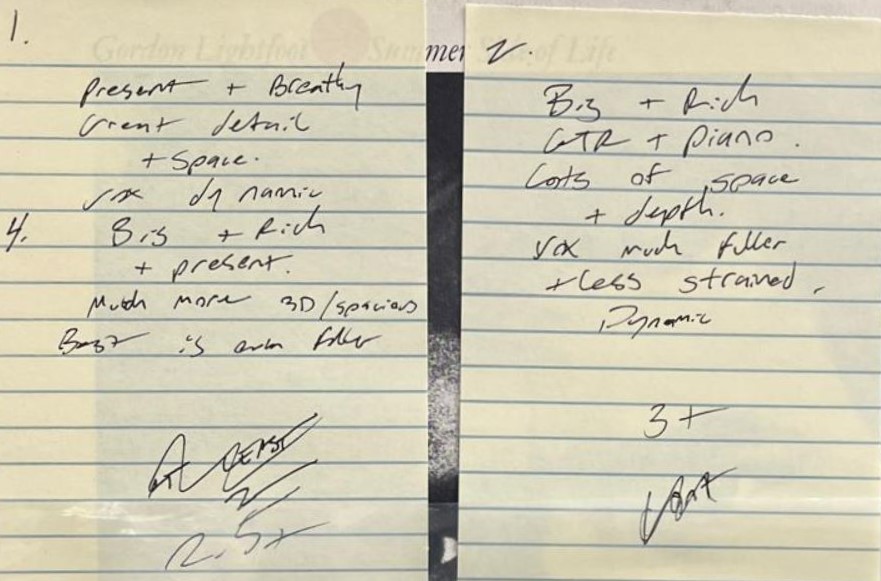
Here are the notes for the 2.5+/3+ copy we put up on the site and sold in 2025.

Side two was killer in every way, and the way we know that is we played a bunch of copies and nothing could beat it. This side two took top honors for having exactly the sound we described above.

(more…)

The “Not-So-Golden-Age” of RCA, Mercury, London and Others

Hot Stamper Pressings of Living Stereo Titles Available Now

We ran into a number of copies of this title that had what we like to call “old record sound,” which is surprisingly common on even the most revered Golden Age labels, RCA included.

No top, no real bottom, congested climaxes and a general shrillness to the sound — we’ve played Living Stereos by the dozens that have these shortcomings and many more.

Some audiophiles may be impressed by the average Shaded Dog pressing, but I can assure you that we here at Better Records are decidedly not of that persuasion.

Something in the range of five to ten per cent of the major label Golden Age recordings we play will eventually make it to the site. The vast majority just don’t sound all that good to us. (Many have second- and third-rate performances and those get tossed without ever making it to a shootout.)

The One Out of Ten Rule

If you have too many classical records taking up too much space and need to winnow them down to a more manageable size, pick a composer and play half a dozen of his works.

Most classical records display an irredeemable mediocrity right from the start. It does not take a pair of golden ears to hear it.

If you’re after the best sound, it’s the rare record that will have it, which makes clearing shelf space a lot easier than you might imagine. If you keep more than one out of ten, you’re probably setting the bar too low, if our experience is any guide.

(more…)

Mistakes Are Fundamental to Finding Better Sounding Records

Our Guide to Record Collecting for Audiophiles

Wise men and women throughout the ages have commented on the value of making mistakes.

Here is one of our favorite quotes on the subject.

“A man should never be ashamed to own he has been in the wrong, which is but saying… that he is wiser today than he was yesterday.”   Alexander Pope, in Swift, Miscellanies

When I think of the 20 odd years (early ’70s to early ’90s) I wasted trying to figure out how audio works before I had acquired any real critical listening skills, it brings to mind that old Faces’ song, “I wish that I knew what I know now, when I was younger.”

Learning how to do shootouts for your favorite albums is without a doubt the fastest and easiest way to hone your listening skills, a subject we discuss often on the site and most cogently in this commentary from way back in 2005.

We believe that the only way to really learn about records is to gather a big pile of them together, clean them up and listen to them one by one as carefully and critically as possible.

We do not recommend devoting much time to reading about them in magazines or on forums.

We also would dissuade the serious record collector from paying much attention to what the most sought after or most expensive pressings are. Records have market prices based on a host of factors that have almost nothing to do with sound quality.

And don’t think you can “logically” predict which pressings should sound the best and then just go about acquiring them.

None of these methods are likely to produce good results.

Making mistakes will though. And the more you make, the more you learn. The more you learn, the easier it is to recognize and pursue good records. It also makes it easy to part with your bad ones. The latter group we hope will include the majority of your holdings of Heavy Vinyl and Half-Speed Mastered Recordings. At best those should be seen as placeholders. They’ll do until something better comes along. And considering how mediocre so many newly remastered records are, “something better’ should not be hard to find.

And the better developed your critical listening skills become, the less likely “they’ll do” at all. They’ll just get put on a shelf. It has been our experience that good records get played and bad records don’t.

(more…)

Living Stereo Sound Like This Is Hard to Beat

Hot Stamper Pressings of Soundtrack Recordings Available Now

Here is the kind of Living Stereo sound we just can’t get enough of.

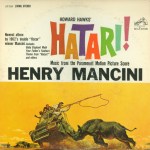
We certainly never suspected that this old TAS list warhorse from 1962 could sound the way this early pressing did when it landed on our turntable recently. We’ve been auditioning copies of Hatari for close to forty years. Now it sound like this? Amazing.

Until we played this Shootout Winning copy, we’d never heard the phenomenal amounts of ambience that surrounds the big room full of musicians assembled here, ambience which is clearly audible on the drums which play such an important part in Mancini’s arrangements.

If you’re a fan of big drums in a big room, this is the record for you.

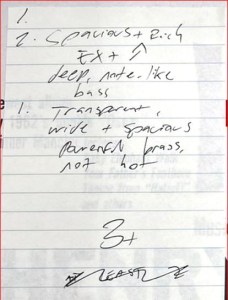
Hearing this album sound the way this copy did was a real thrill, as our notes should make clear:

The notes for side one read:

Track Two

Spacious and Rich

Extended top end

Deep, note-like bass

Track One

Transparent, wide and spacious

Powerful brass, not hot

The notes for track three on side two read:

Lively, jumping out

Present and spacious

(more…)

Good Digital Beats Bad Analog Any Day

Hot Stamper Pressings of the Music of Sonny Rollins Available Now

And this is some very bad analog indeed!

We here present our 2010 review of the Sonny Rollins Plus 4 album, the one remastered on two slabs of 45 RPM Analogue Productions Heavy Vinyl.

It has everything going for it, right?

Steve Hoffman, Kevin Gray, 45 RPMs, Heavy Virgin Vinyl, fancy packaging — clearly no expense was spared!

The ingredients may have been there, but the cake they baked was not only not delicious, it was positively unlistenable — I mean, inedible.

I cannot recall hearing a more ridiculously thick, opaque and unnatural sounding “audiophile” pressing than this Rollins record, and believe me, I’ve heard plenty. (And it seems the bad news will never stop.)

As I noted in another commentary “Today’s audiophile seems to be making the same mistakes I was making as a budding enthusiast more than thirty forty years ago. Heavy Vinyl, the 45 RPM 2 LP pressing, the Half-Speed limited edition — aren’t these all just the latest audiophile fads, each with a track record more dismal than the last one?”

It reminds me of the turgid muck that Doug Sax was cutting for Analogue Productions back in the 90s. The CD has to sound better than this. There’s no way could it sound worse.


CD Update:

I managed to track down a copy of the CD and it DOES sound better than this awful record, and by a long shot. It’s not a great sounding CD, but it sure isn’t the disaster this record is.

Buy the CD, and whatever you do, don’t waste money on this kind of crap vinyl.


This is a very bad sounding record, so bad that one minute’s play will have you up and out of your chair trying to figure out what the hell is wrong with your system. But don’t bother. It’s not your stereo, it’s this record.

It has the power to make your perfectly enjoyable speakers sound like someone wrapped them in four inches of cotton bunting while you weren’t looking.

(more…)

Thoughts on Hearing an Amazing Copy of Thriller in the 80s

Hot Stamper Pressing of the Music of Michael Jackson Available Now

The killer copy of Thriller that we discovered in our 2006 shootout gave us a whole new appreciation for just how good the album could sound. It was a real breakthrough, and proof that significant progress in audio is just a matter of time and effort, the more the better.


Our review from 2006

I remember twenty years ago (that would be 1986) playing Thriller and thinking the sound was transistory, spitty, and aggressive.

Well, I didn’t have a Triplanar tonearm, a beautiful VPI table and everything that goes along with them back then. (More here.)

Now I can play the record.

I couldn’t back then.

All that spit was simply my table, arm, cartridge and setup not being good enough, along with all the garbage downstream from them feeding the speakers.

The record is no different, it just sounds different now. Which is what makes the record a great test. If you can play this record, you can probably play practically any pop and rock record. (Orchestral music is quite another matter.)

This Pressing Changes Everything

This pressing has a side two that’s so amazing sounding that it completely changed my understanding and appreciation of this album. The average copy is a nice pop record. This copy is a Masterpiece of production and engineering.

(more…)

How Does the Heavy Vinyl Pressing of Harvest Sound?

 Hot Stamper Pressings of the Music of Neil Young Available Now

How does the Heavy Vinyl of Harvest sound?

We have no idea. We’ve never played a copy.

Actually, that’s not true. We do have an idea.

Although we’ve never auditioned the Heavy Vinyl pressing of Harvest, we have played the newly remastered After the Gold Rush. We concluded that this is a reissue series that should hold very little appeal for audiophiles. Some excerpts from our review:

We know what the good pressings of the album sound like, we play them regularly, and this newly remastered vinyl is missing almost everything that makes the album essential to any Right Thinking Music Lover’s collection.

We can summarize the sound of this awful record in one word: boring. Since some of you may want to know more than that we’ll be happy to break it down for you a bit further.

What It Does Right

It’s tonally correct.

Can’t think of anything else…

What It Does Wrong

Where to begin?

It has no real space or ambience. When you play this record it sounds as if they must have recorded it in a heavily padded studio. Somehow the originals of After the Gold Rush, like most of Neil’s classic albums from the era, are clear, open and spacious.

Cleverly the engineers responsible for this audiophile remastering have managed to reproduce the sound of a dead studio on a record that wasn’t recorded in one.

In addition, the record never gets loud. The good pressings get very loud. They rock, they’re overflowing with energy.

And, lastly, there’s no real weight to the bottom end. The whomp factor on this new pressing is practically non-existent. The low end of the originals is huge, deep and powerful.

The Bottom Line

This new Heavy Vinyl pressing is boring beyond belief (tip of the hat to Elvis Costello there). I wouldn’t give you a nickel for it. If Neil Young actually had anything to do with it he should be ashamed of himself.

If you want a good copy of the album we have them on the site from time to time. If you can’t afford our Hot Stampers, please don’t waste your money on this one. I have an old CD from 30 years ago, and it is dramatically better than this LP.

Pass / Not Yet

We think the Heavy Vinyl pressing of After the Gold Rush is so awful that whatever supporters it may have — and there are surely some who have spoken highly of it on audiophile forums somewhere, having seen the most ridiculously bad audiophile records touted again and again — are failing utterly in this hobby in one or both of the following ways.

(more…)

On A Day at the Races, Which Side Lacked Space?

Hot Stamper Pressings of the Music of Queen Available Now

We described our 2025 White Hot Shootout Winner this way:

Here are just a few of the things we had to say about this incredible copy in our notes: “tubey and silky vox”…”very transparent and present”…”3D and sweet and tubey”…”big bass!” (side two)…”very full bodied and 3D.”

We shot out a number of other imports and the midrange presence, bass, and dynamics on this outstanding copy placed it well above almost all the other pressings we played.

As you can see from the notes, side one was killer in every respect, and the way we know that with a high degree of certainty is that we played a bunch of copies and nothing could touch it.

Side two was every bit as good in virtually every area, but in the final analysis we determined it fell a bit short in one. We discovered that fact when we came across a side two that was slightly better in one aspect of its sound than the side two you see described in the notes below.

When we played the two best copies back to back, something we do for each side as a final test in every shootout, side one of this copy came out on top, earning a grade of 3+. However, the side two of another pressing showed us there was even more space to be heard surrounding the music than we’d noticed the first time around.

With another copy earning a better grade for having even more space and ambience, we felt the right grade for this side two was 2.5+, Nearly White Hot.

Will the owner of this copy be able to tell?

That seems unlikely. It would be the rare listener indeed who would be able to detect anything missing on this amazingly good side two.

(more…)

Imagine on Mobile Fidelity from 1984

Hot Stamper Pressings of the Music of John Lennon Available Now

This Jack Hunt-mastered Half Speed has the midrange suckout that Mobile Fidelity was notorious for.

Lennon and his piano on the first track sound like they are coming from another room.

And yet somehow there are still “audiophiles” in this day and age that defend the records put out by this ridiculous label.

Oy vey. What is wrong with these people?

I Have a Theory

Actually, I have a good idea why so many so-called audiophile records have a sucked-out midrange.

A midrange suckout creates depth in a system that has difficulty reproducing depth.

Imagine that instead of having your speakers pulled well out from the back wall as they should be, instead you have placed your speakers right up against the wall.

This arrangement, though preferable aesthetically and much more family- and wife-friendly, has the unfortunate effect of seriously limiting your speakers’ ability to reproduce whatever three-dimensional space exists on your recordings.

I hinted back in 2022 that I was going to discuss this idea down the road, and like most things that I was supposed to write about down the road, we’re still waiting to see it.

The album I was going to write more about was Kind of Blue.

(more…)