*Experimenting with Records

Experimenting with records is the only way to learn much about them of any real value.

It’s Already So Good, How Could It Get Any Better?

Hot Stamper Pressings of the Music of Berlioz Available Now

You may have noticed that most of the time when we give out the stampers for the top copies of an album, we do not identify the title of the record that has those Shootout Winning stampers.

As you can imagine, our huge investments in research and development make up a big part of our costs, costs that accrue over the course of years, decades even, and that must eventually be passed on to our customers.

But this title is an exception, because we are telling you straight out that the 1K pressings of CS 6101, Music of Berlioz, are the way to go.

It turns out that both the early Decca pressings (SXL 2134) and the London Bluebacks were cut by Tony Hawkins.

It’s unfortunate that this record did not sell well when it came out in 1959, which explains why we could find no evidence of copies with any stampers other than 1K.

Not that the work of any other mastering engineers was in any way needed. Mr. Hawkins did a wonderful job on the copies we played than managed to reproduce the glorious, Golden Age All Tube analog sound of the master tape, which may sound  tautological as all get out but I assure you is not.

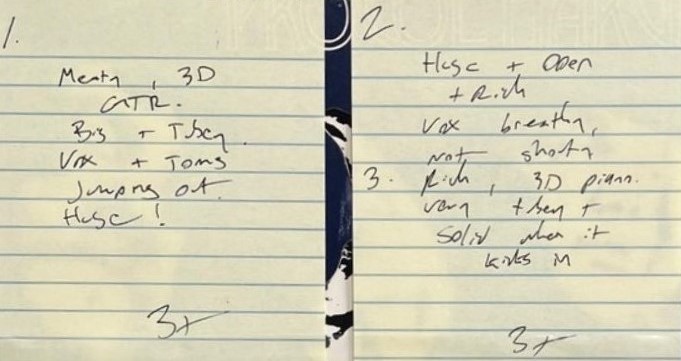
No, sadly for us, that glorious sound could be found on one and only one pressing, the one we graded 3+/3+.

No other pressing earned a top grade on either side. Whatever caused the amazing pressings to come out differently from the very good ones happened in the plating and pressing stages of manufacturing, an area that did not involve the work of any of the Decca mastering engineers.

(more…)

Our Top Copy of Broken Barricades Was Amazing Sounding

Hot Stamper Pressings of Art Rock Albums Available Now

Our recent Shootout Winning early UK pressing was described this way:

Looking for some proggy music that falls somewhere between Jethro Tull and Supertramp, with sonic credentials to match the recordings of those two very well-recorded bands? Well, look no further.

This early UK press is full of the Tubey Magic and studio space that makes the band’s recordings the joy they are to play on a heavily-tweaked audiophile rig.

If you’re a Prog Rock or Art Rock fan, this is a classic from 1971 that belongs in your collection. This also just happens to be our pick for the best sounding recording by the band. Others of similar stature can be found here.

And here are the notes that back up everything we had to say about the copy that knocked us out.

We LOVED playing this album, both for the music and the sound. These guys don’t get the respect they deserve among audiophiles, but we’re doing our best to try to change that.

Side one kicks off with the hit track Simple Sister, and you won’t believe how hard it rocks. Some copies are overly clean — they have the kind of clarity you might hope to find, but lacked the richness and fullness that makes ’70s analog so involving. Those “clean” copies simply do not earn very high grades from us. We leave that sound to the Heavy Vinyl and CD crowd; they seem to like it.

Punter and Thomas

John Punter engineered and Chris Thomas produced. They have worked on many of our favorite — and best-sounding – albums by British artists.

(more…)

Baskets of Recordings and Facets of Reproduction

Hot Stamper Pressings of the Music of Rickie Lee Jones Available Now

Ideally you need a basket of roughly five to ten well known recordings with which to test your equipment, tweaks, room, cleaning regimen and the like.

Don’t rely on any single recording to be The Truth. None of them are. (I found this out the hard way when tweaking the setup in our new studio in 2022.)

To illustrate this idea, imagine your stereo as a huge diamond. Every recording you play is showing you a different facet of that diamond, corresponding to a different strength or weakness of your system’s reproduction.

Audiophile X will play a record and say it has bad bass. His bass reproduction is excellent when playing other recordings, so record X, which he thinks has bad bass, is clearly at fault.

If you have been in audio for very long, you should easily recognize the conclusion this person has drawn as a case of mistaken audiophile thinking. 

Audiophile Y plays the same record and says it has good bass. Assuming the record has good bass for a moment, what is in fact happening in Audiophile X’s system is that most facets of his bass are good, but some facet of his bass is bad, and this record is showing him some shortcoming in his bass reproduction that his other records are not capable of showing him. 

If Audiophile X makes some changes to his stereo, and the record in question now has better bass, and, importantly, other records still sound as good or better than they used to, then some measure of success has most likely been achieved, and another step forward has been taken on that very long and often frustrating journey that we are on.

Flaws in the Diamond

The diamond has many flaws. We find them and fix them by regular tweaking and tuning, both of which have the added benefit of improving one’s critical listening skills.

To help you improve your stereo, room, electricity and the like, we have scores of records that are good for testing a great many aspects of audio reproduction.

Rickie Lee Jones’ first album is what we would call a bad test disc, for one very simple reason:

It can sound good on a system with a great many problems. It doesn’t expose sonic flaws as much as it hides them.

Port’s Rule states: If it isn’t easy for your test discs to sound wrong, they are not very good test discs.

If you are looking for tougher test discs, we have you covered there, with more than two dozen ballbusters guaranteed to bring any stereo to its knees. If you like a challenge, and own some of these records, preferably Hot Stamper pressings you bought from us (because we know those have the right sound; we played them), we invite you to have at ’em.

(more…)

The Best Pressings of Brothers in Arms Are Not Hard to Recognize

We try to be upfront with our customers that the Hot Stamper pressings of Brothers in Arms on our site have many nice qualities, but some of the best qualities of analog recordings from the 50s, 60s and 70s are not among them.

It would be foolish to pretend otherwise. We want our customers to know what to expect when they buy a modern recording, and, having played copies of this album (as well as Love Over Gold) by the score, we are qualified to tell them what even the best pressings do not do as well as we might like. In a recent listing we introduced one of the best sounding pressings from our last shootout this way:

  • Tonally correct from start to finish, with a solid bottom and fairly natural vocals (for this particular recording of course), here is the sound they were going for in the studio
  • Drop the needle on “So Far Away” – it’s airy, open, and spacious, yet still rich and full-bodied
  • We admit that the sound may be too processed and lacking in Tubey Magic for some
  • When it comes to Tubey Magic, there simply is none — that’s not the sound Neil Dorfsman, the engineer who won the Grammy for this album, was going for
  • We find that the best properly-mastered, properly-pressed copies, when played at good loud levels on our system, give us sound that was wall to wall, floor to ceiling, glorious, powerful and exciting — just not Tubey Magical

The notes you see below catalog the qualities of our 2025 Shootout Winner.

Side One

Track One (So Far Away)

(more…)

How Can I Recognize What I Should Be Listening For on an Album?

More Helpful Advice on Doing Your Own Shootouts

Carrying out a carefully controlled shootout with a large number of cleaned pressings is precisely what teaches you what to listen for on an album.

One way to think about it is this: you can’t know what to listen for until you start listening.

If you’re playing enough of copies, and your playback quality is good enough, the records themselves will tell you what they are capable of. All you have to do is listen to what the best of them are doing.

The advice you see below is often reproduced on our site. Here is some we recently included in a listing for Rubber Soul, with specific commentary about the song Norwegian Wood:

If you have five or ten copies of a record and play them over and over against each other, the process itself teaches you what’s right and what’s wrong with the sound of the album at key moments of your choosing.

Once your ears are completely tuned to what the best pressings do well that others do not do as well, using a specific passage of music — the acoustic guitar John strums the hell out of on Norwegian Wood from Rubber Soul just to take one example — it will quickly become obvious how well any given pressing reproduces that passage.

The process is simple enough.

    1. First you go deep into the sound.
    2. There you find something special, something you can’t find on most copies.
    3. Now, with the knowledge of what to listen for, you are in a position to critique any and all pressings that come your way.

Admittedly, to clean and play enough copies to get to that point may take all day, but you will have gained experience and knowledge that you cannot come by any other way. If you do it right, and you do it often enough, it has the power to change everything you will ever understand about audio.

Once you have done that work, when it comes time to play a modern record, on any label, it often becomes clear what they “did to it” in the mastering. Compared head to head to the pressings that were found to have the best sound, it’s obvious how far short of the mark it falls.

The critiques we write nowadays are usually quite specific about the shortcomings of these Heavy Vinyl pressings. Our review for the remastered Rubber Soul is a good example of how thorough we can be when we feel the need to get down to brass tacks. 

(more…)

How Do the The Mastering Lab Pressings of Sticky Fingers Sound?

Hot Stamper Pressing of the Music of The Rolling Stones Available Now

A listing for an early domestic Hot Stamper pressing for Sticky Fingers will typically be introduced like this:

If you have never heard one of our Hot Stamper pressings of the album, you (probably) cannot begin to appreciate just how amazing the sound is.

A landmark Glyn Johns / Andy Johns recording, our favorite by the Stones, a Top 100 Title (of course) and 5 stars on Allmusic (ditto).

After hearing so much buzz about it, we finally broke down and ordered a German TML pressing about a year ago. Having played scores of phenomenally good sounding copies of the album over the past fifteen or so years, we were very skeptical that anyone could cut the record better than the mastering engineers who inscribed Rolling Stones Records into the dead wax on the early pressings. (I could find no mastering engineers credited.)

Well, the results were not good. As we suspected would be the case, we were not impressed in the least with what The Mastering Lab — one of the greatest independent cutting houses of all time, mind you — had wrought.

Their version is not really even good enough to charge money for. It might have earned a grade of One Plus, just under the threshold for a Hot Stamper that we would put on the site these days. Decent, but not much more than that.

Wait, There’s More

We subsequently learned that it is the British TML pressings that are supposed to be the best.

So we got one of those in, an A3/B4 copy.

Better, but good enough? Barely.

Here are the notes for the copy we played. For those who have trouble reading our writing, I have transcribed the notes as follows:

Side One

Track one:

Weighty, a bit veiled or smeary. Backing vox kinda lost.

Track three:

Very full, rockin’ but not the sparkle/space.

Kinda compressed.

Not as huge.

Side Two

Track two:

Not as rich, clear.

A bit pushy/dry vox.

No real space.

Thick drums

Track one:

This works better.

A bit hard, but full and lively.

This Sound?

Is this the sound audiophiles are raving about?

(more…)

Your Shootout Questions Answered – Part One

Hot Stamper Pressing of the Music of The Rolling Stones Available Now

Robert Brook wrote to me recently with some questions.

Hi Tom,

I read your recent post about Sticky Fingers and the European TML reissues you included in shootouts.

It raised a question for me that I’ve been wanting to ask you for a while now.

The fact that the UK TML earned an A+ to A++ grade and that, with just a one copy sample, you wouldn’t consider that pressing to have shootout winning potential, suggests to me that the US pressings you favor will grade at A++ or higher.

In other words, if you put a shootout together of [redacted stamper] pressings and whatever else you like, does every copy in the shootout grade at least A++ / A++? Are the right stampers that reliable?

I guess I’ve always assumed that even if you put together a shootout with this or any other title, and even if you only include pressings that have won or placed high in the past, at least a couple of them would end up graded no higher than A+ or A+ to A++.

And if that is correct, wouldn’t it be worth buying more UK TML’s to see if any emerge that could win a shootout?

With Revolver, for instance, why not just do shootouts with [redacted numbers] if those are the ones that win the shootouts? Why even bother with [later pressings]?

Robert,

All good questions! I could go on for days with this kind of inside baseball stuff. I’ve been living it full time for more than twenty years, and it obviously interests you because you are actually trying to hone your shootout skills and figure out how many of what pressings you need to get one going, etc., etc.

(more…)

Why Are the Earliest Stampers on 461 Ocean Boulevard So Bad Sounding on Side Two?

Hot Stamper Pressings of the Music of Eric Clapton Available Now

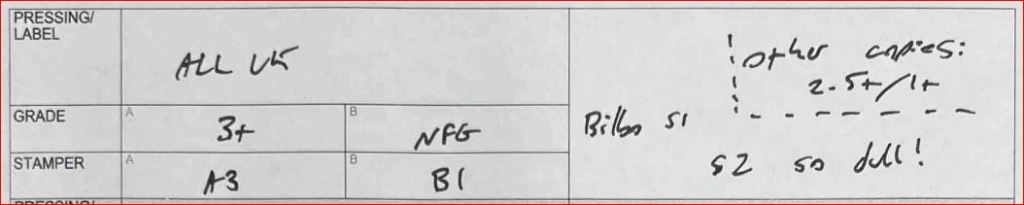
The UK pressings with the side two stampers shown below have not done well in our shootouts for a number of years now. If you own a copy with B-1 stampers on side two, the good news is that we can get you a much better sounding copy of 461 Ocean Boulevard than you have ever heard.

Stamper numbers are not the be-all and end-all in the world of records, a subject we discuss below, but after hearing too many copies with these stampers and substandard sound, from now on we are going to focus our attention on the stampers that do well and avoid copies with the B-1 marking on side two.

Bilbo cut the A-3 side one and did a great job; his side one won our most recent shootout.

Whoever cut side two really screwed it up, as you can see from our notes for our last two shootouts.

When it comes to stampers, labels, mastering credits, country of origin and the like, we make a point of revealing very little of this information on the site, for a number of good reasons we discuss here.

The idea that the stampers are entirely responsible for the quality of any given record’s sound is a mistaken one, and a rather convenient one when you stop to think about it. Audiophiles, like most everybody else on this planet, want answers.

In the world of records, there aren’t many, but B-1 for side two of this album is a clear exception to the rule that the stamper numbers are one part of a multi-faceted puzzle. In this case, B-1 is awful and is best avoided at all costs.

The Biz

Being in the shootout business means we have no way to avoid such realities, which is why it is so easy for us to accept them.

The amateurs and professionals alike who review records for audiophiles want there to be clear-cut answers for every album they write about. Uncertainty and trade-offs upset them no end.

We recognized twenty years ago that the empirical pursuit of record knowledge, practiced scientifically, must be understood as incomplete, imperfect, and provisional.

That is not going to change no matter how upsetting anyone may find it.

(more…)

I Have to Admit: the Cisco Pressing of Home Again! Had Me Vexed

Reviews and Commentaries for the Music of Doc Watson

Folks, if you made the mistake of buying the Cisco Heavy Vinyl reissue of this album, and you manage to grab one of our Hot Stamper pressings, you are really in for a treat.

I have to confess that when this record came out in 2003 I had a hard time coming to grips with what was wrong with it. I knew I didn’t like it, but I wasn’t sure exactly why. I wasn’t sure exactly what it was doing wrong, if anything. It seemed tonally correct and natural sounding. Why didn’t I like it?

It wasn’t phony up top with sloppy bass like a MoFi.

It wasn’t hard and transistory like so many of the Classic Records pressings back then.

I didn’t know the record at all so I really had nothing to judge it by.

But there was definitely something lacking in the sound that had me confused. Eventually I figured it out. Looking back on it now, the problems with the Cisco I could not identify were these:

  • The Cisco lacks presence. It puts Doc Watson further back than he should be, assuming that he is where he should be on the good vintage pressings, which sound right to me — some better, some worse, of course. Moving him back in the sound field does him no favors.
  • The Cisco lacks intimacy, which is key to the best pressings. The shootout winners remove all the veils and put you in the presence of the living, breathing Doc Watson. The Cisco adds veils and takes the intimacy right out of the record.
  • The Cisco lacks transparency. It frustrates your efforts to hear into the recording.
  • Doc is in a studio, surrounded by the air and ambience that would naturally be found there. The Cisco is airless and ambience-free, with Doc performing in a heavily damped booth of some kind. At least that’s what it sounds like.
  • And the last thing you notice is the lovely guitar harmonics on the originals and early reissues, harmonics that are attenuated and dulled on the Cisco.

As my stereo got better and better, and my critical listening skills improved in tandem, it became more and more obvious to me what was wrong with the Cisco. When we play modern Heavy Vinyl pressings these days, especially albums we know well, it usually doesn’t take us two minutes to hear what they are doing wrong.

(more…)

What Are the Best Stampers for Led Zeppelin’s Albums?

Hot Stamper Pressings of the Music of Led Zeppelin Available Now

What are the best sounding stampers for Led Zeppelin’s albums?

As if we would tell you!

This is a reworked excerpt from a much longer piece entitled record collecting for audiophiles – the limits of expert advice

In it we discussed the various stampers for some of Led Zeppelin’s albums and what role they play in our Hot Stamper shootouts.

Please to enjoy.

There is no way to know whether a record is any good without playing it, early stamper, late stamper or any other stamper.

First pressings (A, 1A, A1) don’t always win shootouts.

If they did we would simply buy only first pressings with those early stampers and only sell copies with those early stampers, since they are the best.

But this ignores the inconvenient fact that a great many other things go into the production of a record that have nothing to do with how early the stamper is.

A single copy of an album with stampers numbered (or lettered) A, when compared to B, when compared to C, has no definitive meaning for stampers A, B, C, or any others, because of the tremendous variation in the sound of all the pressings with A,B,C and other stampers.

Example Number One

There is a hot stamper for a certain Zep album that always wins the shootouts, [redacted].

It beats the hell out of the early stampers, A and B. In fact, we don’t even go after A and B anymore because they are expensive and rarely sound good enough to recoup our investment of the time and money we would spend buying, cleaning and auditioning them in a shootout.

A and B can be good, but why pay top dollar for them when they have never been any better than “good?”

We’re looking for “great” so that we can charge a premium price for them. This accomplishes three things that are obviously of great importance to any business:

  1. It pleases the hell out of our customers.
  2. It covers our costs, and
  3. It lets us pay our staff good wages and bonuses for their hard work, skill and knowledge.

(more…)