*Experimenting with Records

Experimenting with records is the only way to learn much about them of any real value.

Heavy Vinyl Quality Control? We Put That Proposition to the Test

bellcurve500

Important Lessons We Learned from Record Experiments

Part one of this commentary concerns the random results of all record making processes. It can be found here.

A Heavy Vinyl Shootout

A number of years ago (2011?) we had the opportunity to crack open two brand new sealed copies of a recently remastered Heavy Vinyl pressing came our way. I already had one which I was waiting to audition, so that meant there were actually three copies to play.

At the time, we were told that with this pressing every effort was made to produce the highest quality product and to maintain the utmost in quality control throughout the production process. They fellow representing the company distributing the title was adamant that every copy produced, from first to last, would be indistiguishable from any other — not just in terms of surfaces, but sound quality too.

To accomplish this feat, the producer used the real master tapes (we were told, no reason to doubt him), had a well known mastering engineer do the mastering at a highly-regarded studio, then had a well-known audiophile pressing plant in Germany make the record, using the finest vinyl compounds available, in presses that meet the highest standards in the industry, operated by skilled individuals of the utmost professionalism.

Any stamper would be replaced long before it could possibly be showing any wear.

All the metal mothers and stampers would be made in a way designed to eliminate all variation.

One and only one complete run would be made. If another was needed at some later date the whole process would have to be started over from scratch using the same strict quality controls.

(more…)

Making Mistakes and Other Advice from Better Records

New to the Blog? Start Here

Record shootouts are the fastest and easiest way to hone your listening skills. We believe that the only way to really learn about records is to gather a big pile of them together, clean them up and listen to them one by one, as critically as you can.

Wise men and women throughout the ages have commented on the value of making mistakes. Here is one of our favorite quotes on the subject.

“Making a different mistake every day is not only acceptable, it is the definition of progress.” Robert Brault

If you have twenty copies of Bridge of Sighs, and most of them are British, you are definitely going to find a Hot Stamper pressing or two, assuming you clean them right and listen to them critically.

Keep in mind that having British pressings in your shootout is absolutely crucial to your success, because those are the only ones that ever win our shootouts, for obvious reasons: they’re made from the master tapes.

The domestic pressings are made from dubs, and yes, I suppose you could shootout twenty of those, but you would only be trying to find the best second-rate pressing of the album out of your twenty, since practically any British pressing will beat even the best domestic pressing.

(more…)

Watch Out for that First Track on If Only I Could Remember My Name

Hot Stamper Pressings of the Music of David Crosby Available Now

If your copy sounds recessed and lacks extension up top, don’t feel bad. Most of them do.

By the way, the first track has that “home recording” sound. It usually sounds weak compared to the rest of this album. Don’t expect any wonders.

As a wannabe hit single, peaking at #95 on the charts, it may even be sourced here from a dub of the real master tape. That shit happens.

Your Reward Awaits You

As you may have read elsewhere on the site, records like this are the reward for owning the right stereo equipment and having it properly tweaked. There is no way in the world I could have played this album 20 years ago remotely as well as I can now. It only makes me appreciate the music even more.

(more…)

After Years of Searching, We Finally Found an Old Beatles Record with Top Quality Sound

Hot Stamper Pressings of The Beatles for Sale Album

UPDATE 2026

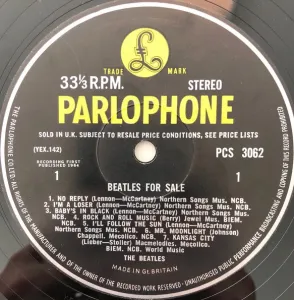
Sometime before 2022 we played a copy of Beatles For Sale on the original label that earned Super Hot Stamper (2+) grades on both sides. This was surprising because we rarely like Beatles albums on the early label with the exception of two titles, Yellow Sub and A Collection of Oldies…


UPDATE: 2022

We just played another original pressing of For Sale and this copy had a Triple Plus (A+++) side one, mated to a Double Plus (A++) side two. For Sale is still the only studio album with top quality sound on the original pressing that we have ever played, but now we can say with some authority that if you have a bunch of originals, you might just have one with killer sound like the one we had. There was a later pressing that also earned our top grade, a subject we touch on in this commentary for Kind of Blue.


UPDATE to the UPDATE: 2023

We’ve just played another original pressing of For Sale in a shootout and amazingly it earned Triple Plus (A+++) grades for its sound on both sides. Most original Beatles pressings on the early label do not even qualify to make it into our shootouts. Their mastering is so crude, congested and distorted that the sound simply cannot be taken seriously on a modern hi-fi rig. On a jukebox, maybe. Mine’s in the shop.

Note that this label information, like most label information, is not as helpful as it might seem. The Yellow and Black Parlophone label was used in the UK all the way up until 1969, during which time a lot of copies of For Sale, first released in 1964, were sold. In other words, if you want to find a great sounding pressing of For Sale on the early label, you have your work cut out for you.


This finding about For Sale is precisely why live and learn is our motto.

We don’t know it all, and we’ve never claimed that we did. We constantly learn things about pressings in our daily shootouts. That should not be too surprising, as record shootouts are the only way to learn anything about the sound of records that’s actually worth knowing.

Start doing your own experiments and your record knowledge might just take off the way ours has. 99% of what we think we know about the sound of records we’ve learned in shootouts over the course of the last twenty years.

We are happy to share our advice with you on getting started.

Before this, the only Beatles record we would sell on the Yellow and Black Parlophone label was A Collection of Oldies… But Goldies. That title does have the best sound on the early label. In numerous shootouts, no Black and Silver label pressing from the ’70s was competitive with the best stereo copies made in the ’60s.

Until now, it was clearly the exception to our rule. From With the Beatles up through Yellow Submarine, the best sounding Beatles pressings would always be found on the best reissue pressings.

Here are the notes for the best sounding For Sale on the early label we played in our 2022 shootout.
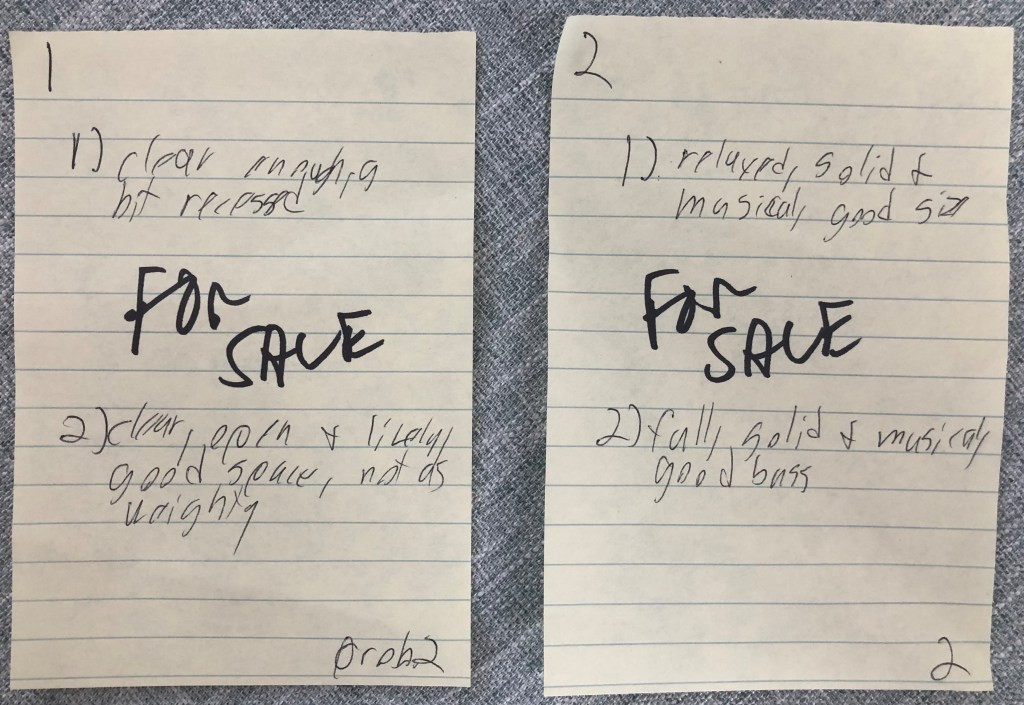
For those who have trouble reading our writing, the notes say:

Side One

  • Track one is clear enough, a bit recessed.
  • Track two is clear, open and lively, with good space, but not as weighty as the best.

Side Two

  • Track one is relaxed, solid and musical, with good size.
  • Track two is full, solid and musical, with good bass.

We Was Wrong

A very good sounding record, with few of the problems we heard on the other early label Beatles pressings we’ve played in the past. Most of them had the kind of old record sound — compressed, congested, harmonically distorted, bandwidth limited, etc. — that kept them from making the cut.

But that’s the reason to play records, not judge them by their labels, right? How else would you possibly learn anything about their sound? And you have to play them head to head against other copies, a normally crude process we’ve refined over the last twenty years into a science we like to call the Hot Stamper shootout.

(more…)

The Warm Moods – The Reissue Is So Good, How Can the Original Be Better?

Our review from years ago for the Discovery reissue of The Warm Moods can be found below.

We loved the sound, so much so that we found it hard to fault.

Imagine our surprise when we discoverd that that the original was clearly better.

Much better. At least a full grade better.

When we did the shootout again, a rare (in stereo anyway) original Reprise showed us just how wrong we were.

The best original pressing we found took the sound of The Warm Moods to another level, and a pretty high one at that.

It’s yet another example in which the most important question in all of audio had been overlooked: compared to what?

Who knew the recording could sound any better than the wonderful Discovery pressing we’d played?

(more…)

Beware of Fooling Yourself with Pseudo Shootouts

Record Shootouts Are Tricky – Here Are Some of the Lessons We’ve Learned
We encourage any audiophile who wants to improve the quality of his record collection to start doing his own shootouts.

Freeing up an afternoon to sit down with a pile of cleaned copies of a favorite LP (you won’t make it through any other kind) and playing them one after another is by far the best way to learn about records and their mysterious pressing variations.

Be sure to take extensive notes.

Shootouts are a great deal of work if you do them right.

If you have just a few pressings on hand and don’t bother to clean them carefully, or follow rigorous testing protocols, that kind of shootout anyone can do. We would not consider that a real shootout.

Art Dudley illustrates this approach, but you could pick any reviewer you like — none of them have ever undertaken a shootout worthy of the name to our knowledge.

With only a few records to play – a woefully inadequate sample size — you probably won’t learn much of value and, worse, you are unlikely to find a top copy, although you may be tempted to convince yourself that you have.


Further Reading

How We Go About Evaluating Big Production Rock Records

More Advice on Developing Your Critical Listening Skills

Big Rock Records such as Honky Chateau always make for tough shootouts. Their everything-but-the-kitchen-sink approach in the studio make it difficult to translate that much sound to disc, vinyl or otherwise.

Everything has to be tuned up and on the money before we can even hope to get the record sounding right. Careful VTA adjustment could not be more critical in this respect.

If we’re not hearing the sound we want, we keep messing with the adjustments until we do. There is no getting around sweating the details when sitting down to test a recording as complex as this. If you can’t stand the tweaking tedium, get out of the kitchen (or listening room as the case may be).

Obsessing over every aspect of a record’s reproduction is what we do for a living. This kind of Big Rock Recording requires us to be at the top of our game, both in terms of reproducing the albums themselves as well as evaluating the merits of individual pressings.

When you love it, it’s not work, it’s fun. Tedious, occasionally exasperating fun, but still fun. And the louder you play a record like this the better it sounds.

More Is More

Elton John is one of the handful of artists to produce an immensely enjoyable and meaningful body of work throughout the ’70s, music that holds up to this day. The music on his albums, so multi-faceted and multi-layered, will endlessly reward the listener who makes the effort and takes the time to dive deep into the sound of his classic releases.

(more…)

Play The Game, Not the Album

Hot Stamper Pressing of the Music of Joni Mitchell Available Now

Another in our series of Home Audio Exercises, one we created all the way back in 2007. If you want to learn more about doing your own shootouts, this listing has lots of good advice on how to go about it.

In 2007, a milestone year for us here at Better Records, we mentioned to our customers that we would not be carrying the new 180 gram Rhino pressing of Blue. We noted:

Since Kevin and Steve are friends of mine I won’t belabor its shortcomings. Let’s just say I think you can do better.

Down the road when we’ve had a chance to do a shootout amongst all our best copies, we will be offering something more to our liking. I recommend instead — and this is coming from a die-hard LP guy, someone who disconnected his home CD player over two years ago and only plays the damn things in the car — that you pick yourself up a nice used copy of the gold CD Hoffman mastered for DCC. It’s wonderful.

Some people are already upset with us over this decision, actually going so far as to question our motives, if not our sanity. Without a doubt we feel this will end up being the single most controversial stance we’ve ever taken. I predict that a great number of audiophiles are going to get really upset over our criticism of this new pressing. We are going to get emails like crazy asking us to explain what on earth could possibly be wrong with such a wonderful sounding LP. The writers of these emails will no doubt extoll its virtues relative to the other pressings they may have heard, and, finding no other reasonable explanation, these writers will feel impelled to question both the quality of our playback equipment and — yes, it’s true — even our ability to recognize a good record when it’s spinning right on our very own turntable.

(more…)

Ravel, Saint-Saens et al. / Tzigane, Havanaise / Kyung-Wha Chung

Hot Stamper Orchestral Imports on Decca & London

This 1979 London original English pressing of violin showpieces (reviewed in 2012) has Super Hot Stamper sound on side two, which came as a bit of a shock to us after playing side one, which is as congested and opaque as one would expect from such a late London recording.

A great many Decca recordings from the Seventies are not to our liking, for reasons we lay out here.

Side two is fabulous — full-bodied, rich and sweet. Even though it may have been recorded in 1977, the engineer is Kenneth Wilkinson, and the hall is Kingsway — not many bad recordings can be attributed to either.    

But bad mastering or bad pressing quality are surely not the fault of either. When the record doesn’t come out of the oven right, the sound is going to suffer, and the sound on this side one is insufferable all right.

But side two is GLORIOUS, with wonderful music played with skill and feeling. (more…)

Audiophile Wire Testing with Jethro Tull and His Friend Aqualung

Hot Stamper Pressings of the Music of Jethro Tull Available Now

… who seems to have a rather nasty bronchial condition…

[This commentary is from 2008 or so I’m guessing. Still holds up though.]

Like Heart’s Little Queen album, Aqualung presents us with a Demo Disc / Test Disc that really puts a stereo through its paces, assuming it’s the kind of stereo that’s designed to play an album like Aqualung.

Not many audiophile systems I’ve run across over the years were capable of reproducing the Big Rock Sound this album requires, but perhaps you have one and would like to use the album to test some of your tweaks and components. I used it to show me how bad sounding some of the audiophile wire I was testing really was.

Here’s what I wrote:

A quick note about some wire testing I was doing a while back. My favorite wire testing record at the time (2007)? None other than Aqualung!

Part One

Here’s why: Big Whomp Factor. Take the whomp out of Aqualung and the music simply doesn’t work, at all. To rock you need whomp, and much of Aqualung wants to rock.

(more…)