*Experimenting with Records

Experimenting with records is the only way to learn much about them of any real value.

Hearing Is All It Should Take, Right?

Hot Stamper Classical and Orchestral Pressings Available Now

Some person on some audiophile forum might feel obligated at some point to explain to you, benighted soul that you are, that the old classical records you — and other audiophiles like you — revere so highly have to be recognized these days for what they are: drastically compromised by the limits of their old technology.

Simply put, there’s just no way they can sound good.

It’s just a fact. It’s science. Technology marches on and those old records belong on the ash heap of history collecting dust, not sitting on the platter of a modern turntable.

That’s why the audio world was crying out for Bernie Grundman to recut those Living Stereo recordings from the 50s and 60s on his modern transistorized cutting equipment and have RTI press them on quiet, flat, high-resolution 180 gram vinyl, following the best practices of an industry that everybody knows has been constantly improving for decades.

Right?

For those of us who actually play these records, there is little evidence to support this narrative.

It’s a story made up mostly of assertions, along with an unhealthy amount of faith in so-called experts. [1]

Note that Bernie had no experience cutting classical music. He was a rock, pop and jazz guy. Robert Ludwig was the classical guy, cutting hundreds of albums for labels like Nonesuch in the 60s. What a different world it would be if he was the guy who cut for Classic Records! This review gets to the heart of the matter.

However, the contrarian view outlined above only really holds true for a very small minority of audiophiles of the analog persuasion: those given to empirical testing of such propositions. [2]

For an audiophile to compare the new pressings to the old ones, proper testing requires that the following four conditions can are met:

  1. He or she has a revealing, accurate stereo,
  2. A good record cleaning system, and
  3. Knows how to do shootouts using his or her
  4. Well-developed critical listening skills

If you’ve spent much time on this blog, you’ve probably read by now that the first three on this list are what allow you to achieve the fourth.

Compromises?

The best classical recordings of the 50s, 60s and 70s were compromised in every imaginable way, yet still they sound amazing.

(more…)

Inner Secrets Is One of the Best Sounding Rock Records We’ve Ever Played

Hot Stamper Pressings of the Music of Santana Available Now

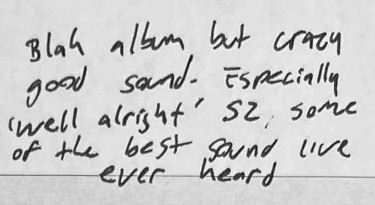
In our most recent shootout (11/2023), the first we’ve done in quite a few years, my main listening guy was blown away by the sound of the Shootout Winning copy. This warmed my heart no end, as I have been raving about the sound of this album for fifteen years or more.

We created a section for phenomenally good sounding records like Inner Secrets, and this link will take you to it.

His notes from the session can be seen below.

And he’s not wrong about much of the album being “blah.” There are really only about four top quality songs out of the nine on the album, but three of those four are killer, and, even at our prices, make the album a Must Own for those of you with big speakers that can play good and loud.

Phase One and Phase Two of a Shootout

Like other Hot Stampers you may have read about, sometimes the instruments and voices just jump out of the speakers. When that happens I usually write “It’s Alive!” on the post-it, and I know exactly what to do with it. I put it right in the Contender pile, to be compared with the other top contender copies at some point.

It’s definitely a crazy-good Hot Stamper; just how hot we still need to find out.

Which is what happens in Phase Two of these affairs. We go back through all the best copies to see in what areas they really shine and in what areas they may fall a bit short of the best.

Of course there’s no way to know what accounts for any of the sound we hear. Not for sure anyway. It’s just interesting to ponder what makes one record sound one way and the next record, with stampers as little as one letter off in the alphabet — sometimes with exactly the same stampers! — sound so different from one another.

Doug Sax Is The Man

All the originals (the only ones with the potential for good sound in our experience) are cut by The Mastering Lab, one of the greatest cutting houses to ever master records.

Doug Sax may or may not have had anything to do with the making of this record, but one thing we can be sure of: he knew how to keep his lathes and amplifiers working at state-of-the-art levels. The sound quality is unsurpassed.

And he did it all with tubes.

(more…)

Your Shootout Questions Answered – Part Two

Hot Stamper Pressings of the Music of The Beatles Available Now

Robert Brook wrote to me recently with some questions about shootouts.

I answered most of them in Part One of this commentary. Here are the questions he posed that remain to be answered.

[I]f you put a shootout together of [redacted stamper] pressings and whatever else you like, does every copy in the shootout grade at least A++ / A++? Are the right stampers that reliable?

I guess I’ve always assumed that even if you put together a shootout with this or any other title, and even if you only include pressings that have won or placed high in the past, at least a couple of them would end up graded no higher than A+ or A+ to A++.

And if that is correct, wouldn’t it be worth buying more UK TML’s to see if any emerge that could win a shootout?

With Revolver, for instance, why not just do shootouts with [the best stampers] if those are the ones that win the shootouts? Why even bother with [later pressings]?

Robert,

First Question

If I may paraphrase, you’re asking, “do the right stampers always get good grades?”

(more…)

2-Packs – The Best Case for Dramatic Pressing Variations

Hot Stamper Pressings of the Music of The Eagles Available Now

Just today (3/16/15) we put up a White Hot Stamper 2-pack of the Eagles’ First Album. One of the two pressings that made up the 2-pack had a killer side two, practically As Good As It Gets. 

What was interesting about that particular record was how bad side one was.

Side one of that copy — on the white label, with stampers that are usually killer — was terrible.

The vocals were hard, shrill and spitty. My notes say “CD sound.”

When a record sounds like a CD it goes in the trade-in pile, not on our site.

We encouraged the lucky owner to play the bad side for himself, just to hear how awful it is. Yet surprisingly, one might even say shockingly, it has exactly the qualities that audiophiles and collectors are most often satisfied with: the right label, and, in this case, even the right stampers (assuming anyone besides us would know what the right stampers are).

The problem was it didn’t have the right sound.

I know our customers can hear the difference, but can the rest of the audio world? Most of my reading on the internet makes me doubt that they can. When some people say that the differences between pressings can’t be all that big, I only wish they could have played the two sides of this copy.

Or  had higher quality reproduction so that these differences become less ignorable.

(more…)

Tchaikovsky / Swan Lake – Notes for All Four Sides

More of the Music of Tchaikovsky

This review was written for our first shootout of the complete ballet in 2012.

This London Small Red Label “Whiteback” (it’s white inside the box, not on the back, but you get what I mean) UK Import 2 LP Set put every other recording we had of Swan Lake to shame. This is the one folks, assuming you want a nearly complete performance of the work. (We will have some single LP highlight pressings coming to the site down the road. The Fistoulari on London can be especially good on the right pressing.) 

The performance here by Ansermet and the Suisse Romande I rank second to none.

Ansermet is surely the man for this music, and the famously huge hall he recorded in just as surely contributes much to the wonderful sound here. (The Royal Gala Ballet is a good example. If you have the two grand to spend we highly recommend you find yourself a good one. And don’t waste your money on the Classic no matter what you may have read elsewhere.)

Speaking of bad sounding Heavy Vinyl, Speakers Corner reissued this very recording on 180g fifteen years ago or so and ruined it. Imagine that. (I happily admit their Nutcracker was quite good for a Heavy Vinyl reissue. It cannot hold a candle to a good vintage pressing but it will beat most of what’s out there on audiophile vinyl, which, truth be told, isn’t saying much.)

This Masterpiece of Ballet Music should have a place in any audiophile’s classical collection.

Others that belong in that category can be found here.

(more…)

Do the “Wrong Stampers” Sometimes Win Shootouts?

mendestill_depth_1102533608More of the Music of Sergio Mendes and Brasil ’66

Soren has some questions about shootouts and our White Hot Stamper pressing of Stillness. His questions are indented, our answers are not.

Tom,

Does it ever bug you to realize, maybe one or two years down the road and with (as Tom mentions) better playback/cleaning technology, that stampers which you dismissed in a shootout turn out to win the next one, meaning that you could have let many possible hot stampers go?

Soren,

We talk about that a bit here: which is better: Phil DeLancie digital or George Horn analog?

But being bugged by it does no good. It is a reality that must be accepted.

Because we know how easy it is to be wrong, or, more precisely, to not know everything we would like to know, we never stop doing research and development for the titles we sell.

We tell people all the time, go play your Heavy Vinyls and Half-Speeds that you haven’t played recently. If you’ve made improvements to your system, they will often start to show themselves to be not nearly as good sounding as you remember, and that means you are making progress.

I was actually reaching out to you to inquire whether the super hot Sergio Mendes Stillness that I bought from you a couple of years ago is the version with the phase reversed on side 2?

I ask because I don’t recall a phase issue on this specific title was ever mentioned on your site back when I bought it (i would have remembered, I think) so maybe you only found out recently?

Side 1 on the record sounds better to me than side 2. The matrix on this side 2 ends in “M3”.

Both M2 and M3 are in correct polarity.

M3 used to win shootouts by the way. For the longest time, at least ten years, I thought M3 was the ultimate side two.

(more…)

Good Audio Advice and Critical Listening Skills

More on the Subject of How to Go About Developing Your Critical Listening Skills

UPDATE 2024

This is an updated version of a commentary written many years ago.


The latest Mapleshade catalog (Spring 09) has, along with hundreds of recommendations, this little piece of audio advice that caught my eye:

For much improved bass and huge soundstage, put your listening chair or sofa right against the wall behind you. Move your speakers in to 5’ in front of you and 7’ or more apart. No room treatments will yield this much bass improvement.

I literally had to read through it a couple of times to be sure I wasn’t hallucinating. But every time I read it, it still said the same thing, so I know I can’t have been dreaming. This is crazy talk. What the hell is wrong with these people?

Well, it’s not all crazy. There is actually a factually true statement at the end of that paragraph. Yes, it is true that no room treatments will yield as much bass as sitting up against a wall. But why stop there? Bass, regardless of its source, immediately seeks out the corners of the room. That’s where the most bass will always be: where the room boundaries are. If you want to hear the maximum amount of bass your speakers are producing, put your head in the corner of the room down at the floor, where three boundaries intersect. Like the sound now? Getting enough bass are ya?

Along the same lines, for a “huge soundstage” try putting one speaker at one end of the room and the other speaker at the opposite end. Why stop at seven feet? My listening room is twenty feet deep; I can get a soundstage that’s twenty feet across without any problem at all.

I would just have to be dumb enough to think that doing such a thing would be a good idea.

Fellow audiophiles and music lovers, it is not. Let’s talk about why.

Room Reflections

The closer you are to anything that the sound coming from your speakers can bounce off of, right before or right after it reaches your ears, the worse the sound. You want to be as far away from everything as you can be, and this includes not only the back wall of your listening room, but the heads of other persons who may be listening with you. This is easily demonstrated. Have a friend or loved one sit next to you and listen critically to some music you know well. Now have that person leave the room. The sound will always get better (unless something else is very wrong). I have done this experiment many, many times and it only comes out one way: fewer near reflections, better sound.

(more…)

How Can Anybody Not Hear What’s Wrong with Old Records Like These?

beatlrubbeoriginalRecord Collecting – A Guide to the Fundamentals

It is our strongly held belief that if your equipment (regardless of cost) or your critical listening skills do not allow you to hear the kinds of sonic differences among pressings we describe, then whether you are just getting started in audio or are a self-identified audio expert writing for the most prestigious magazines and websites, you still have a very long way to go in this hobby.

Purveyors of the old paradigms — original is better, money buys good sound — may eventually find their approach to records and equipment unsatisfactory (when it isn’t just plain wrong), but they will only do so if they start to rely more on empirical findings and less on convenient theories and received wisdom.

A reviewer we know all too well is clearly stuck in the old, mistaken paradigm, illustrated perfectly by this comment:

It’s not my pleasure to be so negative but since I have a clean UK original (signed for me by George Martin!) I’ll not be playing this one again. Yes, there are some panning mistakes and whatever else Martin “cleaned up” but really, sometimes it’s best to leave well-enough (and this album was well-enough!) alone.

We can’t imagine how anyone can have a system in this day and age that can obscure the flaws of the original Parlophone pressings of Rubber Soul (or any other Yellow and Black label Parlophone pressing for that matter, other than Yellow Submarine and Oldies but Goldies).


UPDATE 2022

Here is another exception to that “rule.”


This reviewer apparently does (as do some of our customers, truth be told), but we have something very different indeed. One might even consider it the opposite of such a system.

Our system is designed to relentlessly and ruthlessly expose the flaws of every record we play.

(more…)

Manna – Super Hot Versus White Hot

Hot Stamper Pressings of Great Sounding Pop Albums Available Now

Back in the mid- to late-2000s, we felt we owed our Hot Stamper customers a more complete picture of the good and bad qualities we heard in our shootout for practically every record we played.

The idea was that the buyer could listen along for what the record was doing well and what it might not be doing so well. If you noticed that the top end was a little soft, well, that’s what we might have heard too. We would put that shortcoming, and any others we thought worth mentioning, right there in the listing.

Over the years, in order to avoid having to write every listing from scratch, we streamlined the process and dropped the criticisms.

Below you can see a typical example of an older listing. This is how we used to recognize when a record was Super Hot as opposed to White Hot.

This commentary on the famous recording of The Firebird with Dorati discusses the same issues in more depth.

Side One

A++, with good balance and lots of rockin’ energy. It’s transparent — just listen to how clear the drums are on the first track. It’s a bit dry and doesn’t have all the top end extension of the best, so Super Hot is a fair grade we think.

(more…)

Learning the Record, Any Record

More of the Music of the Traveling Wilburys

Many of the pressings we played of Volume One suffered from too much compression and a phony hi-fi-ish quality on the vocals. We knew there had to be better sounding copies out there somewhere, so we kept dropping the needle on every pressing we could get our hands on until we found one. Here is how we described a killer copy we ran into during that process.

We heard a lot of copies with a spitty, gritty top end, but this one is smooth like butter.

Side two is nearly as good but doesn’t have quiet the same energy factor. It’s still dramatically better than most copies out there.

Now that we’ve discovered these Hot Stampers, the sound is finally where we want it to be. Until this week, we were convinced that these songs sounded better on the radio. (That’s what tons of compression and FM bass boost will do for you.)

Learning the Record

For our recent shootout we had at our disposal a variety of pressings we thought would have the potential for Hot Stamper sound. We cleaned them carefully, then unplugged everything in the house we could, warmed up the system, Talisman’d it, found the right VTA for our Triplanar arm (by ear of course) and proceeded to spend the next hour or so playing copy after copy on side one, after which we repeated the process for side two.

(more…)