*Experimenting with Records

Experimenting with records is the only way to learn much about them of any real value.

Willie Nelson and Leon Russell – One for the Road

More Willie Nelson

More Country and Country Rock

xxxxx

  • The sound is big and rich, the vocals breathy and immediate, and you will not believe all the space and ambience
  • This is an exceptionally good (studio) recording, and this pressing really nails the smooth, rich analog sound of what must be an awesome master tape
  • Our notes for sides one and two on our shootout winning copy read: big/rich/no smear/not bright/breathy vox/big bass/3D/huge vox — that’s our kind of sound!
  • 4 stars: “…it’s a small, priceless gem for any serious fan of either singer.”

(more…)

El Amor Brujo – Brilliant Decca Remastering from 1967

Hot Stamper Pressings of Orchestral Spectaculars Available Now

UPDATE 2022

In 2012 we were knocked out by this Stereo Treasury Budget Reissue pressing.

We had the temerity to charge $175 for our Hot Stamper copy, a record we’d probably picked up locally for five or ten bucks. Nowadays of course it would go for even more than that, and still be worth every penny, assuming the buyer was looking for wonderful music with top quality sound regardless of the vinyl’s trade-in value, which in this case would probably be a dollar.

It is our strongly held belief that records are for playing and enjoying, not trading-in. Some records (like this one) are perfect for collectors, but their appeal is lost on us and has been since I soured on Mobile Fidelity records back in the 80s. It would take us another twenty years before we were done with other pressings that promised so much and delivered so little.

Decca released this title on their London label as a budget reissue, but that didn’t keep them from mastering it properly and pressing it on high quality vinyl.  The same cannot be said for RCA, which kept many of their golden age recordings in print on the RCA red label as well as others, but with sound that was most of the time clearly inferior to those earlier releases.


Our 2012 Review

Our current favorite El Amor Brujo for sound and performance is this Decca recording from 1967 with De Burgos conducting the New Philharmonia.

The best sound on this album is on side two, where El Retablo de Maese Pedro can be found.

(more…)

This Is Why We Love Records from the 50s

Hot Stamper Pressings of Mercury Classical Recordings Available Now

From time to time a record comes our way that sounds absolutely amazing, “I can’t believe it’s a record” amazing.

If it’s the kind of record that sounds like the best copy of Fiesta in Hi-fi from our most recent shootout, we might even let our enthusiasm for its superb fidelity get the better of us. That’s the effect a record as good as the copy we played can have. You just can’t stop yourself from saying one great thing after another about it.

Our over-the-top notes, like those you see below, attempt to convey what it’s like to experience the absolutely breathtaking sound we were hearing.

But where is the harm in that? These are notes that no one outside of the staff are ever expected to see. They are helpful to us in writing our commentary and pricing the specific copy we auditioned, but they are practically never quoted in the listings.

Fiesta in Hi-Fi is an example of one of those recordings that doubles as a thrill ride. They come along from time to time in order to show us the kind of sound that we’d almost forgotten was possible on a record.

Oh yes, with the rare properly-cleaned, properly-mastered, properly-pressed vintage vinyl LP, played back on top quality equipment in a heavily treated, dedicated soundroom, we can assure you it is very possible indeed. Allow us to make the case with the Shootout Winning original pressing you see below.

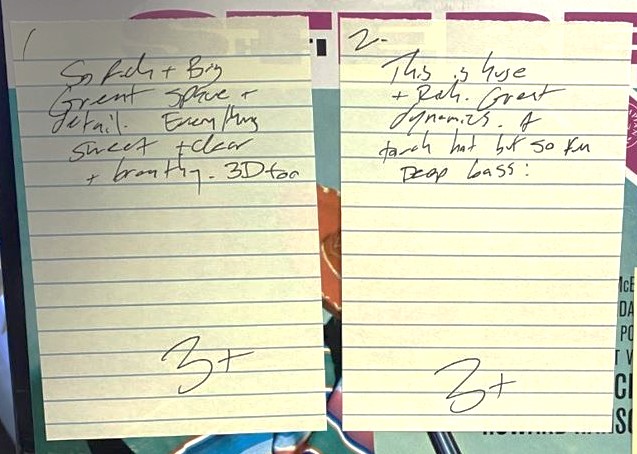
The notes read: 

So rich and big / Great space and detail / Everything sweet + clear + breathy / 3D too / Great dynamics / A touch hot but so fun / Deep bass.

You know what’s unusual about these notes?

(more…)

Focus Is the Hidden Driver of Excellence

More on Developing Your Critical Listening Skills

Every day Delanceyplace sends me email book excerpts, and the one that came today struck me as particularly relevant to the devilishly difficult audio hobby many of us have been engaged in for most of our adult lives. Some of their excerpts are seen below. (Italics added by me.)

I myself wrote a commentary back in 2006 about the 10,000 hour rule, which I have linked below delanceyplace’s piece, along with other commentaries I think you might enjoy.


Focus: The Hidden Driver of Excellence by Daniel Goleman.

“The ‘10,000-hour rule’ — that this level of practice holds the secret to great success in any field — has become sacrosanct gospel, echoed on websites and recited as litany in high-performance workshops. The problem: it’s only half true.

“If you are a duffer at golf, say, and make the same mistakes every time you try a certain swing or putt, 10,000 hours of practicing that error will not improve your game. You’ll still be a duffer, albeit an older one.

“No less an expert than Anders Ericsson, the Florida State University psychologist whose research on expertise spawned the 10,000-hour rule of thumb, told me, “You don’t get benefits from mechanical repetition, but by adjusting your execution over and over to get closer to your goal” .

“Apart from sports like basketball or football that favor physical traits such as height and body size, says Ericsson, almost anyone can achieve the highest levels of performance with smart practice. …
“Ericsson argues that the secret of winning is ‘deliberate practice,’ where an expert coach takes you through well-designed training over months or years, and you give it your full concentration.

“Hours and hours of practice are necessary for great performance, but not sufficient.

How experts in any domain pay attention while practicing makes a crucial difference.

For instance, in his much-cited study of violinists — the one that showed the top tier had practiced more than 10,000 hours — Ericsson found the experts did so with full concentration on improving a particular aspect of their performance that a master teacher identified.

“Smart practice always includes a feedback loop that lets you recognize errors and correct them — which is why dancers use mirrors. Ideally that feedback comes from someone with an expert eye and so every world-class sports champion has a coach. If you practice without such feedback, you don’t get to the top ranks.

“The feedback matters and the concentration does, too — not just the hours. …

(more…)

Our Old Prediction for LSC 2563 Came True

Hot Stamper Pressings that Feature the Violin

Many years ago we wrote:

This is a very old review and it’s doubtful we would not prefer the right Shaded Dog pressing these days.

That turned out to be the case, as we had two late-label 70s Red Seal pressings in the shootout we just did and only one of them was even passable.

A few things about the new pressings and the old commentary caught my eye.

First off, 3s is a fairly low number. The Shaded Dogs that win the shootout must be lower, which means they are either 1s or 2s. Not much to choose from there!

Secondly, the commentary you see below goes into great detail regarding what each piece found on the pressing was doing right and wrong.

It makes us sound like we knew what we were talking about when it came to this specific Red Seal pressing of the album we had played.

I assure you that we did not.

On the web I come across lots of reviews for audiophile pressings in which the writers go on for page after page about how much better the new Heavy Vinyl pressing is compared to the old record the reviewer owns.

This is no longer hard for me to understand. They are simply as lost as I used to be.

(more…)

Bruch & Mozart Violin Concertos / Heifetz in 2010

Years ago we wrote:

This is a very old review, probably from the early 2010s, so take it for what it’s worth. I suspect we could find a much better sounding copy of the album today than we could back then, before we had the cleaning systems and playback equipment we do now.

All that turned out to be true.

In 2024 we did another shootout for the album, our first in more than ten years! I am happy to say the sound was a knockout on the best copies, some of the finest violin concerto sound we have ever heard.

Live and learn is our motto, and progress in audio is a feature, not a bug, of record collecting at the most advanced levels. (“Advanced” is a code word for having little to no interest in any remastered pressing marketed to the audiophile community. If you want to avoid the worst of them, we are happy to help you do that.)

Our comments from 2010:

(more…)

A Short Primer for Some of the Qualities We’re Listening For

Record Shootouts Are Tricky – Here Are Some of the Lessons We’ve Learned

For our last Hot Stamper pressing of Shepherd Moons, we noted:

This may not be our favorite music in the world, but it’s hard to argue with sound as good as this.

We went on to add:

The sound here is airy, open, spacious, and transparent, as well as tonally correct, clear and present.

Those are the qualities of our shootout winning pressings that we found to be the most compelling.

But is that everything we were listening for? Of course not.

So precisely what are the criteria by which a record like Shepard Moons should be judged?

Pretty much the ones we discuss in most of our Hot Stamper listings:

  • energy,
  • vocal presence,
  • frequency extension (on both ends),
  • transparency,
  • harmonic textures (freedom from smear is key),
  • rhythmic drive,
  • tonal correctness,
  • fullness,
  • size,
  • space, and
  • Tubey Magic.

When we can get all, or almost all, of the qualities above to come together on any given side, we provisionally award it a grade of “contender.”

Once we’ve been through all our copies on one side, we then play the best of the best against each other and arrive at a winner for that side.

Repeat the process for the other side and the shootout is officially over. All that’s left is to see how the sides matched up.

It may not be rocket science, but it is a science of a kind, one with strict protocols that we’ve developed over the course of many years to insure that the results we arrive at are as accurate as we can make them.

The result of all our work speaks for itself. We guarantee you have never heard this music — really, any music — sound better than it does on one of our Hot Stamper pressings, or your money back.

(more…)

What Causes Lifeless and Pointless Sound?

More of the Music of Chuck Mangione

We did a shootout for this album in 2012 and had a hard time finding much energy in the music. That is, until we stumbled upon a few good copies, which showed us just how well recorded the album was and how enjoyable the music could be on the right pressing.

It’s shocking just how lifeless and pointless Feels So Good can sound on some copies.

After only a few minutes the band seems to be having a hard time staying awake.

But the same performance is captured on every pressing, so how can the band sound so inspired here and so uninspired elsewhere?

It’s one of the mysteries of recorded media, one which still takes us by surprise on a regular basis, every week in fact.

This idea that most pressings do a poor job of communicating the music still has not seeped into the consciousness of the audiophile public. Here at Better Records, we’ve been diligently working to change that for close to twenty years, one Hot Stamper at a time.

The copies that are present, clear, open, transparent and energetic, with a solid rhythmic line driving the music, are a hundred times more enjoyable than the typical pressing that can be found practically unplayed (gee, I wonder why?) sitting in most record collections.

By the way, if you know Feels So Good only through the radio, you may be surprised to find that it’s close to ten minutes long, not the three minutes you’re familiar with. The band stretches out quite a bit and the solos are fairly inventive, as AMG noted.

This very side two has that problem to a fair degree; it’s a bit too murky and veiled to be as much fun as side one. But so few copies were any good at all that it still earned an A+ grade. If you turn it up it helps it quite a bit. Still, it lack extension high and low compared to this side one. (more…)

Brahms / Piano Concerto No. 1 – What to Listen For

Hot Stamper Pressings of of the Music of Brahms Available Now

Our general notes for the recording seen below explain why the typical copy in our shootout fell short.

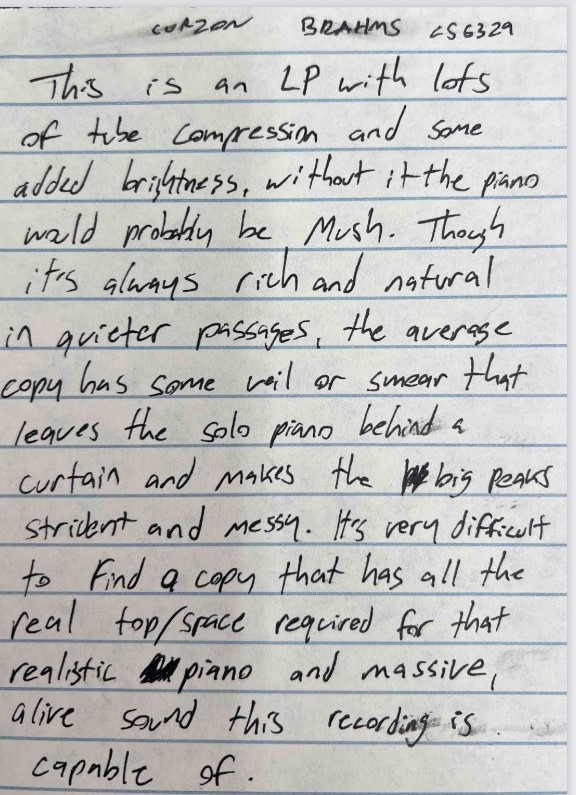
This is an LP with lots of tube compression, and some added brightness.

Without the added brightness, the piano would probably be mud.

The added brightness and compression results in a piano that always sounds rich and natural in the quieter passages.

The average copy also has some veiling or smearing that make the solo piano parts sound like they are coming fom behind a curtain. On these copies, the big peaks can often get strident and very messy.

It’s difficult to find a copy that has all the top end extension and space required to reproduce both a realistic piano and the massive live sound the orchestra is capable of.


All of which adds up to a difficult shootout in which relatively few copies had the sound we were looking for.

Production and Enginneering

(more…)

The Classic Pressing of Beethoven’s 4th Can Have Very Good Sound

More of the music of Ludwig van Beethoven
Somehow we managed to have a Classic Records pressing on hand to play in our most recent shootout for the Beethoven Symphony No. 4.

We knew all the way back in 1997 that Classic had done a good job with the record — we recommended it as one of the best Classic Records pressings in our catalogs at the time — but we sure didn’t expect it to do as well as it did, earning 2 pluses on one side and close to that on the other.

Years ago we wrote:

Here is the kind of sound that Classic Records could not ignore, even though the original was only ever made available as part of RCA’s budget reissue series, Victrola.

Don’t let its budget status fool you — this pressing puts to shame most of what came out on the full price Living Stereo label. (And handily beats any Classic Records reissue ever made.)

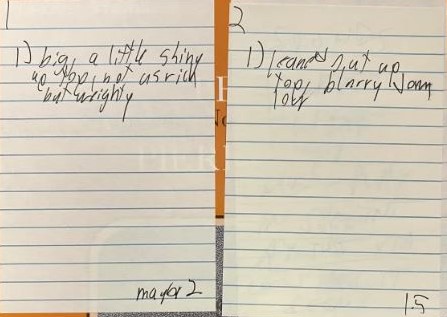
The top and bottom are wrong to varying degrees on both sides of the Classic, as you can see from our notes, which read:

(more…)