Mobile Fidelity

Labels with shortcomings – Mobile Fidelity

A Fun and Easy Test for Abbey Road: MoFi Versus Apple

More of the Music of The Beatles

There is a relatively simple test you can use to find out if you have a good Mobile Fidelity pressing of Abbey Road. Yes, as shocking as it may seem, they actually do exist, we’ve played them, but they are few and far between (and never as good as the best Brits).

The test involves doing a little shootout of the song Golden Slumbers between whatever MoFi pressing you have and whatever British Parlophone pressing you have. If you don’t have both LPs, this shootout will be difficult to do.

The idea is to compare aspects of the sound of both pressings head to head, which should shed light on which one of them is more natural and which is more hi-fi-ish sounding.

The Golden Slumbers Test

I’ve come to realize that this is a Key Track for side two, because what it shows you is whether the midrange of your pressing — or your system — is correct.

At the beginning Paul’s voice is naked, front and center, before the strings come in.

Most Mobile Fidelity pressings, as good as they may be in other areas, are not tonally correct in the middle of the midrange.

The middle of the voice is a little sucked out and the top of the voice is a little boosted.

It’s really hard to notice this fact unless one plays a good British pressing side by side with the MoFi.

Then the typical MoFi EQ anomaly become obvious. It may add some texture to the strings, but the song is not about the strings.

Having heard a number of audiophile systems (especially recently) that have trouble getting this part of the spectrum right, it would not be surprising that many of you do not find the typical MoFi objectionable, and may even prefer it to the good British copies. The point I’m belaboring here is that when it’s right, it’s RIGHT and everything else becomes more obviously wrong, even if only slightly wrong.

The Heart of the Midrange

For a while in my record reviewing system many years ago I had a relatively cheap Grado moving magnet cartridge. The midrange of that cartridge is still some of the best midrange reproduction I have ever heard. It was completely free of any “audiophile” sound. It was real in a way that took me by surprise. I played Abbey Road with that cartridge in the system and heard The Beatles sound EXACTLY the way I wanted them to sound.

(more…)

Why Is It So Hard for Mobile Fidelity to Get the Midrange Right?

Hot Stamper Pressings of the Music of Joni Mitchell Available Now

We recently auditioned the Mobile Fidelity One-Step pressing of Blue and made the notes regarding the sound you see below.

We focussed on the quality of their pressing’s vocal reproduction, for the simple reason that a Joni Mitchell album that gets the vocals wrong is a Joni Mitchell album that no music lover and certainly no audiophile  would ever want to play.

The fact that some audiophiles do want to play this record speaks poorly of their ability to reproduce it properly. Accurate playback will reveal the problems with Joni’s voice described in detail below. The post-it for side one is on the left, for side two on the right.

We try to be very specific about the shortcomings of these records, which is why we reproduce our notes whenever they are available.

Side One

  • Tonally not far off, a bit too stringy and flat. Not awful. Congested vocals at peaks, harsh. 1+

Side Two

  • Vocal peaks like “traveling, traveling, traveling…” or “California” get squashed and harsh, lacking the real dynamics, presence and space of the vocals. No grade. (Awful in other words.)

(more…)

Music from Big Pink on MoFi – Bad Bass Like This Is Just Annoying

Hot Stamper Pressings of Music by The Band Available Now

In 2012 the “new” MoFi put out another remastered Big Pink. Since their track record at this point is, to be honest, abysmal, we have not felt the need to audition it.

It’s very possible, even likely, that they restored some of the bass that’s missing from so many of the originals.

But bad half-speed mastered bass — poorly defined, never very deep and never punchy — is that the kind of bass that would even be desirable?

To us, it is very much a problem. Bad bass is just plain annoying.
Fortunately for all, it is a problem we have to deal with much less often now that we’ve all but stopped playing Half-Speed mastered records.

Here are some other records with exceptionally sloppy bass. If the bass on these records does not sound sloppy, you have your work cut out for you.

Some of our favorite records for testing bass definition can be found here.

Sucked Out Mids

The Doors first album was yet another obvious example of MoFi’s predilection for sucked-out mids. Scooping out the middle of the midrange has the effect of creating an artificial sense of depth where none belongs.

Play any original Bruce Botnick-engineered album by Love or The Doors and you will notice immediately that the vocals are front and center. 

(more…)

There’s Something Not Quite Right about MoFi’s Blue

Robert Brook has a blog which he calls

A GUIDE FOR THE DEDICATED ANALOG AUDIOPHILE

Below is a link to a review Robert Brook wrote recently for the MoFi One-Step pressing of one of our favorite albums of all time, Joni Mitchell’s Blue, originally released in 1971.

BLUE: What’s the RIGHT SOUND For Joni Mitchell’s CLASSIC?

Blue Sounds Funny Now

Based on everything I am reading these days from Robert Brook, he has a good stereo, two working ears, and knows plenty about records and what they are supposed to sound like.

This was not always the case as he himself would tell you. His stereo used to be much better at hiding the faults of a record like the MoFi One-Step of Blue than the stereo he has now. He got rid of most of his audiophile electronics, got a better phono stage, cartridge and arm, improved the quality of his electricity, found some sophisticated vibration controlling platforms for his vintage gear and did lots of other things to make his playback more accurate and — we cannot stress this too strongly — more fun, more exciting and more involving.

When your stereo is doing a better job of reproducing what’s in the grooves of your records, the first thing you notice when playing a Mobile Fidelity or other Heavy Vinyl pressing is that the sound is funny and wrong. (Please excuse the technical jargon; those of you who have been audiophiles as long as we have will understand what I mean, the rest of you can just play along. All of this will make sense eventually.)

When you use colored-sounding audiophile equipment — but I repeat myself — then your colored-sounding audiophile records don’t sound nearly as colored as they would under other conditions.

For example, other conditions obtain if you have — again, sorry about the jargon — revealing, accurate, tonally correct, natural-sounding equipment, free from the colorations — euphonic and otherwise — that allow one piece of audiophile equipment to sound so different from another.

(more…)

John Klemmer – Touch

  • With solid Double Plus (A++) grades on both sides, this copy of the best MoFi title to ever hit the site will be very hard to beat – exceptionally quiet vinyl too
  • Musically and sonically this is the pinnacle of Klemmer’s smooth jazz – we know of none better
  • The best sounding Smooth – But Real – Jazz Album ever made, and the only vintage MoFi we know of that deserves a place in your collection
  • “This is music straight from the heart, smooth but with a few twists and turns to make it interesting. But there are no cliche blues licks, none of the crap that players in this genre try to foist upon as ‘hip.’ Indeed, Klemmer has more in common with the late 60’s mantra playing of Coltrane or Sanders than those other guys (whose names will not be mentioned.)”
  • We’ve recently compiled a list of records we think every audiophile should get to know better, along the lines of “the 1001 records you need to hear before you die,” but with the accent on the joy amazing audiophile-quality recordings like this one can bring to your life.
  • Touch is a good example of a record many audiophiles may not know well but might benefit from getting to know better
  • If you’re looking for the best sounding jazz from the 70s and 80s, you might want to check out these titles

Touch is probably the best sounding record Mobile Fidelity ever made, and the only record of theirs I know of that can’t be beaten by a standard real-time mastered pressing.

We’re talking Demo Disc quality sound here. The spaciousness of the studio and the three-dimensional placement of the myriad percussion instruments and bells within its walls make this something of an audiophile spectacular of a different kind — dreamy and intensely emotional.

Shocking as it may be, Mobile Fidelity, maker of some of the worst sounding records in the history of audio, is truly the king on this title.

Klemmer says pure emotion is what inspired the album’s creation. Whatever he tapped into to find the source of that inspiration, he really hit paydirt with Touch. It’s the heaviest smooth jazz ever recorded. Musically and sonically, this is the pinnacle of Klemmer’s smooth jazz body of work. I know of none better. (If you want to hear him play more straight-ahead jazz, try Straight from the Heart on Nautilus Direct to Disc.) (more…)

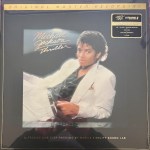
Thriller Is Proof that Mobile Fidelity Is Cutting Some Real Crap These Days

Hot Stamper Pressings of the Music of Michael Jackson Available Now
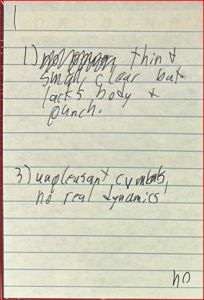
Don’t blame the digital step for the bad sound of this pressing of Thriller. If it were all analog, you can be sure Mobile Fidelity would have screwed it up every bit as badly.

If this is the sound audiophiles are interested in, lord have mercy on their souls. They must be as lost as lost can be.

Side One:

Track One: thin and small, clear but badly lacks body and punch.

Track Two: unpleasant cymbals, no real dynamics.

Side Two:

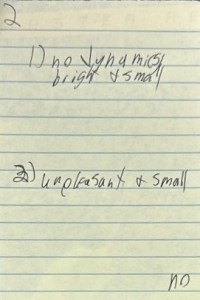
Track One: no dynamics, bright and small.

Track Three: unpleasant and small.

Two Questions

Is this the worst version of the album ever made?

Hard to imagine it would have much competition.

Are any of these Mofi One-Step pressings any good?

I seriously doubt it. Until one comes along that doesn’t sound awful, the jury is out. Those of you looking for miracles are likely to be disappointed.

Having said that, I’m sure there are audiophiles and audiophile reviewers who like the sound of this pressing and have said so online.

Based on what we heard, how on earth are these people qualified to judge the sound of records? I guess that’s three questions.

How bad does a record have to sound before they notice? Make that four, sorry.

Bernie Was The Man

Bernie Grundman cut the original pressings of Thriller. About the nicest thing we can say about him these days is that his work at one time was excellent.

Our evidence? When you hear a killer copy of Thriller — a recording with a lot going on and one that no doubt was difficult to master — the fact that nobody else has even come close to cutting the album as well as he did all those years ago stands as proof that he will always be considered one of the greats. (If he would only stop taking Chad’s calls, the record world would be in a much better place.)

Speaking of Chad (a man who thinks he is “saving the world from bad sound“), we have now auditioned the new Aja UHQR. You can read all about it here.

(more…)

Super Session – A Jack Hunt Mastered MoFi Winner

Hot Stamper Pressings of Music Produced or Performed by Al Kooper Available Now

Sonic Grade: B

Super Session is one of the best-sounding MoFi pressings. The midrange sounds wonderful — silky sweet and transparent. Not having been cut by Stan Ricker, the top end doesn’t have that SR/2 boost. Overall it’s a very nice sounding record, and the music just can’t be beat. 

In fact, it was actually mastered by Jack Hunt, a man we know to be responsible for some of the thickest, dullest, deadest MoFi recuts found in their shameful catalog.

But he did a pretty good job on this one, and for that he deserves some credit.

(more…)

Some Questions Just Don’t Have Good Answers

Yes, that is indeed a real puzzler all right!

I do not remember what audiophile forum I was on when I found this post. It could have been any of them.


Further Reading

To learn more about records that sound dramatically better than any Half-Speed mastered title ever made (with one exception, John Klemmer’s Touch), please go here.

People sometimes ask us how come we don’t like Half-Speed mastered records?

Below you will find our breakdown of the best and worst Half-Speed mastered records we have auditioned over the years.

(more…)

Our Filmed Tapestry Shootout Was a Real Shocker

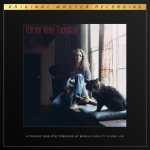
The Washington Post article that Geoff Edgers wrote includes a video of a little shootout we did for Tapestry, using, without my knowledge, the MoFi One-Step, a Hot Stamper pressing, and a current, modern, standard reissue of the album. Could I spot the Hot Stamper without knowing what record was playing?

First up (and of course unbeknownst to me), the MoFi. My impressions from the video:

That’s probably tonally correct for this record. It’s just missing everything that’s good about this record, which is a meaty, rich piano. And the vocal sounds very dry. There’s no Tubey Magic. It’s tonally correct. If you were playing me a CD right now, I wouldn’t be able to tell you weren’t. 

Next up, the cheap ($20?), current reissue:

Piano’s better.

Voice is better!

Richer and smoother.

That’s what this is supposed to sound like.

Her voice sounds mostly correct.

This might not be a particularly good record. If I played a real one for you, you might just say, oh, my God, there’s so much more.

But this is not a wrong record. It’s not awful. It’s doing something… I don’t know if I would say most things right. I’ll just say something right.

At least the person understands what she’s supposed to sound like.

Then the Hot Stamper (a Super Hot copy as it turns out):

She sounds pretty right on this copy.

I think there’s more space.

You hear more space, more three-dimensional space.

The piano: there’s more richness to the tone of the various notes that she’s playing.

I would probably pick this one.

Geoff sums it all up as follows:

So we have a winner, and I couldn’t fool the Hot Stamper king.

Without knowing what he was listening to, he chose the hot stamper of Tapestry.

If he still had it, that copy would be sold for about $400 on the Better Records website.


(more…)

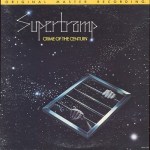
Dreamer Tells You What You Need to Know About this MoFi

Hot Stamper Pressings of the Music of Supertramp Available Now

This commentary was written about 2000, when the Speakers Corner pressing had just come out. We liked it back then, but I doubt we would care much for it now.

Listen to the vocals at the end of Dreamer.

If they are too bright, the bells at the end of the song sound super-extended and harmonically clear and clean.

But at what price? Now the vocals are too bright. Which is more important, good vocals or good bells?

There has to be balance. This is something audiophiles — and audiophile labels, who should obviously know better — seem to have difficulty appreciating.

We used to get these MoFis in on a regular basis, and they usually sound as phony and wrong as can be. They’re the perfect example of a hyped-up audiophile record that appeals to people with lifeless stereos, the kind that need amped-up records to get them to come to life.

I’ve been telling people for years that the MoFi was junk, and that they should get rid of their copy and replace it with a tonally correct version, easily done since there is a very good sounding Speakers Corner 180g reissue currently in print which does not suffer from the ridiculously boosted top end and bloated bass that characterizes the typical MoFi COTC pressing.

Brighter and more detailed is rarely better. Most of the time it’s just brighter. Not many Half-Speed mastered audiophile records are dull. They’re bright because the audiophiles who bought them preferred that sound. I did too, a couple of decades ago [make that four decades ago].

Hopefully we’ve all learned our lesson by now, expensive and embarrassing as such lessons so often turn out to be.

If your system is dull, dull, deadly dull, the way many of our older systems tended to be, this record has the hyped-up sound to bring it to life in a hurry.

There are scores of commentaries on the site about the huge improvements in audio available to the discerning (and well-healed) audiophile. It’s the reason Hot Stampers can and do sound dramatically better than their Heavy Vinyl or audiophile counterparts: because your stereo is good enough to show you the difference.

(more…)