*Acquiring Better Records

The START HERE link right next to HOME above in the upper left is an even better place to learn about Hot Stamper pressings and how to find them.

The commentaries found below typically deal with specific cases and the lessons we took from them.

For the Best Kinks Sound, Stick with the Tri-Tone Mono Pressings

Hot Stamper Pressings of the Music of The Kinks Available Now

This Pink and Green Reprise original MONO pressing is lively, balanced and vibrant, with a healthy dose of the Tubey Magical richness The Kinks’ recordings need in order to sound the way we want them to, which is less irritatingly bright, thin and harsh.

“Tired of Waiting For You” is the big hit here, and like most Kinks albums from back in the day, they put the hit at the end of the side, so you had better make sure whatever copy you find has not been played much or it will be full of inner groove distortion.

Inner Groove Distortion caused by the non-anti-skate-equipped turntables of the day is a chronic problem with rock and pop records from this era. We check all our records for Inner Groove Damage (IGD) as a matter of course when condition checking the surface quality of the vinyl.

The Poster Boy for Inner Groove Distortion is the song “Thank You” on this album from 1969. That record got played a lot back in the day, on the only turntables that we had available to us at the time, crappy ones.

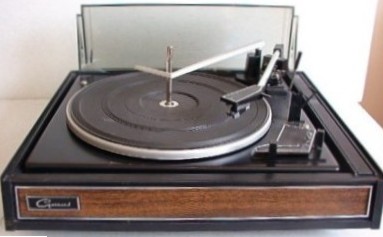
My first “audiophile” table was the extremely plasticky Garrard 40B. I think I bought mine in 1973  and I probably paid about $69 for it. As I recall, this was their entry level model. If any table had been cheaper I would have bought it, which shows you what my starving-college-student budget must have been. Sounded just fine to me, though. What did I know about sound in 1973?

By 1976 I would have some of the best audiophile electronics in the world and the massive speakers you see below. That’s some head-spinning progress if you ask me. Once I had heard how good all my favorite albums were sounding, I got very motivated. This is key: For real progress to occur, the music must do the driving.

(more…)

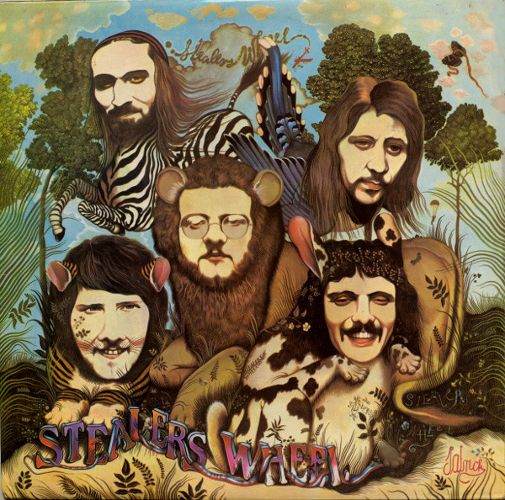
British A&M Vinyl Versus Domestic A&M Vinyl on Stealers Wheel’s Debut

Hot Stamper Pressings of the Music of Gerry Rafferty Available Now

Like so many British bands on the A&M label, when it came time to master the album for the domestic market, the people in charge (whoever they may have been) took the easy way out and simply ordered up a dub of the master tape to cut the album.

Spooky Tooth, Procol Harum, The Police (often but not always), Fairport Convention, my beloved Squeeze and too many others to think about all had their records ruined by sub-generation masters.

But our Hot Stamper pressings will always be British-pressed vinyl from the real master tapes, and that makes all the difference in the world.

Engineering

The legendary Geoff Emerick engineered (along with John Mills) at Apple Studio, which explains why the sound is so good on these import pressings. The album went on to receive the European Edison Award for recording excellence, whatever that is).

Our standard boilerplate for these kinds of records follows:

Tubey Magic Is Key

This original British pressing has the kind of Tubey Magical Midrange that modern records cannot even BEGIN to reproduce. Folks, that sound is gone and it sure isn’t showing signs of coming back. If you love hearing INTO a recording, actually being able to “see” the performers, and feeling as if you are sitting in the studio with the band, this is the record for you. It’s what vintage all analog recordings are known for — this sound.

If you exclusively play modern repressings of vintage recordings, I can say without fear of contradiction that you have never heard this kind of sound on vinyl. Old records have it — not often, and certainly not always — but maybe one out of a hundred new records do, and those are some pretty long odds.

(more…)

If You Own This Classic Records Pressing, I’ll Bet It’s Pristine

Hot Stamper Pressings of Classical Masterpieces Available Now

If I were in charge of the TAS Super Disc list, I would not have put this record on it.

Here are some others that we do not think qualify as Super Discs.

When Classic Records was blowing out its unsold inventory through the Tower Records Classical Annex in Hollywood many years ago — apparently they had run into some financial trouble — this was a title you could pick up for under ten bucks. I remember it being $7, but my memory may not be correct on that point. Whatever the price, it was cheap.

And even at that price it seemed nobody really wanted it.  Which is as it should be. Heavy Vinyl or no Heavy Vinyl, a bad record is a bad record and not worth the bother of sitting down and listening to it.

If you own this record, my guess is it is pristine.

If you played it at all, you played it once and put it away on a shelf where it probably sits to this very day. Good records get played and bad records don’t. If you have lots of pristine records on your shelves, ask yourself this question: Why don’t I want to play them?

You may not like the implications of the answer: They aren’t very good.

And that means you should never have bought them in the first place. But we all make mistakes.

Owning up to them may be hard, but it is the only way to make any real progress in this hobby.

The One Out of Ten Rule

If you have too many classical records taking up space and need to winnow them down to a more manageable size, pick a composer and play half a dozen of his works. You may be surprised at how lackluster the sound is on the majority of them.

Most classical records display an irredeemable mediocrity right from the start.

(more…)

What Are Some Good General Rules for Finding Records with the Highest Quality Sound?

More Entries from Tom’s Audiophile Notebook

The Riverside pressings we’ve auditioned of both The Thelonious Monk Orchestra – At Town Hall and Thelonious Monk Quartet Plus Two – At The Blackhawk were just awful sounding.

The OJC reissues of both albums from the 80s, although better, were not overflowing with the rich, natural, relaxed analog sound we were looking for either.

Ah, but a few years back (2015, maybe?) we happened to drop the needle on one of these Monk Milestone Two-Fers. Here was the sound we were looking for and had had so little luck finding up until then.

Which prompts the question that should be on the mind of every audiophile:

What are the rules for collecting records with the best sound quality?

The answer, of course, is that there are no such rules and there never will be.

There is only trial and error. Our full-time staff has been running trials — we call them shootouts  and needle drops — for more than twenty years now, with far more errors than successes. Such is the nature of records.

(more…)

Fire and Water on a Mythical Pink Island

Reviews and Commentaries for Island Pressings on the Pink Label

Free’s Third Album on the original British Island pink label — wow!

Found one at a local record store a while back. It was the first one I’d ever seen in nice enough condition to buy. Checking the dead wax was a bit of a shock though. Care to guess where it was mastered? Right here in the good old U S of A. In fact, at one of the worst mastering houses of all time: Bell Sound in New York. [This is not fair. We have found many good pressings mastered at Bell Sound.]

Now what does that tell you about British First Pressings? Are those the ones you’re looking for? Don’t get me wrong; I look for them too. But you had better look before you leap, or you’ll end up with a bad sounding, probably quite expensive pressing.

It’s one more reason why we try to play as many records as we can here at Better Records. You can’t rely on anything but the grooves.

Rules of Thumb

Which brings up another interesting issue. Some audiophiles use the following rule of thumb for rock record collecting.

If it’s an English band, get the import pressing. If it’s an American band, the tapes should be here in this country, so the original domestic pressing should be the best.

As a rule of thumb it’s not bad. It’s just wrong so often (Led Zeppelin, Cat Stevens, The Eagles, etc.) that you must be very careful how you apply it.

Same with reissue versus original. Nice rule of thumb but only if you have enough copies of the title to know that you’re not just assuming the original is better. You actually have the data — gathered from the other LPs you have played — to back it up.

(more…)

Deja Vu in (Awful Sounding) Mono Sells for $1200 and People Complain About Our Prices?

More on the Subject of Hot Stamper Pricing

A mono copy of Deja Vu (which no doubt sounds terrible; I had one once) went for $1200 on ebay a few years back!

Oh, but it’s an auction, so I guess that makes it all right. The seller didn’t set the price, the market did.

But the market sets our prices too.

We can’t sell a record for more than what our customers are willing to pay. What exactly is the difference?

Man, I sure would love to get $4k+ for one of our killer Hot Stamper pressings of Deja Vu. I guarantee our copy sounds a whole lot better than the one that sold on ebay.

And the music is the same, right? There is no mono mix, so anyone with a mono switch can hear the record in mono if they wanted to. But why do that? The stereo sound is phenomenal on the best copies!

So what did you get for your additional three thousand dollars?

A nice record to put on the shelf.

Which you could get from us for three thousand dollars less.

(more…)

Which One’s Pink? And What Do All Those Numbers Mean?

This commentary for Dark Side of the Moon was written at the dawn of the Hot Stamper revolution, circa 2006 I believe.

We were asked why we did not give out the stamper information for the pressings we were offering and we felt an explanation was in order.


UPDATE 2024

We’re so fascinated by the unpredictable nature of the stamper information we discover in our Hot Stamper shootouts that we thought it would be a good idea to create a section on the blog just to draw more of our readers’ attention to it. You can find it under the heading of record mysteries. Please to enjoy.


Our Letter from 2006

An erstwhile customer wrote to us a while back asking a question about Dark Side of the Moon: “What is the FULL stamper matrix for this record… all the way around the dead wax?”

I replied that we never give out stamper numbers for the records we sell. The only way to find out the stampers for our records is to buy them.

He then countered with this:

Well, ok. I don’t understand the logic, but it’s your show.

Floyd stampers are probably the most uniquely well documented stampers on [a site that no longer exists] that they’re pretty much common knowledge. If I understand your logic, a first pressing may not be a “Hot Stamper” while a 3rd, 4th or 5th might be. Just a function of the stars aligning when that record is pressed. So what’s the diff?

I would think this would be pretty obvious. If we say pressing X is the best, this is information that you cannot get anywhere else, certainly not on the site you linked to. The day that such a site tells you which stampers sound the best is the day that such a site will have any value to those who are not collecting for the sake of collecting, but are actually searching for the  pressings with the best sound to play. 

The information on that site has absolutely no value to me, or to any of my Hot Stamper customers, nor should it. [It no longer exists by the way. Why would it?]

If you told me what the stampers were and it was a first pressing and /or issue, it would enhance the marketability of that particular record and I would be more inclined to buy it…not that I would sell it, but just knowing it was a first press would have more value to me.

Why would you want a first pressing if it didn’t sound as good? Or, if a later pressing sounded better, why would that make any difference in your desire to buy it? Isn’t the idea to get good sound?

If you buy records principally to collect original pressings, you will end up with some awful sounding records, that I can tell you without fear of contradiction.

On the other hand, if you want the best sounding pressings, we are the only record sellers on the planet who can consistently find them for you. This is precisely the service we offer, unique in the world as far as we know. 

Anyone can sell originals.

Only we can sell the best sound because we are unconcerned with which pressing has it. May the best man win!

(more…)

Blue on Heavy Vinyl – We Broke Through in 2007

Hot Stamper Pressing of the Music of Joni Mitchell Available Now

Thoughts on the so-called definitive vinyl version

Yet another milestone event in the history of Better Records.

In 2007 a customer took issue with our decision to reject the sale of the newly remastered Heavy Vinyl pressing of Blue, the one put out by Rhino and mastered by Steve Hoffman and Kevin Gray.

We actually used to give the record away for free with every purchase of a Hot Stamper Blue, making it easy for our customers to hear for themselves just how superior sounding our Hot Stamper pressings were.


UPDATE 2024

With every purchase of a Hot Stamper Led Zeppelin II, we give our customers the Page-remastered version for free so that they can hear for themselves why our pressing costs well over $1000 and Jimmy’s a small fraction of that figure, sometimes as small as one hundredth!


We did this partly out of necessity. I had foolishly taken the advice of a Mr. Robert Pincus (the discoverer of Hot Stampers let us never forget) that the new version was indeed all it was cracked up to be and proceeded to put in an advance order for twenty copies to sell to our audiophile customers.

We were still selling Heavy Vinyl in 2007, but it would not be long before we decided to end the practice. Within a few years we were only selling records that we had cleaned and played and could guarantee both their superior sound quality and audiophile-quality playing surfaces.

So we had about twenty copies of Blue we did not think qualified as “better records” and decided to just give them away.

After spending quite a number of hours evaluating the new version, I got fairly worked up over the disappointing sound, worked up enough to write a very long commentary about the album, which I entitled Blue, The Game.

Rather than detailing the shortcomings of the new pressing, in this particular commentary, the first of its kind, I decided to take a different tack.

I implored the reader to do his own shootout for the album and tell me what he heard on the various pressings he might have at hand to work with. (Nothing much came of it of course, and not too surprisingly. Shootouts are hard and the vast majority of audiophiles are averse to them in our experience, hence the sorry state of audiophile records and the systems that fail to reveal their shortcomings — but that’s a horse that gets flogged regularly enough on this site. Enough is enough.)

Tom, 

I find it curious you are not carrying the new Joni Mitchell Blue vinyl issue. Even to the point of saying you can do better… for 25 bucks? After clicking on the LP cover and reading the comments from over the years it makes me wonder what your agenda really is. I paid $250 for a wonderful WLP and this Rhino issue smokes it, even as good as it is. I even have a CD cut from this mastering session off the analog FLAT, not Dolby tapes and this vinyl even beats it…. of course just my opinion.

I have listened on $100,000 systems, all the way down to portable units, solid state and tube and there is no denying this is the definitive vinyl version….. and again for 25.00. What a bargain.

Maybe all you did was look at that Rhino sticker and think back to the Grateful Dead records they did a few years ago (horrible) and just assumed this wasn’t up to Better Records standards.

Thanks for reading. I enjoy your e mails and store….

Tom

Tom,

We don’t review records based on their labels or stickers. And of course we never assume anything about the sound of a record. We talk about this stuff all the time. Here’s a relevant quote:

My approach to reviewing records is pure skepticism: a record sounds good if it sounds good, regardless of how it was made, who made it, or why. I’ve heard lots of expensive so-called audiophile equipment do a pretty poor job of making music over the years, the owners of which had an armful of reasons for why the sound should be truly awe-inspiring. But it just wasn’t. Most fancy gold faceplates are nothing but lipstick on a pig in my opinion.

I once heard Blue poorly reproduced at a friend’s house, and this is probably the best explanation for this letter writer’s inability to understand our position on Blue.

And paying $250 for a White Label Demo that apparently doesn’t sound good is the height of audiophile collector foolishness.

That money should have gone for better equipment or room treatments or tweaks, something, anything, to make this guy’s stereo and room work better than they apparently do.

Actually this brings up a good point. If I had to choose one record that separates the men from the boys, the stereos that really work from the artificial, restricted audiophile systems you might read about in the magazines or hear in a showroom or at an audio show, Blue would be a darn good choice.

(more…)

Confessions of an Analog Vinyl Connoisseur

New to the Blog? Start Here

Writing for Dangerous Minds, Richard Metzger recounts his journey though the world of audiophile equipment and his lifelong search for better sounding pressings of his favorite albums.

The first paragraph had me hooked:

“Sorry, but this is not going to be one of those analog vs. digital rants that goofball audiophile types like to indulge in at the drop of a hat. In fact I probably should have just called it something like ‘Why you should never buy new vinyl versions of classic albums.’”

Seems pretty clear he knows what he is talking about.

Later on he adds this bit:

“Nothing trumps empirically comparing a stack of different pressings of the same album in a shootout. This is why you should take what Tom Port of Better Records has to say very seriously. Whether or not you’re willing to pay his Hot Stamper prices, Port probably knows more about records than anyone on Earth and his On The Record blog is one of the very best repositories of hard won empirical evidence relating to audiophile vinyl that’s out there. It might take weeks to read everything, but it’s quite an education.’

I couldn’t agree more. The whole story can be found here. I suspect that if you’ve spent any length of time on this blog, you will get a lot out of it.

On a side note, I think “snob” is not exactly the right word he (or I) should be called.

“Connoisseur” (a discerning judge of the best in any field) is a better fit.

“Snob” (a person who claims to be an expert or connoisseur in a given field and is condescending toward or disdainful of those who hold other opinions or have different tastes regarding this field) implies that I disdain those who listen to music I personally don’t happen to like. But music is a very personal thing, so what you like is your business and nobody else’s.

I strongly believe that the more you listen to music, the more joy you will have in your life.

I hope to add a few comments of my own down the road, especially in the form of rebuttals to uncharacteristically bad advice such as this:

Michael Fremer’s Analog Planet website is a great resource for finding out about new and upcoming quality vinyl releases. He is one of the most knowledgeable people in the world when it comes to vinyl and he’s also produced a handy YouTube guide to AAA mastered new vinyl releases that you should definitely watch.

(more…)

First Get Good Sound – Then You Can Recognize and Acquire Good Records

Please Consider Taking Some of Our Audio Advice

You know why this guy has a wall full of records?

Probably because he likes collecting records. It’s really not all that hard. You just go around buying lots and lots of records. Many of the more popular titles were produced in the millions. Records are quite plentiful when you stop to think about it.

To collect them, you also never have to figure out how to play them properly. In fact, you really don’t have to play them at all.

To be  a record collector these days, the two most valuable skills you can have are finding space to store them and learning the alphabet. Everything after that is gravy. Go on, take a picture!

That’s the Collector Game record lovers and record-loving audiophiles play in a nutshell. You start buying records and if you are obsessive enough and dedicated enough you end up buying enough records to fill a whole wall, ideally from floor to ceiling.

But don’t stop there. You can keep buying more records — again, no need to learn how to play them with even minimal  fidelity — and when you run out of room on the first wall, all you need then is another wall to fill.

That’s the Collector Game. That’s not the game we think audiophiles should be playing.

No. To get your stereo and room to sound right, and recognize when they do sound right, or at least better than before, is the name of the game we recommend audiophiles play. It’s also much, much harder. It can literally take a lifetime of effort depending on how important good sound is to you.

I’ve been at it for forty-five fifty years. I still work at it and try to learn new things every day.


UPDATE 2022

Or at least I did. I retired in 2022 and left the running of the business to my dedicated, hard working and exceptionally talented staff.


Until you get your stereo, room and ears working, collecting good sounding records is all but impossible.

You will very likely waste a fortune on “collectible audiophile records.”

The kind with collector value and not much else.

These are precisely the opposite of Hot Stamper pressings.  Practically all of the value of a Hot Stamper is tied up in its wonderful music and superior sound quality, which is where we think it should be.

(more…)