Rock and Pop LPs to Improve Your Playback

Rockin’ the Mandolin with Loggins and Messina

Hot Stamper Pressings of the Music of Loggins and Messina Available Now

A recent White Hot Stamper pressing of L&M’s fourth release demonstrated pretty convincingly just what an amazing Demo Disc this album can be.

When Jim Messina rips into his mandolin solo halfway through Be Free, your jaw is likely to hit the ground. On the best copies it positively leaps out of the left speaker.

I can’t recall another pop or rock recording that captures either the plucked energy or the harmonic nuances of the instrument better. To hear such a well-recorded mandolin on a copy of this quality is nothing less than a thrill.

This copy showed us:

  • A full-bodied piano
  • Rich, lively vocals, present between the speakers and brimming with enthusiasm
  • Harmonically-rich guitars, mandolins, dobros and the like, as well as a
  • Three-dimensional soundstage that revealed the space around them all

What to Listen For

What typically separates the killer copies from the merely good ones are three qualities that we often look for in the records we play: transparency, speed, and lack of smear.

(more…)

A Fun and Easy Test for Abbey Road: MoFi Versus Apple

More of the Music of The Beatles

There is a relatively simple test you can use to find out if you have a good Mobile Fidelity pressing of Abbey Road. Yes, as shocking as it may seem, they actually do exist, we’ve played them, but they are few and far between (and never as good as the best Brits).

The test involves doing a little shootout of the song Golden Slumbers between whatever MoFi pressing you have and whatever British Parlophone pressing you have. If you don’t have both LPs, this shootout will be difficult to do.

The idea is to compare aspects of the sound of both pressings head to head, which should shed light on which one of them is more natural and which is more hi-fi-ish sounding.

The Golden Slumbers Test

I’ve come to realize that this is a Key Track for side two, because what it shows you is whether the midrange of your pressing — or your system — is correct.

At the beginning Paul’s voice is naked, front and center, before the strings come in.

Most Mobile Fidelity pressings, as good as they may be in other areas, are not tonally correct in the middle of the midrange.

The middle of the voice is a little sucked out and the top of the voice is a little boosted.

It’s really hard to notice this fact unless one plays a good British pressing side by side with the MoFi.

Then the typical MoFi EQ anomaly become obvious. It may add some texture to the strings, but the song is not about the strings.

Having heard a number of audiophile systems (especially recently) that have trouble getting this part of the spectrum right, it would not be surprising that many of you do not find the typical MoFi objectionable, and may even prefer it to the good British copies. The point I’m belaboring here is that when it’s right, it’s RIGHT and everything else becomes more obviously wrong, even if only slightly wrong.

The Heart of the Midrange

For a while in my record reviewing system many years ago I had a relatively cheap Grado moving magnet cartridge. The midrange of that cartridge is still some of the best midrange reproduction I have ever heard. It was completely free of any “audiophile” sound. It was real in a way that took me by surprise. I played Abbey Road with that cartridge in the system and heard The Beatles sound EXACTLY the way I wanted them to sound.

(more…)

Listening for Harmonically Correct Acoustic Guitars on America’s Debut

Hot Stamper Pressings of the Music of America Available Now

The guitars on this record are a true test of stereo fidelity. As it says below, most of the pressings of this record do not get the guitars to sound right. They often sound veiled and dull, and on a copy with a bit too much top end they will have an unnatural hi-fi-ish sparkle.

This kind of sparkle can be heard on many records Mobile Fidelity made in the ’70s and ’80s. Tea for the Tillerman, Sundown, Year of the Cat, Finger Paintings, Byrd at the Gate, Quarter Moon in a 10 Cent Town — the list of MoFis with sparkling acoustic guitars would be very long indeed, and these are just the records with prominent acoustic guitars!

Three Roses and Rainy Day

The key song on side one that we use to test is Three Roses. There are three sonically-separated individuals each playing six string acoustic guitars, and when this side is cut right the guitars sound just gorgeous: sweet, with all their harmonic structures intact. (It’s also my favorite song on side one.)

The real test on side two is the song Rainy Day. Lots of guitars, and when the close-miked descending guitar figure comes in after the first few couplets, if it’s too bright, you’re going to know it. This song is the hardest one to cut and almost never sounds right. Some copies are cut JUST RIGHT. The vocals are breathy, the guitars are full-bodied, and the overall sound is airy, open, and spacious.

(more…)

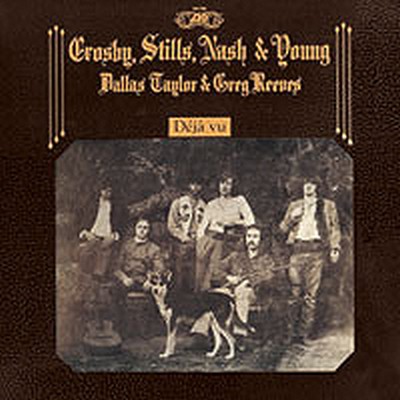
Listening in Depth to Deja Vu

Hot Stamper Pressings of the Music of Crosby, Stills, Nash and (Sometimes) Young

DEJA VU is an album we admit to being obsessed with — just look at the number of commentaries we’ve written about it. It’s yet another in the long list of rock and pop records that really come alive on big speakers at loud levels .

One obvious reason that our turn up your volume is such a good test is that the louder the problem, the harder it is to ignore.

Presenting another entry in our extensive listening in depth series with advice on what to listen for as you critically evaluate your copy of Deja Vu. Here are some albums on our site you can buy with similar track by track breakdowns.

Side One

Carry On

This song is a great test for the quality of the vocals. If you can get through the first part of the song with little to no strain in the voices, you’re on the right track.

The bass on this track always lacks a measure of definition, but you’ll know by track three if your bass is solid enough to set the foundation this music requires to really get going. Carry On has a huge number of overdubs, so it will never have very high resolution, but on a Hot Stamper copy like this one it can sound wonderful.

Teach Your Children 
Almost Cut My Hair

One of the key test tracks we use for side one, this is the only time Crosby, Stills, Nash & Young actually sounds like a rock and roll band. According to Stephen Barncard this was recorded live in the studio. It sure sounds like it. The amount of energy the band generates on this track exceeds all the energy of the first album put together.

The reason this track presents such a tough test is that it has to be mastered perfectly in order to make you want to turn it up as loud as your stereo will play. This song is not for sipping wine and smoking cigars. It positively cries out to be played at serious volume levels on monstrously large speakers. Nothing else will do justice to the power of the band’s one and only live performance.

(more…)

Carlos Santana Knows: Louder Is Better

santasanta_1401s

Hot Stamper Pressings of the Music of Santana Available Now

UPDATE 2026

The commentary below refers to an experience I had playing the album on my Legacy Whisper speakers in the late-90s. I moved into a house in the early 2000s and it took me until about 2005 to get the sound back to the level I had achieved in the 90s. Fortunately for me, my employees and all our Hot Stamper fans, by the mid-2000s we were really cookin’, with dramatic improvements to the sound occurring at a furious clip.


This album needs to be played loud. I mean really loud. Years ago I used to demonstrate how important it was to have the level up good and high on the song Waiting.

Back in the mid-90s, I had somehow lucked into my first shockingly good Hot Stamper copy.

As a demonstration of what the Legacy Whisper system and its 8 fifteen inch woofer/midrange drivers could do, I would play the first minute or so of the track at a pretty good level. There’s lots of ambience, there’s a couple of guys who shout things out from way back in the studio, there’s a substantial amount of deep bass, and the whole recording has a natural smooth quality to it, which is precisely what allows you to play it at loud volumes.

Then I would turn it up a notch, say about 2-3 DB. I would announce to my friends that this is probably louder than you will ever play this record, but listen to what happens when you do. The soundstage gets wider and deeper, all those guys that shout can be heard more clearly, you start to really feel that deep bass, and when the song gets going, it really gets going. The energy of the music would jump to another level.

Then I would turn it up another 3 DB or so. At this point I would say that “this is how loud it should be played.” All the effects I mentioned earlier would become even more pronounced — wider, deeper, more clear, more powerful. The record was actually starting to sound like live music in my living room.

But of course, I was showing off a system that few could afford and that nobody in his right mind would put out in the middle of his living room. You would need a custom sound room, and a big one at that, to fit such a massive speaker and be able to turn it up.

(more…)

In the Market for New Speakers? – Will They Handle the Size and Energy of Take It Easy?

Hot Stamper Pressings of the Music of The Eagles Available Now

Take one of our killer Hot Stamper pressings with you when you go shopping for speakers. The speaker that gets the POWER and ENERGY of this music right is the one you want.

This record will separate the men from the boys thirty seconds into Take It Easy.

It will be glaringly obvious who’s got the piston power and who doesn’t.  

With big bass and huge scope, this may become your favorite disc for showing your friends just what analog is really capable of. No CD ever sounded like one of our killer Hot Stamper pressings.

When the big chorus comes in on Take It Easy — one of the toughest tests for side one — you will be amazed by how energetic and downright GLORIOUS these boys can sound. Believe us when we tell you, it’s the rare copy that can pass that test.

Choruses Are Key

The richness, sweetness and freedom from artificiality is most apparent on Breakfast in America where you most always hear it on a pop record: in the biggest, loudest, densest, climactic choruses.

We set the playback volume so that the loudest parts of the record are as huge and powerful as they can possibly grow to be without crossing the line into distortion or congestion.

(more…)

Listening in Depth to John Barleycorn Must Die

The toughest test on side two is the first track, Stranger to Himself.

Getting the voices right is practically impossible. If the voices are full, smooth, yet breathy and clear, you have that rare copy that actually gets the midrange right. Not many do.

Side One

Glad

The last portion of this track has some really interesting percussion and organ effects. Traffic were trying to break out of the standard pop song format by letting this song wander into psychedelic territory for a few minutes at the end. It’s now become my favorite part of the song.

The reason you want to pay close attention to this part is because it helps you to judge the transparency, immediacy, and top end extension for the whole side. It should be amazingly clear and open-sounding. On too many pressings, the percussion instruments are blurred and lost in the mix. On a Hot Stamper copy they’ll be right in front of you, allowing you to appreciate the interplay among the musicians as they contributed their various parts.

Freedom Rider

You’ll need lots of top end extension for this song to sound right. On many copies the double tracked flute solo in the middle of the song will be aggressive and irritating, but on a Hot Stamper pressing, the flutes will sound airy and breathy with a reasonably good sustain.

Empty Pages

The quality of the voice is what really sets the best copies apart. Winwood is much more present on the better copies. He’s recessed on most and that’s just not where he needs to be for the song to work musically. He needs to be right up front, surrounded by the air and ambience of the studio. The transparency found on the better copies will give you precisely that.

Side Two

Stranger to Himself

John Barleycorn

The acoustic guitars that open up this song are absolute perfection on the best copies — this is the sound of Tubey Magical analog at its best.

This is the real test for side two.

The acoustic guitars should sound rich and sweet. You’ll notice at the beginning of the song that they are a little dull. The last thing in the world you want to do, however, is to brighten them up, because when you do that, as some mastering engineers have in the past, the harmony vocals and the percussion and the tambourine become much too bright later on in the song.

You have to strike a balance between all the elements. That means Steve’s voice at the beginning needs to be a little reserved so that the harmony vocals later on will come in right.

(more…)

Led Zeppelin IV – The First Two Tracks on Side One Are Key

Hot Stamper Pressings of the Music of Led Zeppelin Available Now

We always have a great time doing Zep IV shootouts. It’s one of those all-too-rare cases where amazing music and amazing sonics potentially coexist on the same slab of vinyl. You just need to find the right slab and be able to clean it right, a proposition that turns out to be much harder than it might sound.

You probably know by now just how tough it is to find audiophile quality sonics on this album. Far too many copies just leave us cold. However, the best pressings, whether British or domestic, are so good, and so much fun at the loud volumes we play them at, that in the end it turns out to be worth all the time, trouble and expense it has taken to find them.

On these two tracks, the best pressings of Led Zeppelin IV were capable of producing some of the biggest, boldest sound we have ever heard.

It’s clearly a Demo Disc for big speakers that play at loud levels. The louder you play it, the better it sounds.

Warning: do not attempt to play this album on any system that looks like this one.

The two tracks we discuss below are the ones that can truly test the energy and musical drive of whatever pressing you are playing. If you are fortunate to be able to have one of our better Hot Stamper copies on your table, the energy and musical drive of Black Dog and Rock and Roll might just take your breath away.

Side One

Black Dog

The key to both of the first two tracks is to find a copy with a solid bottom end. Next look for an extended top end, easily heard on all the splashing cymbals.

Now listen for a tonally correct Robert Plant.

(more…)

Sergio Mendes + Psych + Your Mind Will Be Blown

mendestill_depth_1102533608More of the Music of Sergio Mendes and Brasil ’66

This commentary was written sometime around 2010.

If you are looking for DEMO DISC QUALITY SOUND with music every bit as wonderful, look no further — this is the record for you.

If I had one song to play to show what my stereo can really do, For What It’s Worth on a Hot Stamper copy would probably be my choice. I can’t think of any material that sounds better. It’s amazingly spacious and open, yet punchy and full-bodied the way only vintage analog recordings ever are.

This one being from 1970 fits the bill nicely.

Side two of this album can be one of THE MOST MAGICAL sides of ANY record — when you’ve got a killer copy. I don’t know of any other record like it. It seems to be in a class of its own. It’s an excellent test disc as well. All tweaks and equipment changes and room treatments must pass the Stillness test.

(more…)

Ambrosia Is Right at the Top of Our Difficulty of Reproduction Scale

Hot Stamper Pressings of the Music of Ambrosia Available Now

You can play hard-to-reproduce records all day long if your system is tuned up and working fine.

Ours has to be, all day, every day. Our shootouts require that everything is working properly or we wouldn’t be able to trust the results.

But you can’t play this record on such a system without testing everything, because this is the Single Most Difficult to Reproduce Recording I know of.

This is what makes it such a great test disc; to call it a challenge doesn’t begin to convey the difficulty of playing a record that places such heavy demands on a system.

Which means I had to retweak a lot of my table setup to make sure it was 100% right, by ear. Getting the VTA right on this record was fundamentally critical to hearing it sound its best.

(None of those silly setup tools for us here at Better Records. You can hear when it’s right and if you can’t then you need to keep at it until you can.)

Detail Freaks Beware

This is the kind of record that will eat the detail freaks alive. If your system has any extra presence, or boost in the top end — the kind that some audiophiles mistake for “detail” — this record with beat you over the head with it until blood runs out of your ears.

You need balance to get the most out of this album.

The more your system is out of whack, the more this album will make those shortcomings evident.

(more…)