shrill-strings

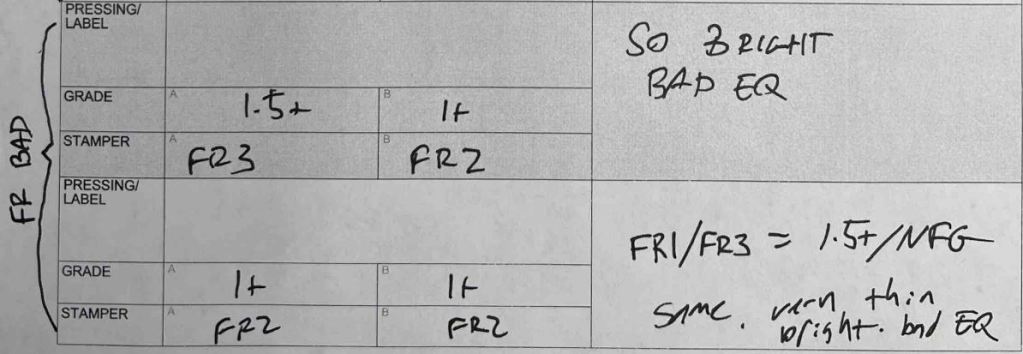
These pressings suffer from shrill string tone.

Strings that are screechy or shrill are the kiss of death on classical and orchestral recordings. Any recordings, come to think of it.

Not as Good a TAS List Title as We Thought, Sorry!

Hot Stamper Pressings of Living Stereo Titles Available Now

We had a handful of copies of this famous TAS List title in the backroom, so we decided it was high time to get a shootout going. We pulled all the pressings of the music (both Billy the Kid and Rodeo) we had on hand on every label and proceeded to needle-drop them in preparation for a big Copland shootout.

Much to our chagrin, most of the copies of LSC 2195 we played were unacceptable. The sound, for the most part, was very much not to our liking. Our notes read:

  • Smeary — (more records with smeary sound can be found here),
  • Dry — (more records with dry sound can be found here),
  • Bright — (more records with bright sound can be found here),
  • Flat — (more records with flat sound can be found here),
  • Hi-Fi-ish — (more records with hi-fi-ish sound can be found here),

Those records weren’t cheap. That was a lot of money down the drain. Not only can’t we sell records that sound as bad as this Living Stereo — our customers simply would not buy them — but we would never even try. Unlike other record dealers, we actually know what our records sound like. We don’t care about the reputations of the records we sell. We only care about their sound.

Some of the records on the TAS List seem better suited to the old school audio systems of the 60s, 70s and 80s than the modern systems of today.

(more…)

Pros, Cons and Celebrating a Milestone of Audio Progress

More of the music of Jules Massenet

About ten years ago we reviewed a copy of the album that had a sub-optimal side two, a side two that suffered from screechy string tone.

Since that time we’ve made a number of improvements to our cleaning regimen and playback system, and the result has been that our last couple of shootouts went off without a hitch, showing us string tone that was virtually free of screechiness.

(The Greensleeves reissues never had much of a screechy strings problem as they tended to be mastered on the smooth side. They are more forgiving of second-rate playback in that respect, but they can also never win shootouts with that overly smooth sound.) [1]

Problem solved! The records were fine, we just couldn’t play them back then as well as we can now.

In 2012, twelve years ago, I had been selling records to audiophiles professionally for 25 years. I had owned a State of the Art system for 37 years.

But I knew I still had plenty to learn, and I kept at it.

After a decade’s worth of tweaking and tuning, the strings of this recording started to sound the way Stuart Eltham and his fellow engineers undoubtedly wanted them to.

This is how you chart your audio progress, by challenging yourself with difficult to reproduce recordings and building on the improvements you continue to make as the years and decades go by.

If you’re in the market for records that can show you that there is still plenty of work left to be done in this crazy audio hobby we’ve all chosen, we have scores of them on the Better Records site.

If we can get them to sound better, so can you.

(more…)

Offenbach & Strauss – A Waste of Money on the Mercury Original

More of the Music of Jacques Offenbach (1819-1880)

This lovely Mercury boasts one of the greatest performances of the piece ever recorded. 

Dorati is surely The Man when it comes to energy, drive and dynamic excitement with this venerable warhorse. He and his Minneapolis Symphony play the hell out of this boisterous music, and luckily for us audiophiles, the Mercury engineers give us Demonstration Quality Sound to go with it.

But not on the original pressing.

The original Mercury release of this record (90016) is a shrill piece of trash, as is the Mercury Wing pressing. So many of the early Mercurys were poorly mastered it seems.

We used to really like the Golden Import reissue, but that was years ago. Not sure how we would feel about it now.

Our current favorite performance of The Gay Parisian is this one on, gulp, Readers Digest.

(more…)

On LSC 2222, How Does the Classic Records Heavy Vinyl Compare?

Hot Stamper Pressings of the Music of Claude Debussy Available Now

In 2005 we played an excellent original pressing of Debussy’s Iberia (LSC 2222) and compared it to the Classic Records reissue. We wrote:


This is a wonderful sounding Shaded Dog pressing. Side two is especially dynamic.

This has long been considered one of the Living Stereo triumphs. The spaciousness and tonal correctness are legendary.  However, this copy does not have the prodigious bass of some that I’ve heard.

The Classic reissue has plenty of deep bass, but it’s shrill and hard and altogether unpleasant, so the better bass comes at a steep price.

For better sounding recordings of Iberia, we know of two and they can be found by clicking here.

(more…)

The First Classic Record We Ever Played – Thus Spake Zarathustra

Hot Stamper Pressings of Living Stereo Titles Available Now

Way back in 1994, long before we had anything like the system we do now, we were finding fault with the “Classic Records Sound.”

With each passing year — 28 and counting — we like that sound less.  Some Classic Records pressings may be on Harry’s TAS list — disgraceful but true — but that certainly has no bearing on whether or not they are very good records. 

I had a chance to play LSC 1806 (pictured above) not long ago and I was dumbfounded at how bright, shrill and aggressive it was.

I still remember playing my first Classic Records title, their first release, which would probably have been in 1994. The deep bass of the organ at the start of Also Sprach Zarathustra, the horns and the tympani blasting out from a dead silent background, put a lump in my throat. Had they actually managed to remaster these old recordings so well that the vintage pressings I was selling for such high prices would soon be worthless? I really do remember having that thought race through my mind.

But then the strings came in, shrieking and as bright as the worst Angel or DG pressing I’d ever heard. It was as if somebody had turned the treble control up on my preamp two or three clicks, into ear-bleeding territory. All my equipment at the time was vintage and tube, and even though my system erred on the dark side tonally, the first Classic release was clearly off the charts too bright and transistory, with none of the lovely texture and sheen that RCA was famous for in the early days of Living Stereo.

I knew right then that my vintage record business was safe.

Here is our review from the ’90s, written shortly after the release of Classic’s first three titles. (With minor additions and changes for clarity and context.)

Hall of Shame Pressings, Every One

I’m reminded of the nonsense I read in TAS and elsewhere in the mid-’90s regarding the reputed superiority of the Classic Records Living Stereo reissues. After playing their first three titles: 1806, 1817 and 2222 (if memory serves), I could find no resemblance between the reviews I read and the actual sound of the records I played. The sound was, in a word, awful.

To this day I consider them to be the single worst reissue series in history.


UPDATE 2025

Analogue Productions now holds that crown, surely. Still going strong, producing one crap pressing for the mid-fi collector market after another, there is simply no recording they won’t see fit to ruin.


When Harry Pearson (of all people! — this is the guy who started the Living Stereo craze by putting these forgotten old records on the TAS list in the first place) gave a rave review to LSC 1806, I had to stand up (in print anyway) and say that the emperor clearly had removed all his clothes, if he ever had any to begin with.

This got me kicked out of TAS by the way, as Harry does not take criticism well. I make a lot of enemies in this business with my commentary and reviews, but I see no way to avoid the fallout for calling a spade a spade.

Is anybody insane enough to stand up for LSC 1806 today? Considering that there is a die-hard contingent of people who still think Mobile Fidelity is the greatest label of all time, there may well be “audiophiles” with crude audio equipment or poorly developed critical listening skills, or both (probably both, as the two go hand in hand), that still find the sound of the shrill, screechy strings of the Classic pressing somehow pleasing to the ear. Hey, anything is possible.

As I’ve said again and again, the better a stereo gets, the more obvious the differences between good vintage pressings and most current reissues become. Modest front ends and mediocre playback systems can disguise these differences and mislead the amateur audiophile.

And the “professional” too. We’ve all had the experience of going back to play a record from years ago that we remember as being amazing, only to find it amazingly bad.

The Japanese Led Zeppelin series from the 90s comes immediately to mind. How could my system have been so dull that those bright pressings actually fooled me into thinking they sounded good all those years ago? I’ve done a few Mea Culpas over the years, and that’s one of the bigger ones.

Remember when Chesky Records were all the rage? Does anybody in his right mind play that shit anymore?

A short anecdote: A good customer called me up one night many years ago. He had just finished playing the Chesky pressing of Spain, and had pulled out his Shaded Dog original to compare. The sound of his Shaded Dog pressing was so much better that he took his Chesky and, with great satisfaction, ceremoniously dropped it in the trash can, noting, “Of course I could have sold it or traded it away, but nobody should have to listen to sound like that.”

Another anecdote: when Chesky first got started in the remastering business, a friend picked up their pressing of LSC 2150, Prokofiev’s Lt. Kije with Reiner. He played it for me when I came over to hear his system, and he and I were both shocked that his ’70s Red Seal pressing was better in every way.

We wanted to know: What kind of audiophile label can’t even go head to head with a cheap reissue put out twenty years after the initial release just to keep the bins stocked and satisfy the needs of the low-budget classical record buyer?

The answer: Plenty of them, and definitely Chesky. Playing most Classic Records classical titles is a painful experience these days. I do not recommend it to anyone with good equipment. If you love the Living Stereo sound and cannot afford vintage pressings, consider playing the CDs RCA remastered. The one I know well is clearly better than Classic’s and AP’s LPs.

(more…)

This Blueback of Le Cid Was Just Awful

Hot Stamper Classical and Orchestral Imports on Decca & London

Don’t buy into that record collector/audiophile canard that the originals are always the best sounding pressings.

This original Blueback pressing — true, we only had the one, so take it for what it’s worth — was a complete disaster: shrill, with no top or bottom to speak of, the very definition of boxy sound.

Our current favorite for sound and performance is the one Fremaux conducted for EMI in 1971.

It had been on the TAS List for some time, but we confess we didn’t bother finding out how good it was until about five years ago when it became clear to us what a wonderful conductor Louis Fremaux could be.

Here are some other Hot Stamper pressings of TAS list titles that we like.

Back to London

The sound of the London original you see above was much too unpleasant to be played on high quality modern equipment. There are quite a number of others that we’ve run into over the years with similar shortcomings.

(more…)

Another Dubious Recording of Tchaikovsky’s Violin Concerto

Hot Stamper Pressings of the Music of Tchaikovsky Available Now

1S/1S Shaded Dog original pressing.

Ooh, let the drooling begin. 

Here is our admittedly very old review for exactly the one copy we had on hand to play, although, to be fair, we have played more than one copy of the album over the years, and it never sounded especially good to us on any of the copies we auditioned.

The violin is very immediate sounding on this recording, maybe too much so.

Either way, the sound of the orchestra is where this record falls short.

It’s congested, thin and shrill in places. The right copy of Heifetz’s performance on LSC 1992 is a much better record overall. Some may prefer Szeryng’s way with this famous piece, which, as a matter of taste, is fine by us.

If you’re listening for just the performance and the sound of the violin, you may find this record to be more acceptable than we did.

(more…)

Classic Records and Audio Progress

Hot Stamper Pressings Featuring the Violin Available Now

An audiophile hall of shame pressing and another Classic Records Classical LP reviewed and found wanting.

Classic Records ruined this album, as anyone who has played some of their classical reissues should have expected. Their version is dramatically more aggressive, shrill and harsh than the Shaded Dogs we’ve played, with almost none of the sweetness, richness and ambience that the best RCA pressings have in such abundance.

In fact their pressing is just plain awful, like most of the classical recordings they remastered, and should be avoided at any price.

Apparently, most audiophiles (including audiophile record reviewers) have never heard a top quality classical recording reproduced properly. If they had, Classic Records would have gone out of business immediately after producing their first three Living Stereo titles, all of which were dreadful and labeled as such by us way back in 1994. I’m not sure why the rest of the audiophile community was so easily fooled, but I can say that we weren’t, at least when it came to their classical releases.

(We admit to having made plenty of mistaken judgments about their jazz and rock, and we have the We Was Wrong entries to prove it.)

(more…)

Bridge Over Troubled Water – Classic Records Reviewed

More of the Music of Simon and Garfunkel

Reviews and Commentaries for Bridge Over Troubled Water

Sonic Grade: C

What’s an easy way to recognize the better pressings?

They’re the ones with textured strings in the orchestral arrangements.

The string tone on the average copy is hard and steely.

The Classic 200 gram pressing suffers from a case of steely strings. When the strings are blasting away at the end of the title song, you want to be able to hear the texture without the strings sounding shrill and edgy.

This is no mean feat, for the record or the stereo.

Here are some of the other records we’ve discovered are good for testing string tone and texture.

(more…)

Ray Charles & Betty Carter – DCC Clear Vinyl Pressing

More Soul, Blues and R&B Albums with Hot Stampers

This Dunhill Compact Classics LP pressed on CLEAR VINYL is one of DCCs earliest forays into analog production from way back in 1988.

Unfortunately it sounds like a bad CD.

Screechy, bright, shrill, thin and harsh, it’s hard to imagine worse sound for this music.

No warmth.

No sweetness.

No richness.

No Tubey Magic. In other words,

No trace of the original’s analog sound.

I have to wonder how records this awful get released.

You can be sure that Hoffman’s Gold CD murders it in every way.

(more…)