psych

Hot Stampers May or May Not Cause Cognitive Dissonance

Acquiring Better Sounding Records – Hot Stampers Versus Collectible Vinyl

Hot Stampers don’t always cause cognitive dissonance because some people never developed much in the way of critical listening skills. There are also other reasons, some of which we discuss below.

Without knowing what to listen for on a record, what are you left with? What aural information can you rely on?  None it seems.

If that is the case, all you can really go by are what your heroes — the mastering engineers who make audiophile recors — tell you. And these days you have so many great ones to choose from!

In the letter below I discuss with my good customer Aaron how to help his friend Jack come to a better understanding of the differences between various pressings of records, vintage LPs like the ones we sell, and the ones that have been remastered on Heavy Vinyl, like the one he already owns.

Head to head comparisons are the best way — practically the only way — to determine what a particular LP sounds like relative to another pressing. Basically, we want to know what the various strengths and weaknesses are for each of the pressings we are playing against each other.

(more…)

How Does the Heavy Vinyl Rubber Soul Sound?

Hot Stamper Pressings of Rubber Soul Available Now

This review was originally written in 2015.


We are so excited to tell you about the first of the Heavy Vinyl Beatles remasters we’ve played! As we cycle through our regular Hot Stamper shootouts for The Beatles’ albums we will be of course be reviewing more of them*. I specifically chose this one to start with, having spent a great deal of time over the last year testing the best vinyl pressings against three different CD versions of Rubber Soul.

The short version of our review of the new Rubber Soul vinyl would simply point out that it’s awful, and, unsurprisingly, it’s awful in most of the ways that practically all modern Heavy Vinyl records are: it’s opaque, airless, energy-less and just a drag.

I was looking forward to the opportunity to take Michael Fremer, the foremost champion of thicky vinyl, to task in expectation of his usual rave review, when to my surprise I found the rug had been pulled out from under me — he didn’t like it either. Damn!

MF could hear how bad it was. True to form, he thinks he knows why it doesn’t sound good:

As expected, Rubber Soul, sourced from George Martin’s 1987 16 bit, 44.1k remix sounds like a CD. Why should it sound like anything else? That’s from what it was essentially mastered. The sound is flattened against the speakers, hard, two-dimensional and generally hash on top, yet it does have a few good qualities as CDs often do: there’s good clarity and detail on some instruments. The strings are dreadful and the voices not far behind. The overall sound is dry and decay is unnaturally fast and falls into dead zone.

It strikes me as odd that the new vinyl should sound like a CD. I have listened to the newly remastered 2009 CD of Rubber Soul in stereo extensively and think it sounds quite good, clearly better than the Heavy Vinyl pressing that’s made from the very same 16 bit, 44.1k remixed digital source.

If the source makes the new vinyl sound bad, why doesn’t it make the new CD sound bad? I can tell you that the new CD sounds dramatically better than the 1987 CD I’ve owned for twenty years. They’re not even close. How could that be if, as MF seems to believe, the compromised digital source is the problem?

Lucky for me I didn’t know what the source for the new CD was when I was listening to it. I assumed it came from the carefully remastered hi-rez tapes that were being used to make the new series in its entirety, digital sources that are supposed to result in sound with more analog qualities.

Well, based on what I’ve heard, they do, and those more analog qualities obviously extend to the new Rubber Soul compact disc. At least to these ears they do.

It’s possible my ignorance of the source tape allowed me to avoid the kind of confirmation bias — hearing what you expect to hear — that is surely one of the biggest pitfalls in all of audio and a pit that Fremer falls into regularly.

(more…)

I Couldn’t Learn Much Until I Figured Out How to Train My Ears

Developing Your Critical Listening Skills Is Key to Finding Better Records

It’s amazing how far you can get in this hobby if you’re obsessive enough and driven enough.

To achieve real success you must be willing to devote huge amounts of time, money and effort to the pursuit of better home audio.

You will really go far if you’re willing to let your ears, not your brain, inform your understanding and appreciation of the sound of the various pressings you play.

If we thought like most audiophiles — that money buys good sound and original pressings are usually the best — we would currently be very unlikely to have a business selling a million dollars or more worth of Hot Stampers every year.

Conventional thinking and wrong-headed thinking would have prevented us from achieving the progress we’ve made over the last twenty years, and they will surely impede your progress too.

(Be sure to avoid these kinds of records while you are at it. They’re nothing but a dead end.)

However, if you choose to follow our approach, you are very likely to be amazed at the positive changes that will come your way.

Training Your Ears

Of course, we should note that it helps to have a dedicated full-time staff doing shootouts, including a full-time record cleaning person. All of the members of the listening panel were musicians with already well-trained ears when we hired them. From the start they had no trouble appreciating the differences between pressings.

I, on the other hand, am not a musician. Over the years I simply tried to get my stereo to sound more like live music. As it improved over the years, it allowed me to hear more and more of what was really on my records. I slowly gained the skills I needed to do the kind of critical listening comparisons that are currently the heart of our business. Let me be the first to admit it was slow going for about the first twenty years.

It has been my experience that most audiophiles are in that same non-musician boat. The problem seems to be that stereos are not nearly as good at teaching these skills as musical instruments are.

Unless you are of an experimental mind and are willing to devote a great deal of your time and money to the audio game, you are unlikely to develop the skills necessary to critically evaluate recordings at the highest level.

Unfortunately, playing into this vicious cycle, those same critical listening skills are the very ones you need to make your stereo revealing enough so that even subtle differences between pressings become not just clear, but obvious.

Better ears lead to better stereos, but bad stereos make it hard to develop better ears.

That’s why I made so many mistakes and learned so little in my first twenty years as an audiophile.

Although we make plenty of mistakes, we think of ourselves as experts when it comes to evaluating the sound of records and stereo equipment. (Experts make mistakes, they just make fewer of them.)

But the practical consequences of these findings are that few audiophiles can ever hope to acquire expert critical listening skills. It takes too much time and it takes too much work. Most people are in this hobby for fun. They already have a job. They don’t need another one.

Perhaps there’s another, better way to look at it. Most people are not going to become scratch golfers, but they can still get better at the game. There is a balance to be achieved between working hard to improve your skills and having fun at the same time.

(more…)

Warning: Hot Stampers May Cause Cognitive Dissonance

Thinking Critically About Records Is Key to Understanding Them

Check out the article that Wired wrote about Better Records and our pursuit of Hot Stampers.

If you have time, go to the comments section and read any of the 300 or more postings claiming that the very idea of Hot Stampers is absurd, not to mention the atavistic, borderline fetishistic attachment to vinyl that these self-described “lovers of sound” engage in, and don’t forget how ridiculously expensive the equipment many of them own must be, making a real trifecta of audiophile inanity.

As if you didn’t know already!

But all of this is true only under one condition:

That you have never played one of our Hot Stamper pressings on top quality equipment.

Once you have played one, even the most skeptical audiophile often finds himself becoming as fetishistic about the pursuit of old records as we are (and have been for fifty years).

We sure get a lot of letters from folks who seem to like our records. Can there really be that much Kool-Aid to go around? is it possible for one sip to change your life?

Good News

There is a way to find out.

If you live in America and you try one of our Hot Stamper pressings and you decide you don’t like it, we will cover the shipping cost both ways and refund 100% of the money you paid.

With a guarantee like that, wouldn’t it be more absurd to conclude, as so many have done, that what we say about records cannot possibly be true? All without even a hint of empirical evidence to support the idea?

The Real Risk

Of course, the real risk in taking a chance on a Hot Stamper is not financial, since we are covering all the costs.

The real risk is that you might end up proving to yourself that some of the things you have been told about records are mistaken.

Carefully cleaned and evaluated vintage pressings can indeed sound dramatically better than the ones they are making these days. We can actually prove it. You just need to let us send you the proof.

Now wait just a gosh darn minute, Mister Hot Stampers, I hear you saying to yourself.

I own so many of these new records! I’m a smart guy. I’m no dummy. How could I have been so easily taken in? Why did I believe them when they told me these new records were the best? You know, the labels that make them and the reviewers who review them and the forum posters who rave about them. Everybody. I thought we all agreed about this!

It’s not right that your Hot Stamper pressings turn all of what I thought I knew to be true on its head. Yes, your records are clearly better, but now I feel I was duped when I bought all these other pressings. I feel like a fool and I don’t like that feeling.

You can see how easy it would be for this turn of events to result in some serious cognitive dissonance, the kind that everyone — even me — will do everything in their power to avoid. (Most of it is subconscious and automatic anyway, so you don’t really have to do anything, truth be told.)

The Right Choice Is Clear

Therefore the easiest choice, the smartest choice, the choice practically every audiophile makes (never mind the general public, they couldn’t care less), is to come up with some reasons why our records cannot possibly be as good sounding as we say.

That’s the ticket. This whole Hot Stamper thing makes no sense. It’s not possible. Your customers are wrong. They are deluding themselves. You guys are the ones who are suffering from cognitive bias, not me. You hear what you want to hear on these old records and you ignore what’s good about the new ones.

I’m pretty sure that must be what’s going on. How can everybody else be wrong and somehow you get to be right? That’s really absurd. You should be ashamed of yourself for ripping off gullible audiophiles who are too stupid to realize that what you are selling is the worst kind of snake oil. Either that or false hope. You’re cynically preying on those who have more money than sense and laughing all the way to the bank. That’s on you. There’s a sucker born every minute, and that’s why you will never run out of customers. Hah!

Fair enough. Well said. You figured out this whole thing must be a scam. Awesome. Good job.
As a bonus, you’ve just saved yourself a huge amount of work and avoided a lot of mental anguish. You proved yourself right without lifting a finger. (Well, you did some typing, so I guess that counts as lifting a finger. But it sure was easier than playing a record and critically listening to it. That stuff is hard.)


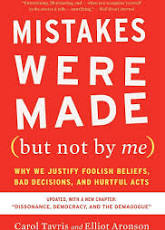
Now that all that Hot Stamper stuff is out of the way, please allow me to point you toward the one book that explains all the bad thinking we humans constantly engage in, this one.

In my experience, no other book explains more about audio and the audiophiles who pursue it, myself included. I guarantee that if you read this book you will never be the same. It is that eye-opening.

Kind of like playing your first Hot Stamper. Nothing is ever the same again. Even if it is a scam.

(more…)

Cognitive Dissonance Defined

More Basic Concepts and Realities Explained 

Wikipedia’s entry for cognitive dissonance:

Cognitive dissonance is a psychological term describing the uncomfortable tension that may result from having two conflicting thoughts (cognition) at the same time or engaging in behavior that conflicts with one’s beliefs. In simple terms, it can be the filtering of information that conflicts with what one already believes, in an effort to ignore that information and reinforce one’s beliefs. In detailed terms, it is the perception of incompatibility between two cognitions, where “cognition” is defined as any element of knowledge, including attitude, emotion, belief, or behavior.

The theory of cognitive dissonance states that contradicting cognitions serve as a driving force that compels the mind to acquire or invent new thoughts or beliefs, or to modify existing beliefs, so as to reduce the amount of dissonance (conflict) between cognitions. Experiments have attempted to quantify this hypothetical drive. Some of these have examined how beliefs often change to match behavior when beliefs and behavior are in conflict.

In popular usage, it can be associated with the tendency for people to resist information that they don’t want to think about, because if they did it would create cognitive dissonance, and perhaps require them to act in ways that depart from their comfortable habits. They usually have at least partial awareness of the information, without having moved to full acceptance of it, and are thus in a state of denial about it.

This guy was comfortable with his penchant for Mobile Fidelity pressings, a sad story if ever I’ve heard one, but one we can all learn from. (And I have to admit I was every bit as clueless myself back in the my nascent audiophile days.)

Empiricism

Some approaches to this audio hobby tend to produce better results than others. When your thinking about audio and records does not comport with reality, you are much less likely to achieve the improvements you seek.

Without a good stereo, it is hard to find better records. Without better records, it is hard to improve your stereo.

You need both, and thinking about them the right way, using the results of carefully run experiments — not feelings, opinions, theories, received wisdom or dogma — is surely the best way to acquire better sound.

An empirically-based approach to audio will surely result in notable improvements to the quality of your playback.

This will in turn make the job of recognizing high quality pressings — the ones you find for yourself, or the ones we find for you — much, much easier.

(more…)

Are You an Audiophile Soldier or an Audiophile Scout?

More Entries from Tom’s Audiophile Notebook

The guy you see pictured to the left has spent much of the last forty years wandering around used record stores looking for better records. Before that he wandered around stores selling new records because he didn’t know how much better used records could be.

Here are some of the things he’s learned since he started collecting at the age of ten a mere sixty years ago. (First purchase: She Loves You on 45, still in the collection, although it cracked long ago and is no longer playable.) 

Click on the picture to make it easier to read.

As you may have read on the site elsewhere, the three most important words in the world of audio are compared to what?

No matter how good a particular copy of a record may sound to you, when you clean and play enough of them you will almost always find one that’s better, and often surprisingly better.

You must keep testing all the reissues you can find, and you must keep testing all the originals you can find.

Shootouts are the only way to find these kinds of very special records. That’s why you must do them.

Nothing else works. If you’re not doing shootouts (or buying the winners of shootouts from us), you simply don’t have top quality copies in your collection, except in the rare instances in which you just got lucky.

In the world of records luck can only take you so far. The rest of the journey requires effort.

(more…)

The Personification of the Dunning-Kruger Effect

Presenting the poster boy for the Dunning-Kruger effect. Mr. Hutchison fancies himself an audiophile/mastering engineer.

Mind you, he’s a mastering engineer in the same sense that a person who makes mud pies is a piemaker.

I have not played any of his classical albums. I have in fact only played one title, a jazz record I happen to know well, and his remastered version is no better than the other records that get an F grade for sound and can currently be found in our bad sounding audiophile records section.

I will publish a review one of these days, but until then, I recommend you steer well clear of this man’s records.


Update 2024:

We’ve reviewed three of this man’s releases to date. None of them should be acceptable to anyone who describes himself as an audiophile. If you “love sound,” these titles should make you sick to your stomach.

We’ve reviewed ERC’s My Favorite Things. (For the benefit of our readers, this is what a good pressing should sound like.)

Robert Brook also reviewed the album, and you can find his review here. (He didn’t like it any more than we did.)

We’ve also reviewed ERC’s Forever Changes. (For the benefit of our readers, this is what a good pressing should sound like.)

And we’ve reviewed ERC’s Quiet Kenny. (Again, this is what a good pressing should sound like.)

(more…)

Is Digital Really the Problem on this Cowboy Junkies Album?

Hot Stamper Pressings of Digital Recordings with Audiophile Sound 

The RCA domestic pressings cut at Sterling are not worth the vinyl they’re pressed on.

Don’t be one of those die-hard analog types who point fingers at the fact that there was digital in the recording chain when their pressing doesn’t sound good.

It’s got nothing to do with digital. It has everything to do with Sterling doing a bad job mastering the domestic vinyl.

(Keep in mind that a very large group of audiophiles, including some well-known reviewers, had no idea there was a digital step used in the process of making some of the records they had raved about. Apparently the only way to hear it is when you already know it’s there.)

Our notes for the domestic pressing below read:

  • Flat and dry vox.
  • Shifted up [tonally]
  • A bit scooped [or “sucked out” in the midrange, meaning the middle of the midrange is missing to some degree]

The midrange suckout effect is easily reproducible in your very own listening room. Pull your speakers farther out into the room and farther apart from each other and you can get that sound on every record you own. I’ve been hearing it in the various audiophile systems I’ve been exposed to for more than 40 years.

Why Defend the Indefensible?

When good mastering houses like Kendun and Sterling and Artisan make bad sounding records, we offer no excuses for their shoddy work. The same would be true for the better-known cutting engineers who’ve done work for them, as well as other cutting operations.

Individuals working for generally good companies sometimes produce substandard work product.

How is this news to anyone outside of the sycophantic thread posters, youtubers, and self-identified record experts who write for the audiophile community?

(more…)

Cognitive Dissonance, or, I Just Paid $600 for This LP – Was That Too Much?

New to the Blog? Start Here

This letter came to us when we first started selling Hot Stamper pressings on our website way back in 2004-2005. Since that time we have received many other letters like it. Apparently, charging a lot of money for used records upsets people. Who knew?

Don, who wrote us the following letter, applauds us for being able to convince our customers to pay forty times the going rate for some of the records we sell — and like it!

The subject line of Don’s letter is Music.

What a great example of free market capitalism at it’s [sic] finest. Your web site is truly a unique example of marketing. You’ve taken a medium that [sic] completely relative and you can convince someone to pay upwards of 40X the going rate because….well, you said so. That doesn’t mean that the record will sound the same to them or that their experience of music is the same as yours as a reviewer. I guess if someone decides to spend $600 on a record they damn well better find a reason why it’s worth it even if they’re not completely convinced. (I took the time to read some of the other comments on your site.)

Don’t understand why someone would be upset about that or how they could argue that the records aren’t worth the price. They’re worth whatever someone is willing to pay for them as I see it. Maybe because they didn’t think of it first or they have some misplaced sense of ethics….who knows. I know it’s not worth it to me and thankfully there are plenty of other resources available for buying music. Another great example of capitalism…..

Sincerely,

Don L.

Don, honestly, I’m positively blushing at the thought that my “say so” is what gets people to pay the ridiculously high prices we charge for what appear to be fairly common rock records, the kind that might be worth roughly, oh, I don’t know, 1/40th of what we are asking? (Truth be told, probably even less.)

Ah, but here’s the kicker: there’s actually a scientific explanation for it!

It’s called cognitive dissonance, and it works like this. Let’s say someone decides to spend $600 on a record — sound familiar? — yet for some reason they’re not completely convinced it’s worth it — ring any bells? — so they find a way to justify the purchase to themselves by rationalizing one of two things: their actions or their perceptions.

In this case, although the actual record may not sound all that good when they get it home, because it costs so much they must find a way to make it somehow seem better than it really is. Failing to do so, this person, demonstrably $600 poorer, would have to conclude that he, like an idiot, has just let himself get ripped off, in this case by us.

Twisted Logic

The logic at work here is pretty straightforward. The buyer says to himself: I am not an idiot. Only an idiot would pay $600 for a record that doesn’t sound amazingly good, especially one that can easily be had for one-fortieth the amount of money I have paid, therefore the record must sound better than my ears tell me it does.

Which — let’s be honest here — may in fact be happening. I don’t know what these records sound like in my customer’s homes. How could I? They live all over the world. I have certainly taken some of my best sounding pressings with me while visiting customers, and they sure sounded good on their systems. But I can’t vouch for systems I have never heard and people I have never met. That would be silly.

You Are Correct Sir

You are certainly correct in pointing out that musical values are relative. The famous Latin proverb “De gustibus non est disputandum,” roughly translated “There’s no accounting for taste,” is one with which I am very familiar. (When somebody pays $600 for The Hunter on vinyl, you don’t have to tell me there’s no accounting for taste.)

As a skeptic I require evidence for what I believe in order to believe it. Although it’s certainly possible that our customers are willing to pay our admittedly high prices on nothing more than our say so, I see no evidence that this is in fact the case. All things being equal I think they must really like our records. They tell us so all the time, and they keep buying them week after week, so if they really are just fooling themselves, they apparently can’t stop doing it.

Occam’s Razor

The scientist’s and skeptic’s best friend, Occam’s razor, comes into play here. It holds that “the explanation of any phenomenon should make as few assumptions as possible.” It’s often paraphrased as “All other things being equal, the simplest solution is the best.” In other words, when multiple competing theories are equal in other respects, the principle recommends selecting the theory that introduces the fewest assumptions…”

Why assume people who buy expensive records are crazy? Why assume that the records they buy aren’t every bit as good as advertised, if not better? Why assume that the “other resources available for buying music” are even remotely as good, absent any evidence?

People assumed that the CD was going to be a cheap and easy resource for their music, and look where that got them.

Assumptions? Us?

(more…)

John writes: “The only problem I have with my evaluations is that I never heard his records.”

More Commentaries Prompted by Forums, Videos and Comments Sections

Please check out the interview Wired conducted with me a few years back.

If you have some time on your hands, maybe too much time on your hands, go to the comments section and read the 300 plus postings that can be found there, the writers of which seem to be offended by the very idea of Hot Stampers.

They also decry the obvious shortcomings of analog vinyl itself, as well as the ridiculously expensive equipment some “credulous, misguided audiophiles,” their terms, use to play vinyl records, as if you didn’t know already!

Here is one that I found to be especially interesting, from a psychological perspective if not from an audio one. (Emphases added.)

Bad, mismatched system setup. Customer base probably has the same. Also evaluation process is questionable. Uses a mediocre solid state amp and looks for “tubey magic” because of some misplaced concept of “accuracy” as I discussed before. [Man, this guy has got our number all right, ouch!]

Yes, there is a lot of bad stuff out there, and it does give the stereo industry as a whole a bad name. I have heard some pretty crappy, expensive setups in my day.

I was listening to Phoebe Snow’s “Second Childhood” on my best system last night. Boy, I love my new turntable!

The only problem I have with my evaluations is that I never heard his records. My comments are probably correct, but it would be interesting to audition a few of his “golden” albums just to confirm he hasn’t really found anything. The reason I am confident that he probably does not have anything is because virtually every repressing I’ve heard is better than the original. Claiming otherwise hurts his credibility.

John

There is one sentence in the paragraphs above that should raise a giant red flag and help you to appreciate how reliable John’s analysis of our stereo and methods might turn out to be. If you didn’t catch it the first time through, give it another shot. Okay, here goes:

The reason I am confident that he probably does not have anything is because virtually every repressing I’ve heard is better than the original.

That’s so strange! Virtually every repressing I’ve heard is worse than the original.

What gives?

If I may paraphrase our writer: the reason I am confident that he probably does not know anything about records or audio is that he thinks repressings are always better than vintage pressings.

We’ve critically auditioned tens of thousands of records, including many hundreds of repressings, admittedly on our “bad, mismatched system setup,” and I guess we must have gotten it all wrong over the 38 39 years we’ve been in the audiophile record business. The shame of it all!

Obviously, John knows he does not need to try one of our Hot Stampers. You can see him talking himself into the wisdom of doing nothing with every paragraph he writes.

It’s easy for him to be right by simply pretending to know something he cannot possibly know.

(Knowledge that is not backed up by empirical findings [1] comes in for a lot of criticism here at Better Records, and for good reason. Guessing, speculating and assuming are poor approaches to separating good pressings from bad ones.)

And if he did ever order one, and had at least a halfway decent stereo to play it on, it would turn his world upside down so fast it would make his head spin, and the possibility of that happening would be very, very upsetting. It makes no sense for John to risk such an outcome.

Even if our records were as cheap as the ones he is buying, even the superior sound would not justify the psychological damage that would result. He would basically have to start his collection over again, as this customer did.  A few hundred others just like him have done the same, and they’re the ones that will be keeping us in business for years to come. To paraphrase another famous saying, “They’ve heard the future, and it works!”

Better for John to follow the path he is on. It’s working for him. Why would he want to rock his own boat?

(more…)