Live and Learn

Here we discuss the records we think we got, uh, wrong.

It’s not really a problem for us though. We feel no need to cover up our mistakes. Recognizing and correcting previous errors is how we’ve managed to learn so much about records that no one else seems to know.

Gaining knowledge — in any field, not just record collecting or music reproduction — is always slow, incremental and riddled with errors and bad judgments.

A common misperception among those visiting the site is that we think we know it all. Nothing could be further from the truth. We learn something new about records with practically every shootout.

By playing the records grouped here, under rigorously controlled conditions, on top quality equipment, we found out just how much better or worse they are than are we thought.

Hey Mr. Fantasy – Where’s the Bass?

Hot Stamper Pressings of the Music of Traffic Available Now

For our newest take on the sound of the various labels and stampers for Mr. Fantasy, please click here.

A long, long time ago, probably at the start of the 2000s, we put up this early UK pressing on the Island pink label.

Charged good money for it, too, justified by the fact that the early pink label pressing would be assumed to have the best sound for audiophiles in search of higher fidelity.

Back then we didn’t know what we know now, which is that the right reissues are dramatically better sounding.

In fact, they handily win our shootouts, something they have been doing for at least the last ten years or so.

The pink label pressing we review below is very unlikely to earn a grade high enough to qualify for Hot Stamper status.

Our Old Listing

This pink label original Island pressing has amazingly sweet, open, extended and transparent mids and highs.

It has two major shortcomings: a lack of bass, and a fair amount of surface noise.

If you can add a few — let’s say three — dB around 50 cycles and can put up with some surface noise and scratches, you are guaranteed to hear some wonderful sound in the best tubey Island tradition. 

Side two sounds better than side one. It has more bass and is more tonally correct overall.

Live and learn is our motto, and progress in audio is a feature, not a bug, of record collecting at the most advanced levels. (“Advanced” is a code word for having little to no interest in any remastered pressing marketed to the audiophile community. If you want to avoid the worst of them, we are happy to help you do that.)

(more…)

Our Old Prediction for LSC 2563 Came True

Hot Stamper Pressings that Feature the Violin

Many years ago we wrote:

This is a very old review and it’s doubtful we would not prefer the right Shaded Dog pressing these days.

That turned out to be the case, as we had two late-label 70s Red Seal pressings in the shootout we just did and only one of them was even passable.

A few things about the new pressings and the old commentary caught my eye.

First off, 3s is a fairly low number. The Shaded Dogs that win the shootout must be lower, which means they are either 1s or 2s. Not much to choose from there!

Secondly, the commentary you see below goes into great detail regarding what each piece found on the pressing was doing right and wrong.

It makes us sound like we knew what we were talking about when it came to this specific Red Seal pressing of the album we had played.

I assure you that we did not.

On the web I come across lots of reviews for audiophile pressings in which the writers go on for page after page about how much better the new Heavy Vinyl pressing is compared to the old record the reviewer owns.

This is no longer hard for me to understand. They are simply as lost as I used to be.

(more…)

Bruch & Mozart Violin Concertos / Heifetz in 2010

Years ago we wrote:

This is a very old review, probably from the early 2010s, so take it for what it’s worth. I suspect we could find a much better sounding copy of the album today than we could back then, before we had the cleaning systems and playback equipment we do now.

All that turned out to be true.

In 2024 we did another shootout for the album, our first in more than ten years! I am happy to say the sound was a knockout on the best copies, some of the finest violin concerto sound we have ever heard.

Live and learn is our motto, and progress in audio is a feature, not a bug, of record collecting at the most advanced levels. (“Advanced” is a code word for having little to no interest in any remastered pressing marketed to the audiophile community. If you want to avoid the worst of them, we are happy to help you do that.)

Our comments from 2010:

(more…)

By 2007 We Had Changed Our Minds about the Classic Who’s Next

Hot Stamper Pressings of the Music of The Who Available Now

Here is our review from 2005.

After doing our next shootout for Who’s Next in 2007, and replaying the Classic afterwards, we changed our minds about Classic’s version of the album.

Apparently, a surprising amount of audio progress was made from 2005 to 2007, reflected in this review as well as dozens of others.

Looking back, 2007 seems to have been a milestone year  for us here at Better Records, although we certainly had no idea at the time that such dramatic changes had been put in motion.

For example, later that same year we swore off Heavy Vinyl (prompted by the less-than-enchanting sound of the Rhino pressing of Blue) and committed ourselves to doing record shootouts of vintage pressings full time. To accomplish this we eventually ended up doubling the staff.

(Cleaning and playing every record you see on our site turned out to very time consuming. No one man band can begin to fathom the complex and random nature of the vinyl LP, which explains why the audiophile reviewers of the world are right about as often as the proverbially stopped clock.)

Live and learn is our motto, and progress in audio is a feature, not a bug, of record collecting at the most advanced levels. (“Advanced” is a code word for having no interest in any remastered pressing marketed to the audiophile community. There is nothing advanced about these deceptively-packaged mediocrities if you have the stereo to reveal their shortcomings. After spending fifty years in audio (1975-2025, we do. )

This is how good Who’s Next sounds these days, when we have them, which is not often.


In 2007 we did a big shootout for Who’s Next, and as is so often the case, the shortcomings of the Heavy Vinyl version were mercilessly revealed when played head to head with The Right Vintage Pressing. (And not the original Track by the way.)

Oddly enough, and contrary to expectation, even the domestic Decca label copies had amazing sound, not just the British Track label pressings I had favored for so long. (To keep from being influenced by biases of any kind, when we do these shootouts the listeners have no idea which pressing they are evaluating.)

(more…)

Bennett and Basie – We Was Wrong about Strike Up The Band

More of the Music of Tony Bennett

More of the Music of Count Basie

Years ago we thought the Emus reissues were the best sounding pressings of this album, but we was wrong and we don’t mind admitting it. We live and learn just like anybody else who plays different pressings of their favorite albums in search of the best sounding versions.

We don’t know it all and we’ve never claimed to. Having done shootouts for thousands upon thousands of titles, we’re bound to make mistakes from time to time. What could be more predictable?

Our erroneous comment from years back went a little something like this:

The originals we have played are uniformly horrible sounding compared to these wonderful reissues – the tonality here is Right On The Money.

The originals tend to be harsh and shrill, and on a big band record like this one, that is simply not a sound that can be tolerated, much less enjoyed.

But the right originals do not have those problems, and those are the ones we offer our customers, along with the better pressings on Emus.

Findings Overturned

We’re so used to the conventional wisdom being wrong, and having our own previous findings overturned by new ones, that in listing after listing we take the time to point out just how wrong we were. (And of course why we think we are correct now.)

A common misperception among those visiting the site is that we think we know it all. Nothing could be further from the truth.

We learn something new about records with practically every shootout.

(more…)

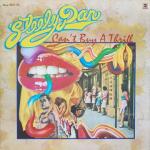
A Killer Can’t Buy a Thrill (and Some Lessons We Learned)

Hot Stamper Pressings of the Music of Steely Dan Available Now

During our shootouts, when we drop the needle on a copy and don’t hear that “Hot Stamper” sound, we toss that one and move on to the next. The difference between a truly Hot Stamper and most copies is so obvious that we rarely waste time on the pressings that clearly don’t have any real magic in their grooves.

Like we’ve said after some of our other Steely Dan Hot Stamper shootouts, you would never imagine how good this album can sound after playing the average copy, which is grainy, compressed and dead as the proverbial doornail. It’s positively criminal the way this well-recorded music sounds on the typical LP.

And how can you possibly be expected to appreciate the music when you can’t hear it right? The reason we audiophiles go through the trouble of owning and tweaking our temperamental equipment is we know how hard it is to appreciate good music through bad sound. Bad sound is a barrier to understanding and enjoyment, to us audiophiles anyway.

We Was Wrong About the Sound

Years ago – starting with our first shootout in 2007 for the album as a matter of fact – we had put this warning in our listings:

One thing to note: this isn’t Aja, Pretzel Logic or Gaucho (their three best sounding recordings). We doubt you’ll be using a copy of Can’t Buy A Thrill to demo your stereo.

We happily admit now that we got Can’t Buy a Thrill wrong. It’s actually a very good sounding record – rich, smooth, natural, with an especially unprocessed quality.

In that sense it is superior to most of their catalog; better than Countdown to Ecstasy, Katy Lied, Royal Scam and maybe even Gaucho (which is a bit too artificial and glossy for our tastes, although it might make owners of less revealing equipment or those who find that kind of sound more appealing positively swoon).

You could easily use Can’t Buy a Thrill to demo your stereo, depending on what you were trying to demonstrate. A realistic, solidly-weighted piano comes to mind — there are many songs with an exceptionally well recorded piano on the album.

Mistakes Were No Longer Made

We used to think it sounded flat, cardboardy, veiled and compressed. It’s actually none of those things on the best copies. The reason we didn’t find those problems during our most recent shootouts is that we must have improved our playback. Precisely how I don’t really know.

Maybe the main improvements happened just last week with the cartridge being dialed in better. Or maybe it was that in combination with the few new room tweaks. Or maybe those changes built upon other changes that had happened earlier; there’s really no way to know. 

(more…)

Did We Get The Power of the Orchestra Wrong, or Are These Just Bad Stampers?

Hot Stamper Pressings of Living Stereo Recordings Available Now

In 2007, we wrote the following review for The Power of the Orchestra, VCS 2659:

DEMO DISC QUALITY ORCHESTRAL SOUND like you will not believe. We put two top copies together to bring you the ultimate-sounding Pictures At An Exhibition. Folks, it doesn’t get any better than this for huge orchestral dynamics and energy.

I confess I badly misjudged this record over the course of the last few years. I remember liking it in the early ’90s; at that time it was the only Golden Age recording of Pictures whose performance moved me. I never liked the famous Reiner, LSC 2201, and Ansermet’s performance on London also lacks drive and coherency in my opinion.

I then went on to extoll the many virtues of the recording, making special mention of the brass, dynamics and bass, which you can read about here.

More recently we played a copy of VCS 2659 in one of our regular Pictures at an Exhibition shootouts and were not the least bit impressed by it.

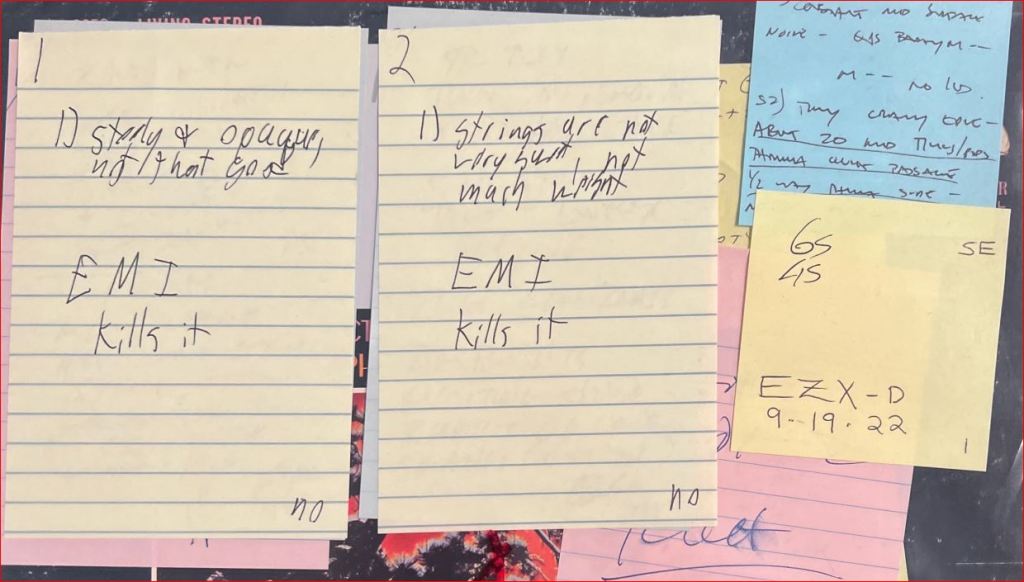
Side One:

Steely and opaque, not that good.

Side Two:

Strings are not very [unintelligible, might be bright], not much weight.

In other words, it just sounded like an old record.

(more…)

Our Search for Shootout Winning Sound on Modern Vinyl Finally Pays Off

Our (Incomplete) List of Potentially Very Good Sounding OJC Pressings

It has finally come to pass. A modern pressing has won a shootout.

Having auditioned more than a dozen modern (post-2000) OJC pressings and having had them fall far short of the mark again and again — when they weren’t just plain awful — we have now discovered one that can win a shootout.

As you imagine, this came as quite a shock.

We weren’t sure precisely which of the many OJC pressings our shootout winner was until we looked up the stamper numbers on Discogs. To our surprise, it had clearly been made sometime in the the 21st century.

That Never Happens

This has never happened before. No record made since 2000 has ever won a shootout against a vintage pressing of the same title.

Modern records range from awful to very good, but one quality they have never had is the ability to be the best of the best.

Now one has.

(more…)

We Were Way Off the Mark with Stand Up in 2006

Hot Stamper Pressings of Jethro Tull Albums Available Now

Years ago we wrote:

This Island Pink Label Original British pressing has ABSOLUTELY AMAZING SOUND! We mention that there was a Sunray pressing that may have been even better, but I didn’t have this copy in hand to compare the Sunray to, so I can’t be sure that pressing was any better.

This one sounds as good as any I’ve ever heard. 

It’s amazingly dynamic and powerful, yet full of tubey magic. I played almost ten different pressings of this record today (11/08/06): every domestic label variation and a handful of imports. This copy is clearly the best of the batch.

A textbook case of live and learn.

My stereo was dramatically less revealing back then and also I did not know how to clean records properly. Those two facts, combined with the underdeveloped or yet-to-be-developed listening skills that go with them, allowed me to arrive at the wrong conclusion.

In 2006 we simply had not done our homework well enough. I had been an audiophile for at least 31 years by then, and a legitimate audiophile record dealer for 19.

Sure, by 2006 my staff and I had auditioned plenty of the pressings that we thought were the most likely to sound good: the original and later domestic pressings, the early and later British LPs: in other words, the usual suspects.

The result? We were roughly in the same position as the vast majority of audiophiles. We had auditioned a sizable number pressings of the album and thought we knew enough about the sound of the album to pick a clear winner. We thought the best pink label Island pressings had the goods that no other copies could or would have.

But of course, like most audiophiles who judge records with an insufficiently large sample size, we turned out to be completely wrong.

Logic hadn’t worked. None of the originals would end up winning another shootout once we’d discovered the right reissues.

But in 2006, we hadn’t stumbled upon the best pressings because we hadn’t put enough effort into the only approach that actually works.

What approach is that? It’s trial and error. Trial and error would eventually put us on the path to success. We had simply not conducted enough trials and made enough errors by 2006 to find out what we know now.

We needed a breakthrough, and we hadn’t gotten it yet.

(more…)

And to Think I Used to Like this Strauss Record

Hot Stamper Mercury Pressings Available Now

I used to like this Strauss Family Album back in the old days. Picked them up whenever I saw them, usually for ten bucks or less. They’re fairly common. It’s not exactly HiFi a la Espanola.

Now when we play this Mercury, it doesn’t sound so good. We traded what we had in stock back to stores or gave them away as freebies to our good customers.

A lot of records that I used to like because they were cleaner and brighter — later Red Seal Living Stereos, some OJC jazz, some reissues of rock — sounded much better when my system was darker and less revealing.

Side one of this copy has steely strings, the kiss of death on this kind of music.

Side two is passable, a low grade Hot Stamper. If you see this album for five bucks, pick it up and give it a listen. More than that and you should probably pass.

(more…)