*Thinking About Records

Old Tapes, New Tapes, You Know We’ve Heard Our Share

Skeptical Thinking Is Key to Finding Better Sounding Records

I ran into a comment I had made more than twenty years ago about a Hot Stamper jazz reissue from the 70s that, at the time, we thought sounded better than any other version. The original pressing of the record would have come out in the fifties. We wrote:

“The master tapes were about fifteen years old when this record was mastered.  Compare that to a current cutting which would be made from approximately fifty year old tapes.”

Perhaps that explains it.

Or maybe it doesn’t. Whether it explains it or not, when you get right down to it, it’s nothing but guesswork.

It has no predictive value.

If, like most people, you enjoy having your biases confirmed, then by all means, whatever reasons work for you are fine by us.

(more…)

Time Out Is a Classic Case of Live and Learn

Hot Stamper Pressings of the Music of Dave Brubeck Available Now

When we did a shootout for this album way back in October of 2007, we took the opportunity to play the Classic Records 200 gram pressing. Maybe we got a bad one, who knows, but that record did not sound remotely as good as the real thing. (6 eye or 360, both can be quite good. Skip the Red Label ’70s reissues.)

The piano sounded thin and hard, which was quite unexpected given the fact that we used to consider the Classic LP one of their few winners and actually recommended it. Another example of we was wrong.

As we said in our shootout: “We dropped the needle on the Classic reissue to see how it stacked up against a serious pressing. Suffice it to say, the real Time Out magic isn’t going to be found on any heavy vinyl reissue!”

If I were in charge of the TAS Super Disc List, I would not have put this record on it.

(more…)

Answers to Some of Your Hot Stamper Questions

More Straight Answers to Your Hot Stamper Questions

We discuss a number of subjects with our letter writer below, including what we think of The Beatles’ records in mono, our grading system, how we clean our records and various and sundry other aspects of the business we run. These are the kinds of questions we get regularly and are more than happy to answer.

Hey Tom, 

First off, I got to say, congratulations on a great concept. Also, congrats on having the balls to charge what these albums are worth.

Thanks. You hit the nail right on the head — we charge what the pressings are worth. They are often incredible sounding records of some of the greatest music ever recorded. We should know; we played them, something that no other record dealers on the face of the earth can say. To those of us who do the listening, as well as our Better Records customers, they are priceless.

Like any business, we charge what the market will bear, and it seems people are willing to pay a lot for these records, although less for some than they used to — some of our records now sell for half or even less than what we were getting two or three or five years ago.

That said, the top copies have held their prices pretty well over the years and have often gone up substantially. It’s the second tier and third tier titles and the Super Hots that have tended to fall in price. That’s where the real “bargains” are these days.

Like all of our Hot Stamper pressings, even the cheapest of them (starting at $25!) are guaranteed to be better sounding than any pressing you own or have ever heard, or your money back.

OK – I spent a fortune on my system. Including acoustic design, the best of everything – speakers, turntable, preamp, amps – you get it. The whole set up probably cost me over $600k.

Wow. I don’t have $600k in my system, but I do have about $600k worth of labor in it (!) You can read all about our stereo here.

I am a crazy fanatic – audio perfection is something that really moves me.

Me too. I wrote about it in a commentary that describes how I fell in love with a record that gave me the reason I needed to get deep into audio.

(more…)

So Many Columbia Classical LPs Are Bad Sounding – Why Is That?

Hot Stamper Pressings of Vintage Columbia Albums Available Now

UPDATE 2026

This commentary was written in 2005 or thereabouts. Still holds up though.


Columbia classical recordings have a tendency to be shrill, upper-midrangy, glary and hard sounding.

The upper mids are usually nasally and pinched; the strings and brass will screech and blare at you in the worst possible way.

If Columbia’s goal was to drive the classical music lover with high-fidelity equipment screaming from the room, more often than not they succeeded brilliantly. Occasionally they failed.

Some of those pressings we call Hot Stampers, but not many.

Columbia Rock and Jazz

When I play Columbia recordings from the 50s and 60s of Brubeck, Ellington, Miles and other jazz giants, what strikes me is how natural, warm and sweet the sound is. I was playing an old mono Ellington record recently and when the clarinet solo came in, it almost took my breath away. The sound of the instrument was that real. This from a mid-’50s run-of-the-mill Columbia pressing. Those guys (the engineers and the musicians) knew what they were doing.

Sometimes when I read about the extraordinary lengths modern engineers go to in order to use the highest quality audiophile equipment: custom microphones, tape recorders, wire, and the like, it makes me wonder how so many of the best sounding recordings in the world managed to be made without any of that stuff.

RCA didn’t need it for their Living Stereos.

Decca didn’t need it.

Contemporary Records managed to record the best sounding jazz records without it.

How did all those great sounding records get made with such bad equipment?

I guess we’ll never know.

(more…)

Jerry Seinfeld – “No one’s really that great.”

Shane Parrish quotes comedian Jerry Seinfeld on what it takes to be great:

“No one’s really that great. You know who’s great? The people that just put tremendous amount of hours into it. It’s a game of tonnage.”


Please forgive me in advance for quoting at length from a commentary I wrote long ago concerning a favorite album of mine and how it serves to illustrate The Pareto Effect.

The album in question has been a key test disc for me. It’s one that helped me dramatically improve the quality of our playback over the last 40-plus years.

The albums on the list linked to above do exactly what good test discs should do.

They can show you what your system is doing wrong, or poorly, and once you’ve fixed it, or made it better, they show you that it actually is better, maybe even right, or at least more right than it was before.

We audiophiles need records like these. They make us better listeners, and they force us to become good at building our audio systems. Because the amount of experimenting you do with your setup, components, room, electricity and the like is the only thing that can take you to the highest levels of audio.

The reality we audiophiles must face in our journey to higher quality sound is that buying good equipment, regardless of price or quality, will not get us there.

(more…)

Have You Ever Noticed that Sometimes the Highs Come Back on Some Pressings?

More of the music of Sergei Rachmaninoff (1873-1943)

This side one is interesting., I would say that it starts out Super Hot (A++) and within a few minutes becomes White Hot (A+++). The piano is a bit veiled at the start, but within a relatively short period of time that subtle loss of transparency disappears and the piano is RIGHT THERE.

This is not unusual in our experience.

The first track on many records can sound dull, and by the second track the highs come back and the tonality is right from top to bottom. Who knows why?

We speculate that the vinyl did not have time to fully heat up the edge of the record, but that’s speculation, something that has almost no value in our (yours and mine) quest for better sounding records. 1A, 1B, first off the stamper, who gives a flying you-know-what. You have to play the record to know how it sounds.

The rest is BS, proffered mostly by those who are simply too lazy (or busy; some folks do have real jobs!) to do the work of cleaning and playing multiple copies of an album in order to have the evidence they need to support their opinions.

We much prefer real knowledge supported by real evidence, not the other kind.

(more…)

Are You a Soundphile? I Used to Be One

Hot Stamper Classical and Orchestral Pressings Available Now

UPDATE 2026

About 30 years ago I got hold of a Japanese pressing of Marriner conducting Haydn’s Toy Symphony and Mozart’s Eine Kleine Nachtmusik and was blown away by the absolutely phenomenal quality of the Haydn. Listing the record for sale, I raved:

DEMO QUALITY SOUND! This is the best sounding Toy Symphony you will ever hear!

…all the little toys that play along with the music just JUMP out of the speakers. The recording is so transparent and the toys are so well miked it’s like hearing the work for the first time, or live.

Now we know definitively that this is clearly not true, assuming yoy have one of our Hot Stamper pressings of the EMI original. They are better in every way than the Japanese pressing, which is the one purporting to have audiophile sound.

If this sounds familiar to you, I’m guessing this is not your first visit to the blog or our site. There is almost always a vintage pressing with superior sound when compared to the audiophile pressings made from the same recording.

The problem is: You just don’t know which vintage pressing will have superior sound. Maybe they all will. Maybe none of the copies you own will. There is one, but how do you find it?

In order to get that answer, you have to know how to do carefully controlled shootouts, and not just once, but more often than not a number of them over a period of years. Whatever answer you may come up will most likely be provisional, not definitve, because that’s the only way the process of discovery can work when applying scientific methodologies to the solution of a problem like “which pressings sound best on record X?”.

We did the shootout in 2022 and found out that the best of the original EMI pressings are quite a bit better, a classic case of live and learn, as well as one of the hundreds of breakthrough discoveries we’ve made over the years. That’s what happens when you are in the business of playing records and then selling the best of them to audiophiles looking for superior sound.

I believe I had at least one or two UK EMI pressings to play against the Japanese ones, but all the details of how I came to this conclusion — a proto-shootout, carried out long before I knew how to do a real one — are lost to the mists of time.

Keep in mind that my stereo was dramatically less revealing back then. Also I had not learned how to clean records properly. Those two facts, combined with the underdeveloped listening skills that go with them, helped me to arrive at the wrong conclusion.

No, the Japanese pressing, specifically targeted to audiophiles, or “soundphiles” if you like, is not superior to a properly mastered and pressed UK LP.

If you have more than a handful of Japanese pressings in your collection, you can be sure that there is still plenty of room for improvement in your audio system.

(more…)

Are Hot Stampers a Better Mousetrap? A Case of Added Value? A Scam?

Basic Concepts and Realities Explained

This hobby is supposed to be fun. If you’ve been in it for any length of time you know that sometimes it is and sometimes it isn’t.

But if you enjoy doing it at least some of the time, and you devote the proper resources to it — the three big ones are time, effort and money — you will no doubt derive much more pleasure from it than you ever dreamed would be possible.

Especially if you use our approach. It works for us and there’s no reason it can’t work for you.

Finding Hot Stampers is all about doing shootouts for as many different pressings of the same title as you can get your hands on.

There are four basic steps you must take, and you have to do right by each of the four if you are going to be successful at discovering and evaluating your own Hot Stampers. 

We discuss every one of them in scores of commentaries and listings on this blog. Although none of it will come as news to anyone who has spent much time reading our stuff, we cobbled together this commentary to help formalize the process and hopefully make it easier to understand and follow.

If you want to make judgments about recordings — not the pressing you have in your collection, but the actual recording it was made from — you have to do some work, and you have to do it much more thoroughly and carefully and above all scientifically than most audiophiles and record collectors apparently think is necessary.

Don’t be one of those guys. Do it right and get the results that are out of reach with any other approach.

(more…)

Is It All About the Music or Is It All About the Sound?

Top Quality Audio Is Key to Finding Good Records

UPDATE 2026

There is a word that better describes the trite phrase I discuss below than “truism” does. You can find it at the end of this commentary.


There is a truism  — a statement that is obviously true and says nothing new or interesting — that frequently pops up in the comments section on audiophile forums.

Working similarly to Godwin’s law, the longer an audiophile thread goes on, the more likely it is to be said. A quick recap of Godwin’s law:

“Godwin’s law, short for Godwin’s law (or rule) of Nazi analogies, is an Internet adage asserting: “As an online discussion grows longer, the probability of a comparison involving Nazis or Hitler approaches 1.”

The truism I’m talking about is commonly phrased, “It’s the music, stupid,” an echo of James Carville’s “It’s the economy, stupid,” from Bill Clinton’s presidential campaign of 1992. (I prefer not to use the word “stupid” when discussing my fellow audiophiles’ comments, but the play on words does not work without it, so there it is.)

Who would be foolish enough to take up the other side of such an argument, if we can call it that?

Allow me to have a go at it.

So, if I understand correctly, it’s all about the music, right? Not the sound?

What about other kinds of art? What is it about with respect to them?

Christopher Nolan shoots on IMAX film, which in its current iteration is either 65 or 70mm.

If his movies are about a story and its characters, why not shoot them on 35mm? Or 16mm. Or Super 8? Or, gasp, HD-digital?

Same story, same characters.  But would it be the same movie-going experience?

And nobody has trouble understanding that. Here’s Nolan on 70 mm.

(more…)

Finding Good Companies to Invest In Is a Lot Like Finding Good Sounding Records to Play

Important Lessons We Learned from Record Experiments

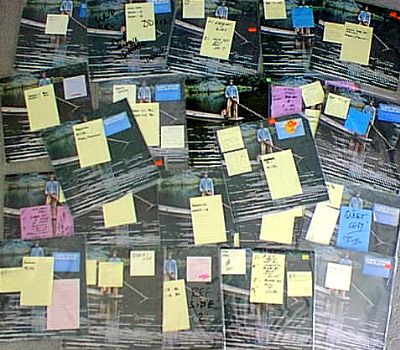
Which of the copies pictured below sound good and which ones don’t?

If you turn over enough of these “rocks,” you — and you alone — will know.

There are some amazing sounding winners in this pile. If you conduct your shootouts following the  tried and true methods we describe on the blog, you will be able to hear One Man Dog and every other album you love sound better than you ever dreamed possible.

Pictured below are just a small fraction of the rocks we’ve turned over in the 20 years since we began doing shootouts.

(more…)