*What’s the Big Idea?

Thoughts on The Big Picture from someone who has been playing records for almost 60 years. I bought a copy of She Loves You on Swan in 1964 and still own it. In case you were wondering, the disc is cracked but the picture sleeve is still in pretty good shape.

How Did Columbia Make So Many Great Sounding Records Without Today’s Obviously Superior Mastering Equipment?

Hot Stamper Pressings of Vintage Columbia Albums Available Now

When I play Columbia recordings from the 50s and 60s of Brubeck, Ellington, Miles Davis and other jazz giants, what I find most striking about them is how natural, warm and sweet they sound.

I was playing an old mono Ellington record a while back, and when the clarinet solo came in, it almost took my breath away. The sound of the instrument was that real. This from a mid-50s run-of-the-mill Columbia pressing.

Those guys — the engineers and the musicians — knew what they were doing.

Sometimes when I read about the extraordinary lengths modern engineers go to in order to use the highest quality audiophile equipment: custom microphones, tape recorders, wire, and the like, it makes me wonder how many of the best sounding records in the world managed to be recorded without the benefit of any of that stuff.

RCA didn’t need it for their Living Stereos.  Decca didn’t need it.

Contemporary Records managed to record many of the best sounding jazz records without it.

How did all those great records get made with such bad equipment?

I guess we’ll never know.

Columbia may not have always recorded the best “serious” jazz, but they were very serious about the sound of their jazz. Outside of Contemporary, Columbia has better sounding jazz records than any other label of which I am aware.

Recordings made at their 30th Street Studio are pretty hard to beat. There is no Heavy Vinyl reissue on the planet that can compete with the sound of one of our Hot Stamper pressings of any of the albums recorded there you see available on our site, and they are guaranteed to knock your socks off or your money back.

And the Brubeck albums recorded by Fred Plaut are some of the most amazing sounding of all the Columbias, something few audiophiles would dispute. (Try to get the early pressings in stereo. Nothing can touch them. If you can’t afford our prices, we are more than happy to help you find your own. )


UPDATE 2025

We have two new lists for those who would like to know which Columbia label pressings win shootouts — one for 6-Eye Label winners and one for 360 Label winners.

(more…)

THE Hot Ticket, or Just One of a Bunch of Potentially Hot Tickets?

Hot Stamper Pressings of Rock and Pop Albums Available Now

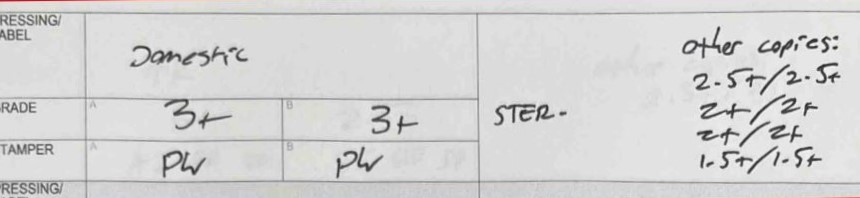
Below you will find the stamper sheet for a title from a recent shootout we did for a rock record whose name we are not revealing.

You may have noticed that when we give out the stampers for the top copies, we rarely identify the title of the record with those Shootout Winning stampers.

As you can well imagine, our sizable investments in research and development over the course of decades make up a big part of the costs we must pass on to our customers.

I can’t say this title is typical of most of the rock and pop we play, but it’s not all that unusual either.

Obviously, knowing the “right” stamper information in this case gets you in the ballpark, but it won’t help you hit the grand slam home run you want to. To do that you have to clean and play about five copies the way we did.

Hot Stamper shootouts may be expensive, they may be a lot of work, but our experience tells us there is simply no other way to find top quality pressings — the ones that earn the 3+ grades, not the 1.5+ grades.

They might all look the same, but they sure don’t sound the same.

In this particular case, the import pressings we played — the ones we expected to do the best as a matter of fact — had by far the worse sound.  There were a couple of them, there was a domestic reissue, and there were five originals: eight records in total.

Changes for 2024

Beginning in 2024 we decided to make available to our readers a great deal of the pressing information we’ve compiled over the last twenty years, under these headings:

(more…)

What Does Neutral in Audio Really Mean?

Robert Brook runs a blog called The Broken Record, with a subtitle explaining that his blog is:

A GUIDE FOR THE DEDICATED ANALOG AUDIOPHILE

Here is Robert’s latest posting.

What Does NEUTRAL in Audio REALLY MEAN?

I wrote about this very subject in one of Robert’s postings from 2024, this one. Here is most of what I had to say at the time:

Dramatic limitations and massive amounts of colorations are endemic to home audio systems.

The only way to get rid of them is by doing the unimaginably difficult work it takes to learn how to identify them and then figure out practical ways to root them out.

This, in my experience, is a process that will rarely be accomplished, even by the truly dedicated. It unfolds slowly, over the course of decades, and only for a very small percentage of audiophiles. Most will simply give up at some point and choose to enjoy whatever sound quality they have managed to achieve up to that time. To attempt to go further feels like banging your head against a wall.

Regrettably, to push on in this devilishly difficult hobby we have chosen for ourselves is for the few, not the many.

(Of course it didn’t hurt that we got paid to do it. An undiagnosed but all-too-real obsessive personality disorder also played a part, as did certain records that I fell in love with a long time ago.)

Pass/Not-Yet

In our opinion, some of those who gave up the fight did so prematurely.

They thought they’d come a long way, and perhaps they had, but there was still plenty of potentially life-changing improvement possible.

Can you blame them? Devoting the seemingly endless amounts of time and money necessary to climb the greased ladder leading to better sound is not a choice most audiophiles are in a position to make.

Wives, children, jobs, mortgages, and a great deal more — especially the lack of a dedicated listening room — all conspire to limit the efforts of even the most committed audiophile.

Not to pile on, but there is an easy way to spot these folks, the ones who could only take it so far:

    1. By the records they own (many of which are on Heavy Vinyl),
    2. Or want to buy (ditto),
    3. Or have nice things to say about (ditto again, read the posts found on every audiophile forum).

We’ve made a partial list of the records that best identify this group, and it can be found here.

It should be noted that bad records, the kind being made by audiophile labels of every stripe these days, are no good for any of this work. The goal is to figure out how to make top quality vintage pressings sound right. (More on that subject here.)

Most new pressings will only sound enjoyable if the system playing them is good at hiding their flaws. We hope it goes without saying that no right-thinking audiophile should want anything to do with such a system, or such records.

And with his latest post, Robert Brook proves once again that he is an audiophile who knows what the goal of playing music in the home should be — to make it sound as natural and lifelike as possible — and, even more importantly, he recognized that it would take years of work to make that sound a reality, and knowing all that, committed himself to the task.

And why has he done all this work?

Because he is the one who gets all the benefits.

He gets to hear the greatest music ever recorded in a more powerfully immersive way than 99% of the audiophiles who share neither his approach nor his ambition. (You can add work ethic for the trifecta.)

If you want easy answers and quick fixes, Robert (and I) will tell you there are no such things in the world of audio. Until you’ve done the work, this way of thinking may seem counterintuitive and confusing, especially if you’ve spent much time on audiophile forums.

(more…)

Neil Young’s Guitar Masterpiece – Danger Bird

Hot Stamper Pressings of the Music of Neil Young Available Now

Listen to the way Danger Bird (the second track on side one of  Zuma opens. Each instrument, one by one, slowly, deliberately, one could almost say haltingly, feeds into the mix, until the churning guitars give way to Neil’s spare vocal — fatalistic, doomed, already resigned to some fate he barely understands. 

Even though the song has just begun, you sense that Neil feels a weight and a darkness bearing down on him, that it’s ongoing, that it’s already started, that somehow you’re coming into it in the middle, well after the weight of it has begun to crush and perhaps even kill him. He knows the story of Danger Bird all too well.

It’s as powerful and intense a piece of music as any I have ever experienced; sublime in its simplicity, transcendental in effect. You feel yourself swept along, an out of body experience that you can’t control. When Neil launches into the first of many guitar solos the sense of journeying or exploring with him the imaginary musical world he is creating is palpable. He doesn’t seem to know where it will lead and neither do you. There is no structure to reassure you, no end in sight, only the succession of notes that play from moment to moment, first tensing, then relaxing; cresting, then falling away.

Music has the power to take you out of the world you know and place you in a world of its own making. How it can do that nobody knows. Whatever Neil tapped into to make that happen on Danger Bird, he succeeded completely.

If you’re in the right frame of mind, in the right environment, with everything working audio-wise, a minute into this song you will no longer be sitting in your comfy audio chair. You won’t know where you are, which is exactly where you should be.

(more…)

It May Be Hard to Believe, But We Actually Enjoy Testing Records

Advice to Help You Make More Progress in Audio

Some audiophile reviewers opining at great length about the sound quality of various kinds of discs — both compact and vinyl — prefer to review only those that sound good to them and simply ignore the rest. (A small sample of the writings of one such reviewer can be found here on the blog, but there are doubtless others who follow the same approach.)

We think this does the audiophile community a disservice.

Needless to say, we see our role differently. Like Consumer Reports, we like to test things.

They test toasters, we test records. We put them through their paces and let the chips fall where they may.

They want to find out if the things they are testing offer the consumer good quality and value.

We want to find out if the records we are testing offer the audiophile good sound and music.

It takes a lot of people and a healthy budget to carry out large numbers of these kinds of tests.

No other record dealers, record reviewers or record collectors could possibly have auditioned more than a fraction of the records that we have. We’ve been looking for the best sounding pressings of records for a very long time, more than forty years.

Now, with a staff of ten or more, we can buy, clean and play records in numbers that are unimaginable for any single person to attempt.

That puts us in a unique position to help audiophiles looking for the highest quality pressings.

Yes, we have the resources, the staff and the budget. More importantly, we came up with a different approach.

We’ve learned through thousands and thousands of hours of experimentation that there is no reliable way to predict which pressings will have the best sound for any given album.

The impossibility of predicting the sound of records is one which we learned to accept as axiomatic. As a born skeptic, this was never difficult for me. Early on in my audio career, sometime in the ’80s, I realized it was self-evident.

The solution we put into practice given the nature of records comprises the four principles we adopted:

  1. We stopped pretending to know something that can’t be known.
  2. We stopped relying on theories proven to have very little if any predictive effect.
  3. We stopped relying on the experts and so-called authorities.
  4. We stopped assuming and speculating and, importantly, we stopped worrying about getting it wrong.

What remained was the simplest possible approach to the problem that would actually work. One that could be taught in a high school science class, if high school science classes were run by skeptical record collectors.

(more…)

Even In The Quietest Moments and Your 1977 Ears – There’s No Going Back

supereveni_1506_1x

Hot Stamper Pressings of the Music of Supertramp Available Now

By 1977 I was a huge fan of the band, having first discovered their music on Crisis (1975) and Crime (1974), in which order I honestly can’t remember.

I played their albums all the time, especially Crisis.

The first Supertramp album I bought on audiophile vinyl would have been Crime of the Century by Mobile Fidelity, which came out in 1978.

Every right-thinking audiophile had that one — MoFi sold over a hundred thousand of them (along with a hundred thousand of Aja, Touch and one or two others).

And why not? The sound was killer on the systems of the day. Lots of slam down low (but not really that low, although it seemed plenty low at the time), lots of extra top up high, lots of phony detail, just what the old school stereos of the day, like mine, needed.

Crisis? What Crisis? followed in 1975. It was the Supertramp album that sent me over the top. I played that album relentlessly. Before long Art Rock was at the top of my list anytime I wanted to have an immersive musical experience, and that, for an obsessive audiophile like myself, meant almost every day.

Supertramp, Yes, Roxy Music, 10cc, Eno, Crack the Sky, ELO, Bowie – it’s all I wanted to listen to back then, and it encouraged me to keep upgrading my equipment whenever I had the money, although I admit to being completely clueless about all of that at the time. More on that subject here.

A year and a half later EITQM followed. It too became a staple of my musical diet. Man, I played that record till the grooves were worn smooth.

I thought the sound of my domestic pressing was killer at the time, too. Crisis was a demo disc at my house and this was right up there with it. Now the obvious question is, did I have a good sounding copy, or did my stereo not reveal to me the shortcomings of my LP? Or maybe my ears were not well enough trained to hear what was wrong.

Those of you who have been doing this for a long time know the answer: any or all of the above, probably all, and nobody can know just how much of each.

And there is no way to find out because you are not that person anymore.

Your 1977 Ears… and Mine

Even if you could recreate your old stereo and room, and find your original copy, there’s one thing you can’t do, and that’s listen to it with your 1977 ears.

Every time you play a record and listen to it critically, your ears get better at their job.

(more…)

Hot Stampers Helped Some Audiophiles Hear What They’d Been Missing

Hot Stamper Pressings of the Music of Led Zeppelin Available Now

One of our good customers had this to say about some Hot Stampers he played at a stereo show recently. You can read all about it here.

We carried on the conversation:

Tom,

Thank you and for sure I’d be more than happy to spread the word more and help out! Send me cards for sure. I’m def a Better Records disciple.

You should consider teaming up with a room at the show next time. I think worth your while. Time to break the grip of the MoFi Mafia at these shows.

All the best, Mike

Mike,

We went to some shows years ago and nothing came of it.

It may turn out that none of these people will ever want to pay good money — let’s be honest, a lot of good money — for Hot Stampers. I wrote about it here.

Experience over many years has borne out this view, disappointing as it may be.

The audiophiles who go to shows for some reason don’t seem to be able to wrap their heads around the concept of Hot Stampers.

Hard to imagine that none of them can afford our records. The money someone might pay for three wacky MoFis or three Analogue Productions disasters would probably get you one very good sounding Hot Stamper pressing. In my book, one good record that you might actually listen to and enjoy often is a whole lot better than any number of modern records that you will seldom play and more than likely simply file away on the shelf where their sole purpose will be to collect dust.

I’m guessing. I don’t really know what people do with all these mediocre sounding reissues. I wrote about what I suspect happens to them here.

I Beg the Question

But this is purely an exercise in “begging the question.”

I’m assuming things I do not know to be true, in order to make the very point I have the burden of proving.

To make my case, I would need to provide evidence to back up the claim that these records don’t get played and enjoyed. To be honest, I have no evidence whatsoever that the owners of these records don’t enjoy the hell out of them.

It’s a naked expression of prejudice on my part. I’m assuming that what’s obviously true for me must be true for others. I don’t enjoy playing these Heavy Vinyl records, and I think that other audiophiles must be as disappointed by them as I am.

But Heavy Vinyl records are selling very well these days. Somebody is buying them.

And they buy them even though, as our writer points out, they cannot begin to compete with good vintage pressings.

More question begging? Not really. This happens to be something I can provide plenty of evidence for and can prove with ease.

Practically every record on our site is a rebuttal to audiophile pressings from every era, made by every company in the remastering business.

To find out how wrong these modern records are, all you need do is buy one of our Hot Stampers and play them head to head.

Oh well. All we can do is keep trying to get the word out. And we thank you for your help showing audiophiles what they are missing.

Because explaining doesn’t work. Only hearing works.

(more…)

Hot Stampers and Good Sounding Records Are Not the Same Thing

Hot Stamper Pressings of the Music of Stevie Ray Vaughan Available Now

They are barely even related. Here’s why.

A good customer wrote to us recently to say that he was not happy with the Stevie Ray Vaughan White Hot Stamper pressings we had sent him.

Tom,

I also have a couple more returns for you: SRV Couldn’t Stand the Weather and SRV Soul to Soul. While these are good, they’re just not quite up to White Hot Stamper quality like some of the other records clearly are.

I took the opportunity to reply at length.

Dear Sir,

You appear to be conflating two concepts, Hot Stampers and good recordings. They are not the same thing. They are barely even related.

Hot Stampers are especially good sounding pressings of specific albums that we found through shootouts.

The recordings of these albums may be better or worse than others you are familiar with. That has nothing to do with how hot the stampers are of the pressings we sell.

It works this way: if you had a hundred copies of The Dark Side of the Moon, the median pressing– the one that would have ranked number 50 out of 100 — would sound substantially better than either of those two SRV albums.

Pink Floyd: amazing recording. 

SRV: good, not great recording.

We would never sell an average pressing of DSOTM. We only sell the best sounding versions of it.

We would never sell the average version of any SRV album. We only sell the best sounding versions of them.

But no SRV album is ever going to sound like a good Dark Side of the Moon! (more…)

We Used to Blame CCR’s Records for the Bad Sound We Heard Too

Hot Stamper Pressings of the Music of Creedence Clearwater Revival Available Now

Another entry that falls under the heading of

What’s the big idea?

Before 2008 or so we had regularly been frustrated with this band’s recordings. There were plenty of  customers for their albums, but even our best Hot Stampers fell well short of the standards we set for top quality sound.

We assumed the recordings themselves were at fault.

Things started to turn around after that, judging from this bit of boilerplate at the bottom of a listing for Green River from around 2010 or so:

Many copies were gritty, some were congested in the louder sections, some never got big, some were thin and lacking the lovely analog richness of the best — we heard plenty of copies whose faults were obvious when played against two top sides such as these.

The best copies no longer to seem to have the problems we used to hear all the time.

Of course the reason I hadn’t heard the congestion and grittiness in the recording is that two things changed. (1) We found better copies of the record to play — probably, can’t say for sure, but let’s assume we did — and (2) we’ve made lots of improvements to the stereo since the last time we did the shootout.

You have to get around to doing regular shootouts for any given record in order to find out how far you’ve come, or if you’ve come any distance at all. Fortunately for us the improvements, regardless of what they might comprise or when they might have occurred, were incontrovertible. The album was now playing at a much, much higher level.

It’s yet more evidence supporting the possibility, indeed the importance, of taking full advantage of the revolutions in audio of the last ten or twenty years. [Make that thirty by now.]

Live and Learn

When Creedence’s records started to sound good, we stopped blaming those albums for being badly recorded.

It’s amazing how many records that used to sound bad — or least problematical — now sound pretty darn good. 

Every one of them is proof that comments about recordings are of limited value.

The recordings don’t change. Our ability — and yours — to find, clean and play the pressings made from them does, and that’s what Hot Stampers are all about.

(more…)

Cognitive Dissonance Defined

More Basic Concepts and Realities Explained 

Wikipedia’s entry for cognitive dissonance:

Cognitive dissonance is a psychological term describing the uncomfortable tension that may result from having two conflicting thoughts (cognition) at the same time or engaging in behavior that conflicts with one’s beliefs. In simple terms, it can be the filtering of information that conflicts with what one already believes, in an effort to ignore that information and reinforce one’s beliefs. In detailed terms, it is the perception of incompatibility between two cognitions, where “cognition” is defined as any element of knowledge, including attitude, emotion, belief, or behavior.

The theory of cognitive dissonance states that contradicting cognitions serve as a driving force that compels the mind to acquire or invent new thoughts or beliefs, or to modify existing beliefs, so as to reduce the amount of dissonance (conflict) between cognitions. Experiments have attempted to quantify this hypothetical drive. Some of these have examined how beliefs often change to match behavior when beliefs and behavior are in conflict.

In popular usage, it can be associated with the tendency for people to resist information that they don’t want to think about, because if they did it would create cognitive dissonance, and perhaps require them to act in ways that depart from their comfortable habits. They usually have at least partial awareness of the information, without having moved to full acceptance of it, and are thus in a state of denial about it.

This guy was comfortable with his penchant for Mobile Fidelity pressings, a sad story if ever I’ve heard one, but one we can all learn from. (And I have to admit I was every bit as clueless myself back in the my nascent audiophile days.)

Empiricism

Some approaches to this audio hobby tend to produce better results than others. When your thinking about audio and records does not comport with reality, you are much less likely to achieve the improvements you seek.

Without a good stereo, it is hard to find better records. Without better records, it is hard to improve your stereo.

You need both, and thinking about them the right way, using the results of carefully run experiments — not feelings, opinions, theories, received wisdom or dogma — is surely the best way to acquire better sound.

An empirically-based approach to audio will surely result in notable improvements to the quality of your playback.

This will in turn make the job of recognizing high quality pressings — the ones you find for yourself, or the ones we find for you — much, much easier.

(more…)