*Reviewing the Reviewers

How Not to Conduct a Proper Shootout for Aqualung

UPDATE 2023

This commentary was probably written circa 2010 since that’s the date on Fremer’s Aqualung review, which, for those with much more tolerance for audiophile BS than I am able to muster can be found here. I’ve made a few changes to the commentary below, but most of the original text is intact.


We recently put up a Hot Stamper Aqualung that just BLEW THE DOORS OFF the CLASSIC 200g pressing. Michael Fremer may think the new reissue is the ultimate pressing, but we sure don’t. 

The Aqualung shootout on his site is priceless. He has so many silly things to say about it, let’s not waste any more time and get right to them.

His Shootout Begins

He says he “… compared Classic’s new 200g reissue with: 1) an original UK Chrysalis 2) an original American Chrysalis/Warner Brothers, 3) an original French Pink Label Island, 4) The Mobile Fidelity ½ speed mastered edition and 5) DCC’s 180g issue mastered by the team of Hoffman and Gray.”

How many of each? One, right? (All the articles in front of the nouns are singular. Assuming MF is using good grammar, how many could there be?)

Mikey, that’s your first mistake.

When it comes to the domestic release, one is a wholly inadequate sample size for pressings that were pumped out by the millions and therefore mastered multiple times. Go to Discogs if you want to see just how many different stamper numbers can be found in the original Reprise pressings. Hint: it’s a lot. Some of them are known to us to be awful, some fall into the middle of the pack, and some we like. Figuring out which are which has taken us a lifetime of work and is well beyond the ability of any single person to decode for more than a few dozen records.

(more…)

Our Guide to Legrand Jazz on Impex

Hot Stamper Pressings of 30th St. Recordings Available Now

Years ago I wrote about how important the Legrand Jazz album was in my growth as a critical listener.

It’s yet another example of an album that helped make me a better audiophile by showing me the error of my tweaking and tuning ways.

Now there is a new pressing of it. Well, new to us anyway. (We readily admit to being behind the times and make no apologies for it. With records like these, we often find ourselves wondering why we bother.) Two new pressings in fact. One on a single disc at 33 RPM as of 2017, and one mastered at 45 RPM on 2 LPs as of 2019, still in print and available for $59.99.

Production details can be found at the end of this review, along with some favorable comments, some from none other than Steve Hoffman himself.

But first let’s hear from the personification of the well-meaning audiophile reviewer, Michael Fremer. He gives the Impex pressings an 11 for sound. He writes (emphasis added):

“This IMPEX reissue is sourced from an “analog mix-down transfer of the original 1958 work tape by Mark Wilder at Battery Studios” and cut by Chris Bellman and Bob Donnelly at Bernie Grundman Mastering on Grundman’s all-tube mastering system. I have a clean, original 6-Eye pressing that this superbly pressed reissue betters in every way. This will make both your stereo and your heart sing. Some of the greatest jazz musicians of that or any era wailing and clearly having a Legrand time. Limited to 3000 copies. Don’t miss it!”

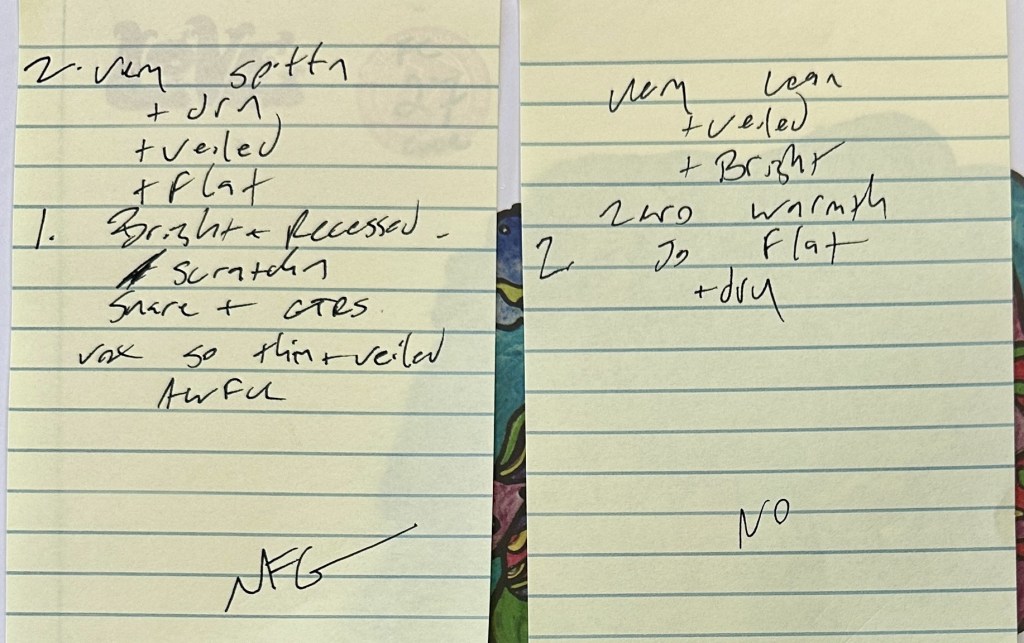
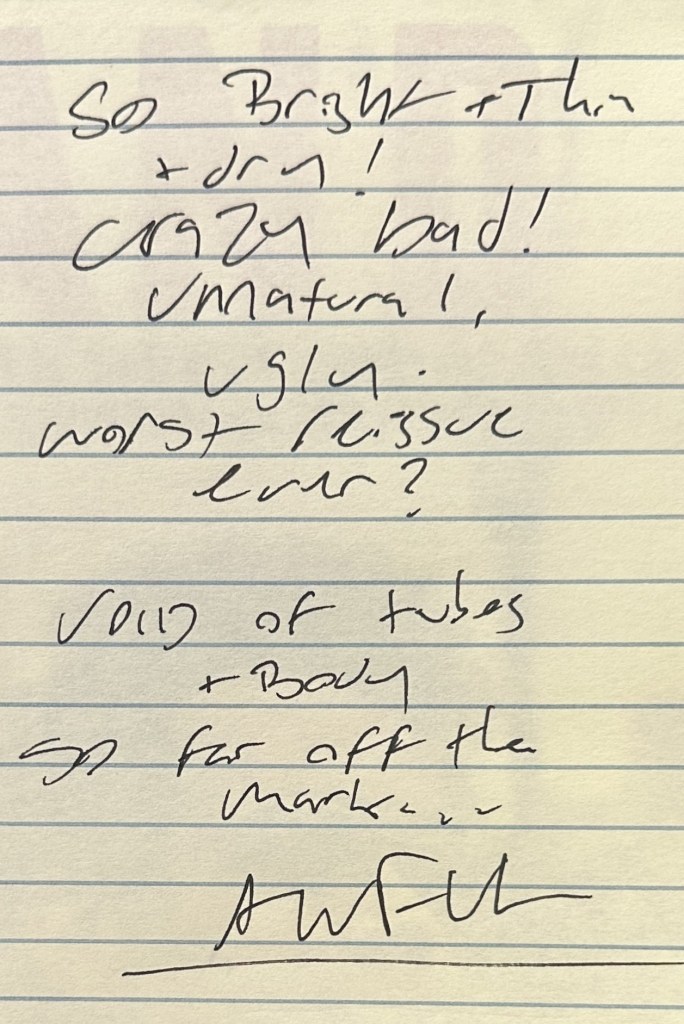
Our notes (for those who have trouble reading our scratch)

  • So bright and thin and dry.
  • Crazy bad!
  • Unnatural, ugly.
  • Worst reissue ever?
  • Void of tubes and body.
  • So far off the mark.
  • Awful.

(more…)

“What I’m all about is saving the world from bad sound.”

Check Out Some of Our Reviews (and Those of Our Customers’) for Albums on the Analogue Productions Label

Saving the world from bad sound you say? Hey, that’s what I’m about too!

I thought I was doing a pretty good job of it, laying out, often in great detail, exactly what’s wrong with these new Heavy Vinyl records being put out by the likes of Mobile Fidelity and Analogue Productions.

We have over 250 listings for them right here on the blog. Are there some good ones I missed?

Apparently the writer for the Times thinks there are, although some of the ones he mentions do not do much for his credibility. (Aja comes to mind, made from a copy tape — Chad goes that extra mile all right! To see what Sisario has to say about the album, with our take as well, just scroll to the bottom of this commentary.)

Let’s see what Sisario has to say about the man from Kansas and his vinyl empire.


An article about Chad Kassem and Analogue Productions has just come out, written by Ben Sisario for The New York Times.

Sisario is the guy who was as enamored with Pete Hutchison of the Electric Recording Company as he seems to be of the fellow you see pictured, a man who he has no trouble calling “The Wizard of Vinyl,” and with a straight face as far as I can tell.

Audiophiles in my experience tend to be credulous — I should know, I was as credulous as they come about everything audio back in my twenties and thirties — but it seems that writers for The New York Times will believe almost anything somebody tells them about records. (Perhaps Sisario will be taken to task in the comments section, but I’m sure not going to waste my time trying to find out.)

I would love to have him come to Westlake so we could play him some of the albums he seems to think are so great. That would be one helluva wake-up call. Not only would he have to retract this article, he would have to retract the one about Hutchison. That would be a win win in my book!

(more…)

Doesn’t Anyone Know What Love Is (Supposed to Sound Like)?

Click Here to See Our Most Recent Review for a Real Gold Label Stereo Pressing of Forever Changes 

The one person we can say for sure who must have absolutely no idea what a vintage pressing of the album is supposed to sound like is Chris Bellman. Allow us to make the case.

Below you can see our notes for the Rhino Heavy Vinyl pressing of Forever Changes cut by Chris for Bernie Grundman Mastering in 2012.

We recently got hold of a copy locally and figured why not give it a spin and see how one of the most respected mastering engineers of the day, CB, fared with this apparently difficult to master title. (Others have tried and failed. See here and here.)

The Gold Label pressings are the only ones we buy these days. The Big Red E Elektras are passable at best, and everything after them is terrible, including imports and all the Heavy Vinyl reissues that we’ve had the misfortune to play over the years. We hope to be posting some of the stampers to avoid (we call them bad stamps) before too long.

Let’s get right into the sound of this 2012 remaster. We played the two tracks on each side that we’re most familiar with from doing shootouts for the title.

As the record played, to the best of our ability we made notes of the sound we were hearing:

(more…)

Classic Records 45 RPM Recut – This Is Your Idea of a Great Firebird?

Hot Stamper Pressings of the Music of Igor Stravinsky Available Now

Many years ago, a customer alerted me to a review Wayne Garcia wrote about various VPI platters and the rim drive, and this is what I wrote back to him:

Steve, after starting to read Wayne’s take on the platters, I came across this:

That mind-blowing epiphany that I hadn’t quite reached with the Rim Drive/Super Platter happened within seconds after I lowered the stylus onto the “Infernal Dance” episode of Stravinsky’s Firebird (45 rpm single-sided Classic Records reissue of the incomparable Dorati/LSO Mercury Living Presence recording).

That is one of my half-dozen or so favorite orchestral recordings, and I have played it countless times.

This is why I have so little faith in reviewers. I played that very record not two weeks ago (04/2010) against a good original and the recut was at best passable in comparison. If a reviewer cannot hear such an obvious difference in quality, why believe anything he has to say?

The reason we say that no reviewer can be trusted is that you cannot find a reviewer who does not say good things about demonstrably mediocre and even just plain awful records. It’s the only real evidence we have for their credibility, and the evidence is almost always damning.

I want a reviewer who knows better than to play such an underwhelming pressing and then waste my time telling me about it. He should tell us what a good record sounds like with this equipment mod. Then I might give more credence to what he has to say.

Reviewer malpractice? We’ve been writing about it for more than 25 years.

P.S.

This is one of the Classic Records titles on Harry Pearson’s TAS List of Super Discs(!)

P.P.S.

Allow me to quote a writer with his own website devoted to explaining and judging classical recordings of all kinds. His initials are A.S. for those of you who have been to his site.

Classic Records Reissues (both 33 and 45 RPM) – These are, by far, the best sounding Mercury pressings. Unfortunately, only six records were ever released by Classic. Three of them (Ravel, Prokofiev and Stravinsky) are among the very finest sounding records ever made by anyone. Every audiophile (with a turntable) should have these “big three”.

Obviously we could not disagree more. I’ve played all six of the Classic Mercury’s. The Chabrier, Ravel and Prokofiev titles are actually even worse than the Stravinsky we reviewed.

This same reviewer raved about a record we thought had godawful sound, Romantic Russia on MoFi, a label that never met an orchestral string section it didn’t think needed brightening.

Find me a Mobile Fidelity classical record with that little SR/2 in the dead wax that does not have bright string tone. I have yet to hear one.

What is it with audiophile record reviewers? They seem to be taken in by the most unnatural sounding pressings. The world is full of wonderful vintage pressings that have no such problems. If you are an audiophile who feels himself qualified to write about records, shouldn’t you at least be able to hear the difference between a phony audiophile pressing and the vintage pressings it supposedly improved?

(more…)

Sonny Rollins Helped Us See the Light Many Years Ago

The following commentary was taken from our mid-90s catalogs, the ones that came out back in the days when it was still possible to find great jazz records like Alternate Takes for cheap, often still sealed.

The Analogue Productions Heavy Vinyl recuts done by Doug Sax had come out a few years earlier, starting in 1992. Those remastered records were in print at the time I wrote this, and I was pretty pissed off at the way they sounded.

Here is our listing with some minor changes from long ago:

Acoustic Sounds had just remastered and ruined a big batch of famous jazz records, and shortly thereafter a certain writer in The Absolute Sound had said nice things about them.

Said writer and I got into a war of words over these records, long, long ago. You’ll notice that no one ever mentions these awful records anymore, and for good reason: they suck. If you own any of them, do yourself a favor and get either the CD or a good LP for comparison purposes. I expect you will hear what I’m talking about.

In my essay on reviewers I attack him for giving a big “Thumbs Up” in TAS to the botched remastering of Sonny’s Way Out West. The OJC reissue, though superior, is still only a pale shadow of the original.

The Real Deal

Now we have the real thing! This LP has three alternate takes from that session, all mastered by George Horn, and surprise, surprise, surprise, they sound just like my original, much better than (but not so different from) the OJC, and worlds away from the muted flab of the Analogue Productions LP!

(more…)

Destination Stereo, Gresham’s Law and the State of Reviewing As We See It

Hot Stamper Pressings of Orchestral Spectaculars Available Now

Explosive dynamics, HUGE space and size, with unerringly correct tonality, this is a Demo Disc like no other.

When “in-the-know” audiophiles discuss three-dimensionality, soundstaging and depth, they should be talking about a record with sound such as this.

But are they? The so-called “glorious, life-changing” sound of one Heavy Vinyl reissue after another seems to be the only kind of record audiophiles and the reviewers who write for them want to talk about these days.

Even twenty years ago reviewers noted that tracks on compilations such as this often had better sound than the albums from which they were taken, proof that they were listening critically and comparing pressings.

What happened to reviewers of that caliber?

I can tell you what happened to them: they left audio, driven out according to the principle that underlies Gresham’s Law:

Bad reviewers drive out good ones.

Which leaves you with the type that can’t tell how mediocre-at-best most modern Heavy Vinyl reissues are. A sad state of affairs if you ask me, but one that no longer impacts our business as we simply don’t bother to buy, sell or play most of these records.

(more…)

Hot Stamper Sharing Can’t Get Off the Ground, How Come?

Basic Concepts and Record Realities Explained 

The above link takes you to our blog. Normally such a link would take you to our in-stock Hot Stamper pressings on the site for the band in question, but we rarely have any Traffic albums to sell these days, which is the case as of this writing.

Finding just the right Traffic pressings, with audiophile-quality vinyl no less, requires effort and resources that we just haven’t been committing to lately. We hope to do better in 2025.

In 2014 somebody on the Hoffman forum tried to get a Hot Stamper thread going under this heading: cheap Hot Stampers revealed.

The thread:

“If you have a “hot stamper” record – one that smokes and takes no prisoners, I mean a BADASS pressing, show it here with matrix info, label or other identifying features so we can all hunt with a bit of a head-start.

“I know these records are out there, just looking for a place to show off their analog glory.

“Here is a recent find that fits the bill and then some:

“Traffic: Best Of Traffic UK.

“Matrix # ILPS 9112 A-1/B-1”

OK, let’s talk about this Island reissue. We know the record well. If it sounds the way the copies we played over the years have sounded, we would say it can be good, not great, and if it qualified for Hot Stamper status, it might — might — earn a plus and a half at best. (1.5+.)

We don’t even bother to pick them up at any price these days, if that tells you anything.

He got very little support in his endeavor. The thread closed after a while with practically nothing in it.

Could it be that the folks on the Hoffman forum have a poor grasp of the amount of effort, time and money it takes to find Hot Stampers?

And, having committed to neither the effort, the time nor the money, find that they have nothing of any value to contribute to such a list?  

Yes, that could be. That definitely could be. Thank god it doesn’t keep them from criticizing those of us who, working in concert with a staff of ten or so, have devoted ourselves to the task and found them by the thousands.

By the way, we know that Traffic title very well. The Pink Label original is by far the best pressing in our experience. No copy we have ever heard on the label promoted by this poster would qualify as much more than a bargain Hot Stamper in comparison to the Pink Label and Pink Rim label pressings that we sell, although of course, not having heard his copy, we can’t say it’s not fabulous. 

It’s just not very likely to be fabulous. 

(more…)

The Timekeepers Is Probably Bad on Heavy Vinyl, But Who Can Be Bothered to Find Out?

More of the Music of Count Basie

Analogue Productions remastered this longtime favorite of ours, The Timekeepers, on 45 RPM vinyl. Considering their dismal track record — an unbroken string of failures, scoring not a single winner that I am aware of — I’m guessing the Hot Stamper we offered here would have blown the doors off their version, as well as any other Basie album they have done or ever will do on vinyl.

A good customer emailed us back in 2012 with the quote below, authenticating our rather negative disposition at the time concerning the AP releases from the ’90s:

Recently I unearthed a pile of “The Tracking Angle” magazines, MF’s short-lived venture in publishing, that I’d kept all these years (this may damn me in your eyes, but at the time he was one of the more animated [animated but consistently wrong, not a good tradeoff] writers on audio). I dutifully reread the very first issue (Jan. 1995) for the first time in many years, even a review of “Tea for the Tillerman,”… I was flabbergasted to come across this:

So what does Mr. “Better Records” think? In a newsletter where he says a digital remastered OJC vinyl title sounds better than Acoustic Sounds’ all analogue version and says the whole lot of them “suck” and “simply cannot sound good on a good stereo,” he calls this Cat Stevens reissue “Fabulous. Very dynamic with plenty of presence in the midrange, unlike the ‘audiophile’ records of today.”

We proudly stand behind every word. If the comparable OJC title sounds better than the remastered one Acoustic Sounds is peddling, then it sounds better, digital remastering or no digital remastering.

We don’t pay any attention to who makes the records, how they make them or why they make them.

We just play them and let the chips fall will they may. Mr. Fremer thinks that making records the “right” way should result in better sounding records, but we have found precious little evidence to back up that theory, and volumes of evidence which utterly refute it.

Yes, those Analogue Productions records sucked, they continue to suck, and they will always suck. The “audiophile” records of that day did lack presence, and the passage of time is not going to change that fact.

Play practically any Reference, Chesky or Classic title from 1995 to the present day and listen for the veiled midrange, the opacity, the smeary transients, and the generally constricted, compressed, lifeless quality of its sound, a sound that has been boring us to tears for decades as well as fundamentally undermining the very rationale for the expense and hassle of analog itself in the modern digital age, a much more serious charge.

Ask yourself, where are those records now?

Piled on the ash heap of analog history, that’s where (apologies to Leon Trotsky). Nobody writes about them anymore, and it’s not because they were so good, no matter what any audiophile-type reviewer thought or may think about them.

As long as Analogue Productions is around, at least no one can say that Mobile Fidelity makes the worst sounding audiophile records in the world. They are certainly some of the worst, but not so hopeless that they have never made a single good sounding record, which is the title that Chad Kassem holds.

To the best of our knowledge. Obviously we have only played a small fraction of the records released on his godawful label. In our defense let me say that a small fraction was all we could take.


Our Take on the MoFi 45 Brothers In Arms

Hot Stamper Pressings of the Music of Dire Straits Available Now

We have never bothered to play their remaster, along with some other Heavy Vinyl reissues we think have very little chance of actually sounding good to us.

I found out recently that the MoFi is now on the TAS Super Disc list. You can find it along with the domestic — yes, you read that right — domestic pressing of the first album.

Now just how hard of hearing do you have to be to think that the domestic pressing of Dire Straits’ first album is a Super Disc? A nice record, sure, but nice records aren’t really Super Discs, are they?

Not when there are UK pressings that trounce it. We should know, we’ve played them by the dozens. How the writers for The Absolute Sound can be this far off the mark is a question we cannot begin to answer.

The most obvious answer — and therefore the most likely one — is reviewer malpractice.

What else could it be?

What We Think We Know

We have written quite a number of reviews and commentaries for the first album and we encourage you to read some of them.

Speaking of Super Discs, the good British pressings are so good we put them on our Top Ten Most Tubey Magical Rock and Pop Recordings List. No domestic pressing we have ever played would qualify as anything other than a minimally-acceptable Hot Stamper.

We would never bother to put such a pressing in a shootout, when even the average run-of-the-mill UK copy is better.


We Get Letters

A few years ago we received this email from a customer.

“How would you compare the Brothers in Arms SHS to the Mobile Fidelity 45 rpm copy?”

Dear Sir,

We have never bothered to play their remaster, and why would we? Every MoFi pressing made by the current regime has had major sound problems when compared head to head with the “real” records we sell, and it’s simply not worth our time to find out exactly what is wrong with the sound of any of these new reissues, theirs included.

[I will be reviewing their unbelievably awful Dire Straits first album on 45 one of these days. Rarely have I heard such a good recording, a brilliant recording, turned into such a piece of crap. Robert Brook didn’t like it either.]

However, we have been known to make an exception to that rule from time to time. Recently we did so in the case of the Tea for the Tillerman George Marino cut at 45 RPM for Analogue Productions.

(more…)