Mistaken Ideas

We used to refer to them as myths but we’ve come to the conclusion that mistaken ideas is more correct.

It’s also a less pejorative way of saying that some things audiophiles believe are lacking in the kind of hard evidence that one would think should be required to defend them.

The fact that good evidence is not required for audiophiles to believe practically anything they think they know about records and audio is one reason we write so much about these subjects on this blog.

Are White Label Promos the Way to Go on this Mystery Columbia Jazz Album?

Hot Stamper Pressings of Vintage Columbia Albums Available Now

Recently we conducted a shootout for a Columbia recording, one that we had auditioned a couple of times before and one for which we knew the music and the general quality of the sound well.

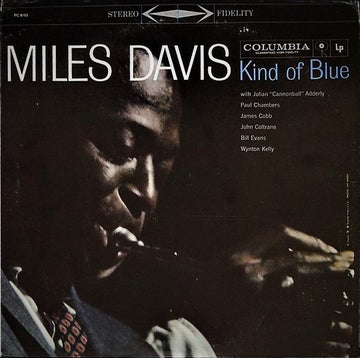
It’s not the record you see pictured. For now we’re keeping the title a mystery, consistent with the idea that we give out lots of bad stampers on this blog, but almost never do we give out the good ones. (When we do give out the best stampers, we keep the title a mystery. We are not the least bit interested in putting ourselves out of business.)

The discussion for today revolves around the idea held by a great many audiophiles that the White Label Promo copies are going to be the best sounding pressings of almost any album they might happen to run across.

And, to be fair, in the case of this mysterious double album, they’re right.

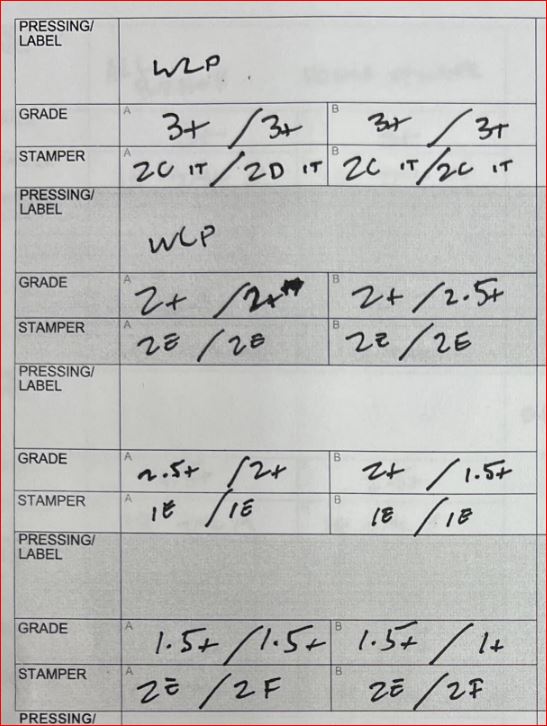
Our two best sounding copies were White Label Promos.

What interests me in these findings is that the stampers for a White Label Promo copy, the second one, the one with mostly Super Hot grades, are almost identical to the one that came in last in the shootout, with barely passable grades.

If an audiophile collector were to go to Discogs, find the WLP pressings, write down their stampers, and then check them against the copies he owned or might want to buy, he could either find himself with a top quality copy, or a not-nearly-as-good copy, depending on his luck. (And side four of the worst pressing earned a sub-Hot Stamper grade of 1+.)

Why one set of stampers sounds so much better than another set, or the same or similar set on a different pressing, is a mystery.

Does anyone have a practical way to get around the unfortunate reality that allows one set of stampers to sound great and the same or a similar set of stampers to sound not much better than decent?

Well, we can’t say there is a practical way, but we do know of an impractical one. We’ve been practicing and refining that one for more than twenty years.

(more…)

Mapleshade Thinks Female Vocals Are Good for Turntable Setup

Years ago, in a section on their site, Mapleshade recommended a female vocal for turntable setup and mentioned Blue by name.

How much deep punchy bass is there on Blue? Barely a trace in the piano, that’s it. Blue is a good record for testing some sonic qualities, not at all good for testing others.

Our advice: do not limit yourself to a female vocal recording when setting up your turntable.

We use Bob and Ray Throw a Stereo Spectacular because it is BIG.

How big is Blue? How big can it get? How big is it supposed to be?

We asked that very question about a Heart album we liked to test with years ago. As you can imagine, it is an impossible question to answer when one has only a single copy of the album.

Blue is simply not a good test for size, power, weight or energy.

These things are very important to us — we talk about them in almost every Hot Stamper listing we write — and if you are not the kind of audiophile BS record lover whose collection is full of Sarah McLachlan and Patricia Barber “vinyls,” they should be every bit as important to you as they are to us.

They are what make music fun and exciting.

Don’t you want your music to be fun and exciting?

We sure do. It’s practically a three word definition for the kinds of records we sell.

(more…)

We Used to Blame CCR’s Records for the Bad Sound We Heard Too

Hot Stamper Pressings of the Music of Creedence Clearwater Revival Available Now

Another entry that falls under the heading of

What’s the big idea?

Before 2008 or so we had regularly been frustrated with the sound of this band’s recordings. There were plenty of  customers for their albums, but even our best Hot Stampers fell well short of the standards we set for high quality sound by other artists.

We assumed the recordings were at fault.

Things started to turn around after that, judging from this bit of boilerplate at the bottom of a listing for Green River from around 2010 or so:

Many copies were gritty, some were congested in the louder sections, some never got big, some were thin and lacking the lovely analog richness of the best — we heard plenty of copies whose faults were obvious when played against two top sides such as these.

The best copies no longer to seem to have the problems we used to hear all the time.

Of course the reason I hadn’t heard the congestion and grittiness in the recording is that two things changed. (1) We found better copies of the record to play — probably, can’t say for sure, but let’s assume we did — and (2) we’ve made lots of improvements to the stereo since the last time we did the shootout.

You have to get around to doing regular shootouts for any given record in order to find out how far you’ve come, or if you’ve come any distance at all. Fortunately for us the improvements, regardless of what they might comprise or when they might have occurred, were incontrovertible. The album was now playing at a much, much higher level.

It’s yet more evidence supporting the possibility, indeed the importance, of taking full advantage of the revolutions in audio of the last ten or twenty years. [Make that thirty by now.]

Live and Learn

When Creedence’s records started to sound good, we stopped blaming those albums for being badly recorded.

It’s amazing how many records that used to sound bad — or least problematical — now sound pretty darn good. 

Every one of them is proof that comments about recordings are of limited value.

The recordings don’t change. Our ability — and yours — to find, clean and play the pressings made from them does, and that’s what Hot Stampers are all about.

(more…)

The Million Dollar Stereo (Updated)

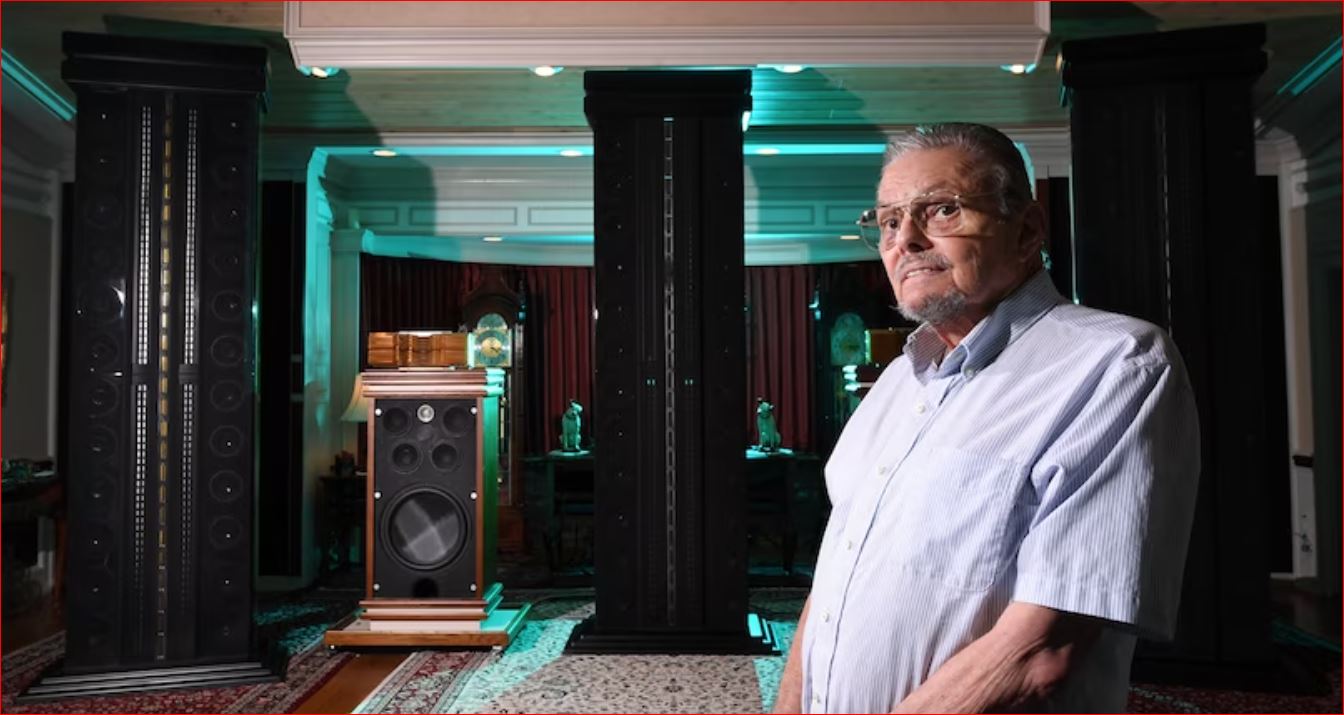
Ken Fritz turned his home into an audiophile’s dream — “the world’s greatest hi-fi”.

What would it mean in the end?

Geoff Edgers has written a highly entertaining story about an extremely misguided audiophile who went “searching for perfect sound” in ways that practically guaranteed he would never find it.

There are a number of lessons to be learned from this fellow’s mistakes.

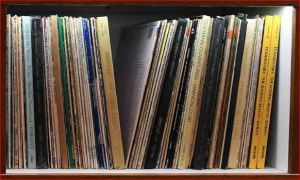
Just to take one obvious example, this picture of some of the records in his collection speaks volumes, at least it does to me.

He built a million dollar stereo to play records like these?

No amount of money spent on equipment can make most of these titles sound good, and failure to appreciate that fact is just one of the many fatal errors the late Mr. Fritz made in his approach to both records and audio.

He mistakenly thought he was at the “I know everything” stage, but that is just the prelude to the stages of knowledge where real understanding and progress begin, not end.

My own stereo history may be of some value in helping to shed light on these issues. Like everyone else, I started at the bottom. Thank god I didn’t have a million dollars to waste back then because I clearly didn’t understand audio any better than the late Mr. Fritz did.

Like him and practically every audiophile I’ve ever come in contact with, I sure thought I did. Having suffered myself from a serious case of pretentious-knowledge syndrome, it’s easy for me to spot the signs in others. (My understanding is that you can’t sign up on the Hoffman Forum without first proving your know-it-all bona fides.)

Why So Uncomfortable?

In a recent letter I received about the Dynavector 17dx cartridge we use, this question was posed:

Why is it that audiophiles are so uncomfortable with the idea that they might be wrong? I mean, you can’t improve if you think you are already right.

I answered as follows:

I was no different back when I started. For about my first ten years in high-end audio, roughly 1975-85, I bought the most expensive equipment that I could afford, as long as it sounded good to me and was well-liked by those whose ears I trusted.

Is the audiophile of today doing anything different?

What would you be doing if you hadn’t stumbled on a guy with some credibility — he sold you some records that sounded amazing, so he must know something — who turned you on to some audio stuff that sounds great and, better yet, didn’t cost that much?

And how did this guy — me — come to find out about all this stuff in the first place? Well, I’ll tell you.

He had a good audio friend who turned him on to Dynavector cartridges twenty years ago (but oddly enough not the really good one they sell. I had to make that leap for myself).

And this audio friend had learned through extensive trial and error that there were certain receivers one could pick up for cheap at thrift stores that offered excellent, audiophile-quality sound. (Trial and error were his forte. This is the same guy that clued me into the concept of Hot Stampers, a life-changing concept if ever there was one.)

As it turned out, even my friend did not know how good the sound of the receiver he sold me could be when fed by a top quality outboard phono stage, something he did not have access to. (The receiver’s phono stage is decent but hopelessly outclassed by the EAR 324p we use.)

I ended up buying four or five different models with mediocre-at-best sound before I realized the one I owned must be a fluke. Then I bought three more of the model I liked and they all sounded different too, although they ranged in sound at most from excellent to crazy good. So I put the best sounding one in my system and kept the other three for backup. Like I said, they were cheap.

When I met my friend George Louis in San Diego back in the 80s, he had a much better system than I did. He was using non-audiophile-approved equipment that drove custom speakers. He showed me that my audiophile electronics and my Fulton so-called state-of-the-art speakers were not nearly as good as I thought they were. What did I know back then? Not as much as I thought I did, that’s for damn sure.

When I moved to Los Angeles in 1987, I met a fellow audiophile named Robert Pincus and we quickly became friends. I was selling vintage classical records to audiophiles (along with lots of other records) and he was supplying me with whatever Shaded Dogs, Mercs, Londons, EMIs and such that he could dig up with top quality sound and surfaces.

He showed me that no two records sound the same, and even that often two sides of the same record don’t sound the same. Once I had a chance to listen to some of the “Hot Stamper” pressings he brought me, I was sold.

(more…)

We Learned a Valuable Lesson About Goats Head Soup in 2016

More of the Music of The Rolling Stones

Presenting a classic case of live and learn.

We would agree with very little of what we had to say about Goat’s Head Soup as a recording when we wrote about it back in 2011 — and for the previous 35+ years since I had first played a domestic original. (Turns out the imports are no good either.)

Having done a big shootout for the album in 2016, we now know that there most certainly are great sounding pressings to be found, because we found some. We broke through.

The data are in, and now we know just how wrong we were.

In our defense, let me just ask one question: Did anybody else know this record was well recorded? I can find no evidence to support anyone having ever taken such a contrarian position.

But we’re taking that position now.

All it takes is one great sounding copy to show you the error of your ways, and we had more than one.

Here’s what we had to say back in 2011. After having played dozens of copies and never hearing the record sound more than passable, can you blame us?

(more…)

Challenging Our Assumptions for Better Sound

Robert Brook runs a blog called The Broken Record, with a subtitle explaining what the aim of his blog is:

A GUIDE FOR THE DEDICATED ANALOG AUDIOPHILE

Here is Robert’s latest posting.

CHALLENGING Our ASSUMPTIONS For BETTER SOUND

We’ve written about the lessons to be learned from the misguided exploits of the late Mr. Fritz ourselves, and you can read all about them here.

(more…)

A Pink Label Island LP Left Us with Egg on Our Face

Hot Stamper Pressings of the Music of Traffic Available Now

We used to think that The Best of Traffic had better sound than the early pressings of Mr. Fantasy, but in a head to head comparison with a killer copy we played not long ago, we were proved wrong, or, perhaps more accurately, we proved ourselves wrong, something we pride ourselves in being able to do by carrying out regular shootouts for records we’ve been listening to for more than twenty years.

Oddly enough, in our shootouts we often learn new things about records we thought we knew well.

Here is what we had to say about one of the tracks on Mr. Fantasy that we thought sounded dramatically better on The Best of Traffic back around 2005:

Best evidence: Heaven Is In Your Mind, the second track on side one. It is amazing sounding here and such a disappointment on every Pink Label Island original we’ve played.

Once you know how good that song can sound — by playing a Hot Stamper copy of Best of Traffic like this one — going back to the original version of the song found on the album is not just a letdown, it’s positively painful. Where’s the analog magic? The weight to the piano? The startling clarity and super-spaciousness of the soundfield? The life and energy of the performance?

They’re gone, brother. Not entirely gone, mind you, more a shadow of what they should be, but once you’ve heard the real thing it’s not a lot of fun listening to a shadow.

You can be sure that we did not know what we were talking about when we wrote all that.

What we had done is assumed that all the pink label pressings of Mr. Fantasy sounded like the one we played, something we’ve been telling audiophiles for twenty years not to do, because collecting records by label is a fool’s game.

In this case, clearly we are the fools.

It probably — probably, since all the evidence points in the same direction — had the stampers you see below, apparently known as an Orlake Pressing, something I knew nothing about until reading about it on Discogs just now.

  • Matrix / Runout (Side A, stamped): ILPS+9061+A
  • Matrix / Runout (Side B, stamped): ILPS+9061+B

These same stampers would be used to press the Pink Rim Label copy you see below. We put it into a recent shootout and described it as having “hollow, dubby” sound.

Yes, we heard the very same “dubby” sound on a copy we played about twenty years ago, and thought all the early pressings on Island, pink and pink rim alike, had these same mastering shortcomings.

Back then we didn’t know what we know now, which is that the right UK pressings on Island of Mr. Fantasy are dramatically better sounding.

(more…)

Should We Follow George Martin’s Expert Advice?

Hot Stamper Pressings of the Music of The Beatles Available Now

Scroll down to the bottom and click on the lighter text for “2 Comments” to read someone’s defense of the mono mixes, followed by our reply.


One of our good customers had this to say about the new Revolver pressing and The Beatles in mono:

Hey Tom,

I think the Revolver new thing doesn’t sound terrible. It’s just what you’re comparing it with. Most people are going off original pressings maybe and the acclaimed mono and stereo box stuff that came out in the last 10 years. IF you don’t try one of those Harry Moss records or a 1970s pressing, you probably think the new Revolver is fine or even good. That’s my theory. Who knows.

And as far as mono vs. stereo… you know the answer to this but I’m not sure. Were those earliest records meant to be mono or recorded as if they would be put out as mono and later records – maybe Rubber Soul on – meant to be stereo? I don’t know the answer to that. But maybe that’s why people are so loyal to mono. They feel like “this is how it was meant to be heard by the artist.”

George Martin was very clear about that, the first two albums for sure and really, the first four are, for him, better heard in mono than stereo.

Dear Sir,

I disagree. I think George heard the playback on studio monitors stuck on a wall five feet from his head.

Who cares what that sounds like?

Nobody who isn’t mixing a record would ever listen to music that way, certainly not in this day and age.

More importantly, who are you going to believe, your lying ears or George Martin?

This is fundamental to understanding everything to do with audio and records.

Richard Feynman summed it up beautifully:

Science is the belief in the ignorance of experts.

Watch the Let It Be documentary produced by Peter Jackson, especially the last part where they play the album back for everyone who was involved in the making of it.

With four crappy monitor speakers lined up left to right and shoved up against a wall.

This is how they listened to the album in order to approve Glyn Johns’ mix and the takes he chose to use?

(more…)

Rock Of Ages – A Definitive Sonic Assessment?

Hot Stamper Pressings of Roots Rock Albums Available Now

In 2006 we put up a copy with with what we implied were Hot Stampers (before we were using the term regularly) on at least one side:

“Side One sounds tonally right on the money! This is as good as it gets… Robert Ludwig mastered all of the originals of these albums, but some of them have bad vinyl and don’t sound correct.

“I only played side one of the album, so I can’t speak for the other sides, but what I heard was sound about as good as I think this album can have.”

There are some truths along with some half-truths in the above comments, and let’s just say we would be quite a bit more careful in our language were we writing about that copy today.

One side is no indication whatsoever as to the quality of the other three, and without the kind of cleaning technologies we have available to us today, I wouldn’t want to make a “definitive” sonic assessment for any of them.

When you play uncleaned or poorly cleaned records, you’re hearing a lot of garbage that has nothing to do with the sound of the vinyl itself.

Note that we are joking above: there is no such thing as a definitive sonic assessment of a record, from us or anybody else.

Mistaken audiophile thinking? We’ve done our share and then some.

We firmly believe that plenty of audio progress awaits us all, but to realize that progress we must rationally approach the problems encountered in reproducing music in the home, thinking about them critically, not as True Believers, but as skeptics who require empirical evidence to support their beliefs.

It is axiomatic with us that the more skeptical you become, the more successful you will be in pursuing this devilishly difficult hobby of ours.

(more…)

Do All the Early Stamper Shaded Dog Pressings of this Title Sound Good?

Hot Stamper Pressings of Living Stereo Recordings Available Now

Below you will see the full stamper sheet for a shootout we did recently.

Note that the album you see pictured — LSC 2265 — is not the record we did this particular shootout for.

We are not revealing what mystery title had these stampers and earned these grades for the simple reason that we rarely if ever give out the specific information that identifies the best sounding pressing of any album.

As I’m sure you can understand, we want you to buy the copy with the Hottest Stampers from us, not find one on your own! We’re happy to be somewhat helpful, but naturally we find it necessary to draw the line somewhere, and giving out “the shootout winning stampers” are where we choose to draw it.

One set of stampers for the mystery Shaded Dog pressings we played in our most recent shootout sounded consistently subpar.

(more…)