Label Advice

Some of the titles listed here have better sound on labels that many record collectors would probably not assume would be the best.

Other titles have inferior sound based on the labels we’ve identified in these listings.

Keep in mind that all the practical advice you see here is based solely on the numerous experiments we’ve run and the data we’ve collected from them.

Sidewinder on the Liberty Label Might Sound Dubby and Weird

Hot Stamper Pressings of Blue Note Recordings Available Now

The top copy from our most recent shootout went for $1500 and, in our opinion, was worth every penny of that amount, being one of the best sounding jazz records we have ever played

It probably took us ten years to get this latest shootout going, but the best copies we played were so impressive that they made all the time and money it took to pull it off worth the effort — what a record!

The copies that do not have VAN GELDER in the dead wax are very unlikely to be any good. The Liberty label pressing that we played in our shootout was minty and cost us a pretty penny, but the sound was No F***ing Good.

It’s yet another reason we don’t judge records by their labels.

Of course, as all our customers know, we judge records by one thing and one thing only: their sound.

Our shootout winner may have been a reissue, but it sure wasn’t one of those copies you can find on the Liberty label without VAN GELDER in the dead wax.

(more…)

Art Pepper Today – Latest Findings

Hot Stamper Pressings of the Music of Art Pepper Available Now

UPDATE 2024

In 2010 we wrote a commentary about the album which can be found here.

It’s a long story that goes into great detail comparing the sound of the original Galaxy pressings with those of the much more common OJC’s.

Fourteen years later (!) and here we are, finally getting to the point where we have enough copies of Art Pepper Today to do a proper shootout.

Since this is a title we have not played in a very long time, we took the opportunity to give a quick listen to both kinds of pressings just to make sure that both could be expected to do well enough to be included in the shootout.


The OJCs Fall Short in a Different Way

Well, it turns out that the OJC pressings are no longer cutting it. That’s money down the drain.

It seems to be the case that they are dark and hard sounding compared to the Galaxy pressings.

This is a bit surprising because most of the OJC pressings that we don’t like are thin and bright, not dark and hard.

That’s not the way OJC’s typically sound, but in the world of records, when has that ever counted for anything?

Patterns are helpful up to a point, but on this album, the patterns we see across the label have broken down, which is why our business is built upon a foundation of playing every record we sell and judging it strictly on its own merits.

There are just too many exceptions to whatever patterns we may think we have detected.

(more…)

Roxy Music’s Debut Is a Masterpiece

Folks, this is a true Demo Disc in the world of art rock.

It’s rare to find a recording of popular music with dynamics such as these.

In both music and sound, this is arguably the best record the band ever made. Siren, Avalon and Country Life are all musically sublime, but the first album has the kind of dynamic, energetic, POWERFUL sound that their other records simply never show us. And we’ve played them by the dozens, so there’s a pretty good chance we will never find copies with the abundant richness and power we find here.

We hope you will agree with us that it was entirely worth the wait, as this album is a MASTERPIECE of Art Rock, Glam Rock and Bent Rock all rolled into one.

AMG calls Roxy Music the “most adventurous rock band of the early ’70s” and I’m inclined to agree with them. Roxy are certainly one of the most influential and important bands in my growth as a listener and audiophile, along with Supertramp, Ambrosia, 10cc, Steely Dan, Yes, Bowie and others, groups of musicians dedicated to exploring and exploding the conventions of popular music.


Want to find your own killer copy?

(more…)

On King Crimson’s Red Album, How Good Are the Polydor Pressings?

Hot Stamper Pressings of the Music of King Crimson Available Now

Harsh and congested.

Not remotely competitive with the British originals.

Clean copies on the UK Island label may be hard to find, but they are the only game in town if you are serious about sound.

Want to find your own killer copy?

Consider taking the following moderately helpful advice.

As of 2024, shootouts for this album should be carried out:

How else can you expect to hear the record sound its best?

Based on our experience, Red sounds better:

That’s about it. They are neither easy nor cheap to find, but they are definitely the best sounding.

There’s more collecting help where that came from. Click on the top link below to learn about the pressings that win shootouts.

(more…)

How Do the Columbia Special Products Reissues Sound on Mingus Dynasty?

Hot Stamper Pressings of the Music of Charles Mingus Available Now

In general it is best to avoid pressings with the round sticker you see to the left, the one attached to the Columbia Special Products bargain reissue series.

They are rarely much better than awful, although there are a few exceptions to that rule. (There are almost always exceptions to the kinds of rules collectors use to find the best sounding records.)

The 6 Eye label domestic stereo pressings of Mingus Dynasty win our shootouts, in this case without exception.

On this title, the 360 label pressings, Black Print or White Print, can sound very good, but they never win shootouts.

We’ve identified a select group of reissues with the potential to do well in shootouts, typically earning a grade of Super Hot (A++) when up against the best originals, which are the only ones that seem to have the potential to earn our top grade, White Hot (A+++).

(more…)

Avoid the Tan Labels and Non-TML Pressings for Nilsson Schmilsson

Hot Stamper Pressings of the Music of Harry Nilsson Available Now

Not that we would ever claim that TML in the dead wax guarantees good sound.

Side two of our tan label copy below was passable, but that’s sonically a very long way from the top copies we played, which of course were all TML, with lots of different stampers, none of which we are likely to reveal, now or in the future, for reasons we are sure you understand.

Anyone who buys one of our White Hot Stamper copies will definitely know, but we only find a couple of those every few years, as this is not a shootout that’s been easy to do for a very long time.

Make sure your equipment is tuned up and the electricity is good before you get anywhere near a pressing of this album.

Big production pop like this is hard to pull off. Harry did an amazing job, but the recording is not perfect judging by the dozen or so copies I played this week and the scores I’ve suffered through before.


Nilsson Schmilsson is an album we think we know well, one that checks off a number of important boxes for us here at Better Records:

(more…)

For Top Quality Sound on Maiden Voyage, Skip the Black B

Blue Note Pressings with Hot Stampers Available Now

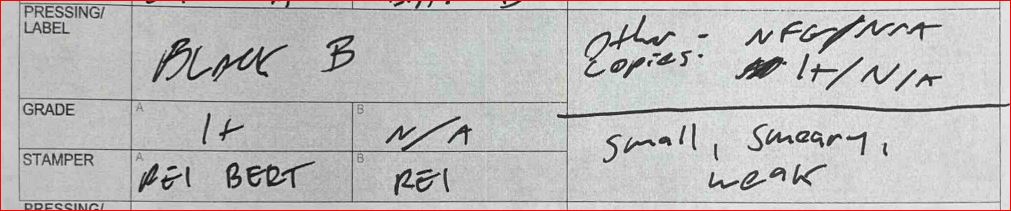
The three copies we had in our recent shootout for Maiden Voyage on the 70s Black B label did poorly.

Like a lot of the records we play when they weren’t mastered properly, they were small, smeary and weak. Considering how bad they sounded, it’s possible — accent on the word possible — that someone remastering the album for a modern audience could do a better job than Blue Note was doing in the late-70s.

This, of course, is not our standard, nor should it be anyone else’s.

Below you will find links to other records with the same problems as this Blue Note reissue.

(more…)

Skip the Later Labels of this Rodrigo Title on the TAS List

More of the music of Joaquín Rodrigo (1901-1999)

This is a TAS list title that deserves its place on a list of Super Discs, as long as you are talking about one that sounds the way the best copies do.

The best sides are exceptionally transparent and full of energy, with the lush strings of the guitars sounding much more textured and real. The orchestra is rich and sweet, especially for a Mercury, yet the guitars are clear, present and appropriately placed relative to the surrounding ensemble.

But all the later label pressings we’ve bought over the years, mostly because we could afford to buy them, hoping for a miracle, have fallen well short of the mark. The notes below tell the story of their typical and obvious shortcomings.

Side One of the most recent late label pressing we played was crude, smeary and hot (bright).

Side Two was even worse, it was very hot (bright).

If you want to avoid records with these problems, click on any of the links below to see the titles we’ve found over the years with the same issues.

(more…)

Forget the STS Labels with Black Print on Images Pour Orchestra

More of the music of Claude Debussy (1862-1918)

None of the pressings on this later Stereo Treasury label that we played in our most recent shootouts were very good, unlike the Silver Print labels, which can sound quite respectable.

At this stage of the game, we’ve learned our lesson and will not be giving any more of the Black Label pressings a chance. This goes for practically all the records we’ve played on the later Stereo Treasury label. They rarely sound any good and just aren’t worth the trouble now that we know what the best pressings are.

Both the Ansermet on London and the Munch on RCA are better recordings, but both sell for quite a bit more money than the Stereo Treasury pressings we offer, so if you can’t see spending the kind of bread they command, there is a much more affordable alternative that is guaranteed to satisfy.

(more…)

Maybe We SHOULD Start Buying Blue Notes on the Early Labels

Hot Stamper Pressings of Blue Note Albums Available Now

If there are record companies whose fans are extremely particular about the labels of the pressings they prefer, Blue Note has to be right at the top of that list.

The consensus among record collectors seems to be that the early label Blue Notes are practically guaranteed to have the best sound. In top condition they often sell for many thousands of dollars, far more than we have ever charged for any Hot Stamper Blue Note pressing

We are on record as not favoring early labels over later ones, absent the evidence to support such bias, but perhaps there actually are some records you should be buying based on their labels. This one, for example.

If all the stampers of a title are the same and they’re all cut by Rudy Van Gelder — early labels, middle labels and later labels alike — what do you use to guide you when trying to find the best sounding pressings?

This is precisely the conundrum that an audiophile would be faced with as he goes about trying to find the best sounding pressings of the Blue Note album whose stamper sheet you see below.
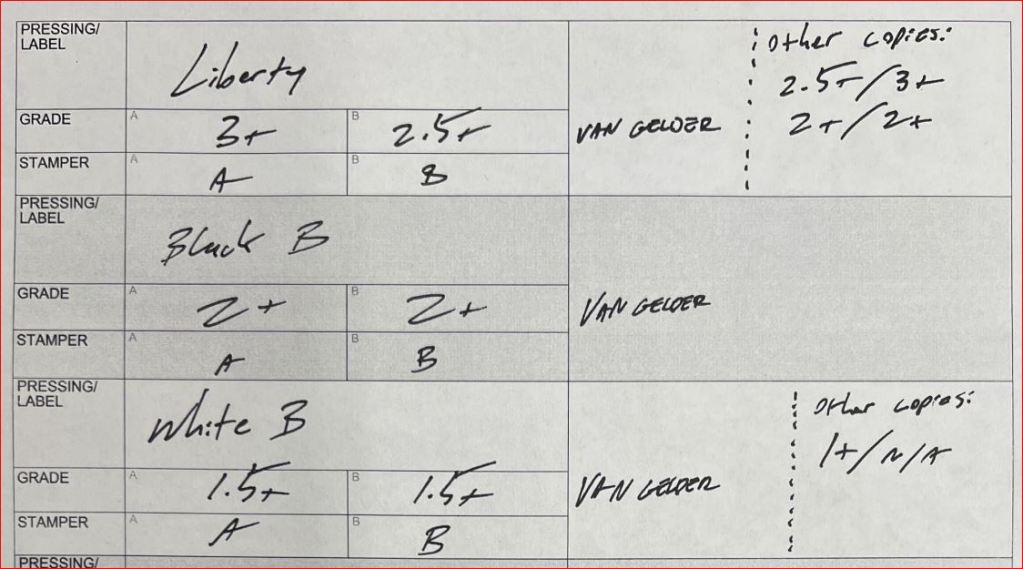
This stamper sheet reflects a fairly typical shootout for a Blue Note pressing. It’s hard to find six clean copies no matter what the title is. We probably returned or gave up on half the copies we bought, so we might have had to buy nine in order to shootout six.

(Note that there is nothing on any label after the White B from the 70s. We have never heard any title with an 80s label or later sound worth a damn so we stopped buying them a long time ago.)

Drawing Conclusions

Let’s look at some of the conclusions the typical record collector/audiophile might draw from the information above.

For example:

1.) I have a Blue Note with Van Gelder stamps and it’s decent sounding but I like [fill in the blank with some other pressing] better. Since all the pressings are cut by him, he must not have done a very good job. Thank goodness modern mastering engineer X came along to finally bring out the sound of the master tape that he was not able to do.

That’s an easy one to rebut. The later pressings cut by Rudy are consistently worse sounding than the earlier ones in the case of this title. If you don’t have a big batch to work through, however, you simply have now way of knowing that fact, and therefore whatever conclusions you choose to draw from a too-small pool of pressings are suspect at best.

(more…)