Heavy Vinyl Commentaries

Letters and commentaries on the subject of the modern remastered Heavy Vinyl pressing.

Six Ways in Which Bad Sounding Remasters Get Approved

Hot Stamper Pressings of the Music of Jethro Tull Available Now

UPDATE 2026

The comments you see below for Stand Up were written in 2023.

Unfortunately, we rarely have any stock on Stand Up, or any of the other classic Tull releases for that matter. (There is a copy of Thick as a Brick on the site as of this writing, but it may have sold by the time you read this.)

In our commentary we discuss some of the reasons why a truly awful sounding Heavy Vinyl pressing — in this case the Analogue Productions’ remaster of Stand Up — could possibly have gotten released.


Our Commentary from 2023

Here’s how we think it might have gone down.

On whatever crappy audiophile system they are using to play these records, the new pressing beat the original Pink Label Island. Drinks all around.

Not knowing that the original pressings do not sound very good — really, not knowing all that much about records period — made their job seem a lot easier than it actually was.

They didn’t produce a good sounding record. They produced a record that was (perhaps) better than a bad sounding record. They unknowingly set the bar very low.

But unknowingly is how this label has been operating from the very beginning.

I’ve written extensively about many of their bad sounding records, starting all the way back in 1995 with Way Out West.
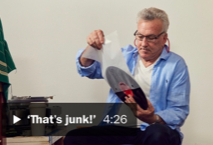
Not much has changed. You may remember from the Washington Post video years back that Geoff Edgers blind-tested me with two copies of Quiet Kenny, one from The Electric Recording Company (“this guy makes mud pies!”) and the other from Analogue Productions (‘it’s the best record they ever made, because it’s not terrible”), or words to that effect.

If I’d had a good copy of Quiet Kenny on hand, a record I think I know much better now that we have done a couple of shootouts for it, I could have elucidated all the shortcomings of the AP pressing in great detail. Instead I was stuck comparing a very bad pressing of the album to a copy that was not as bad.

(more…)

If It’s Made from the Real Master Tape, Shouldn’t Blue Sound Better than This?

Hot Stamper Pressings of the Music of Joni Mitchell Available Now

UPDATE 2026

I wrote the commentary you see below way back in 2006. I wanted to give our customers an incentive to critically listen to the new Rhino pressing of Blue, a Heavy Vinyl reissue we actually gave out for free with every Hot Stamper of the album we sold.

We wanted our customers to try and answer the question I had posed in my review as to what aspect of the sound was improved in the new pressing, relative to the vintage copy they would have just purchased from us.

For those of you who have been reading our commentaries about modern remasterings, you know that rarely do we find any area of their sound that could be considered in any way “improved.”

As you will see from our commentary below, no less a personage than Michael Fremer had said at the time that the Rhino pressing “has far greater presence and physicality and is more immediate, dynamic, detailed and especially transparent.”

As hard as it may be to believe, I actually agreed with him about one of those qualities.

I’ve broken down his list below. If you have one of our Hot Stampers and the Rhino reissue, play them back to back and try to hear what is better about the reissue. Which of the following does it have more of compared to even the best vintage pressings?

  • More presence,
  • More physicality (whatever that is),
  • More immediacy,
  • More dynamics.
  • More detail,
  • More transparency

I had posed this question on the blog over the course of many years and never got anything approaching a serious answer.

(more…)

Houses of the Holy on Classic Records and 156 Other Records No Audiophile Should Want Anything to Do With

Hot Stamper Pressings of the Music of Led Zeppelin Available Now

Houses of the Holy is another one of the very bad records Michael Fremer put on his 2009 Top LP list, while passing over one of Classic’s better titles, the first Led Zeppelin album.

(We don’t like it as much as we used to, but it is still a good record if you get a good pressing of it, something that can never be guaranteed of course. We link to our review of it below.)

Michael Fremer’s web site used to be called called musicangle (now defunct). On this site you would have been able to find a feature called “157 In-Print LPs You Should Own!”

Surprisingly it seems that the link still works. If I had made a list this misguided, it surely would have turned into a “I’m sorry,  I didn’t know what I was talking about” commentary. I would have felt an obligation to correct the record, out of sheer embarrassment at the very least.

But this guy apparently never learns. As far as he’s concerned, what worked in 1982 ain’t broke and don’t need fixing.

(more…)

Robert Brook’s Guide to Legrand Jazz on Impex

Robert Brook has a blog which he calls

A GUIDE FOR THE DEDICATED ANALOG AUDIOPHILE

Robert tries to remain positive when choosing the words that would best describe the award winning Impex release of Legrand Jazz. In the end he goes with the spoken word over the written one.

Years ago I wrote about how important the Legrand Jazz album was for me in my growth as a critical listener. It’s yet another example of an album that helped make me a better audiophile by showing me the errors of my tweaking and tuning ways.

Let’s watch the video and see what Robert has learned about Impex’s recent release.

Legrand Jazz (featuring Miles Davis) – the 2019 IMPEX Double 45 rpm

Michael Fremer gives the Impex pressings an 11 for sound. He writes (emphasis added):

“This IMPEX reissue is sourced from an “analog mix-down transfer of the original 1958 work tape by Mark Wilder at Battery Studios” and cut by Chris Bellman and Bob Donnelly at Bernie Grundman Mastering on Grundman’s all-tube mastering system. I have a clean, original 6-Eye pressing that this superbly pressed reissue betters in every way. This will make both your stereo and your heart sing. Some of the greatest jazz musicians of that or any era wailing and clearly having a Legrand time. Limited to 3000 copies. Don’t miss it!”

Who are you going to believe, the Self-Appointed Vinyl Experts of the World and Bestowers of Prestigious Audio Awards (awards which you may have never heard of; I sure hadn’t), or some guy who’s just dedicated to being an Analog Audiophile and knows a good record when he hears one? (Or doesn’t hear one, as the case may be.)

Like Robert, I tried being kinder and gentler, but it didn’t take. I may resolve to try harder in 2024 2026. Then again, I may not. If we’re nicer to the people currently making Heavy Vinyl records, aren’t we running the risk, to cop a line from the late, great P.J. O’Rourke, of encouraging them?

(more…)

Good Digital Beats Bad Analog Any Day

Hot Stamper Pressings of the Music of Sonny Rollins Available Now

And this is some very bad analog indeed!

We here present our 2010 review of the Sonny Rollins Plus 4 album, the one remastered on two slabs of 45 RPM Analogue Productions Heavy Vinyl.

It has everything going for it, right?

Steve Hoffman, Kevin Gray, 45 RPMs, Heavy Virgin Vinyl, fancy packaging — clearly no expense was spared!

The ingredients may have been there, but the cake they baked was not only not delicious, it was positively unlistenable — I mean, inedible.

I cannot recall hearing a more ridiculously thick, opaque and unnatural sounding “audiophile” pressing than this Rollins record, and believe me, I’ve heard plenty. (And it seems the bad news will never stop.)

As I noted in another commentary “Today’s audiophile seems to be making the same mistakes I was making as a budding enthusiast more than thirty forty years ago. Heavy Vinyl, the 45 RPM 2 LP pressing, the Half-Speed limited edition — aren’t these all just the latest audiophile fads, each with a track record more dismal than the last one?”

It reminds me of the turgid muck that Doug Sax was cutting for Analogue Productions back in the 90s. The CD has to sound better than this. There’s no way could it sound worse.


CD Update:

I managed to track down a copy of the CD and it DOES sound better than this awful record, and by a long shot. It’s not a great sounding CD, but it sure isn’t the disaster this record is.

Buy the CD, and whatever you do, don’t waste money on this kind of crap vinyl.


This is a very bad sounding record, so bad that one minute’s play will have you up and out of your chair trying to figure out what the hell is wrong with your system. But don’t bother. It’s not your stereo, it’s this record.

It has the power to make your perfectly enjoyable speakers sound like someone wrapped them in four inches of cotton bunting while you weren’t looking.

(more…)

Universal Japan and the Economics of Buying a Pig in a Poke

Skeptical Thinking Is Critical to Finding Better Records

One of my good customers sent me this email shortly after this series came out, circa 2000:

I noticed that Universal Japan has come out with several new titles, stuff I’m interested in, like Stevie Wonder / Innervisions… Stan Getz, James Brown… and many others — that are on acousticsounds.com.

Generally, for these somewhat expensive heavy vinyl releases (relative to used prices), I’m trying to stick with stuff where your site has favorable comments regarding the sound quality, but you don’t seem to carry these new items.

Do you think they are bad, or you just have not had a chance to check them out yet?”

I replied as follows:

We have a longstanding antipathy toward records pressed in Japan that were not recorded in Japan. (Here is one of the exceptions because the mastering was done by the real mastering engineer, using the real tape, here in America. There are also some excellent direct to disc albums that were recorded here in the states and subsequently pressed in Japan.)

Japanese pressings almost NEVER sound good to these ears. The only report I’ve heard concerned Aja, which was that it was awful, bright as bright can be.

A Japanese pressing that’s too bright? Shocking. Say it isn’t so.

We are going to be carrying almost no new releases of Heavy Vinyl pressings from now on.

They just don’t sound good to us and we don’t want to waste our time playing bad records when there are so many good ones sitting around that need a loving home.

If you pay $30 for Heavy Vinyl reissues and only one out of five sounds good — an optimistic estimate if you ask me — you’re really paying $150 for the one good one, right?

This makes no sense to me. And since the real odds are one out of ten, it’s really $300 for the good one.

(more…)

How Does the Heavy Vinyl Pressing of Harvest Sound?

 Hot Stamper Pressings of the Music of Neil Young Available Now

How does the Heavy Vinyl of Harvest sound?

We have no idea. We’ve never played a copy.

Actually, that’s not true. We do have an idea.

Although we’ve never auditioned the Heavy Vinyl pressing of Harvest, we have played the newly remastered After the Gold Rush. We concluded that this is a reissue series that should hold very little appeal for audiophiles. Some excerpts from our review:

We know what the good pressings of the album sound like, we play them regularly, and this newly remastered vinyl is missing almost everything that makes the album essential to any Right Thinking Music Lover’s collection.

We can summarize the sound of this awful record in one word: boring. Since some of you may want to know more than that we’ll be happy to break it down for you a bit further.

What It Does Right

It’s tonally correct.

Can’t think of anything else…

What It Does Wrong

Where to begin?

It has no real space or ambience. When you play this record it sounds as if they must have recorded it in a heavily padded studio. Somehow the originals of After the Gold Rush, like most of Neil’s classic albums from the era, are clear, open and spacious.

Cleverly the engineers responsible for this audiophile remastering have managed to reproduce the sound of a dead studio on a record that wasn’t recorded in one.

In addition, the record never gets loud. The good pressings get very loud. They rock, they’re overflowing with energy.

And, lastly, there’s no real weight to the bottom end. The whomp factor on this new pressing is practically non-existent. The low end of the originals is huge, deep and powerful.

The Bottom Line

This new Heavy Vinyl pressing is boring beyond belief (tip of the hat to Elvis Costello there). I wouldn’t give you a nickel for it. If Neil Young actually had anything to do with it he should be ashamed of himself.

If you want a good copy of the album we have them on the site from time to time. If you can’t afford our Hot Stampers, please don’t waste your money on this one. I have an old CD from 30 years ago, and it is dramatically better than this LP.

Pass / Not Yet

We think the Heavy Vinyl pressing of After the Gold Rush is so awful that whatever supporters it may have — and there are surely some who have spoken highly of it on audiophile forums somewhere, having seen the most ridiculously bad audiophile records touted again and again — are failing utterly in this hobby in one or both of the following ways.

(more…)

Classic Records Had an Epiphany in 2007 – UHQRs Actually DO Sound Good

More Records Perfectly Suited to the Stone Age Stereos of the Past

Don’t believe your ears!

Listen to Mike Hobson. After all, he’s the expert, right?

This commentary was written in 2007 and we admit it may be a bit long in the tooth for the brave new world of Heavy Vinyl we currently find ourselves in. Classic Records has been gone for a while now and when that blessed day came we were finally able to say good riddance to their bad records.


Mike Hobson thinks he knows why his pressings often don’t sound good and/or are noisy. We’ll let him explain it. If you want the whole story (which goes on for days) you can find it on the Classic Records website, assuming it’s still active. While you’re there, remember the sound.

One day, while out for a run, I had an epiphany and rushed home to dig out a JVC pressing from the 1980’s pressed for Herb Belkin’s Mobile Fidelity. The Mobile Fidelity UHQR pressings were always revered as sounding better than the standard weight pressings from JVC [citation needed, big time] – but why I thought? To find out, I cut a UHQR pressing in half and guess what I found? First, it weighed 195 grams and IT WAS A FLAT PROFILE! I cut a 120g JVC pressing in half and found that it had the conventional profile that, with small variations, seems to be a record industry standard and is convex in it’s [sic] profile – NOT FLAT.

So, that is why the UHQR JVC pressings sounded better than their standard profile pressings and further confirmation of why our Flat Profile pressings sound better than 180g conversional pressings! [italics added]

This is a classic (no pun intended) case of begging the question, asserting the very thing that Mr. Hobson is trying to prove.

There was no need to saw up a record. Mofi actually explained in the booklet for every UHQR how its shape differed from a conventional disc.

(more…)

The Law of Large Numbers Can Help You Find Better Records

Presenting another entry in our series of big picture observations concerning records and audio.

One of our good customers had this to say about some Hot Stampers he purchased recently:

Hey Tom,   

I’m going out of my frigging mind on this White Hot stamper of Roy Orbison Greatest Hits. What a piece of sh*t is my DCC test pressing.

Naz

Naz,

I actually used to like the DCC vinyl. I suspect you did too back in the day.

Then my stereo got a lot better, which I write about under the heading progress in audio.

Eventually it became obvious to me what was wrong with practically all of the Heavy Vinyl pressings that were put out by that label.

The good ones can be found in this group, along with other Heavy Vinyl pressings we liked or used to like.

The bad ones can be found in this group.

And those in the middle end up in this group.

Audio and record collecting (they go hand in hand) are hard. If you think either one is easy you are most likely not doing it right,, but what makes our twin hobbies compelling enough to keep us involved over the course of a lifetime is one simple fact, which is this: Although we know so little at the start, and we have so much to learn, the journey itself into the world of music and sound turns out to be not only addictive, but a great deal of fun.

Every listing in this section is about knowing now what I didn’t know then, and there is enough of that material to fill its own blog if I would simply take the time to write it all down.

Every album shootout we do is a chance to learn something new about records. When you do them all day, every day, you learn things that no one else could possibly know who hasn’t done the work of comparing thousands of pressings with thousands of other pressings.

The Law of large numbers[1] tells us that in the world of records, more is better. We’ve taken that law and turned it into a business.

It’s the only way to find Better Records.

Not the records that you think are better.

No, truly better records are the records that we proved to be better empirically, by employing rigorous scientific methodologies that we have laid out in detail for anyone to read and follow.

Being willing to make lots of mistakes is part of our secret, and we admit to making a lot of them

(more…)

Letter of the Week – “My stereo upgrades have widened the sonic chasm between good, old-fashioned records and their nouveau imposters.”

Record Collecting for Audiophiles – These Are the Fundamentals

One of our good customers, Dan, found much to agree with in our recent Better Record’s record collecting commentary and offered up his own two cents worth in the letter below. (Emphasis added.)

Tom,

Just wanted to affirm the new Better Records axiom of “the better your stereo gets, the fewer modern reissues you will own.” My collection has dozens of these Heavy Vinyl reissues, and none of them are holding up after a year and half’s worth of significant improvements to my stereo.

It was only at the beginning of last year that I found myself pleased with roughly 50% of my heavy vinyl purchases. Now, that number has plummeted to less than 10%. Almost everything that’s being put out today is an utter disappointment.

Of course, part of the explanation may be that my listening skills have improved. But it’s hard to imagine that I would have liked dull, dreary, lifeless vinyl a year or two ago. I like to think not.

More probable is that my stereo upgrades have widened the sonic chasm between good, old-fashioned records and their nouveau imposters.

I’d also like to second the avoidance of new vinyl purchases until major stereo improvements are made. I’m trudging through the laborious task of replacing these records with older, better sounding copies. It’s excellent advice to those new to the game or young (or both).

Amazingly, hearing the difference doesn’t even require a Hot Stamper, almost any original or early reissue will beat the Sundazed, Classic, etc. That’s how inferior they are. To borrow from The Who, the sound must change.

Dan,

I agree with this bit at the end of your letter, with one caveat:

Amazingly, hearing the difference doesn’t even require a Hot Stamper, almost any original or early reissue will beat the Sundazed, Classic, etc. That’s how inferior they are.

The caveat would be if you know how to clean your records right, right in this case being the way we recommend you clean them, using Prelude fluids and a machine.

Old uncleaned records can sound pretty bad. An audiophile pressing may beat your old original — until you clean it.

It’s one of the revolutionary changes in audio we spend so much time talking about, and it can make all the difference in the world on some records, especially old ones.

Thanks for your letter. You are not alone in swearing off these modern mediocrities. Many of our customers went through the same process you have, and it seems they are as pleased with the results as you.

Best, TP

(more…)