*Collecting Better Records

Ideas and methods for collecting the best sounding pressings of your favorite music.

What It Took to Find Hot Stamper Pressings of Two Very Tough Titles

Hot Stamper Pressings of the Music of Talking Heads Available Now

[Emphasis added.]

Hey Tom, 

Just got my Super Hot Stampers of Remain In Light and Station To Station. I was very much looking forward to the arrival of these LPs… I was not disappointed. Verily, I was completely floored!

First, my apologies. I have been reading your website for over two years, gleaning information to help me find Hot Stampers, or at least good sounding records. I had not made a purchase until this past week. I was starting to feel guilty; you have given me so much great direction and guidance over these years, and I had not supported you in the proper way.

So I made a modest purchase of these two records, to assuage my guilt and support your efforts. You will be getting much more business from this satisfied customer.

I have Remain In Light on LP, CD and even the FLAC file release. My new Hot Stamper truly puts these recordings to shame. No, really, TO SHAME! If this ever gets on the Better Records Testimonials: “People let me tell you…it’s sent a chill up and down my spine…”!

I really can’t believe how well balanced the sound is: great bottom end, mids are pronounced and the shrillness is GONE! No smear anymore! Breathtaking.

My copy of Station to Station is just as wonderful.

I’ve been convinced of “Hot Stamper” recording for quite some time now, thanks to Tom and the BR crew; I’ve found some great recordings after conducting my own modest shoot-outs. Found some real gems. But the best results that I have ever got, and there are only a few, have now been easily matched and outstripped by my first BR purchase!

Rob

Rob,

Thanks for your enthusiastic letter. We’re on the same page. I too get excited when I hear my favorite music sound better than I ever expected it would. (more…)

How Can You Tell When the Conventional Wisdom Is Wrong?

Skeptical Thinking Is Critical to Achieving Better Sound

Let me be clear: conventional wisdom applied to collecting higher quality vintage vinyl pressings will be right more often than it is wrong. If it were the other way around, it would not be wisdom, it would be folly.

The person who applies the kind of advice you see described below will surely end up with a decent collection of records, records which will no doubt be better sounding than if he were buying records randomly.

As we said, conventional wisdom generally gets more records right than wrong. More right than wrong, yes, but plenty wrong just the same. That is the subject of this commentary.

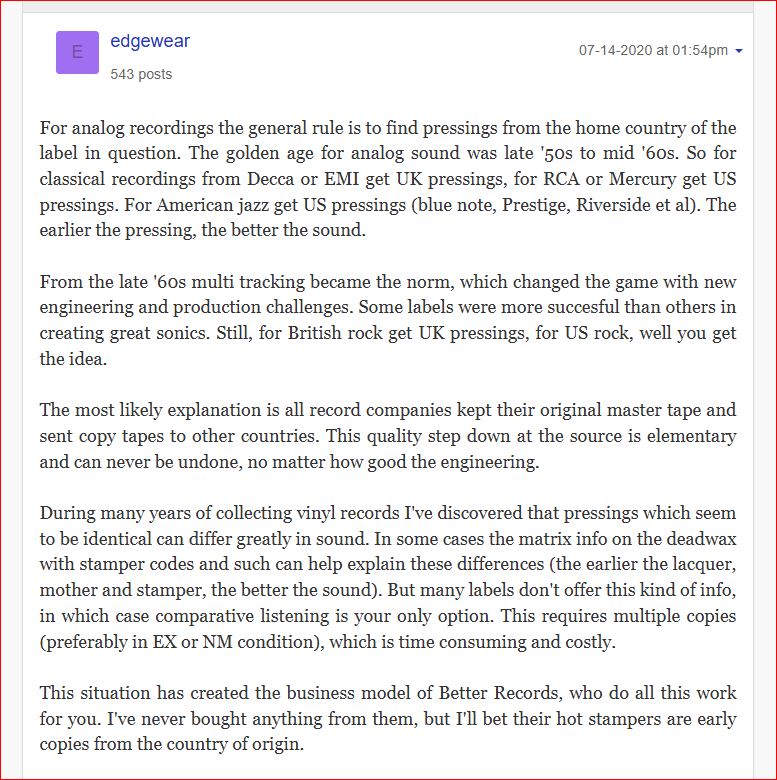
Mr. edgewear does us a huge favor by laying out a great many of the most popular tenets of record collecting advice in the two posts below. (I probably found his post on the Steve Hoffman forum discussion of Hot Stampers. It goes on for days.)

I plan to follow up on some of these assertions in greater detail. (Please note that “assertions” is the most accurate description of the information Mr. edgewear provides, as there is simply no effort made to provide evidence of any kind to back up his pronouncements, the standard operating procedure for the internet.)

Let’s look closer at some of the most likely results if someone were to follow the advice offered above.

(more…)

Two Approaches to Finding Better Records (and One of Them Actually Works!)

Skeptical Thinking Is Key to Finding Better Sounding Records

If you want to believe the press releases, the hype, the liner notes, the reviews (which are rarely more than the worst kind of malpractice in our opinion) and all the rest of it, that’s your business.

Good luck with that approach; you’re going to need it. When you reach the dead end that more than likely awaits you, come see us.

After 35 38 years in the record business there is a good chance we will still be around.

Our approach, on the other hand, revolves around cleaning and playing as many records as we can get our hands on, and then judging them on their merits and nothing but their merits, calling them as we see them as best we can, without fear or favor.

Our judgments may turn out to be wrong. Tomorrow we may find a better sounding pressing than the one we sell you today. It doesn’t happen very often, but it does happen.

We don’t know it all and we’ve never pretended that we did. All knowledge is provisional. We may not be the smartest guys in the room, but we’re sure as hell smart enough to know that much.

If somehow we did know it all, there would not be a hundred entries in our live and learn section.

We regularly learn from our mistakes and we hope you do too.

But we learn things from the records we play not by reading about them, but by playing them. Our experiments, conducted using the shootout process we’ve painstakingly developed and refined over the course of the last twenty years, produces all the data we need: the winners, the losers, and the ranking for all the records in-between.

We’ve learned to ignore everything but the sound of the records we’ve actually played on our reference system.

What, of any real value, could someone possibly tell us about a record that we’ve played for ourselves?

(more…)

Bernie Finds the Right Sound for The Genius After Hours

charlgeniusHot Stamper Pressings of Titles that Sound Better in Mono Available Now

This commentary was written about ten years ago has been updated with the latest information from the shootout we did in 2025.


Proof positive that there is nothing wrong with remastering vintage recordings if you know what you’re doing. These sessions from 1956 (left off of an album that Allmusic liked a whole lot less than this one) were remastered in 1985 and the sound — on the better copies mind you — is correct from top to bottom.

The highest compliment I can pay a pressing such as this is that it doesn’t sound like a modern remastered record.

It sounds like a very high quality mono jazz record from the 50s or 60s.

Unlike modern recuts, it doesn’t sound EQ’d in any way.

It doesn’t lack ambience the way modern records do.

It sounds musical and natural the way modern records rarely do.

If not for the fairly quiet vinyl, you would never know it’s not a vintage record. The only originals we had to play against it were too noisy and worn to evaluate critically. They sounded full, but dark and dull and somewhat opaque.


UPDATE 2025

The originals on the Atlantic Plum and Red Label are not the way to go on this album. Our shootout notes below make that clear. Take our friendly and helpful advice and steer clear of them.

(more…)

In the Real World, You Can Only Choose Two Out of Three

More Heavy Vinyl Commentaries and Reviews

I got this idea while thinking about the old saying:

Fast, cheap and good – pick two.

I’ve modified this saying into a version for audiophiles that takes into account that although some record collectors with top quality equipment may want to pursue the modern Heavy Vinyl pressing, they will run into the unavoidable reality that as their stereo starts to sound better, their new Heavy Vinyl records will start sounding worse.

They may want to get many things out of audio and record collecting, but they can’t have it all.

As will explain in detail further on, they will be forced to limit themselves to two of the following three.

Let’s assume that the audiophiles who collect modern records are those who:

  1. Want to have a revealing, accurate stereo.
  2. Want to be able to enjoy their favorite music.
  3. Want to continue to buy Heavy Vinyl pressings because they enjoy buying and collecting those records.

So let’s look at what happens when they pick one of the only three combinations that are logically available to them:

If they pick one and two, they get to keep their good stereo, and they can continue to enjoy their favorite music on it, but they will not be able to play Heavy Vinyl pressings anymore and will have to stop buying them.

On high-quality equipment those records reveal their manifest shortcomings and are simply no fun to play. They can have one and two but not three.

Damn!

What about one and three then?

If they pick one and three, they can still have excellent stereo reproduction in the home, and they can still buy and collect Heavy Vinyl pressings to their heart’s content, but they will not be able to enjoy the pressings they buy. Those pressings will simply not sound very good on a system that is working properly.

One hopes that before too long these folks will recognize that all they were doing was buying junk vinyl from the grifters exploiting the lo-fi and mid-fi crowd while pretending to appeal to the higher end of the market.

The lo-fi/mid-fi types are those who, lacking high-quality playback, are simply not able to tell the difference. Good systems make it easy to expose the incompetence of the pretentious hacks who make these new records.

Bad systems let them get away with murder.

And the folks making these records probably have playback systems of such low quality that they haven’t a clue as to just how bad their records actually sound. This allows them to be both incompetent and pretentious. They don’t know how little they know, the Dunning-Kruger effect in action.

OK, apparently one and three are out. How about two and three? How might those two work together?

Not any better. Choosing one and three, audiophiles can enjoy their music, and they can play their Heavy Vinyl pressings, the ones they like to buy and collect, endlessly discussing their merits on youtube as well as every audiophile forum on the web, but they can forget having a good stereo — the better the reproduction, the worse these Heavy Vinyl LPs sound. The ultimate effect is to ruin the fun of buying, collecting and discussing them.

Options two and three are sure to be the solution audiophiles and record collectors will find the most agreeable of the three combinations available to them.

Since nothing is harder than getting good sound in the home, these audiophile/record collectors will never need to burden themselves with the effort and expense of improving their playback.

They can simply enjoy doing what they like to do, which is buying records and playing them.

Which is why everybody got into the hobby in the first place, right?

True enough, as far as it goes. For those of us who became obsessed with music and wanted to hear it at its best, mostly on vinyl, we found that if we kept working on our systems, pushing against the boundaries of trying to get higher fidelity sound in the home, we actually could break through the barriers and achieve sound quality we never expected to find.

There was, however, an unintended consequence of making so many improvements to our playback and having them build one upon another to create so many revolutionary changes.

Our stereos became so good at reproducing music from vinyl that the newly remastered records that used to sound fine began sounding worse and worse. And when I say worse and worse, I mean really, really bad.

(more…)

The One True Test for Records

More Entries from Tom’s Audiophile Notebook

There is only one true test for records: Which ones do you want to play?

Collect those and sell off all the others.

Acquiring better sounding pressings and getting rid of those that are no longer satisfying will result in a collection that is a joy to own, a collection that will provide a great deal more satisfaction than one made up primarily of collectible records.

To me there is nothing more thrilling in audio than hearing a favorite, familiar recording sound better than I ever thought it could. If that’s the kind of thrill you are looking for, I recommend you visit the site as often as you can. Something of interest is sure to pop up.

It can’t be downloaded. It can only be found — as far as I know — on an old vinyl record.

Like many of our customers who’ve had their standards raised by our Hot Stamper pressings, you may be so exhausted and disappointed by the mediocrities being churned out these days by one Heavy Vinyl grifter after another that you finally make the pledge to swear off bad records for good. Only you can free yourself of the chains that are holding you back.

Once those chains are broken, a world of possibilities will open up, populated by vintage vinyl pressings that exist by the millions all over the world, waiting to show you just how sublime and immersive and enjoyable music can sound in your very own home.

Here is a good way to get started.

(more…)

If You’re Just Getting Started, Beware of LPs that Will Inhibit Your Progress

Hot Stamper Pressings of Blue Note Albums Available Now

Robert Brook wrote a scathing review of the Tone Poets pressing of One Flight Up in 2023, much to the dissatisfaction of some of his readers. I was the first to leave a comment as I thought he hit the nail on the head when he said:

Overall, the Tone Poet is closed, distant and frankly boring to listen to. Where is the energy of the music? Where is the presence of these musicians? Where is the studio space?

The snare sounds muted. the piano weak, the horns, especially Gordon’s saxophone, resolves poorly and becomes increasingly tiresome to listen to. On my first listen I lasted about 3 minutes into side 1, mostly because I couldn’t stand the way the sax was sounding.

I posted the comments below on Robert’s review. (I have taken the liberty to rewrite some of my comments for the purposes of clarity, along with some additional thoughts.)

Robert,

Another great post. I have many comments to make, so here goes.

When audiophiles prefer records which are clearly second-rate, more often than not I chalk it up to their lack of a better record to play. In order to hear what they are missing, they have to have a record that somehow makes clear to them precisely which aspects of the sound are failing, or at the very least, not up to par.

You could give out the stamper numbers for your Blue Note reissue — I would be surprised if it does not have VAN GELDER STEREO in the dead wax — and those who like the Tone Poets release of One Flight Up could easily find one on Discogs or Ebay and do the comparison for themselves.

But you know what? I would bet you dollars to donuts they will never do that. They simply won’t bother.

(more…)

Building a Store of Knowledge, One Record at a Time

Hot Stamper Pressings of the Music of Elton John Available Now

We recently ran across the commentary below in a reply to a Hot Stamper testimonial for Honky Cat. Drawing on our own experience, we give a quick and dirty primer on how one can build up one’s knowledge of records, stampers, labels, pressing variations and the like.

We don’t really give out much in the way of specific information about any of those things; we just tell you how it can be done. It’s your job to go out and do it. It’s simple: just follow the path we have laid out for you. How tough can it be?

Phil wondered how we could find such an amazing sounding record, which in this case is a rhetorical question.

Phil knows exactly how we find them, because he shops at the same L.A. stores we do and finds a few himself — the only way it can be done, the old-fashioned way.

We buy them, clean them and play them, just like Phil does.

The difference these days is one of scale. With seven or eight people [now ten to twelve] finding, cleaning and playing records every day, we can probably shootout forty or fifty or even a hundred times as many records as any suitably dedicated single person working by himself could.


It turns out, as a practical matter, no such person seems to exist. At least we can find no evidence to support the existence of anyone doing shootouts like the ones we do.

Sure, these kind get done, which may fool some people, but they don’t fool us.


And to find the raw material (LPs, what else?), it helps immensely if you live in a major city like L.A., where records, even high-quality ones, are still abundant, if not ubiquitous. [Not so much anymore.]

After a shootout, one of my favorite things to do is [was, I’m retired now] jot down the stampers for the hottest copies.

I then head right out to my favorite record stores to search through the bins and — even better — the overstock underneath.

So many times I’ve thrilled to the purchase of an album with exactly the right stampers that very day, a copy that I would never have known to buy had we not just done the shootout.

Streamlining the Process

This is how record knowledge builds: one LP at a time. To that end we’ve streamlined the system of finding Hot Stampers, turning the process into a rough kind of science and devoting well over a hundred manhours a week to the effort.

It’s time-consuming and expensive, but every week we find Hot Stamper copies of great albums that MURDER the competition, in the process often dramatically changing our expectations of how good that music can sound. We call them breakthrough pressing discoveries.

It’s the most fun part of the record business.

The rest of it, if I can be honest, I could happily do without. 

(more…)

The Reissues Consistently Beat the Originals on this Mystery Mercury

Hot Stamper Pressings of Mercury Classical Records Available Now
For Mercury classical and orchestral recordings, the original FR pressings on the plum labels are the way to go, right? 

In some cases, yes. We talk about how much better the FR pressings for The Firebird are compared to the much more common, and still quite good, M2 reissue pressings here.

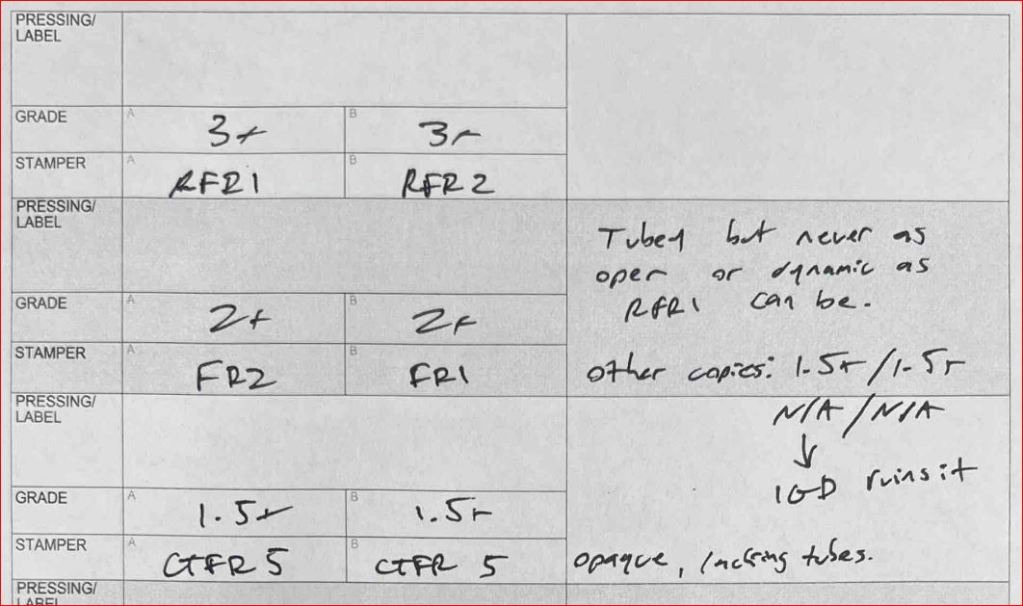
The stamper numbers you see below belong to a different album.

The notes for the FR originals we played read:

  • Tubey but never as open or dynamic as RFR-1 can be.

The better of the three FR pressings we played was not a bad sounding record, earning a grade of 2+. They’re just not as good sounding as the RFR reissues, which, of course, are the ones that win shootouts.

Something to keep in mind: A Super Hot Stamper Mercury orchestral record is guaranteed to be dramatically better than any Heavy Vinyl reissue ever made.

(more…)

Commitment Issues We All Must Face

Hot Stamper Pressing of the Music of Joni Mitchell Available Now

UPDATE 2026

This commentary about a very special 2-pack was written close to ten years ago. We think it’s every bit as true today as it was then.


The long and the short of it is simply that when it comes to collecting high quality vinyl:

There are no easy answers and there are no quick fixes.

To those of us who have been doing this for a long time, the above is obvious, perhaps even axiomatic in the sense that it is a “self-evident truth that requires no proof.”

(The fact that the modern audiophile reviewer class has yet to appreciate this basic concept goes a long way in explaining how inadequate and error-prone their approach to records and audio has always been. Some of them may still be living in 1982, but I’m glad to say we’re not. Our business could not exist in 1982. Many of the technologies on which it is based had not yet been invented.)

Once you stop looking for easy answers and quick fixes, you will then be free to build a truly wonderful stereo system and acquire a superb sounding record collection to play on it. It will, naturally, and to some of you surprisingly, comprise virtually nothing but vintage vinyl.

The album under discussion today is Joni Mitchell’s Song to a Seagull. Our commentary begins:

It took two records to make this White Hot Stamper 2-pack, with top quality sound from start to finish. The result? One of the best sounding, if not THE best sounding copy to ever hit the site. If you’re a Joni fan this is one of her strongest records, and one that definitely belongs in your collection. If you own any other pressing we’re confident that this copy will positively blow your mind.

These two sides have the kind of sound quality you probably never imagined would be possible — but it is! We played it, we heard it for ourselves, and now we offer it to you, the Joni Mitchell (nee Roberta Joan Anderson) fans of the world.

(more…)