Albums to Improve Your Playback

Listening in Depth to Pretzel Logic

Hot Stamper Pressings of the Music of Steely Dan Available Now

It’s positively criminal how mediocre this amazingly well-recorded album sounds on the average pressing of it. How can you possibly be expected to appreciate the music of Pretzel Logic when it sounds like that?

The reason we audiophiles go through the trouble of owning and tweaking our temperamental equipment is that we know how hard it is to enjoy good music when it doesn’t sound right.

Bad sound is a barrier to deeper understanding and a more intense listening experience, which is why I spent 50 years building a stereo that could play a record like Pretzel Logic right, or at least as right as I could get it to sound. (Speaking of sound, acquiring this preamp only a few years after discovering the music of Steely Dan changed everything for me.)

I also credit Pretzel Logic, probably more than any other album of theirs, with helping me dramatically improve the quality of my playback.

Side One

Rikki Don’t Lose That Number

By far the biggest hit on this album and one of the biggest for the band, it’s also one of the clearest indicators of Hot Stamper Sound. The Horace Silver inspired intro is at its best when you can easily hear the acoustic guitar in the left channel doubling the piano. On most copies it’s blurry and dull, which causes it to get lost in the mix. Transparent copies pull it out in the open where it belongs.

That’s the first test, but the real test for this track is how well the (surprisingly) DYNAMIC chorus is handled. On a properly mastered and pressed copy, Fagen’s singing in the chorus is powerful and very present. He is RIGHT THERE, full of energy and drive, challenging the rest of the band to keep up with him. And they do! The best copies demonstrate what a lively group of musicians he has backing him on this track. (If you know anything about Steely Dan’s recordings, you know the guys in these sessions are the best of the best.)

Check out the big floor tom that gets smacked right before the first chorus. On the best copies the whomp factor is off the scale.

Shocking as it may seem, most copies of this album are DOA on this track. They’re severely compressed — they never come to life, they never get LOUD. The result? Fagen and the band sound bored. And that feeling is contagious.

Of course few audiophiles have any idea how dynamic this recording can be because they’ve never heard an especially good pressing played back on a big speaker system in a big room.

Only a handful of the copies we played had the truly powerful dynamics heard on the best copies. These are Pretzel Logics with far more life than I ever dreamed possible. Who knew?
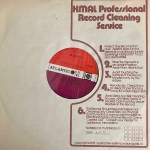
As an aside, back in 1976 I had my fifty favorite albums professionally cleaned on a KMAL record cleaning machine at the stereo store I worked at. They would give you a custom record sleeve along with the cleaning, and sure enough I found my original Pretzel Logic with its KMAL sleeve. My copy was pretty good but no Hot Stamper. So, yes, it really did take us thirty years to find the best copy!

(I took the picture of the KMAL sleeve you see to the left partly because it provides a piece of factual evidence that I really didn’t have a clue about records in 1976. I was proud to be the owner of an original British pressing of Led Zeppelin II — which is absolutely the wrong pressing of the album if you are interested in good sound — but of course I had no way to know that back then.  (more…)
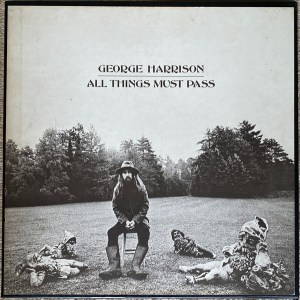
George Harrison – All Things Must Pass

More of the Music of The Beatles

  • This early British box set of All Things Must Pass with the reissued (but still original looking) box boasts stunning Nearly Triple Plus (A++ to A+++) grades or close to them on all SIX sides – just shy of our Shootout Winner
  • If you’ve struggled with domestic pressings and later imports or Heavy Vinyl reissues, your troubles are over – here is the sound you were looking for
  • This is a tough record to play, but if you devoted plenty of time and money into your system, and you have big dynamic speakers and the power to drive them to fairly loud levels, you are really in for a treat with this set
  • 5 stars: “Without a doubt, Harrison’s first solo recording is his best. Drawing on his backlog of unused compositions from the late Beatles era, Harrison crafted material that managed the rare feat of conveying spiritual mysticism without sacrificing his gifts for melody and grand, sweeping arrangements.”
  • This is clearly George Harrison’s best sounding album. Roughly 150 other listings for the best sounding album by an artist can be found here.
  • This is a Must Own title from 1970, an exceptionally good year for rock and pop music
  • Ken Scott used a great deal of tube compression in the mixing and mastering of the album, which of course makes the sound exceptionally Tubey Magical. No modern reissue we’ve ever played has been able to capture that sound
  • The flip side is that it is also one of the most difficult to reproduce, requiring the highest quality, most transparent, least distorted, most highly-tweaked equipment in order to cut through the layers and layers of sound

(more…)

Lincoln and Doug Produced The Audiophile Sgt. Pepper of Its Day

Hot Stamper Pressings of the Music of Lincoln Mayorga Available Now

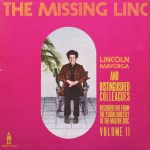
When I was selling audio equipment back in the 70s (Audio Research, Fulton speakers), The Missing Linc this was a favorite Demo Disc in our store.

With a big speaker like the Fulton J, the bass drum at the end of track two would shake the walls. At the time I had never heard a record with bass that went remotely that deep. (The album came out in 1972. I’m guessing I probably first heard a copy in ’75 or ’76 when I bought my Fultons, which would have been sometime in my early twenties.)

Every bit as amazing to me was the string quartet on side 2. You could actually hear the musicians breathing and turning the pages on their music stands, just as if you were actually in their “living presence.” No recording I had ever owned allowed me to hear that level of natural detail.

This is one of the albums that made me realize how good audio in the home could be.

(more…)

Tom Petty – Hard Promises

More of the Music of Tom Petty

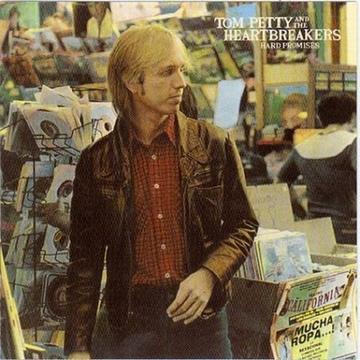
  • A Hard Promises like you’ve never heard, with solid Double Plus (A++) grades from top to bottom – exceptionally quiet vinyl too
  • Recorded at Sound City, home to some of the greatest analog sound ever recorded, this 1981 Backstreet pressing still has plenty of analog magic in its grooves
  • 4 1/2 stars: “…filled with great songwriting, something that’s as difficult to achieve as a distinctive sound… ‘The Waiting’ became the best-known song on the record, but there’s no discounting ‘A Woman in Love,’ ‘Nightwatchman,’ ‘Kings Road,’ and ‘The Criminal Kind,’ album tracks that would become fan favorites… it has a tremendous set of songs and a unified sound that makes it one of Petty’s finest records.”
  • If you’re a fan of Tom Petty and his hard-rockin’ bandmates, this is a classic from 1981 that belongs in your collection

The album tends to be bright, thin, edgy, pinched and gritty — radio friendly, maybe, but not especially audiophile friendly.

We hate that sound but we are happy to report that some copies manage to avoid it, and this is one of them.

Is that richer, fuller sound the sound of what’s on the master tape or did the mastering engineer “fix” it?

We’ll never know, obviously. How could we?

What we do know is the sound of the pressings we actually have to play, and this one is killer.

Recorded by Shelly Yakus at Sound City, Van Nuys and at Cherokee Studios, Hollywood, CA, this vintage Backstreet pressing has the kind of Tubey Magical Midrange that modern records can barely BEGIN to reproduce. Folks, that sound is gone and it sure isn’t showing signs of coming back. If you love hearing INTO a recording, actually being able to “see” the performers, and feeling as if you are sitting in the studio with the band, this is the record for you. It’s what vintage all analog recordings are known for — this sound.

(more…)

Listening In Depth to Let It Be

Hot Stamper Pressings of the Music of The Beatles Available Now

This is the first time we’ve discussed individual tracks on Let It Be.

Our recent shootout [now many years ago], in which we discovered a mind-boggling, rule-breaking side one, motivated us to sit down and explain what the best copies should do on each side of the album for the tracks we test with. Better late than never I suppose. 

These also happen to be the ones that we can stand to hear over and over, dozens of times in fact, which becomes an important consideration when doing shootouts, as we must do them for hours on end.

On the better pressings the natural rock n’ roll energy of a song such as Dig A Pony will blow your mind. There’s no studio wizardry, no heavy-handed mastering, no phony EQ — just the sound of the greatest pop/rock band of all time playing and singing their hearts out.

It’s the kind of thrill you really don’t get from the more psychedelic albums like Sgt. Pepper’s or Magical Mystery Tour. You have to go all the way back to Long Tall Sally and Roll Over Beethoven to find the Beatles consistently letting loose the way they do on Let It Be (or at least on the tracks that are more or less live, which make up about half the album).

Side One

Two of Us

Dig a Pony

On the heavy guitar intro for Dig a Pony, the sound should be full-bodied and Tubey Magical, with plenty of bass. If your copy is too lean, just forget it, it will never rock.

What blew our minds about the Shootout Winning side one we played recently was how outrageously big, open and transparent it was. As the song started up the studio space seemed to expand in every direction, creating more height, width and depth than we had ever experienced with this song before.

(more…)

Bashin’ Is a Good Test for Setup, Tweaks, Room Treatments, etc.

Hot Stamper Pressings of Large Group Jazz Recordings Available Now

On side one of Smith’s (and Oliver Nelson’s) Masterpiece, Bashin’, the bell tree in the right channel on track one is a great test for top end extension, resolution of harmonic complexity, overall clarity and freedom from smear.

Get all the top end you can from whatever turntable adjustment, tweak or room treatment you’re messing around with, then check to make sure that all the brass instruments still sound right. If they do, you are probably good to go.

Blary, smeary, leading-edge-challenged horns are the kiss of death on this album, as are grainy, gritty, transistory ones.

When the horns have clarity, correct tonality, plenty of space around them and a solid, full-bodied sound, probably every other instrument in the soundscape will too. Other records with brass instruments that are good for testing can be found here.

(more…)

Led Zeppelin – Led Zeppelin IV

More of the Music of Led Zeppelin

  • A Zep IV that was doing just about everything right, earning solid Double Plus (A++) grades on both sides
  • Insane rock and roll energy like nothing you have ever heard – the sound is full-bodied and reasonably smooth, making it possible to get the volume up good and high where it belongs
  • Here are the rock and roll classics that reign supreme to this very day – “Black Dog,” “Rock & Roll,” “Stairway to Heaven,” “When the Levee Breaks,” every one sounding better than you’ve ever heard them or your money back
  • There are some bad marks (as is sometimes the nature of the beast with these Classic Rock records) on “Rock and Roll,” but once you hear just how excellent sounding this copy is, you might be inclined, as we were, to stop counting ticks and just be swept away by the music
  • 5 stars: “Encompassing heavy metal, folk, pure rock & roll, and blues, Led Zeppelin’s untitled fourth album is a monolithic record, defining not only Led Zeppelin but the sound and style of 70s hard rock.”
  • If you’re a fan of the band, this title from 1971 is clearly one of their best, and one of their best sounding
  • The complete list of titles from 1971 that we’ve reviewed to date can be found here.

It is a positive THRILL to hear this record rock the way it was meant to. If you have big speakers and the power to drive them, your neighbors are going to be very upset with you when you play this copy at the listening levels it was meant to be heard at.

You’d better be ready to rock, because this copy has the ENERGY and WHOMP that will make you want to. Zep IV demands loud levels, but practically any copy will punish you mercilessly if you try to play it at anything even approaching live levels.

(more…)

Which Is More 3-Dimensional, Mono or Twin Track?

Hot Stamper Pressings of the Music of The Beatles Available Now

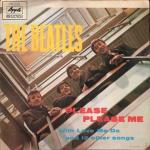
With all due respect to George Martin, we’ve played a number of mono pressings of Please Please Me in the past twenty or so years and have never been particularly impressed by any of them.

The monos jam all the voices and instruments together in the middle, stacking them one in front of the other, and lots of musical information gets mashed up and simply disappears in the congestion. 

But is twin track stereo any better?

Yes, when you do it the way Norman Smith did on Please Please Me.

Twin Track stereo (which is actually not very much like two-track stereo, I’m sure Wikipedia must have a listing for it if you’re interested) is like two mono tracks running simultaneously. It allows the completely separate voices to occupy one channel and the completely separate instruments to occupy another, with no leakage between them.

On some stereos it may seem as though the musicians and the singers are not playing together the way they would if one were hearing them in mono. They are in fact recorded on two separate mono tracks, the instruments appearing in the left channel and the singers in the right, separated as much as is physically possible.

Stuck in their individual stereo speakers, so far apart from one another, the members of the band don’t even seem to be playing together in the same room.

That’s on some stereos, and by some stereos I mean stereos that need improvement. Here’s why.

Three-Dimensional Mono?

In the final mixing stage, Norman Smith added separate reverb to each of the two channels, sending the reverb for the sound recorded in each channel to the opposite channel. This has the effect of making the studio, the physical space that The Beatles appear to be in, seem to stretch all the way from the right channel, where the Beatles’ voices are heard, to the back left corner of the studio, where the reverb eventually trails off.

(more…)

Listening in Depth to JT

Hot Stamper Pressings of the Music of James Taylor Available Now

There are at least five or six James Taylor records that I would happily nominate as Desert Island Discs.

His albums set a standard that few other singer/songwriters’ albums can meet. Joni Mitchell comes to mind, and, like our friend James here, she explored many different styles of music throughout her career, the mark of a true artist.

After her, though, I would be hard pressed to name anyone with a body of work as extensive as Mr. Taylor’s.

And just to be clear, this would include all pop and rock artists from the 60s right through to the present. He is one of the greats in my book, and many of his albums are Must Owns.

And this is especially true for us audiophiles. The sound quality of the better pressings of most of his albums is consistently superior to the work of others from that time. Peter Asher deserves most of the credit for that.

Don’t try to start with the first album, which we can’t find for you because only the British pressings sound good and they are just too hard to find in clean condition [even though we did manage to do the shootout in 2022].

Instead go right to Sweet Baby James and JT.

The next group to pursue would contain Mud Slide Slim, Gorilla and In the Pocket.

Follow that up with One Man Dog and Dad Loves His Work (so underrated!).

(more…)