uhqr

“Ultra High Quality Records” or “Lipstick on a Pig”?

Hot Stamper Pressings of Audiophile Recordings Available Now

Today’s vinyl-loving audiophile seems to be making the same mistakes I was making more than forty years ago. Heavy Vinyl, the 45 RPM 2 LP pressing, the Half-Speed Limited Edition — aren’t these all just audiophile fads, each with a track record of underperformance that seems to worsen with each passing year? Would you really want to defend this piece of junk in 2023?

In my formative years in audio, starting in the mid-70s, it would never have occurred to me to buy more than one copy of a record. I didn’t need to do a head-to-head comparison in order to find out which one sounded better. I approached the subject Platonically, not scientifically: the record that should sound better, would sound better.

uhqrb

Later on in the decade, a label by the name of Mobile Fidelity would come along claiming to actually make better sounding pressings than the ones the major labels put out, and cluelessly I bought into that nonsense too. (To be fair, sometimes they did — Waiting for Columbus and American Beauty come to mind if you don’t have properly-pressed, properly-mastered originals, but my god, Katy Lied, Year of the Cat and Sundown have to be three of the worst sounding records I’ve ever played in my life.)

And isn’t it every bit as true today as it was in the past that the audiophiles who buy these “special” pressings, like the ones I bought back in the 70s and 80s, rarely seem to notice that many of them don’t actually sound good? (Some of the worst can be found here, the worst of the worst here.)

CofAEasy Answers and Quick Fixes

Turns out there are no easy answers. There are no quick fixes. In audio there’s only hard work and more hard work. That’s what gives the learning curve its curvature — the more you do it, the better you can do it.

And if doing all that work is also your idea of fun, you just might get really good at it.

If you actually enjoy playing five or ten or even fifteen copies of the same album to find the few that really sound good, and the one that sounds amazing — because hearing your favorite music the way it was meant to be heard is a positive thrill — then you just might end up with one helluva record collection, worlds better than one filled with audiophile pressings from any era, most especially the present.


Further Reading

We Used to Really Like The Forward Look on UHQR

Audiophile Records with Honest-to-Goodness Top Quality Sound

Hot Stamper Pressings of Live Jazz Recordings Available Now

This is a very old review, probably from 2010 or thereabouts.

Hard to say what we would think of this pressing today, what with our unwavering antipathy to Half Speed mastering. In the case of this record, you can add the consistently poor track record of the so-called UHQR to our list of reasons for suspecting that the quality would not in fact by Ultra High.

You are no doubt aware that the UHQR was recently brought back from the dead by Analogue Productions on a pressing whose packaging is quite a bit more impressive than its sound.

Our Old Review

This is a BRAND NEW UNPLAYED Reference 45 RPM Half-Speed Mastered UHQR LP. They only made 1,000 of these, so sealed or unplayed copies are virtually non-existent.

This is actually one of the best sounding Reference Records. It was recorded in the ’50s on location and has very natural sound. Half-Speed Mastered by Jack Hunt even!

I think the exceptionally natural sound found on this record is the result of two factors:

  1. It’s a live recording, meaning not everything can be controlled and the space is real, not engineered. And,
  2. This is early days in the recording history of Keith Johnson. As time went on he thought his engineering skills were improving, but I see little evidence of that in the results of his labors: the records he’s been making since 1957.

His records are as phony and weird as practically every other audiophile label of the day (M&K, Telarc, Chesky), no doubt the result of these audiophile types thinking they knew a lot more about recording music than turned out to be the case.

Play any vintage pressing from the ’50s to see exactly what they failed to accomplish.

We know of at least two releases on Reference Records with “astoundingly” bad sound.

Both figure prominently on our list of the worst kind of audiophile bullshit records.


Further Reading

Can’t Buy Much of a Thrill – Now with Notes!

Hot Stamper Pressings of the Music of Steely Dan Available Now

At least some of the thrills are here, and for any record on Chad’s label, that is really saying something.

Sonic Grade: B+ to A-

A few comments for the UHQR have been added since this went up on 4-4-23, now that I’ve had a chance to see the notes in full. I’ve noted the additions in brackets and sectioned some off as well.

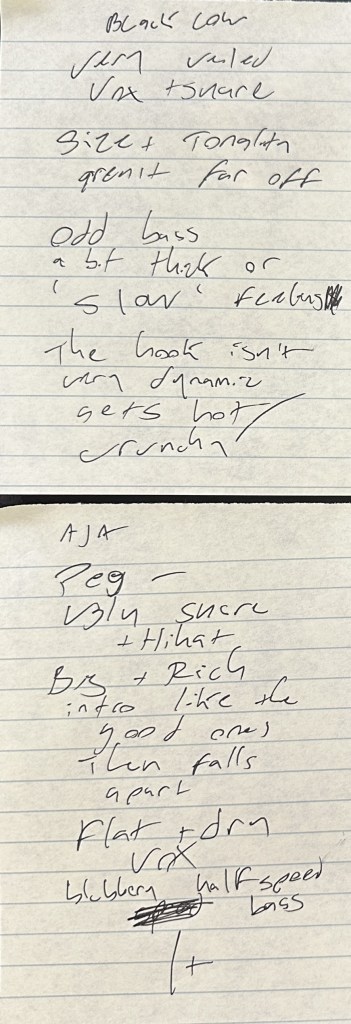
Word from the listening panel is in, and they say the new Bernie Grundman mastered UHQR is actually not bad! [Not good, but not bad.]

The tonality is much closer to correct than a lot of the Heavy Vinyl LPs we’ve played recently. Oddly enough, instead of the EQ being overly smooth, in the way that appears to be all the rage these days, the tonality instead errs on the side of somewhat thinner and brighter than ideal. (One could also use the term “correct.”)

This should not be especially surprising. Bernie Grundman has been remastering Heavy Vinyl records since the mid-’90s. Overly smooth titles that he cut are hard to find, on the hundreds of titles he did for Classic Records or anywhere else. The more of his recent work I play, the more I have come to see his disastrously dull Giant Steps as an outlier.

The instruments where these tonality issues are most easily recognized are two that we have written a great deal about on this blog: pianos and snare drums.

The snare sound on the Brothers in Arms that Chris Bellman cut at Bernie Grundman Mastering has the same problem as this new Can’t Buy a Thrill. (Review with specifics coming, sorry for the delay, it has only been two years and I’ve been busy with other things.)

The thin sounding piano on the Cisco pressing of Aja is likewise a common shortcoming we notice on many of the modern recuts we play.

With links to 29 titles to test for a correct piano sound, and 13 for the snare test, the critical listener should be able to find some records in his own collection that will shed light on the problems we heard on Chad’s UHQR.

If your system errs on the side of fat and dark, Chad’s repress has what you need to “fix” the sound of the album. Instead of a murky piano, now you have a clear one. Instead of a too-fat snare getting lost in the mix, now you have a clear snare that you can more easily separate out from the other instruments.


Added 4/5

Note that we did not play all four sides. We felt sides one and three were enough to get an idea of how thrilling this pressing was going to be. We don’t get paid to play Heavy Vinyl pressings. We play them to help audiophiles understand their strengths and weaknesses. We hope that some audiophiles will hear what we have described and perhaps consider that there is a better way. That other way can be found in the bins of their local record store or, for those with deeper pockets, on our site. Either way, settling for the kind of sound found on these modern reissues is the one choice no one should be making.

We played the following four songs, and heard the sonic qualities described below:

(more…)

Our Advice on the Sgt. Peppers Pressings to Avoid

beatlessgtHot Stamper Pressings of Sgt. Peppers Available Now

Chris, an erstwhile customer from a very long time ago, sent us a letter describing his search for a good sounding Sgt. Pepper.

The first thing that comes to mind when reading his letter is that many record collecting rules were broken in going about his search the way he did. But then I thought, What rules? Whose rules? Where exactly does one find these rules? If one wants to avoid breaking them they need to be written down someplace, don’t they?

Wikipedia maybe?

Sadly, no, not at Wikipedia, or any place else for that matter — until now. As crazy as it sounds, we are going to try to lay down a few record collecting rules for record loving audiophiles, specifically to aid these individuals in their search for better sounding vinyl pressings. And by “these individuals” we mean you.

See if you can spot the rules that were broken by Chris in his fruitless search for a good sounding Sgt. Pepper. Note that this letter came to us long before the new Beatles CDs and vinyl had been remastered.

Hi Tom

A few months ago, I purchased a new UK import of Sgt Pepper. Too bad it turned out to be digitally remastered. I had been checking your site for this album over the last few months, but only saw two: a sealed MFSL UHQR for $1000, and a hot stamper for $500, both out of my price range. So then I started looking at Ebay, and recently purchased two “sealed” versions of Sgt Pepper – a USA Apple, which cost me $170, and a USA Capitol (original rainbow label) for which I paid $80.

Tonight, I wanted to copy one of the Sgt Pepper’s to Hi-rez (192/24) DVD audio. Both sealed records from Ebay were cleaned with Last RCM record cleaner on a VPI 16.5, and treated with LAST record preservative. (My usual routine)

First I tried the Capitol (rainbow). It even had “mastered by Capitol” stamped on the run-out area, usually a good sign, I thought. The sound was quite good, except for two things:

1) the sound level drops about 3 db in the first track where they sing “We’d love to take you home with us , we’d love to take you home” (3 db drop occurs) followed by “I don’t really want to…” 2) the record has thousands of audible ticks. No kidding, when I recorded it, and looked at the waveform in Adobe Audition, there are really about 20 little ticks per second. If I try to clean it up manually, one click at a time, (my usual routine), it will take an eternity to finish the job. (slight exaggeration) [sic] So I tried the $170 sealed “Apple” purchased from someone named “sealedbeatles”.

This record is a total disaster. It has no high end. It’s like someone turned the treble all the way down (if my system had a treble control). I looked at the spectrum of a few seconds of music, and the level at 8 khz is the same as the level at 60 khz, down about 90 db. (duller than poor AM radio). The record is loaded with surface noise too. The record is totally useless.

Finally I tried the UK digitally remastered Parlophone, purchased probably from Music Direct, or some place like that. It sounds harsher than hell, and oddly has a tone actually recorded on the record at about 70 Khz, which you can “see” poking up from the noise floor in its spectrum.

I’m still looking.

Chris

My first thoughts upon receiving this letter:

There is almost no chance Chris would be successful with the approach he took.

The following would have been my five pieces of advice had he told me in advance what he was planning to do.

(more…)

1812 Overture on Telarc

More of the music of Peter Ilyich Tchaikovsky (1840-1893)

Reviews and Commentaries for Recordings of the 1812 Overture

Sonic Grade: D

If you want an amazingly dynamic 1812 with huge amounts of deep bass reproduced for the cannon, you can’t do much better than this (or its UHQR brother). 

But if you want rich, sweet and tonally correct brass and strings, you had best look elsewhere. I’ve never liked the sound of this record and I’m guessing if I heard a copy today I would like it even less. 

Who in his right mind thinks live classical music actually sounds like this?

Telarc makes clean, modern sounding records. To these ears they sound pretty much like CDs.

If that’s your sound you can save yourself a lot of money avoiding vintage Golden Age recordings, especially the ones we sell. They’re much more expensive and rarely as quiet, but — again, to these ears — the colors and textures of real instruments seems to come to life in their grooves, and in practically no others.

We include in this modern group analog labels such as Reference, Sheffield, Chesky, Athena and the like. Having heard hundreds of amazing vintage pressings, at this stage of the game I find it hard to take any of them seriously.

Twenty years ago, maybe. But twenty years is a long time, especially in the world of audio.

We started a list of records that suffer from a lack of Tubey Magic like this one, and it can be found here.

(more…)

The Planets – MoFi and UHQR Reviewed

Reviews and Commentaries for The Planets

Sonic Grade: Regular MoFi LP: F / UHQR: D

Years ago we auditioned an excellent sounding Decca Purple Label British import LP, the same performance, the same recording that Mobile Fidelity remastered (#510), but, thankfully, it sounded a whole lot better.

I just listened to both and a catalog of the faults of the MFSL pressing would be quite lengthy. I won’t waste your time listing them.

Although the recording is far from perfect, the Decca pressing shows it in its proper light. It finds the right balance between the multi-miked sound of the super disc List Mehta and a vintage recording from the Golden Age such as the famous Boult.

The sound is very dynamic and the brass has tremendous weight.

Not the MoFi. It’s thin and bright.

Their UHQR is somewhat better, not quite as thin and phony up top, but not really very good either.

Avoid them both.

Our Recommendation

Our favorite performance of The Planets can be found here.

Many of Solti’s recordings from the Seventies are not to our liking, for reasons we lay out here.


Our Pledge of Service to You, the Discriminating Audiophile 

We play mediocre-to-bad sounding pressings so that you don’t have to, a free service from your record-loving friends at Better Records.

(more…)

Does It Seem to You That This Guy Knows Much About Dark Side of the Moon?

Hot Stamper Pressings of the Music of Pink Floyd Available Now

It doesn’t to me, but I admit to some bias when it comes to DSOTM. I must have played more than a hundred different pressings over the last forty-odd years.

Year after year I was sure I understood exactly which copies had the best sound, and again and again I was proved wrong. (To be clear, I proved myself wrong. Shootouts have a way of doing that kind of dirty work.)

We only found out what the best sounding versions were about five or six years ago [make that ten]. We did that by doing shootout after shootout with every version we could lay our hands on, starting around 2005. We even did a shootout for two different Mobile Fidelity pressings many years ago, which we think makes for some good reading to this day.

It’s especially good reading for those who don’t appreciate how dramatic pressing variations can be for even quality controlled limited editions. The comparison of the two MoFi’s centers around the idea that midrange tonality is by far the most important quality to listen for on Dark Side, and that, surprisingly to some audiophiles, but obviously not to us, there are MoFi pressings with a correct midrange and there are some without.

Is this fellow listening for midrange tonality? If you watch the video and he says he is, then you can let me know!  And if not, you can ask him in the comments why he wasn’t. Maybe he just likes the chiming clocks and the deep bass of the heartbeat.

Some audiophiles have been known to ignore fundamentals such as a proper midrange when comparing records.

And picking six random copies of six different pressings is not exactly approaching the problem scientifically either of course. It is a clear violation of the first cornerstone of Hot Stamper shootouts, which clearly states the following, accent on the must:

  1. You must have a sufficient number of copies to play in order to find at least one “hot” one.

Impressive Records? Not Really

Most of the versions of DSOTM that this individual is reviewing have never impressed us sonically. They are the pressings that most audiophiles have probably heard about and read about in the magazines and on forums. If you know practically nothing about the album going in, these might be the six pressings you would consider playing against each other in a shootout. To be charitable, I suppose you could call it a good start.

Our reviewer seems to be the type who puts a great deal of faith in so-called audiophile pressings — the Japanese Pro-Use Series, the UHQR — the kinds of records that sound more and more artificial and/or mediocre to us with each passing year.

If your stereo is not showing you what’s wrong with these kinds of records, you have your work cut out for you. This is especially true of some of the Ultra High Quality Records put out my Mobile Fidelity in the early ’80s, like this one.

Our Take on DSOTM Pressings

The domestic pressings we have auditioned over the years have never made it into a real shootout. They have always sounded far too flat and veiled to be taken seriously. There are some very good sounding Pink Floyd pressings on domestic vinyl — Wish You Were Here and The Wall can both sound amazing on domestic vinyl — but Dark Side is not one of them in our experience.

(more…)

Back to the Stone Age with The Pines of Rome on Mobile Fidelity

Click Here to See Our Favorite Pines of Rome

An audiophile hall of shame pressing and another MoFi LP reviewed and found wanting.

MoFi’s version of this The Pines of Rome (#1-507) is one of the worst sounding classical records they ever made, and that’s saying something, because most of their classical catalog is awful.

Thin, bright, with sloppy bass and completely unnatural string tone — the MoFi makes the typical Classic Record sound good.

And that’s REALLY saying something.

The UHQR is somewhat better, especially in the lower octaves, but it’s maybe a D+ or C-, not a Better Record by any means.

How dull and opaque does a stereo have to be to make this record listenable?

The answer is VERY dull and VERY opaque.

Stone Age audio systems are the only ones that can play junk like this and get away with it.       

(more…)

Tea For The Tillerman – MoFi Reviewed (UHQR too)

Hot Stamper Pressings of the Music of Cat Stevens Available Now

Sonic Grade: MoFi LP: D / Sonic Grade: MoFi UHQR:

Tea for the Tillerman is, I hope it goes without saying, one of the greatest folk rock records of all time, music that belongs in any collection.

I’ve been playing this album for more than 30 years [now more than 50] and I can honestly say I’ve never once tired of hearing it.

I do get tired of hearing bad copies. I become absolutely incensed when I play the Mobile Fidelity version of this album, because what they did to this record is a travesty. If you want to know what the guitars on this album are NOT supposed to sound like, play the MOFI.

And if you want to hear an even worse version, play the UHQR.

(more…)