That’s Funny

The most exciting phrase to hear in science, the one that heralds new discoveries, is not “Eureka!” (I found it!) but “That’s funny …”
— Isaac Asimov

Domestic Pressings of Clear Spot? Forget ‘Em!

Hot Stamper Pressings of the Music of Captain Beefheart Available Now

We did this shootout many years ago, so many years ago that I cannot find a record of it.

I remember we thought the German pressings were perhaps a bit boosted on both ends and not as natural sounding as the domestic pressings.

After a multitude of improvements in our cleaning and playback, we would agree with our previous understanding that the German pressings are often wrong, but now we also know how right the right ones can be.

It turns out tha some German pressings are not particularly good, another piece of the puzzle that fell into place during our most recent shootout, as painful as that turned out to be considering the money wasted on them.

Did we have the bad German stamper pressings last time around? Who knows?

The producer, Ted Templeman, (Doobie Brothers, James Taylor) brought his mainstream talents to bear on this music, and when the Captain’s free-form tendencies smashed into Templeman’s conservatism, the result was this musical supernova — out there, but not too far out there.

(Play Trout Mask Replica sometime if you miss that feeling from your old hippie days of being on acid. With that music, drugs are entirely superfluous.)

I don’t know how many audiophiles like Captain Beefheart, probably not too many, but if you’re ever going to try one of his albums, this is the place to start: his masterpiece.

(more…)

The Original Mercury Pressings Don’t Sound Good on this Title, But Why?

Hot Stamper Pressings of Mercury Classical Recordings Available Now

For Mercury classical and orchestral recordings, the original FR pressings (when there are such pressings) on the plum label are the way to go, right? 

In some cases, yes. We talk about how much better the FR pressings for The Firebird are compared to the much more common, and still quite good, M2 reissue pressings here.

And the FR pressing of the Rachmaninoff record you see pictured above may indeed have the best sound.
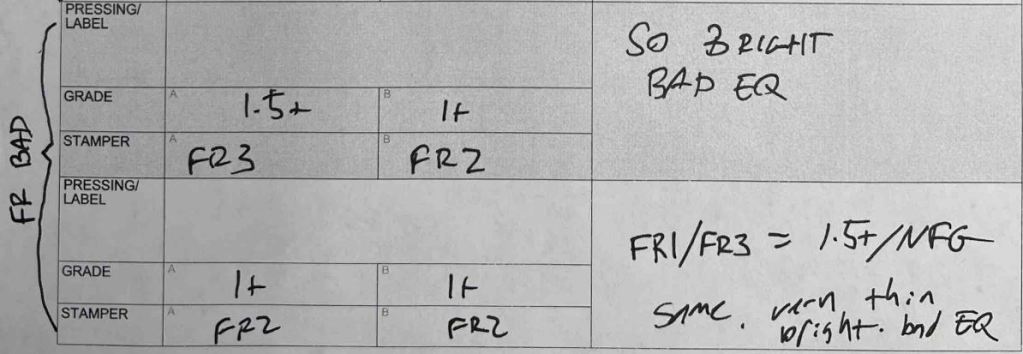

The stamper numbers you see below belong to a different album.

(We’ve lately been giving out much more stamper information than we used to, but for now we are keeping this title closer to the vest.)

Note that we had FR1, FR2 and FR3, all originals, yet none of them could be considered good enough to offer our customers.

It’s just another one of a number of rules of thumb collectors use (“A method or procedure derived entirely from practice or experience, without any basis in scientific knowledge; a roughly practical method.”), one that will sometimes lead you astray if what you are trying to find are not just good sounding pressings of albums, but the best sounding pressings of albums.

Same with reissue versus original. Nice rule of thumb, but it only works, to the extent that it works at all, if you have enough copies of the title to know that you’re not just assuming the original is better. You actually have the data — gathered from the other LPs you have played — to back it up.

Who knew the recording would sound so much better on the right reissue pressings?

(more…)

Do the “Wrong Stampers” Sometimes Win Shootouts?

mendestill_depth_1102533608More of the Music of Sergio Mendes and Brasil ’66

Soren has some questions about shootouts and our White Hot Stamper pressing of Stillness. His questions are indented, our answers are not.

Tom,

Does it ever bug you to realize, maybe one or two years down the road and with (as Tom mentions) better playback/cleaning technology, that stampers which you dismissed in a shootout turn out to win the next one, meaning that you could have let many possible hot stampers go?

Soren,

We talk about that a bit here: which is better: Phil DeLancie digital or George Horn analog?

But being bugged by it does no good. It is a reality that must be accepted.

Because we know how easy it is to be wrong, or, more precisely, to not know everything we would like to know, we never stop doing research and development for the titles we sell.

We tell people all the time, go play your Heavy Vinyls and Half-Speeds that you haven’t played recently. If you’ve made improvements to your system, they will often start to show themselves to be not nearly as good sounding as you remember, and that means you are making progress.

I was actually reaching out to you to inquire whether the super hot Sergio Mendes Stillness that I bought from you a couple of years ago is the version with the phase reversed on side 2?

I ask because I don’t recall a phase issue on this specific title was ever mentioned on your site back when I bought it (i would have remembered, I think) so maybe you only found out recently?

Side 1 on the record sounds better to me than side 2. The matrix on this side 2 ends in “M3”.

Both M2 and M3 are in correct polarity.

M3 used to win shootouts by the way. For the longest time, at least ten years, I thought M3 was the ultimate side two.

(more…)

Album 1700 – Gold Versus Green

Hot Stamper Pressings of Folk Rock Records Available Now

In previous shootouts we felt strongly that the best Gold Label copies had the lock on Tubey Magic, while the best Green Label pressings could be counted on to offer superior clarity.

That was quite a few years ago, and as we never tire of saying, things have changed.

Now the Gold Label pressings have the ideal combination of Tubey Magic and clarity.

In fact, based on our recent shootout we would state categorically that the best originals are clearly better in every way, with the most vocal presence, the most harmonic resolution, the most space, the most warmth and intimacy, the most natural string tone on both the guitars and bass — in sum, the most of everything that allows a Hot Stamper vintage LP to be the most sublime musical experience available to any audiophile fortunate enough to own it.

Steve Hoffman’s famous phrase is key here: we want to hear The Breath Of Life. If these three gifted singers don’t sound like living, breathing human beings standing across from you — left, right and center — toss your copy and buy this one, because that’s exactly what they sound like here.

The TUBEY MAGIC of the midrange is practically off the scale. Until you hear it like this you really can’t even imagine it. It’s a bit shocking to hear each and every nuance of their singing reproduced so faithfully, sounding so much like live music.

This is high-rez ’60s style; not phony and forced like so much of what passes for audiophile sound these days, but relaxed and real, as if the recording were doing its best to get out of the way of the music, not call attention to itself. This, to us, is the goal, the prize we must constantly strive to keep our eyes on. Find the music, leave the rest.

(more…)

Oliver Nelson and RVG – Mastering Better than the Master?

More Music and Arrangements by Oliver Nelson

The sound of this Shootout Winning reissue is tonally correct, Tubey Magical and above all natural. The timbre of each and every instrument is right and it doesn’t take a pair of golden ears to hear it. So high-resolution too. If you love ’50s and ’60s jazz you cannot go wrong here.

For those record lovers who still cling to the idea that the originals are better, this pressing will hopefully set you straight.

Yes, we can all agree that Rudy Van Gelder recorded it, brilliantly as a matter of fact. Shouldn’t he be the most natural choice to transfer the tape to disc, knowing, as we must assume he does, exactly what to fix and what to leave alone in the mix?

Maybe he should be; it’s a point worth arguing.

But ideas such as this are only of value once they have been tested empirically and found to be true.

We tested this very proposition in our recent shootout, as well as in previous ones of course. It is our contention, based on the experience of hearing quite a number of copies over the years, that Rudy did not cut the original record as well as he should have. For those of you who would like to know who did, we proudly offer this copy to make the case.

Three words say it all: Hearing is believing.

(And if you own any modern Heavy Vinyl reissue we would love for you to be able to appreciate all the musical information that you’ve been missing when playing it. I remember the one from the ’90s on Impulse being nothing special, and the Speakers Corner pressing in the 2000s if memory serves was passable at best.)

(more…)

Letter of the Week – “the violin now is more natural as you described.”

More of the Music of Harry Belafonte

One of our good customers had this to say about some Hot Stampers he purchased recently (emphasis added):

Hey Tom, 

I bought the harry Belafonte Carnegie Hall recently, a White Hot. I went to the On The Record site and came across the Offenbach Readers Digest discussion of reversed polarity. I had bought this record on your site a long time ago.

I listened to the record with the polarity reversed.

This is the first time I have heard this record sounding better.

Open, spacious and heard lots of macro and micro details, especially on side one, and the violin now is more natural as you described.

Btw, Do you have records with reversed polarity ready to hit the site? Please let me know.

Very interesting!

Hi,

Thanks for your letter. Glad I was able to help you get that Offenbach record to sound the way it should. It is a knockout performance with audio quality to match.

Funny how you rarely see much discussion of records with reversed polarity.

Do most audiophiles have polarity switches on their preamps or phono stages?

Can they be bothered to go back and forth enough times to make sure they have the correct polarity setting for the records they play?

Do they listen critically enough to hear any of the changes we describe when the polarity is right or wrong?

All good questions,. none of which we are able to answer. Sometimes our own customers don’t get around to switching the polarity of records that are reversed until many months later. Some of them may not ever switch polarity at all.

We discuss a number of records with well known (well known to us anyway) polarity issues here.

(more…)

Chicago II – Why Does Side Four Tend to Be the Best Sounding Side?

More of the Music of Chicago

Important Lessons We Learned from Record Experiments 

There is one, and really only one, major problem with the sound of this album — too many overdubs, meaning too many generations of tape on too many instruments. There are easily three and four generations of tape on some of the tracks, probably more, all causing compression and a loss of transient information.

When the drums sound like cardboard boxes being hit with wet noodles it’s because they recorded them early on and then bounced their tracks down to another track and then bounced that track down to another track until what’s left sounds like a cassette tape you made of a song playing on the radio.

Yes, it’s that bad.

Best Evidence?

Side four. Side four is on most copies almost always the best sounding side. It’s also the side with the simplest arrangements, which means it probably has the fewest overdubs. The second track on side four is an obvious example. It’s mostly just bass, drums, flute, vocal and guitar, sonic elements which would more or less fit on the eight tracks of their eight track machine.

Listen to how real and immediate the sound is. You don’t hear that sound on the rest of the album because the rest of the album has multiple horn overdubs, multiple vocal overdubs and all kinds of percussion overdubs everywhere you look. Foreigner used 48 tracks to record Dirty White Boy. Chicago had eight to record their much more complex arrangements.

The result? They found themselves running out of tracks over and over again, resulting in reductions and further reductions, piling losses upon losses. This album is the poster boy for bad planning in the studio.

Not So Fast

Or is it? To our surprise we actually did manage to find at least one amazing side for each of the four sides of the album. Of course almost none of the hot sides mated with any of the others, meaning that the only way to get a complete album was to have at least two copies from which to play the best sides.

Meaning that bad pressing quality and bad mastering quality had to have been the principle cause of the mediocre sound of many of the copies we played. This is easily demonstrated by the fact that the stampers found on the best copies are sometimes the stampers found on the worst.

What Stampers Mean

Stampers mean something, but sometimes, as is the case here, they don’t mean much. (If you don’t know that by now you probably haven’t done that many big shootouts on your own. Can’t blame you — without lots of helpers in the cleaning and needle-dropping departments they’d be an even bigger pain than they already are. Even with three people involved it can still take almost all day, and that’s if you just happen to have ten or fifteen copies handy. It took us about two years to find that many, shopping at multiple stores weekly.)

(more…)