Passable Sound

Talk About Getting the Sound Wrong – What Was Decca Thinking?

Hot Stamper Pressings of the Music of The Rolling Stones Available Now

Even though we know that the UK Decca pressings have not done well in our shootouts for more years than I care to remember, if we see one for cheap locally you know we’re going to buy it and get it another chance at the brass ring no matter how many times it’s failed in the past.

As you can see from our shootout notes, the Decca import has once again let us down.

It’s bright, with no warmth or weight. It’s not musical like the London pressings with the right stampers are.

If a certain kind of audiophile were to play this record, the kind of audiophile who might be given to simplistic conclusions based on insufficiently small sets of data — which, in our experience, pretty much covers the entire audiophile record collector community, including, if not especially, the so-called expert reviewers — the conclusion such a person might reach is that Beggars Banquet is just not very well recorded.

If Decca pressings don’t sound good, what on earth would?

Or, to put it another way, if Decca, the label that the Stones recorded this album for, can’t figure out how to make Beggars sound its best, why would we assume that any other company could?

We would, naturally, assume that Decca did the best they could with the tape and the mediocre quality of the sound you hear — 1+/1.5+ is pretty much our definition of mediocre — is all there is.

The Option that Is Almost Always Wrong

Worse — if a new Heavy Vinyl pressing of the album came out with even halfway-decent sound, then it would prove beyond a doubt that some modern mastering engineer had finally figured out how to get Beggars to sound right.

But of course it would prove no such thing.

If all you have to guide you is conventional collector wisdom, then the one thing you can be sure of is that the Decca pressing from the UK should have better sound than any other, especially any record made in the states.

But it doesn’t. It’s possible I suppose – we haven’t played every pressing ever made – but it sure is unlikely based on the evidence presented to our ears over the course of the last twenty to thirty years or so.

If you would like to hear Beggars Banquet sound right, and have the hundreds of dollars we charge for a copy that is guaranteed to sound right or your money back, click on the link. It’s rare that we have one in stock, but you never know.

(more…)

Skip the Original OJC of West Coast Sound (C3507)

Hot Stamper Pressings of Contemporary Jazz Albums Available Now
UPDATE 2025

A new shootout for this title gave us a better understanding of the OJC relative to the other pressings we were playing. We came across one fairly good sounding OJC pressing out of the three we played, one that earned grades of 2+/1.5+, so if you have an OJC, play it and see whether it is one of the good ones or, as is most likely the case, one of the bad ones.

Side two is the side to play to hear what we are on about. The grades ranged from decent, 1.5+, to just awful, NFG.


The sound of the early OJC pressings of West Coast Sound that we played recently were not to our liking.

They are brighter and thinner than even the worst of the real Contemporary pressings.

That is decidedly not our sound.

We have to admit that we used to find the sound of many of these OJC pressings much more tolerable in the past.

More than tolerable. Enjoyable. Recommendable. Saleable even.

Nothing to be ashamed of, that was many years ago. As you may already know, live and learn is our motto. Getting it wrong is a feature, not a bug, of collecting if your goal is to find the best sounding pressings of the music you love.

(If you have some other goal, this may not be the right blog for you. Definitely steer clear of this website. The prices there are ridiculous!)

It’s true: Our old system from the 80s and 90s was tubier, tonally darker and dramatically less revealing, which strongly worked to the advantage of leaner, brighter, less Tubey Magical titles such as this one.

That was thirty or more years ago. Pretty much every dynamic speaker system I ran into had that sound. And I was never a fan of screens or horns. Like most audiophiles, I thought my stereo sounded great. It sure sounded right to me at the time.

And the reality is that no matter how hard I worked or how much money I spent, I would never have been able to achieve substantially better sound for one simple reason: most of the critically important revolutions in audio had not yet come to pass. It would take many technological improvements and decades of effort until I would have anything like the system I do now.

Time Further Out on Impex – You Could Do a Whole Lot Better

Hot Stamper Pressings of the Music of Dave Brubeck Available Now

The Impex pressing of this classic album was mastered by the late and formerly great George Marino at Sterling Sound. It was released in 2013. We did a big shootout for the album at the end of 2023 and somehow found a copy of the Impex to include.

(My guess is that we probably picked it up locally for cheap. We never pay good money for these pressings. We do these reviews as a public service, so keeping out costs down is baked in to the deal. Now that we’ve played it, we will trade it back to the store we bought it from for whatever they are willing to give us. We sure don’t have any use for it.)

Here it is 2025 and we are just now getting around to publishing the notes  for the Impex LP you see below.

We rarely put much effort into detailing the shortcomings of these Heavy Vinyl reissues. The people that buy them don’t care what we think, and, to be honest, probably cannot hear the sonic flaws we expose or they would long ago have given up buying such markedly inferior pressings, perhaps about the time Classic Records starting pressing their ersatz Living Stereo LPs in the mid-90s.

The fact that some of Classic’s pressing are still on the so-called TAS Super Disc list (renamed the TAS Super LP List for 2023), along with scores of other Heavy Vinyl duds, does not speak well for the magazine or its readers.

The typical audiophile record buyer can be forgiven for not finding much fault in the sound of this Impex pressing. It’s not awful the way so many of their releases are. But up against the real thing it leaves a lot to be desired, and what it lacks can be found in abundance on our admittedly-expensive Hot Stamper pressings.

In our world, the world of truly high-fidelity pressings, you get what you pay for, and if you ever feel otherwise, you get your money back, no questions asked.

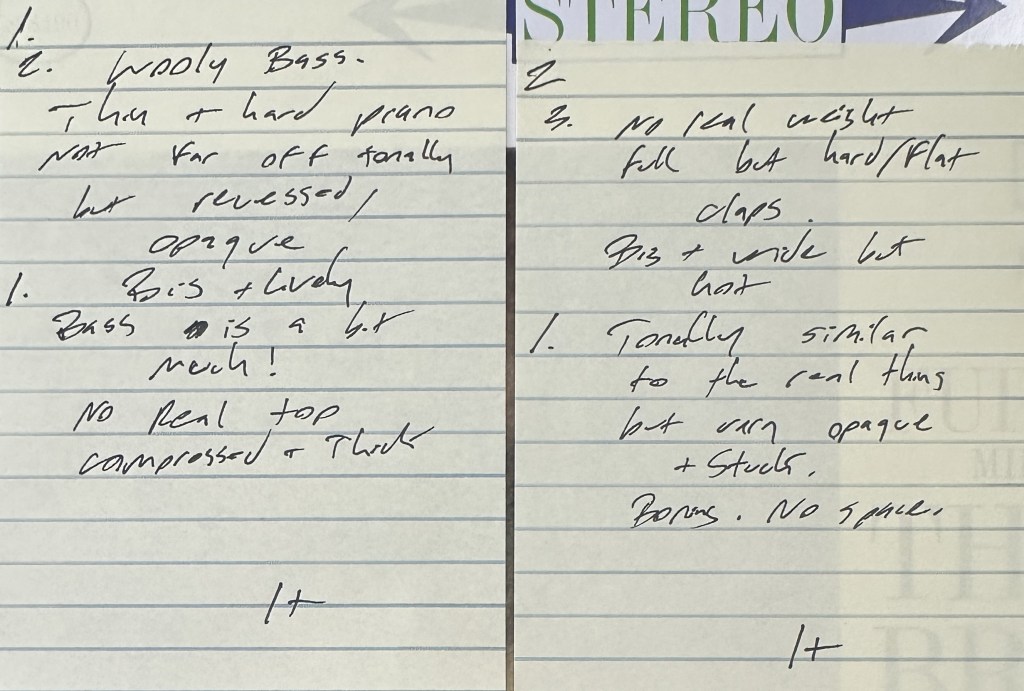
With grades of one plus on both sides, the sound was not good enough to compete with even the lowliest of our Hot Stamper pressings. Those must earn a grade of 1.5+ or better to make it to our site.

The notes for side one read:

Track two

  • Wooly bass
  • Thin and hard piano
  • Not far off tonally but recessed and opaque

Track one

  • Big and lively
  • Bass is a bit much!
  • No real top
  • Compressed and thick

The notes for side two read:

Track three

  • No real weight
  • Full but hard/flat handclaps
  • Big and wide but hot

Track one

  • Tonally similar to the real thing but very opaque and stuck (in the speakers)
  • Boring
  • No space

Reminds me in some ways of a George Marino-mastered title that we spent a great deal of time evaluating a few years back, this one.

Either way, it’s not terrible, but it’s not all that good either.

Any Six-Eye and probably any 360 Columbia label pressing (but probably not your average 70s Red Label LP —  we stopped buying them years ago) will be better sounding.

Noisier for sure, but clearly better sounding.

If you own this modern reissue and want to hear just how good the album can sound, we would be honored to make that happen.

(more…)

On Young Person’s Guide, Stick with the Unboxed Deccas

Hot Stamper Pressings of Classical and Orchestral Music Available Now

This is our favorite recording of the work. Those of you looking for a Young Person’s Guide can stop looking, this is the one.

For those who have never heard it, check out The Young Person’s Guide on YouTube – it is a tour de force of orchestral excitement, especially from the percussion section.

We’ve learned from shootouts past (and were reminded again during our most recent) that the London pressings can also be quite good, but none of them can hold a candle to the early Deccas.

However, the later Boxed Label Deccas leave a lot to be desired and should be avoided by those looking for top quality sound.

Side one of this copy was dry and hot. Side two thin and very small.

This is an amazing recording, but you’d never know it from playing the reissues.

There are about 150 orchestral recordings we think offer the best performances with the highest quality sound. This record is certainly deserving of a place on that list.

(more…)

Brahms & Dvorak / Hungarian & Slavonic Dances – Updated

Hot Stamper Classical and Orchestral Imports on Decca & London

UPDATE 2022

The last time we played a few copies of this London title, CS 6198, we were quite a bit less impressed than the review below might lead you to believe.

We found the sound to be plenty Tubey Magical, but the louder peaks were sour. Overall we judged the sound to be OK at best.

Having played a number of different pressings over the years, our favorite recording of the Slavonic Dances these days is the one with Kertesz on the Decca World of Great Classics budget reissue label.

It may come as a shock to some record collecting audiophiles, but there are actually budget reissues of some titles that can beat any and all comers. Here are some that we’ve come across, discoveries which we are happy to share with you.

(more…)

Some Pressings of Tchaikovsky’s Piano Concerto No. 1 Can Sure Be a Letdown

Hot Stamper Pressings of the Music of Tchaikovsky Available Now

I don’t know of another recording of the work that gets the sound of the piano better. On the properly-mastered, properly-pressed copies, the percussive quality of the instrument really comes through.

But that quality (along with lots of others) is only heard on the better copies.

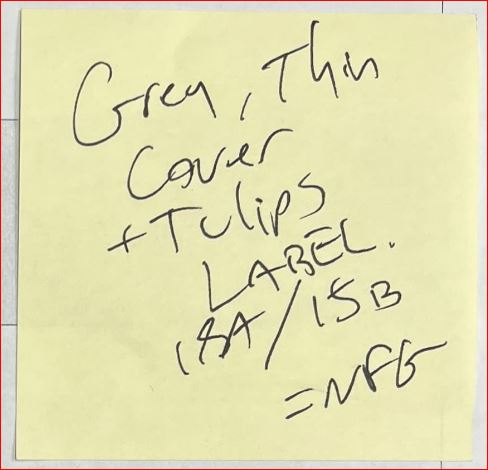
The reissues (one with the later Tulips label, one with the earlier Large Tulips label) described below are at best passable, and some of them were just awful.

The note to the left makes clear that even some of the early Large Tulips label pressings had very bad sound. Watch out especially for 18A/15B stampers. They’re NFG: No F***ing Good.

As you can see from the notes above for this particular recording in the Black and White cover, one side was passable, earning our 1.5+ grade. That makes it a decent sounding record, I suppose, but it’s a long, long, long way from the best.

1.5+ is four grades down from the top copy. That’s a steep dropoff as far as we’re concerned. 1.5+ only hints at how good a recording this DG can be on the best pressings.

To see more records that earned the 1.5+ grade, please click here. (Incidentally, some of them are even on Heavy Vinyl. The better modern pressings have sometimes, if rarely, been known to earn Hot Stamper grades, and two recently shocked the hell out of us by actually winning a shootout. Wouldn’t you like to know which two!)

One Plus (1+) is a sub-Hot Stamper grade. We do not sell records that do not earn a grade of at least 1.5+ on both sides.

For those who might be interested, there’s more on our grading scale here.

Our Favorite Performance with Sound to Match

A recent listing for the album can be found here.

Without question this is a phenomenal piano recording in every way.

On the best copies the rich texture of the strings is out of this world — you will have a very hard time finding a DG with better string tone. This record does not have the shortcomings of the average DG: it’s not hard, shrill, or sour.

DG made plenty of good records in the 50s and 60s, then proceeded to fall apart, like most labels did. This is one of their finest. It proves conclusively that at one time — 1962 to be exact — they clearly knew exactly what they were doing.

It’s amazing how many piano recordings have poorly-miked pianos. The badly recorded pianos are either too distant, lack proper reproduction of the lower registers, or somehow smear the pounding of the keys into a blurry mess.

Are they badly recorded?

Or is it a mastering issue?

Perhaps a pressing issue?

(more…)

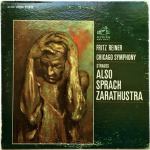
For Also Sprach Zarathustra, These Stampers Are Passable at Best

Hot Stamper Pressings of Living Stereo Titles Available Now

Even though they had the Shaded Dog label, some of the later stampers for this record were not very good sounding compared to the ones that won our shootouts.

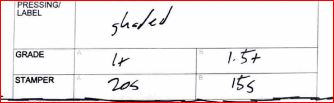
20s backed by 15s earned grades that would prevent it from being sold as a Hot Stamper pressing.

One side was passable, earning our 1.5+ grade. It’s a decent sounding side I suppose, but a long, long, long way from the best.

1.5+ is four grades down from the top copy, the kind that would end up in this section. (To read about some phenomenally good sounding Shootout Winning pressing we’ve played recently, click here.)

That’s a steep dropoff as far as we’re concerned. 1.5+ only hints at how good a recording LSC 2609 can be on the best vintage pressings.

To see more records that earned the 1.5+ grade, please click here. (Incidentally, some of them are pressed on Heavy Vinyl. The best modern pressings have sometimes, though rarely, been known to earn Hot Stamper grades, and one shocked the hell out of us by actually winning a shootout. Wouldn’t you like to know which one!)

The 1+ grade found on this side one means it’s simply not very good, Shaded Dog label or no Shaded Dog label.

The average Shaded Dog may be better than the average classical record, but that certainly doesn’t mean it has any claim to audiophile sound. We’ve played bad early RCA pressings by the hundreds. Now, with this blog we can point some of them out to those record lovers who are more interested in top quality sound than an original label.

For those who might be interested, there’s more on our grading scale here.

There are quite a number of other records that we’ve run into over the years with obvious shortcomings.

(more…)

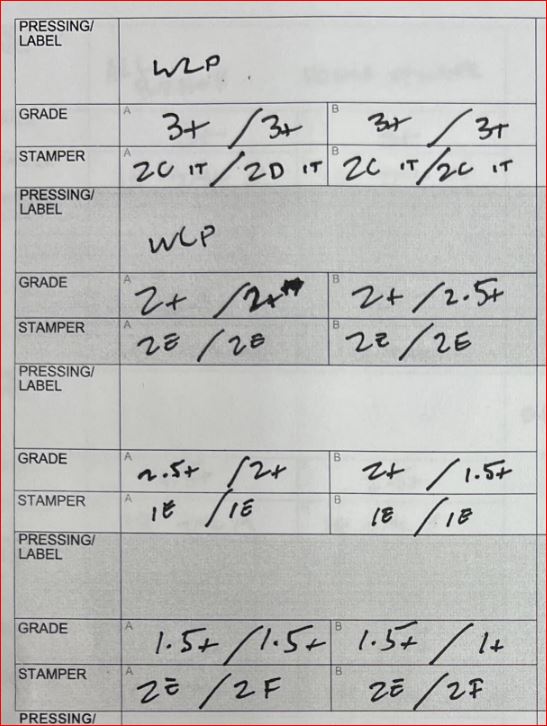
Are White Label Promos the Way to Go on this Mystery Columbia Jazz Album?

Hot Stamper Pressings of Vintage Columbia Albums Available Now

Recently we conducted a shootout for a Columbia recording, one that we had auditioned a couple of times before and one for which we knew the music and the general quality of the sound well.

It’s not the record you see pictured. For now we’re keeping the title a mystery, consistent with the idea that we give out lots of bad stampers on this blog, but almost never do we give out the good ones. (When we do give out the best stampers, we keep the title a mystery. We are not the least bit interested in putting ourselves out of business.)

The discussion for today revolves around the idea held by a great many audiophiles that the White Label Promo copies are going to be the best sounding pressings of almost any album they might happen to run across.

And, to be fair, in the case of this mysterious double album, they’re right.

Our two best sounding copies were White Label Promos.

What interests me in these findings is that the stampers for a White Label Promo copy, the second one, the one with mostly Super Hot grades, are almost identical to the one that came in last in the shootout, with barely passable grades.

If an audiophile collector were to go to Discogs, find the WLP pressings, write down their stampers, and then check them against the copies he owned or might want to buy, he could either find himself with a top quality copy, or a not-nearly-as-good copy, depending on his luck. (And side four of the worst pressing earned a sub-Hot Stamper grade of 1+.)

Why one set of stampers sounds so much better than another set, or the same or similar set on a different pressing, is a mystery.

Does anyone have a practical way to get around the unfortunate reality that allows one set of stampers to sound great and the same or a similar set of stampers to sound not much better than decent?

Well, we can’t say there is a practical way, but we do know of an impractical one. We’ve been practicing and refining that one for more than twenty years.

(more…)

Sterling Cut By Far the Best Sounding Pressings of I’m Ready

Hot Stamper Pressings of Soul, Blues, R&B, etc. Available Now

Forget the reissue copies that come in the cover you see to the left, the one with a thin black border.

If you want to hear this album right, a Hot Stamper early domestic pressing is the only way to go.

And take it from us, you need to see the Sterling mark in the dead wax of your pressing to have any hope of hearing audiophile-quality sound.

As you can see from the notes above, the two reissue non-Sterling copies we played had hopelessly bad sound.

One was smeary, hard and hot.

The other was the brightest and most spitty.

Note that we didn’t deem it necessary to play side two of either copy. A one plus side one rules out the possibility of it being a Hot Stamper pressing.


Consider taking our moderately helpful advice concerning the pressings that consistently win our shootouts.

Based on our experience, I’m Ready sounds its best:

(more…)

Did You Get Your $1.87’s Worth on the Reissue of Suites For Solo Cello?

Hot Stamper Pressings of Mercury Recordings Available Now

Many of the Oval Label pressings we’ve played recently have fared poorly in our shootouts.

As you can see from the notes below for this particular Starker record, one side was passable, earning our 1.5+ grade. It’s a decent sounding record I suppose, but a long, long, long way from the best.

1.5+ is four grades down from the top copy. That’s a steep dropoff as far as we’re concerned. 1.5+ only hints at how good a recording SR 90370 can be on the best vintage pressings.

To see more records that earned the 1.5+ grade, please click here. (Incidentally, some of them are even on Heavy Vinyl. The better modern pressings have sometimes, if rarely, been known to earn Hot Stamper grades, and one shocked the hell out of us by actually winning a shootout. Wouldn’t you like to know which one!)

For those who might be interested, there’s more on our grading scale here.

We often tell audiophiles that it’s never a good idea to judge records by their labels, so when it came time to do a shootout for this famous Bach recording from Mercury, it was only fitting that we play every pressing we had on the shelf, including the later Ovals, which are by far the easiest to find for any of the Starker Mercury titles.

Well, now we know. This is some weak tea, probably not too different from the Philips-pressed Golden Imports we gave up on long ago.

(more…)