Passable Sound

A Scheherazade that Lacks Power in the Brass and Richness in the Lower Strings? No Thanks

Hot Stamper Pressings of the Music of Rimsky-Korsakov Available Now

One of the most dynamic Scheherazade‘s on record. The brass really blasts through in this recording. 

Of course the question is how does this recording stack up to the famous Reiner. Well, I’ll tell you.

The Minneapolis Symphony Orchestra is not in the same league with the CSO, that’s well known. Dorati may be every bit as talented as Reiner, but he doesn’t have the players at his disposal capable of pulling off demanding material such as this.

But the orchestra acquits itself well here. The first violinist is quite good. That’s not the problem.

What lets the side down is the Mercury recording team, who fail to adequately present the weight of the orchestra in the lower midrange and below. One thing I noticed recently when playing an original LSC 2446 was how rich and powerful the sound was in the lower strings and in the brass relative to later pressings of the same title and other recordings of the work.

That opening movement of Scheherazade needs power down there and the Mercury simply doesn’t have enough of that power to qualify it as one of the top sounding Mercs.

(more…)

Is CTFR-1 Dark and Congested, or Flat and Bright?

Hot Stamper Pressings of Mercury Classical Records Available Now

For Mercury classical and orchestral recordings, the original RFR-1 pressings on the plum label are the way to go, right? 

In some cases, yes. The first pressings of Mercury albums often win our shootouts.

And for both sides of a copy to win a shootout, like our gold promo seen in the stamper sheet below, everything about the pressing must be right. We call records that win their shootout, earning 3+ grades on both sides, Top Shelf pressings. They are rare and special enough to have a section of their own on the site (which, as of this writing, has all of 19 records in it.)

What we find to be interesting about this specific shootout, however, is that we had two later pressings, both with the same stampers, and they sounded markedly different from each other. (Note that the stamper numbers you see below belong to a different album than the one shown above.)

If a collector were to tell you that that the CTFR pressings tend to be dark and congested, and you owned one with the exact same stampers, CTFR-1, you might be inclined to agree with this person.

But if you were the owner of the copy we played that was flat and bright, again, with CTFR-1 in the dead wax of both sides, you would think this person was 1.) Out of his mind, or, 2.) Deaf as a post, or, 3.) The owner of some very inaccurate playback equipment.

He could be all three, but in this case, an unusual one to be sure, his copy of the album doesn’t tell you anything about the sound of your copy of the album. They could match, or they could be completely different. Some records are like that. Not all that many, but definitely some.

Sample Sizes and One Man Bands

Those of us who play a variety of pressings of the same album know how easy it is to draw mistaken conclusions about records. CTFR-1 on this title is the perfect example of a record whose stampers don’t tell you much about its sound. (Even RFR-1 on side one of one copy was no better than “good,” quite a long ways from the best.)

(more…)

A Disappointing OJC of Swinging With The Mastersounds

Hot Stamper Pressings of Top Quality Jazz Recordings Available Now

UPDATE 2025

We did a shootout for this Mastersounds title many years ago. It didn’t sell very well so we decided to give it a rest for a while, something in the range of a decade or so.

Recently we got another couple of copies in, including their other album we used to like on OJC, A Date with the Mastersounds, and found none of the copies we played to be nearly as impressive as we thought they were back in the day. Some quick notes:

  • A Date with the Mastersounds

Vibes are dry and glassy. Not much Tubey Magic.

  • Swinging With The Mastersounds

Rich but veiled sound. Just OK, not great.

With that said, we still like the music, so if you see one of these pressings for cheap and you like vibes-based jazz from the 50s, pick it up and discover the music of The Mastersounds for yourself.

(more…)

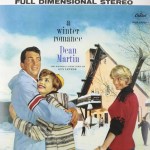
We Forgot How Mediocre the Originals of A Winter Romance Are

Hot Stamper Pressings of the Music of Dean Martin Available Now

We gave a couple of early pressings another chance and they blew it!

The copies we sell as Hot Stampers are the reissues from the 60s. Here is what we had to say about a copy we posted for sale recently:

With a voice that is relaxed, smooth and warm, Dino is the perfect guy to sing these songs.

The sound of this reissue is far better than any of the originals we played, which mostly weren’t very good. Which just goes to prove (once again) that in the world of vinyl, the idea that the original will have the best sound is a pernicious falsehood.

Rich, sweet, full of ambience, dead on correct tonality, and wonderfully breathy vocals – everything that we listen for in a great record is here.

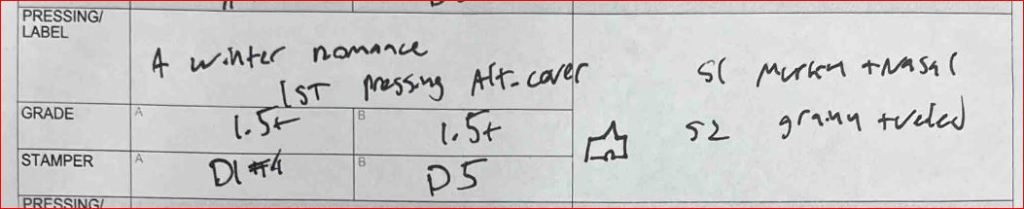
To back that up with actual stamper sheet evidence, here are the grades for the two early pressings we put in our shootout. We’d heard the originals before and never liked them, but sometimes if a particular presssing is cheap and easy to find, we give it another chance.

I think we’re done with the originals now though. They’ve let us down too many times.

Who wants to hear Dean Martin’s gorgeous baritone sounding lean, dry and recessed, or, alternately, murky, nasal, grainy and veiled?

If I didn’t know better I would suspect these originals were modern reissues. This kind of crap sound is all over the Heavy Vinyl records we play, although nobody but us ever seems to notice.

The Point Is

This serves to make a very important point that is near and dear to our hearts:

(more…)

None of the Living Stereos with Reiner Conducting Was Better than Passable

Hot Stamper Pressings of Living Stereo Titles Available Now

For a cover this beautifully rendered, you would think the sound of the Shaded Dog pressings of LSC 2219 would be something special.

Unfortunately, as we were preparing our shootout for the work we did not find that to be the case.

We dropped the needle on some copies and judged that the grades would be roughly in the range of 1+. Some copies might be a bit better, some might be a bit worse, but most of them would have sound that was merely passable, even after a good cleaning. (Without a good cleaning, most would probably not even earn that single plus.)

We do not sell records with 1+ grades. You should have no trouble finding those on your own. The world is full of them. They’re what most audiophiles call “good sounding records.”

Our favorite Brahms Second Piano Concerto for sound and performance is LSC 2581. It was recorded for RCA only a few years later in 1962.

The average Shaded Dog may be better than the average classical record, but that certainly doesn’t mean it has any claim to audiophile sound. We’ve played bad early RCA pressings by the hundreds. Now, with the help of this blog, we can point some of them out to the record lovers who are looking for top quality sound and don’t care that much about the label.

(more…)

Buy Promos, Don’t Buy Promos — Honestly, Just Make Up Your Mind

Hot Stamper Pressings of Vintage Columbia Albums Available Now

Recently we conducted a shootout for a Columbia recording of jazz fusion music, one that we had auditioned a couple of times before and one for which we knew the music and the general quality of the sound well.

It’s not the record you see pictured. For now we’re keeping the title a mystery, consistent with the idea that we give out lots of bad stampers on this blog, sometimes really bad stampers, but almost never do we give out the good ones.

All the copies we had in our shootout were pressed domestically, and all were mastered by the legendary Robert Ludwig. No Nice Price junk, no imports, none of that crap. We might have made those mistakes in previous shootouts, but having done this shootout a number of times now, we know what works and what doesn’t.

When we do give out the best stampers, as in the case here, we tend to keep the title a mystery. We are not the least bit interested in putting ourselves out of business.

The discussion for today revolves around the idea held by a great many audiophiles that the promo pressings are going to be the best sounding pressings of almost any album they might happen to run across.

And, to be fair, in the case of this mysterious album, they’re potentially right.

Our best sounding copy was a promo pressing.
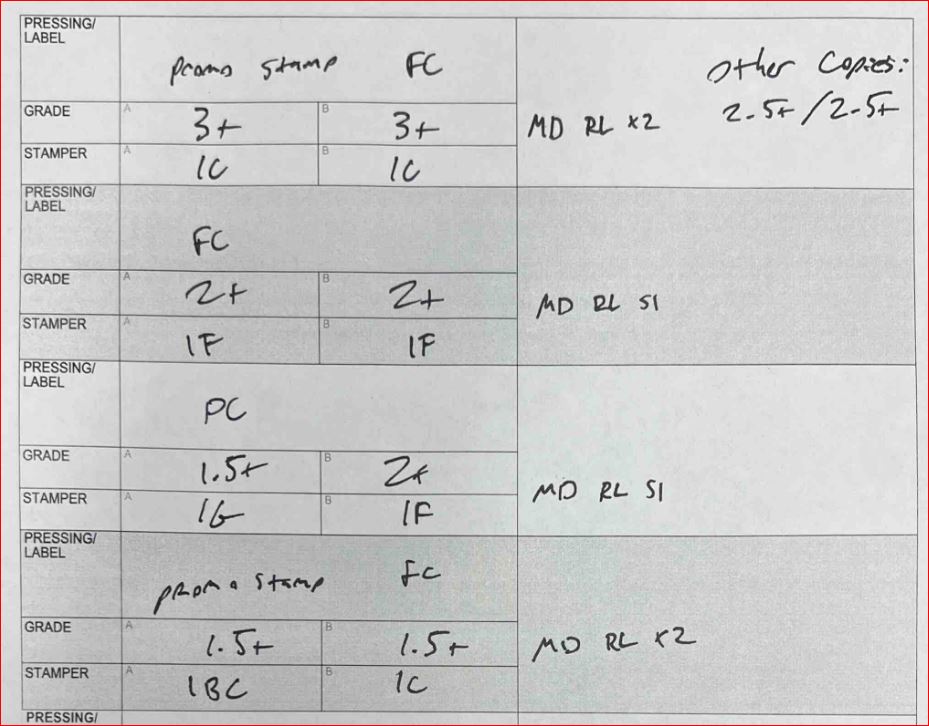
What interests me in these findings is that the other promo copy, the one you see at the bottom of the shootout sheet, earned 1.5+ on both sides. It came in last in the shootout, earning good, not great Hot Stamper grades.

If an audiophile collector were to go to Discogs, find the promo pressings, write down their stampers, and then check them against the copies he owned or might want to buy, he could either find himself with a top quality copy, or a far-from-as-good copy, depending on his luck.

Why one set of stampers sounds so much better than another set, or the same or similar set on a different pressing, is a mystery.

Does anyone have a practical way to get around the unfortunate reality that allows one set of stampers to sound great and the same or a similar set of stampers to sound not much better than decent?

Well, we can’t say there is a practical way, but we do know of an impractical one. We’ve been practicing and refining that one for more than twenty years.

(more…)

The Domestic Stampers of 10cc’s Masterpiece Had Us Fooled for Years

Hot Stamper Pressings of the Music of 10cc Available Now

I haven’t run into many audiophiles who own a copy of The Original Soundtrack, or any other 10cc album for that matter.

It’s the rare person who has the the kind of system that can play a recording with such explosive dynamics.

As I have an uncontrollable habit of saying, this is the kind of record that is guaranteed to bring any audiophile stereo to its knees. 

Since that is the case, and audiophiles who build the kind of big systems in heavily-treated custom rooms to meet the challenge such recordings present are thin on the ground — very thin it seems, as I am the only one I have ever known — it stands to reason that practically no audiophiles have ever experienced the size and power of the recording as it was meant to be heard.

I thought I was doing a very good job reproducing the sound of the album, but recent research has proved that, once again, I was mistaken. Previously I had written:

The recording itself is a tour de force, the main reason I’ve been demonstrating my stereo with it for more than thirty years. The extended suite that opens side one, One Night in Paris, has ambience, three-dimensional sound effects, and incredibly dynamic multi-tracked vocals at the climax that will leave you with your jaw on the floor.

All true. But I had been playing both domestic pressings and British pressings over the course of those thirty years, and I don’t remember clearly preferring one to the other.

With our latest shootout the British pulled away from the pack in a big way, with no British pressing being beaten by any domestic competitor.

The domestic pressings ranged from very good — 2+ on both sides — to passable at best — 1+ on both sides.

I honestly used to think they were close, that they would be hard to tell apart. Those days are gone. We are operating at a whole ‘nother level, and I am glad that we are. We want to give out only the most accurate information and sell only the best sounding records.  What I had thought was true ten years ago turns out to have been off the mark.

When reality turns out to be dramatically different from what you thought it was, and you can prove it — you actually have the physical records to back up your newer, more correct understanding — that’s audio progress.

You might try proving yourself wrong more often.

Most audiophiles I have run into like having their biases confirmed, but look where that has gotten some of them — stuck in a rut. Break out of that way of thinking and you may very well find that you have broken through to another level.

Because if you don’t go out of your way to prove yourself wrong, who will?

(more…)

Out of Two Jazz Samba Originals, Only One Had Even One Good Side

Hot Stamper Pressings of Bossa Nova Albums Available Now

Recently we did a shootout for one of our favorite Bossa Nova albums and had this to say about it:

As you can see from the notes, both sides of our most recent White Hot shootout winning copy were doing everything right.

This is by far the best copy of the album we have ever played — we had no idea a copy could possibly sound this good and be pressed on vinyl this quiet.

Remarkably spacious and three-dimensional, as well as relaxed and full-bodied – this pressing was a big step up over all of the other pressings we played in our recent shootout.

No other copy earned a better grade than 2+ on either side, and some of the originals were godawful (watch for the “wrong” stampers coming to the blog soon).

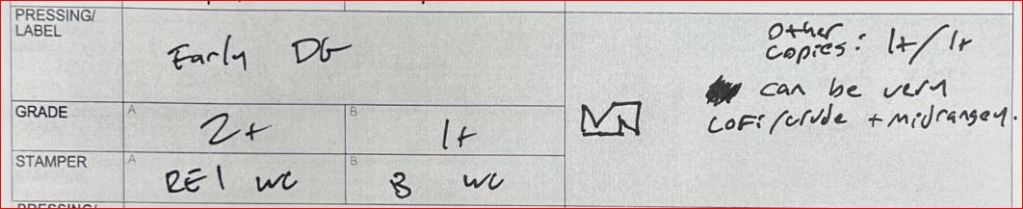
Here are the wrong stampers we aluded to above, the originals with these markings:

As you can see from the notes, these original stereo pressings can be lo-fidelity, crude and midrangey.

This serves to make a very important point that is near and dear to our hearts:

The idea (and operational premise of most record collectors) that the originals are always better is just a load of bunk.

They might be and then again they might not be. If you want better sounding records, you had better open your mind to the idea that some reissues have the potential to sound better than even the best original pressings.

These, for starters, and there are hundreds more on the blog you can read about here.

(more…)

On Barney Kessel’s Easy Like, Stick With the Earlier Contemporary Pressings

Hot Stamper Pressings of Contemporary Jazz Albums Available Now

The Shootout Winning pressing we played in 2024 was yet another killer Barney Kessel recording from the Golden Age of Tube Recording:

Both sides of this vintage Contemporary pressing were giving us the rich, sweet and tubey MONO sound we were looking for, earning INCREDIBLE Shootout Winning Triple Plus (A+++) grades or close to them

Roy DuNann (at the console on select tracks, with Val Valentin handling engineering duties on the others) always seems to get phenomenally good sound out of the sessions he recorded – amazingly realistic drums in a big room; Tubey Magical guitar tone; deep, note-like string bass, and on and on

For some reason, the guitar sound from this era of All Tube Chain Recording seems to have died out with the times – it can only be found on the best of these vintage pressings, and, as you may imagine, the better the guitar sounds, the more likely it is that the record will win our shootout

If you don’t have an electric guitar jazz record with this kind of off-the-charts Tubey Magical sound, maybe it’s time you got one

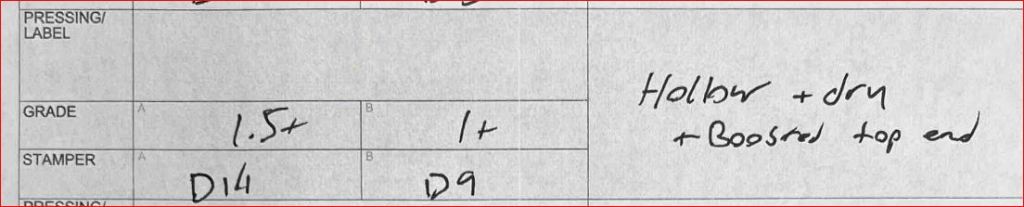
You would never know how good the recording was by playing this D14/D9 pressing on the original label.

The sound was hollow and dry with a boosted top end. The 1+ grade awarded to this side two means it’s simply not that good, early label or no early label.

This Is Why

This is why we do shootouts, and why you must do them too, if owning the highest quality pressings is important to you.

Fortunately for readers of this blog, our methods are explained in detail, free of charge.

We’ve also written quite a few commentaries to help audiophiles improve the way they think about records.

I implore everyone who wants to make progress in this hobby to learn from the mistakes we’ve made. There are 146 “we were wrong” listings on the site as of this writing, and we learned something from every damn one of them.

(more…)

I Robot Is a Tough Nut to Crack, Even If You Have Plenty of Early British Pressings to Play

Hot Stamper Pressings of Prog Rock Albums Available Now

Here is how we described a Hot Stamper pressing of I Robot that went up recently, our first in five years:

An early UK pressing (and the first copy to hit the site in years) with seriously good sound throughout.

Many copies tend to be overly smooth, but this one has the kind of clarity that allows the natural textures of the instruments to come through.

Transparency is key to the sound of the better copies, and that is precisely where the dubby domestic pressings fall apart.

Even many of the early British pressings fell short. Good luck finding top quality sound on this one. At the very least you are going to need a big budget — these early UK pressings are not cheap to find in audiophile playing condition.

As you can see, we weren’t kidding about those UK pressings falling short. Here’s two that did, with their stamper numbers posted for all to see.

Side two of the first copy is being held back by sound that is smeary, dry and hard.

Side one of the second copy is murky and hot (bright).

Note that these are early UK stampers, which some in-the-know audiophile collectors will tell you are clearly the best.

(more…)