Record Advice, by Title

This Phenomenally Well Recorded Montoya Album Is an Amazing Find

Hot Stamper Pressings of Living Stereo Titles Available Now

Flamenco meets Jazz in this extraordinary Living Stereo all analog recording from 1958 (only the second copy to hit the site in years).

Ed Begley is the engineer here and he knocked this one out of the park. The sound is shockingly real – proof positive that the cutting systems of the day are capable of much better sound than many audiophiles might think. If more evidence is what you’re after, see here and here

Need a refresher course in Tubey Magic after playing too many modern recordings or remasterings? This record is overflowing with it.

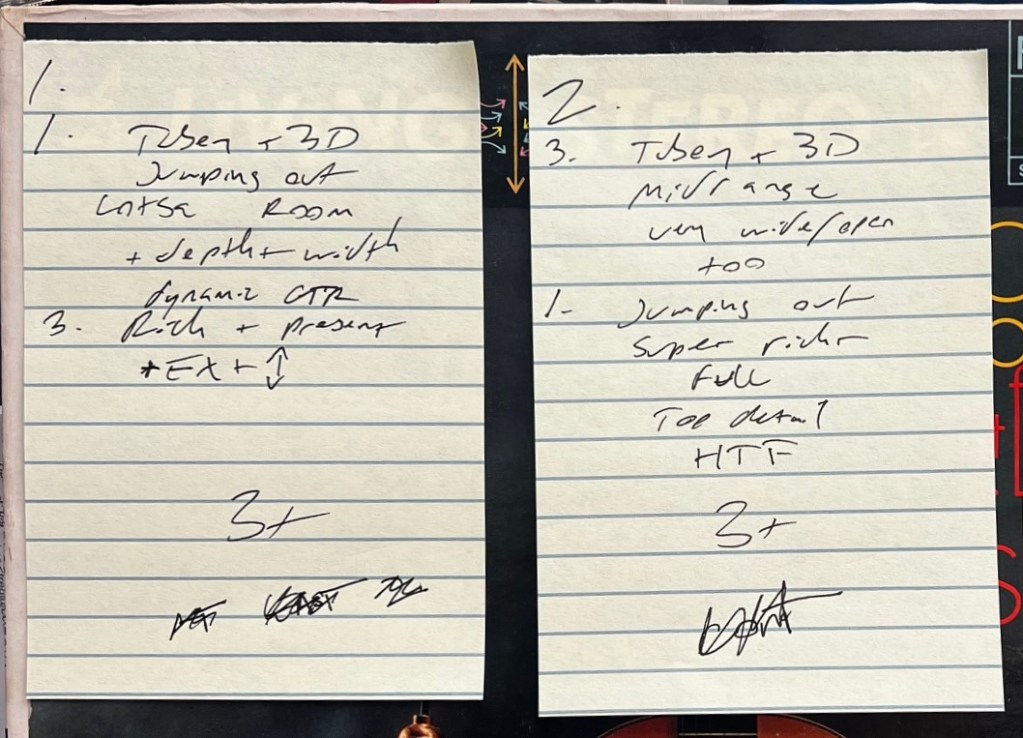
Side One

Track One

    • Tubey and 3-D
    • Jumping out
    • Lots of room and depth and width
    • Dynamic guitar

Track Three

    • Rich and present
    • Extending high and low

(more…)

How Do the Columbia Special Products Reissues Sound on Mingus Dynasty?

Hot Stamper Pressings of the Music of Charles Mingus Available Now

In general it is best to avoid pressings with the round sticker you see to the left, the one attached to the Columbia Special Products bargain reissue series.

They are rarely much better than awful, although there are a few exceptions to that rule. (There are almost always exceptions to the kinds of rules collectors use to find the best sounding records.)

The 6 Eye label domestic stereo pressings of Mingus Dynasty win our shootouts, in this case without exception.

On this title, the 360 label pressings, Black Print or White Print, can sound very good, but they never win shootouts.

We’ve identified a select group of reissues with the potential to do well in shootouts, typically earning a grade of Super Hot (A++) when up against the best originals, which are the only ones that seem to have the potential to earn our top grade, White Hot (A+++).

(more…)

Listening in Depth to the White Album

Hot Stamper Pressings of The White Album Available Now

It’s exceedingly difficult to find audiophile quality sound on The White Album. The Beatles were breaking apart, often recording independently of each other, with their own favorite engineers as enablers, and George Martin nowhere to be found most of the time. They were also experimenting more and more with sound itself, which resulted in wonderful songs and interesting effects. However, these new approaches and added complexity often result in a loss of sonic “purity.”

Let’s face it, most audiophiles like simplicity: A female vocal, a solo guitar — these things are easy to reproduce and often result in pleasing sound, the kind of sound that doesn’t take a lot of expensive equipment or much effort to reproduce.

Dense mixes with wacky EQ are hard to reproduce (our famous difficulty of reproduction scale comes into play here), and the White Album is full of that sound, taking a break for songs like Blackbird and Julia.

Some of the Tubey Magic that you hear on Pepper is gone for good. (Play With a Little Help from My Friends on a seriously good Hot Stamper pressing to see what has been lost forever. Lovely Rita would probably work just as well, too.)

Side One

Looks at the lineup for side one. Is there a rock album on the planet with a better batch of songs?

Having done shootouts for the White Album by the score, we can also say with some certainty that side one is the most difficult side to find White Hot stamper sound for. It’s somewhat rare to find a side one that earns our top Triple Plus (A+++) sonic grade, even when all the other sides do. (Actually what happens more often than not is that we take the best second discs and mate them with the best first discs to make the grades consistent for the whole album. But don’t tell anybody.) (more…)

Are Your Cellists Digging In on I Am the Walrus?

This commentary was written many years ago.

Over the last decade I Am The Walrus has evolved into a good test for side one, a fact that came as a complete surprise to me. As I was listening to the various copies in a shootout years ago I noted that the opening cellos and basses in the right channel were often tonally identical from copy to copy, but sounded quite a bit more lively and energetic on some pressings relative to others. Was it EQ? Level? Compression?  

Why so much more passion from the players on some copies and not others?

As I tried to puzzle it out, playing first one copy and then another, it became clear to me what was happening. The cellists and the bassists were just plain digging HARDER into the strings on the best copies. When you see live classical music, the cellists at the front of the orchestra are usually sawing away with abandon when the music is really going. They dig their bows hard into the strings to make them vibrate as loud as possible. To make their instruments heard in the back row it becomes a matter of muscle, of pure physical exertion.

So armed with the copies where the string players are working the hardest, I checked the other tracks. Sure enough, the opening cut, MMT, jumped out of the speakers with the most energy I had heard on any copy. As I went through the tracks one by one, they had the most life of any of the copies I had been listening to. To use a word that was popular at the time, the music was HAPPENING.

This was the final piece to the puzzle. Tonality always comes first. Frequency extension; lack of distortion; rich, powerful bass — these are important qualities as well. But the life of the music is in the micro and macro dynamics, and that is what I had not been paying sufficient attention to during the shootout.

That was until I listened to Walrus and heard the players working up a good healthy sweat. Then I knew I had a Hot Stamper. And when I played the not-so-Hot Stampers, the string guys sounded like session musicians picking up a paycheck.

Where was their passion? Didn’t they realize they were making a classic?

If you get the right pressing they sure were!

(more…)

How Good Are the Later Reissues of The Bridge?

When we did a shootout for The Bridge about ten years ago, we thought the reissues with the cover you see to the left actually sounded better than the original pressings, but we were clearly wrong and we have no other option than to admit it, as painful as that may be.

True, we never cared much for the later reissues described below — the tan labels can be passable but fall well short of the standards we set now.

However, even the best orange label pressings from 1975 don’t sound as good to us now as we thought they did ten years ago.

They can be good, but in our experience they can never be great. Great is the sound that can only be found on the best originals, and they win all the shootouts now.

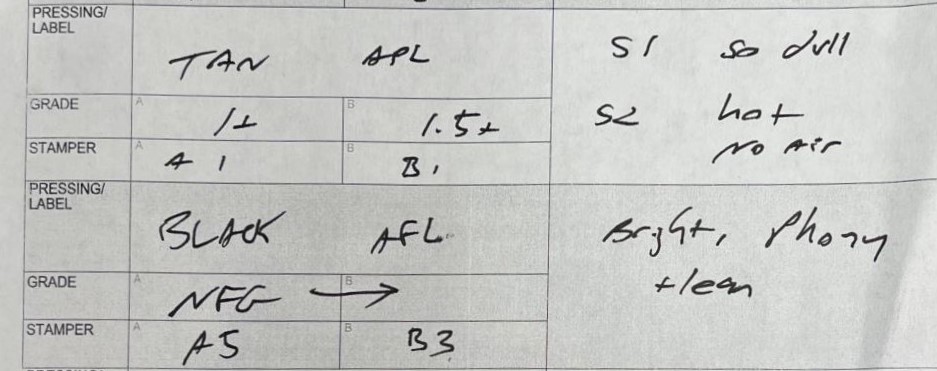
The notes for the AFL pressing with the black label describe it as bright, phony and lean.

This is the kind of sound better suited to the stone age stereos of the past.

I should know. I had a stereo all the way up until the late-90s — not exactly stone age quality, but far from the sound we have now — that prevented me from hearing my records with the highest quality reproduction.

(more…)

801 Live – None Rocks Harder

Hot Stamper Pressings of the Music of Brian Eno Available Now

I listened to this album from start to finish just yesterday (5/31/2024), so I thought it only fitting that I share my enthusiasm for this absolutely amazing record with those who read this blog.

The best Island copies of this album rock harder than practically any record we’ve ever played. If you have the system for it, this amazing Rhett Davies recording will bring a live art rock concert right into your living room.

This is a big speaker record. It requires a pair of speakers that can move air with authority below 250 cycles and play at fairly loud levels. If you don’t own speakers that can do that, this record will never really sound the way it should.

It’s right at the top of the list of my favorite rock albums — a desert island disc if ever there was one. I stumbled across it more forty years ago and I’ve loved it ever since. It all started when a college buddy played me the wildly original Tomorrow Never Knows from the album and asked me to name the tune before the vocals kicked in. Eno’s take is so different from The Beatles version that I confess it took me an embarrassingly long while to catch on.

Demo Disc Quality Sound

This is a true Demo Disc in the areas of sound reproduction listed below. Other records with these important qualities can be seen by clicking on any of these links.

Adventures in Music and Sound

Phil Manzanera and Brian Eno were founding members of Roxy Music. AMG calls Roxy Music the “most adventurous rock band of the early ’70s” and I’m inclined to agree with them.

Those who played in Roxy Music are certainly some of the most influential and important artists in my growth as a music lover and audiophile, joining the ranks of 10cc, Steely Dan, Yes, James Taylor, Peter Gabriel, David Bowie, America, Fleetwood Mac, Supertramp, Eno, Talking Heads, The Doors, Jethro Tull, Elton John, The Beatles, Santana, Crosby, Stills and Nash, Little Feat, Traffic, Nilsson, Elvis Costello, Sergio Mendes, Neil Young, The Eagles, Frank Zappa, Pink Floyd, Joni Mitchell, The Cars, Peter Frampton, Led Zeppelin, Cat Stevens and countless others.

These musicians and bands were clearly dedicated to making high quality recordings, recordings that could only come to life in the homes of those with the most advanced audio equipment.

My system was forced to evolve in order to reproduce the scores of challenging recordings issued by these groups in the 60s and 70s.

The love you have for your favorite music has to be the strongest driving force if you actually want to be successful in this hobby.

Some of the records that did the most to help me advance in audio can be found here.


Want to find your own top quality copy?

Consider taking our moderately helpful advice concerning the pressings that tend to win our shootouts.

(more…)
Exile on Main Street – A Good Test for Grit and Grain

More reviews and commentaries for the music of The Rolling Stones

The best copies will tend to have the qualities we discuss below, and the more abundant these qualities are on any given pressing, the higher its grade will be.

Yes, it is a science, an empirical one, which can only be carried out by the use of strict protocols and controls, but it sure ain’t rocket science.

All you need is the system, the room, the records, the time and the will to do the painstaking critical listening required to carry out the task.

It can be done, but you could spend a lifetime meeting audiophiles of the vinyl persuasion and never run into a single one who has made the effort more than a handful of times.

To be honest, shootouts are a bitch. If you aren’t getting paid to do them the way we are, finding the motivation to devote the time and energy required to do them right — not to mention the piles of copies of each record you will need — is daunting to say the least.

So, back to the question: what to listen for? (more…)

Check Out the Huge Chorus of The Ark

Hot Stamper Pressings of Albums with Huge Choruses

Listen to the chorus on the first track, The Ark. On the best copies, it really gets loud without becoming harsh or shrill. So many popular albums have choruses (and guitar solos) that are not much louder, and sometimes not even as loud, as the verses, which rob the songs of their drama.

This recording has the potential to give you a dramatic, powerful, loud chorus and it’s a thrill when you find a pressing that delivers on that promise.

One way we know to listen for these volume changes is that we actually play our records good and loud. When a dynamic recording such as this comes along, we have to watch our levels, otherwise, the chorus will overwhelm the system and room.

When playing this copy, be sure to set the level for the chorus of the first track. Everything should play just fine once that setting is correct, as the artist intended.

The double-tracked vocals on Whatever’s Written in Your Heart are a good test for transparency, resolution and Tubey Magic. There should clearly be two voices heard. The richness and the clarity of the best pressings make it possible to have it all.

(more…)

Finlandia – Live and Learn

More of the music of Jean Sibelius (1865-1957)

More of the music of Edvard Grieg (1843-1907)

Years ago we noted how much worse the Classic Records pressing of our then current favorite Finlandia sounded when compared head to head with our best RCA Shaded Dog pressings.

We wrote:

Classic Records ruined this album. Their version is dramatically more smeared and low-rez than our good vintage pressings, with almost none of the sweetness, richness and ambience that the best RCA pressings have in such abundance.

Woops.

Turns out the RCA pressing we used to like was not as good as we thought, something we discovered to our chagrin in 2014.

Our current favorite pressing is on a Decca reissue label. Go figure.  When you hear how good this record sounds, you may have a hard time believing that it’s a budget reissue from 1970, but that’s precisely what it is.

Even more extraordinary, the right copies are the ones that win shootouts.

Want to find your own top quality copy?

(more…)

Is Digital Really the Problem on this Cowboy Junkies Album?

Hot Stamper Pressings of Digital Recordings with Audiophile Sound 

The RCA domestic pressings cut at Sterling are not worth the vinyl they’re pressed on.

Don’t be one of those die-hard analog types who point fingers at the fact that there was digital in the recording chain when their pressing doesn’t sound good.

It’s got nothing to do with digital. It has everything to do with Sterling doing a bad job mastering the domestic vinyl.

(Keep in mind that a very large group of audiophiles, including some well-known reviewers, had no idea there was a digital step used in the process of making some of the records they had raved about. Apparently the only way to hear it is when you already know it’s there.)

Our notes for the domestic pressing below read:

  • Flat and dry vox.
  • Shifted up [tonally]
  • A bit scooped [or “sucked out” in the midrange, meaning the middle of the midrange is missing to some degree]

The midrange suckout effect is easily reproducible in your very own listening room. Pull your speakers farther out into the room and farther apart from each other and you can get that sound on every record you own. I’ve been hearing it in the various audiophile systems I’ve been exposed to for more than 40 years.

Why Defend the Indefensible?

When good mastering houses like Kendun and Sterling and Artisan make bad sounding records, we offer no excuses for their shoddy work. The same would be true for the better-known cutting engineers who’ve done work for them, as well as other cutting operations.

Individuals working for generally good companies sometimes produce substandard work product.

How is this news to anyone outside of the sycophantic thread posters, youtubers, and self-identified record experts who write for the audiophile community?

(more…)