Classic Records – All

Michael Fremer Says You Should Own the Classic 45 of Time Out

Hot Stamper Pressings of the Music of Dave Brubeck Available Now

Michael Fremer spends two hours and ten minutes on his site going through a list of 100 All Analog In Print Reissued Records You Should Own.

On this list is the 45 RPM Bernie Grundman cutting of Time Out. Fremer apparently liked it a whole lot more than we did. We think it is just plain awful.

The MoFi Kind of Blue is on this same list, another pressing that is astonishingly bad, or, at the very least, really, really wrong.

If you’re the kind of person who might want to give Michael Fremer the benefit of the doubt when it comes to All Analog records he thinks sound good, ones he thinks you should own, try either one of them. If you think they sound just fine, you sure don’t need me to tell you that they’re completely and utterly awful.

There might be some decent records on the list, but if it has two massive failures that I just happened to come across in the five minutes I spent watching the video — I have very little tolerance for the sort of amateurishness he displays — I would suspect the winners are few and the losers many.

As a practical rule, if you want good sounding vinyl, you should avoid anything on his list.

And if you do try some and do like them, let me know which ones you think sound good and I will try to get hold of some copies and listen to them for myself.

Here is what we had to say about the Brubeck that Mikey recommends. We called it:

An audiophile hall of shame pressing and another Classic Records jazz LP poorly mastered for the benefit of audiophiles looking for easy answers and quick fixes. Sonic Grade: F.

Our story:

Not long ago we found a single disc from the 45 RPM four disc set that Classic Records released in 2002 and decided to give it a listen as part of a shootout. My notes can be seen below, but for those who have trouble reading my handwriting, here they are:

  • Big but hard
  • Zero (0) warmth
  • A bit thin and definitely boring
  • Unnatural
  • No fun
  • No F***ing Good (NFG)

Does that sound like a record you would enjoy playing? I sure didn’t.

(more…)

Witches’ Brew on Classic Records and How Crazy Wrong I Was, Part One

Hot Stamper Living Stereo Orchestral Titles Available Now

Well below the reproduction of the front page of our old catalog you will find the review I wrote in 2007 for the Classic Records’ Heavy Vinyl pressing of Witches’ Brew.

Clearly I did not care for it in the least. In fact, I thought it was one of the worst reissues I’d ever heard, so aggressive, boosted and unnatural it all but defied understanding. That anyone could play such a record and not notice how wrong it sounded did not speak well for audiophiles.

Now when I think about the Classic Records reissue of Witches’ Brew and its awful sound, it’s obviously a modern remastering I could not possibly have liked.

However, in preparing to move to Georgia in 2022, I found myself digging through some old catalogs from the early Nineties. Something I read in one of them chilled me to the bone.

There it was in black and white, lower left: my rave review for the Classic Records pressing of Witches’ Brew.

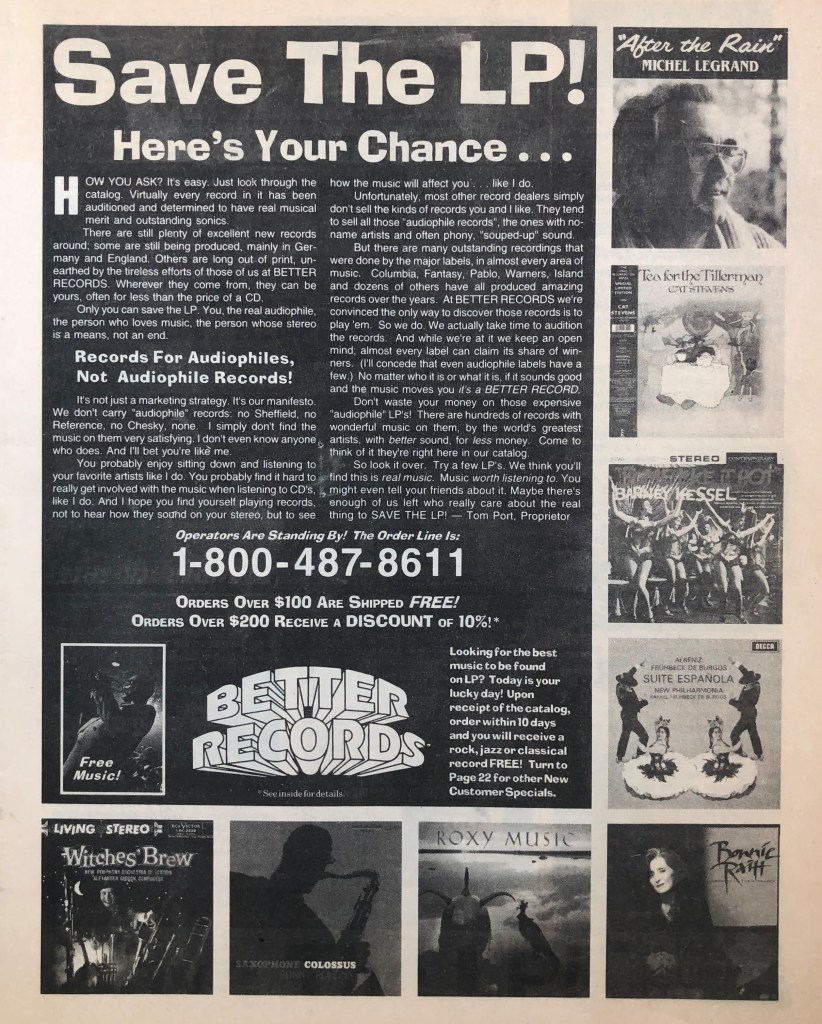
It’s actually on the front page of the catalog, along with at least one other record that I would be mortified to sell today: the OJC pressing of Saxophone Colossus.

(As soon as I find my review in the old catalog for Saxophone Colossus, I will post it. I can hardly believe I wrote it, but I did. I wrote all my catalogs back then. My lack of competence and the guilt associated with my lack of expertise at the time is undeniable. It obviously would be foolish and wrong of me to try to deny any of it, so I don’t.)

(more…)

Led Zeppelin II on Classic Records – Seriously, What Could Be Sadder?

Hot Stamper Pressings of the Music of Led Zeppelin Available Now

An unmitigated disaster — ridiculously bright and ridiculously crude.

In short, a completely unlistenable piece of garbage, and, along with the MoFi pressing from 1982, one of the worst sounding versions of the album ever made.

Over the years we have done many Led Zeppelin shootouts, often including the Classic Heavy Vinyl Pressings as a “reference.” After all, the Classic pressings are considered by many — if not most — audiophiles as superior to other pressings.

What could be sadder?

In fact, you will find very few critics of the Classic Zep LPs outside of those of us (me and the rat in my pocket) who write for this Better Records, and even we used to recommend three of the Zep titles on Classic: Led Zeppelin I, IV and Presence when they first came out.

Wrong on all counts.

Since then we’ve made it a point to review most of the Classic Zeps, a public service of Better Records. We don’t actually like any of them now, although the first album is still by far the best of the bunch.


Below you will find our reviews of the more than 200 Heavy Vinyl pressings we’ve played over the years.

(more…)

Another “Problematical” Classic Records Reissue

Hot Stamper Pressings of Living Stereo Titles Available Now

It’s been quite a while since I played the Classic pressing of these works by Shostakovich, but I remember it as nothing special.

Like a lot of the records put out by this label, it’s tonally fine but low-rez and lacking spacewarmth and above all, Tubey Magic.

I don’t think I’ve ever played an original or a Victrola reissue that didn’t sound better, and that means that the best grade to give Classic’s pressing is probably a D for below average.

The Classic Records pressing can currently be found on the TAS list, but we don’t think it has any business being there, along with a great many others, far more than we could ever find the time to play and review.

(more…)

By 2007 We Had Changed Our Minds about the Classic Who’s Next

Hot Stamper Pressings of the Music of The Who Available Now

Here is our review from 2005.

After doing our next shootout for Who’s Next in 2007, and replaying the Classic afterwards, we changed our minds about Classic’s version of the album.

Apparently, a surprising amount of audio progress was made from 2005 to 2007, reflected in this review as well as dozens of others.

Looking back, 2007 seems to have been a milestone year  for us here at Better Records, although we certainly had no idea at the time that such dramatic changes had been put in motion.

For example, later that same year we swore off Heavy Vinyl (prompted by the less-than-enchanting sound of the Rhino pressing of Blue) and committed ourselves to doing record shootouts of vintage pressings full time. To accomplish this we eventually ended up doubling the staff.

(Cleaning and playing every record you see on our site turned out to very time consuming. No one man band can begin to fathom the complex and random nature of the vinyl LP, which explains why the audiophile reviewers of the world are right about as often as the proverbially stopped clock.)

Live and learn is our motto, and progress in audio is a feature, not a bug, of record collecting at the most advanced levels. (“Advanced” is a code word for having no interest in any remastered pressing marketed to the audiophile community. There is nothing advanced about these deceptively-packaged mediocrities if you have the stereo to reveal their shortcomings. After spending fifty years in audio (1975-2025, we do. )

This is how good Who’s Next sounds these days, when we have them, which is not often.


In 2007 we did a big shootout for Who’s Next, and as is so often the case, the shortcomings of the Heavy Vinyl version were mercilessly revealed when played head to head with The Right Vintage Pressing. (And not the original Track by the way.)

Oddly enough, and contrary to expectation, even the domestic Decca label copies had amazing sound, not just the British Track label pressings I had favored for so long. (To keep from being influenced by biases of any kind, when we do these shootouts the listeners have no idea which pressing they are evaluating.)

(more…)

The Classic Pressing of Beethoven’s 4th Can Have Very Good Sound

More of the music of Ludwig van Beethoven

Somehow we managed to have a Classic Records pressing on hand to play in our most recent shootout for the Beethoven Symphony No. 4.

We knew all the way back in 1997 that Classic had done a good job with the record — we recommended it as one of the best Classic Records pressings in our catalogs at the time — but we sure didn’t expect it to do as well as it did, earning 2 pluses on one side and close to that on the other.

Years ago we wrote:

Here is the kind of sound that Classic Records could not ignore, even though the original was only ever made available as part of RCA’s budget reissue series, Victrola.

Don’t let its budget status fool you — this pressing puts to shame most of what came out on the full price Living Stereo label. (And handily beats any Classic Records reissue ever made.)

The top and bottom are wrong to varying degrees on both sides of the Classic, as you can see from our notes, which read:

(more…)

Hearing Is All It Should Take, Right?

Hot Stamper Classical and Orchestral Pressings Available Now

Some person on some audiophile forum might feel obligated at some point to explain to you, benighted soul that you are, that the old classical records you — and other audiophiles like you — revere so highly have to be recognized these days for what they are: drastically compromised by the limits of their old technology.

Simply put, there’s just no way they can sound good.

It’s just a fact. It’s science. Technology marches on and those old records belong on the ash heap of history collecting dust, not sitting on the platter of a modern turntable.

That’s why the audio world was crying out for Bernie Grundman to recut those Living Stereo recordings from the 50s and 60s on his modern transistorized cutting equipment and have RTI press them on quiet, flat, high-resolution 180 gram vinyl, following the best practices of an industry that everybody knows has been constantly improving for decades.

Right?

For those of us who actually play these records, there is little evidence to support this narrative.

It’s a story made up mostly of assertions, along with an unhealthy amount of faith in so-called experts. [1]

Note that Bernie had no experience cutting classical music. He was a rock, pop and jazz guy. Robert Ludwig was the classical guy, cutting hundreds of albums for labels like Nonesuch in the 60s. What a different world it would be if he was the guy who cut for Classic Records! This review gets to the heart of the matter.

However, the contrarian view outlined above only really holds true for a very small minority of audiophiles of the analog persuasion: those given to empirical testing of such propositions. [2]

For an audiophile to compare the new pressings to the old ones, proper testing requires that the following four conditions can are met:

  1. He or she has a revealing, accurate stereo,
  2. A good record cleaning system, and
  3. Knows how to do shootouts using his or her
  4. Well-developed critical listening skills

If you’ve spent much time on this blog, you’ve probably read by now that the first three on this list are what allow you to achieve the fourth.

Compromises?

The best classical recordings of the 50s, 60s and 70s were compromised in every imaginable way, yet still they sound amazing.

(more…)

Manassas – A Classic Records Disaster

Hot Stamper Pressings of the Music of Stephen Stills Available Now

The Classic pressing was a disaster. Can you imagine adding the kind of grungy, gritty sound that Bernie’s mastering chain is known for (around these parts, anyway) to a recording with those problems already?

It was a match made in hell.

Back in the day when I was selling lots of Classic Heavy Vinyl, this was one of the titles I refused to have anything to do with. This and Stephen Stills’ first album — both were personal favorites of mine and both were awful on Classic Records.

Is it the worst version of the album ever made? Hard to imagine it would have much competition.

Lots of rave reviews for the two of them in the audiophile press at the time though. I guess nothing ever really changes, does it? Played a Sundazed record lately? Well, there you go. How are these people impressed with such bad sound?

Of course I know exactly how it is possible to be impressed by bad sound. I spent my first twenty years in audio being clueless. Why should I expect the audiophile of today to have figured things out in less time than it took me?

(more…)

Physical Graffiti on Classic Records

More of the Music of Led Zeppelin

An Audiophile Hall of Shame pressing and another Classic Records Rock LP badly mastered for the benefit of audiophiles looking for easy answers and quick fixes.

Tonally correct, which is one thing you can’t say for most of the Zeps in this series, that’s for sure. Those of you with crappy domestic copies, crappy imported reissues and crappy CDs, which make up the bulk of offerings available for this recording, probably do not know what you’re missing.

What’s Lost

What is lost in these newly remastered recordings? Lots of things, but the most obvious and bothersome is transparency.

Modern records are just so damn opaque.

We can’t stand that sound. It drives us crazy. Important musical information — the kind we hear on even second-rate regular pressings — is simply nowhere to be found. That audiophiles as a group — including those that pass themselves off as champions of analog in the audio press — do not notice these failings does not speak well for either their equipment or their critical listening skills.

It is our contention that almost no one alive today is capable of making records that sound as good as the vintage ones we sell.

Once you hear a Hot Stamper pressing, those 180 gram records you own may never sound right to you again. They sure don’t sound right to us, but we are in the enviable position of being able to play the best properly-cleaned older pressings (reissues included) side by side with the newer ones.

(more…)

Song for Beginners Was Remixed and Ruined on Classic Records

I’ve listened to Nash’s first solo outing countless times over the last thirty years, even more than Crosby, Stills and Nash’s first album. As I was listening to the Classic pressing, I recall thinking “Wow, I don’t remember that sound being there; this version is so much better I can hear things I never heard before!”

Well, owners of this album (all five of you) will certainly hear things you never heard before, because some of the tracks on this album have been remixed and some of the instruments re-recorded. How about them apples.

Both the snare and the kick drum on some songs are clearly too “modern” sounding for anything recorded in 1971. For Pete’s sake, they’d be right at home on Nevermind.

Sometimes the vocal tracks are different—probably alternate takes I would think, as Graham obviously can’t sing like he did thirty years ago to even attempt a re-recording.

As you can imagine, remastering a well-known title and creating a new sound for it is a huge bête noire for us here at Better Records. This Classic Records release is like nails on a blackboard to me now.

No doubt the idea was Graham’s but it was a very bad one indeed. (If you can get hold of the original unadulterated CD, I highly recommend it. The sound is excellent.)

(more…)