*Experimenting with Records

Experimenting with records is the only way to learn much about them of any real value.

Born Under a Bad Sign Is Amazing Sounding on the Right Pressing

Hot Stamper Pressings of Electric Blues Albums Available Now

We finally got a shootout going and found this killer copy.

Every copy we found with Hot Stampers in clean condition, a grand total of three original stereo copies, sold quickly, so for those of you who wanted to finally be able to hear the record in all is glory, sorry!

Here are the notes for our Shootout Winning copy. It sold for $899.
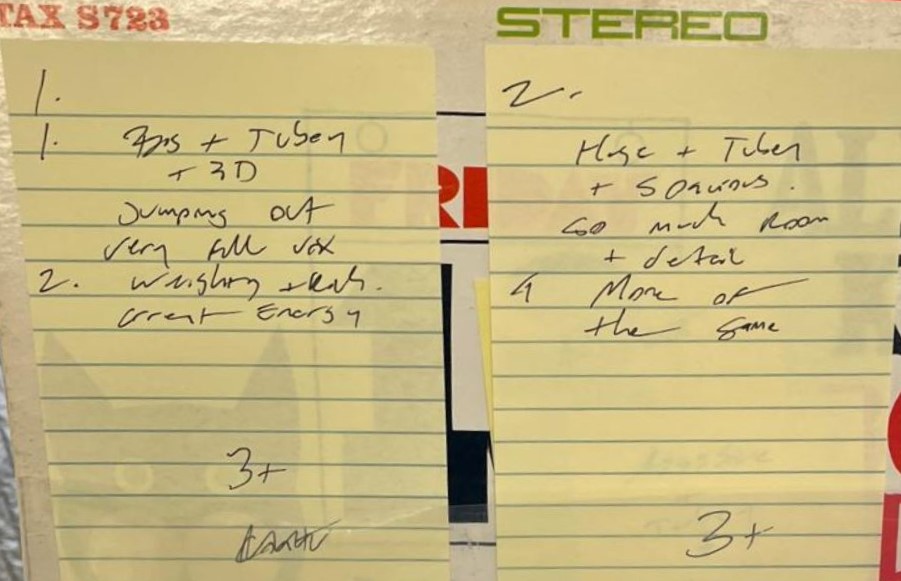
Side One

  • Big and tubey and 3-D
  • Jumping out
  • Very full vocals
  • Weighty and rich
  • Great energy

Side Two

  • Huge and tubey and spacious
  • So much room and detail
  • More of the same!

That’s the kind of sound your nine hundred bucks buys you.

Here is how we described it on the site:

  • Born Under A Bad Sign returns to the site for the first time in years, here with KILLER Shootout Winning Triple Plus (A+++) grades on both sides of this original Stax pressing – fairly quiet vinyl too
  • These are just a few of the the things we had to say about this amazing copy in our notes: “big and tubey and 3D”…”jumping out of the speakers”…”very full vox”…”weighty and rich”…”great energy”…”so much room and detail”
  • No other copy came close to this one, and we had a bunch, many of which earned grades of 1.5+ because, on this record, you really have to know what to look for in the dead wax
  • Incredibly dynamic, rich and full, with lots of texture to the guitars, this copy brought the music to life right in our listening room
  • Accept no substitutes – no reissue of the album can ever give you the energy, size and you-are-there presence that’s on this disc

More amazing finds similar to this one can be found here.

Craft Recordings remastered this Albert King title, and you should not be surprised to find that it sounds as awful as the other pressings put out by this ridiculous label, remastered pressings that we took the time to audition and review out of the goodness of our hearts, in the hopes of saving those of you out there in the land of audiophiles who might be tempted to buy some of their low- to mid-fi releases and could be scared away by our criticisms.

(more…)

Frames of Reference, Carefully Conducted Shootouts and Critical Listening

Hot Stamper Pressings of Decca Recordings Available Now

The sound we were hearing on this pressing of the Beethoven Septet (CS 6132) during a recent shootout was both rich and sweet, with easily recognized, unerringly correct timbres for all seven of the instruments heard in the work.

The legendary 1959 Decca tree microphone setup had worked its magic once again.

And, as good as it was, we were surprised to discover that side two was actually even better!

The sound was more spacious and more transparent. We asked ourselves, how is this even possible?

Hard to believe, but side two had the sound that was TRULY hard to fault.

This is precisely what careful shootouts and critical listening are all about.

Shootouts are the only way to answer the most important question in all of audio: “compared to what?”

Without shootouts, how can you begin to know what are the strengths and weaknesses of the copies you own?

The vast majority of our Shootout Winning pressings fall short in one way or another on one side, something we have lately been making more of an effort to highlight on the blog.

Now, if you are a fan in general of modern Heavy Vinyl pressings, what exactly is your frame of reference? How many good early pressings of those same titles could you possibly own, and how were they cleaned?

Without the best pressings around to compare, Heavy Vinyl might sound fine.

It’s only when you have something better to play that its faults come into clearer focus.

And if you have any of these titles and they sound fine to you, this is a situation that requires your immediate attention!

(more…)

System Neutrality — “Allowing the Music to Speak”

Robert Brook runs a blog called The Broken Record, with a subtitle explaining what the aim of his blog is:

A GUIDE FOR THE DEDICATED ANALOG AUDIOPHILE

We know of none better, outside of our own humble attempt to enlighten that portion of the audiophile community who love hearing music reproduced with the highest fidelity and are willing to go the extra mile to make that happen.

System NEUTRALITY: “ALLOWING the MUSIC to SPEAK”

An excerpt:

I am here to tell you, however, that in the few short hours that I spent with Robert and his system, I gained a tremendous amount of knowledge, both in technical tweaks and in the philosophy of how to listen. Despite owning either identical hardware or that of similar ilk (same speakers, cartridge, similar turntable, treatments, and so on). Robert’s system sounded fundamentally different from mine.”

This is surely the result of the large numbers of small changes — with potentially big effects — Robert made to his system, proof that the 80/20 rule is real.

If you click on the 80/20 link above you will find links to hundreds of test records at the bottom of the commentary, along with this paragraph:

These are the records that challenged me and helped me to achieve more progress in audio. If you want to improve your stereo, these are some of the best records we know of to help you take your system to the next level.

To that end, I recently compiled a list of seventy or so records that had been helpful in getting my system to sound better, mostly by working on the many problems I heard when attempting to hear them at their best over the course of the last forty-plus years.

These two were by far the most helpful, but, as I say, there were scores of them, records that I played hundreds and hundreds of times while I went about tweaking and testing. (That’s how I ended up with the lovely lattice all over my soundroom that you can see in the pictures below.)

(more…)

Is This Really Robert Ludwig’s Doing? I Thought He Was One of the Good Guys

Hot Stamper Pressings of Rock and Pop Albums Available Now

Below is the complete shootout stamper sheet for a rock record whose name we do not plan to reveal at this time.

We could reveal it, since knowing the “right” stamper numbers appears to be of no help at all — the best stampers and the worst stampers are exactly  the same stampers! (Nothing new there.)

RL stands for Robert Ludwig and MD stands for Masterdisk.  As you can see, Robert Ludwig cut all seven of the pressings that made it to the shootout.

One of them actually won. “Robert Ludwig’s stuff cannot be beat!” might be the post on whatever audiophile forum you frequent. (If it’s Hoffman’s forum, it would more likely read “Robert Ludwig’s stuff cannot be beat except by Steve Hoffman!”)

Another pressings with those same markings came in next to last, with such mediocre-at-best sound that it would not qualify as a Hot Stamper at all. (1.5+ on both sides or better is the minimum grade for any record we sell.)

Robert Ludwig really screwed up the mastering of this title, another forum member might post.

Can they both be wrong? Of course they can. When has any information posted on a forum been reliable or free from error?

If you were to tell me you have the Robert Ludwig-mastered original pressing for this record and it sounds amazing, I would be inclined to agree with you that that is very possible. If, on the other hand, you were to tell me you have the Robert Ludwig-mastered original pressing for this record and it sounds terrible, I would say I happen to know firsthand that that’s possible too.

The most likely sound for any copy you might have is “good, not great,” because only two copies earned grades of 2+ or better on both sides. Two out of seven. (Which is disappointing because it hurts our bottom line when so few copies in a shootout will end up selling for much more than we invested in them in money and labor.)

(more…)

Which Side of this Pressing Lacked Space, and How on Earth Did You Spot It?

Hot Stamper Pressings of the Music of Thelonious Monk Available Now

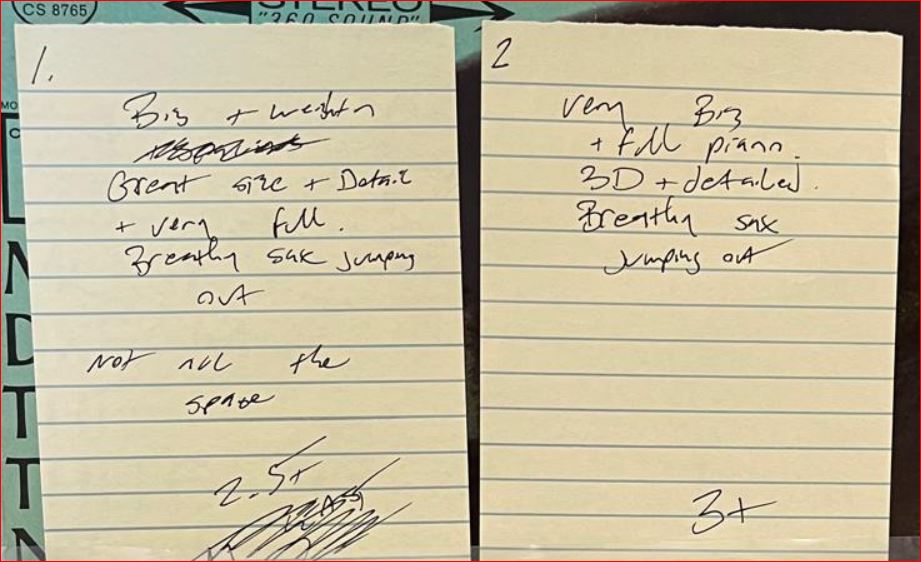
Our notes for a recent shootout winning copy read:

Monk’s Dream returns to the site for only the second time in over two years, here with INCREDIBLE Shootout Winning Triple Plus (A+++) grades or close to them throughout this black print Stereo 360 pressing.

These are just a few of the things we had to say about this killer copy in our notes: “big and weighty”…”great size and detail and very full”…”breathy sax jumping out of the speakers”…”very big and full piano”

In our notes you can see that side one fell short in one area, space, but how would anyone know that who hadn’t played a copy with even more space than this one? That’s why we do shootouts and you must do them too.

Both of these sides are rich, spacious, big and Tubey Magical, with less smear on the piano, a problem that holds many copies back. The sound found on these early Columbia 360 Label Stereo pressings is absolutely the right one for Monk’s music.

As you can see from the notes we took for this copy, we are not making any of this up!

This is why we do shootouts. If you really want to be able to recognize subtle (and sometimes not so subtle!) differences between pressings, you must learn to do them too.

And make sure to take notes about what you are hearing, good and bad.

One side falling short of the full Three Pluses happens all the time.

One out of five records that has one shootout winning side will have a matching shootout-winning other side.

(more…)

I Couldn’t Learn Much Until I Figured Out How to Train My Ears

Developing Your Critical Listening Skills Is Key to Finding Better Records

It’s amazing how far you can get in this hobby if you’re obsessive enough and driven enough.

To achieve real success you must be willing to devote huge amounts of time, money and effort to the pursuit of better home audio.

You will really go far if you’re willing to let your ears, not your brain, inform your understanding and appreciation of the sound of the various pressings you play.

If we thought like most audiophiles — that money buys good sound and original pressings are usually the best — we would currently be very unlikely to have a business selling a million dollars or more worth of Hot Stampers every year.

Conventional thinking and wrong-headed thinking would have prevented us from achieving the progress we’ve made over the last twenty years, and they will surely impede your progress too.

(Be sure to avoid these kinds of records while you are at it. They’re nothing but a dead end.)

However, if you choose to follow our approach, you are very likely to be amazed at the positive changes that will come your way.

Training Your Ears

Of course, we should note that it helps to have a dedicated full-time staff doing shootouts, including a full-time record cleaning person. All of the members of the listening panel were musicians with already well-trained ears when we hired them. From the start they had no trouble appreciating the differences between pressings.

I, on the other hand, am not a musician. Over the years I simply tried to get my stereo to sound more like live music. As it improved over the years, it allowed me to hear more and more of what was really on my records. I slowly gained the skills I needed to do the kind of critical listening comparisons that are currently the heart of our business. Let me be the first to admit it was slow going for about the first twenty years.

It has been my experience that most audiophiles are in that same non-musician boat. The problem seems to be that stereos are not nearly as good at teaching these skills as musical instruments are.

Unless you are of an experimental mind and are willing to devote a great deal of your time and money to the audio game, you are unlikely to develop the skills necessary to critically evaluate recordings at the highest level.

Unfortunately, playing into this vicious cycle, those same critical listening skills are the very ones you need to make your stereo revealing enough so that even subtle differences between pressings become not just clear, but obvious.

Better ears lead to better stereos, but bad stereos make it hard to develop better ears.

That’s why I made so many mistakes and learned so little in my first twenty years as an audiophile.

Although we make plenty of mistakes, we think of ourselves as experts when it comes to evaluating the sound of records and stereo equipment. (Experts make mistakes, they just make fewer of them.)

But the practical consequences of these findings are that few audiophiles can ever hope to acquire expert critical listening skills. It takes too much time and it takes too much work. Most people are in this hobby for fun. They already have a job. They don’t need another one.

Perhaps there’s another, better way to look at it. Most people are not going to become scratch golfers, but they can still get better at the game. There is a balance to be achieved between working hard to improve your skills and having fun at the same time.

(more…)

Critical Listening Vs. Listening for Enjoyment

Record Collecting for Audiophiles – A Guide to the Fundamentals

In order to do the work we do, our approach to audio has to be fundamentally different from that of the audiophile who listens mostly for enjoyment.

Critical listening and listening for enjoyment go hand in hand, but they are not the same thing.

The first of these — developing and applying your critical listening skills — allows you to achieve good audio and find the best pressings of the music you love.

(Developing critical thinking skills when it comes to records and equipment is important too but that is not the focus of today’s commentary.)

Once you have a good stereo and a good record to play on it, your enjoyment of recorded music should increase dramatically. A great sounding record on a killer system is a thrill.

A Heavy Vinyl mediocrity, played back on what passes for so many audiophile systems these days — regardless of cost — is, to these ears, an insufferable bore. (And, judging by what we’ve played in 2024 and 2025, these remastered releases are sounding as bad as they ever have.)

If this sounds arrogant and elitist, so be it. Heavy Vinyl records are fine for some people, but for the last twenty or so years we’ve managed to set a higher standard for ourselves and our customers. Holding our records to that higher standard allows us to price our Hot Stamper pressings commensurate with their superior sound and please the hell out of the people who buy them.

For those who appreciate the difference, and have resources sufficient to afford them, the cost is reasonable. If it were not, we would have gone out of business long ago.

Hot Stampers are not cheap. If the price could not be justified by the better sound quality and quieter surfaces, who in his right mind would buy them? We can’t really be fooling that many audiophiles, can we?

(more…)

On Our Top Copy of Face Value, How Did We Know that One Side Lacked Weight?

Hot Stamper Pressings of the Music of Phil Collins Available Now

We described our most recent shootout-winning pressing this way:

An early UK copy of Phil Collins’s killer solo debut with STUNNING Shootout Winning Triple Plus (A+++) side two mated to a nearly as good side one.

The recording of this album is still analog and the quality is excellent, thanks to hugely talented engineer and producer Hugh Padgham (Peter Gabriel, Genesis, The Police, Yes, Emerson, Lake & Palmer, etc.).

Song after song, Collins’s songwriting and musicianship shine with this breakout record, the first and clearly the best of all his solo albums. The sound on the better copies is vibrant, with superb extension on the top, punchy bass, and excellent texture on the drums and percussion, as well as spacious strings and vocals.

Side two was killer in every way, and the way we know that is we played a bunch of copies and nothing could beat it. This side two took top honors for having exactly the sound we described above.

For Those About to Rock

Of special interest to those of you who would like to do your own shootouts for the album are some of the specific notes we took:

The third track is “much less pinched,” with the most warmth and the least hardness.

Those are the areas that set this killer side two apart — it wasn’t as pinched and hard as most copies, and it had more warmth. Listen for those three things on the third track of the second side and you might just find it’s a lot easier to pick a winner.

Side one was doing great in many areas. Track three (again) was punchy, rich and relaxed, with no hardness.

It had most, but not all of the weight.

Same story as side two. Listen for all those qualities, especially hardness and how much weight you can hear on the first side. You will need big speakers to do this shootout, and don’t be afraid to turn them up.

(more…)

An Extraordinary Recording of the Carmen Fantasie – This Is Why You Must Do Shootouts

It has been years since a Whiteback pressing on the later label won a shootout. Some reissue copies of CS 6165 have earned Nearly White Hot Stamper grades, but we would be very surprised if one of the Blueback originals we play in the next shootout does not come out on top. They are just too good.


This London Whiteback LP has DEMO DISC sound like you will not believe, especially on side two, which earned our coveted A Triple Plus rating. The sound is warm, sweet and transparent; in short, absolutely GORGEOUS. We call it AGAIG — As Good As It Gets!

As this is one of the Greatest Violin Showpiece Albums of All Time, it is certainly a record that belongs in every right-thinking audiophle’s collection. (If you’re on our site and taking the time to read this, that probably means you.) Ruggiero Ricci is superb throughout.

And side one was just a step below the second side in terms of sound quality, with very solid A++ sound. To find two sides of this caliber, on quiet vinyl no less, is no mean feat. You could easily go through ten copies without finding one as consistently good sounding as this one.

A True Demo Disc, Or Was It?

Ricci’s playing of the Bizet-Sarasate Carmen Fantasie is OUT OF THIS WORLD. There is no greater perforrmance on record in my opinion, and few works that have as much Audiophile Appeal.

Which is why I’ve had a copy of this record in my own collection for about fifteen years marked “My Demo Disc.” But this copy KILLED it. How could that be?

It just goes to show: No matter how good a particular copy of a record may sound to you, when you clean and play enough of them you will almost always find one that’s better, and often surprisingly better.

Shootouts are the only way to find these kinds of records. That’s why you must do them.

Nothing else works. If you’re not doing shootouts (or buying the winners of shootouts from us) you simply don’t have top quality copies in your collection, except in the rare instances where you just got lucky. In the world of records luck can only take you so far. The rest of the journey requires effort.

(more…)

What the Shootout Winning Copies of A Hard Day’s Night Really Get Right

Hot Stamper Pressings of the Music of The Beatles Available Now

I wrote this bit of commentary about twenty years ago:

When comparing pressings of this record, the copies that get their voices to sound both present and warm, smooth, and sweet, especially during the harmonies, are always the best.  All the other instruments seem to fall in line when the vocals are correct. This is an old truism — it’s all about the midrange — but in the case of A Hard Day’s Night, it really is true.

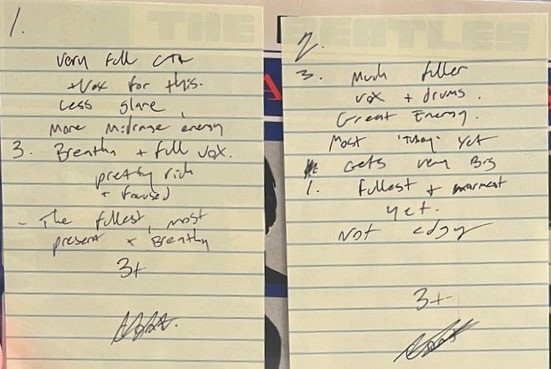
Now that we are putting our unredacted (!) shootout notes on the blog for everyone to see, here are the actual notes for the shootout winning pressing we just played (6/2025), notes that back up what we said so many years ago 100%.

What’s does this amazing side one sound like?

  • Very full guitars and vocals for this
  • Less glare
  • More midrange energy
  • Breathy and full vocals
  • Pretty rich and focussed
  • The fullest, most present and breathy vocals

And this amazing side two?

  • Much fuller vocals and drums
  • Great energy
  • Most “tubey” yet
  • Gets very big
  • Fullest and warmest yet
  • Not edgy

Both sides had qualities that did much to set them apart, coupled with fewer of the shortcomings we found in practically all the other pressings we played.

Less glary and less edgy are critical to the better pressings, simply because few copies are not glary and edgy in the midrange to some degree.

But the real keys to the shootout winners are vocals that are full, present, warm and breathy.

For The Beatles in 1964, nothing else about the sound of their recordings could possibly compete with those four qualities.

We could add two more. Energy would probably be the next most important one, followed by Tubey Magic.

That brings the total of most important qualities to a grand total six.

(more…)