*Experimenting with Records

Experimenting with records is the only way to learn much about them of any real value.

How Do the Early Pressings of The Poll Winners Sound?

Hot Stamper Pressings of Contemporary Jazz Albums Available Now

A recent Shootout Winning copy with the early stereo badge cover was described this way:

Stunning sound throughout this vintage Black Label Stereo Records pressing, with both sides earning Shootout Winning Triple Plus (A+++) grades or close to them

Roy DuNann always seems to get the real sound out of the sessions he recorded – amazingly realistic drums in a big room; Tubey Magical guitar tone; deep, note-like bass, and on and on

4 1/2 stars: “The choice of material, the interplay between the three players, and the lead work all meld together beautifully on The Poll Winners, making it a classic guitar album in a small-group setting.”

Musically, all true. Sonically, not so much. The early D1/D2 stampers on the early Black Label might be passable on side one (1+), but side two was just a mess (NFG).

Side One

Track Two

  • A bit bright and flat

Track One

  • Very clear but lacking richness, weight and depth
  • Thin, and bright up top
  • 1+

Side Two

Track One

  • Narrow stereo field
  • Weird tape hiss
  • Metallic top end
  • Very recessed and weird
  • Nope

A different Stereo Badge Cover copy sporting a Black Label won the shootout by the way. Go figure.

(more…)

Which Art Pepper Today Is Better: Phil DeLancie Digital or George Horn Analog?

Hot Stamper Pressings of the Music of Art Pepper Available Now

UPDATE 2024

This commentary was written in 2010 or thereabouts.

There is new information about the album as of 2024, which can be found here.


We’d wanted to do Art Pepper Today for more than a decade, but the original Galaxy pressings were just too thick and dark to earn anything approaching a top sonic grade. Thirty years ago on a very different system I had one and liked it a lot, but there was no way I could get past the opaque sound I was now hearing on the more than half-dozen originals piled in front of me.

So, almost in desperation we tried an OJC reissue from the ’90s. You know, the ones that all the audiophiles on the web will tell you to steer clear of because it has been mastered by Phil DeLancie and might be sourced from digital tapes.

Or digitally remastered, or somehow was infected with something digital somehow.

Well, immediately the sound opened up dramatically, with presence, space, clarity and top end extension we simply could not hear on the originals. Moreover, the good news was that the richness and solidity of the originals was every bit as good. Some of the originals were less murky and veiled than others, so we culled the worst of them for trade and put the rest into the shootout with all the OJCs we could get our hands on.

Now, it’s indisputable that Phil DeLancie is credited on the jacket, but I see George Horn‘s writing in the dead wax of the actual record, so I really have no way of knowing whether in fact Mr Delancie had anything to do with the copies I was auditioning. They don’t sound digital to me, they’re just like other good George Horn-mastered records I’ve heard from this period.

And of course we here at Better Records never put much stock in what record jackets say; in our experience, the commentary on the jackets rarely has much to do with the sound of the records inside them.

And, one more surprise awaited us as we were plowing through our pile of copies.

When we got to side two we found that the sound of the Galaxy originals was often competitive with the best of the OJCs. Which means that there’s a good probability that some of the original pressings I tossed for having bad sound on side one had very good, perhaps even shootout winning sound, on side two.

This is a lesson I hope to take to heart in the future. I know very well that the sound of side one is independent of side two, but somehow in this case I let my prejudice against the first side color my thinking about the second.

Of all the people who should know better…

(more…)

Our Shootout Winner Had Sound that Was Really Jumping Out of the Speakers

Hot Stamper Pressings of Direct-to-Disc Recordings Available Now

Recently we put up a copy of this wonderful direct to disc recording with this description:

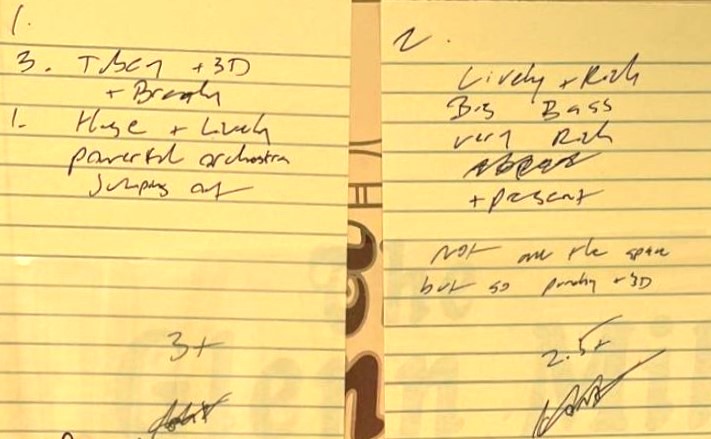
Here are just a few of the things we had to say about this incredible copy in our notes: “tubey and 3D and breathy”…”huge and lively”…”powerful orchestra”…”jumping out of the speakers”…”very rich and present.”

Great energy, but the sound is relaxed and Tubey sweet at the same time, never squawky, with plenty of extension on both ends – that’s analog for ya!

This is no sleepy over-the-hill Sheffield Direct-to-Disc (referring to the later Harry James titles, not the excellent first one) – these guys are the real deal and they play their hearts out on this album, recorded in a church with exemplary acoustics.

Note that side two did not have all the space, but was so punchy and 3-D that it was easy to award it a Nearly White Hot Stamper grade of 2.5+. The copy that beat it had all the same qualities and more space, sounding more like side one of this very pressing.

And here are the actual notes for the Shootout Winning copy we found.

We have no trouble hearing when a record is doing everything right, and when a record has one side that is a bit lacking, it’s the shootout that shows us in what area it is lacking.

In this case, our notes read:

  • Not all the space but so punchy and 3-D

Track one had sound that “jumped out of the speakers,” and if — like us — that’s the kind of sound you are looking for, our Hot Stamper pressings are where you can find it.

If you would like to test the pressings you own, here are a few that might make good tests for that quality. Also, many of our customers have commented about that quality in the Hot Stamper pressings we sent them, and you can read their letters here.

(more…)

The Who By Numbers – How Did We Know Side Two Was Slightly Veiled?

Hot Stamper Pressings of the Music of The Who Available Now

Here is how we might typically describe one of our Shootout Winning copies:

Who By Numbers returns to the site for only the second time in over three years, here with KILLER Shootout Winning Triple Plus (A+++) sound or close to it on both sides of this vintage Polydor import pressing – fairly quiet vinyl too.

Glyn Johns‘s magic is on display here, with open mics in a big studio space creating the 3D soundscapes we love.

Features two of their most iconic songs, “Slip Kid” and “Squeezebox,” and both sound incredible on this copy.

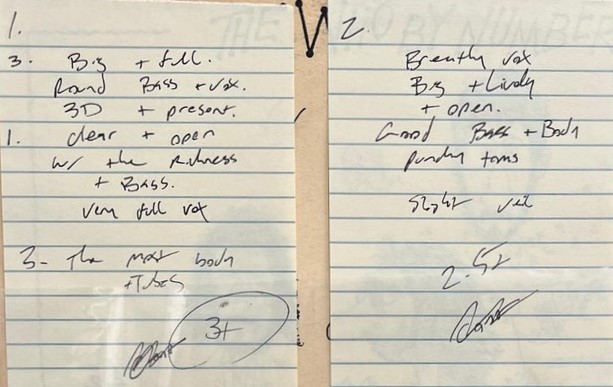
To back it all up, here are the notes for that very copy.

We started playing track three on side one, Squeeze Box, and returned to that track when we had two top copies to play against each other in the final round. Which one won? The one with “the most body and tubes.”

Note that side two of this copy was slightly veiled compared to the side two of the best copy we played, the one that would go on to earn 3+.

We don’t like veiled records — records where there is a curtain, no matter how transparent, in front of the musicians. Heavy Vinyl pressings are typically quite veiled and recessed in the midrange compared to their vintage vinyl counterparts, and that sound is simply not going to cut it with us. (Other folks may prefer a different sound it seems.)

Midrange presence is one of the most important qualities of any rock or pop recording we evaluate. You want Roger Daltry to be front and center, neither recessed nor behind a veil.

(more…)

For a Better Approach to Finding Higher Quality Pressings, Sweat the Details

Please Consider Taking Some of Our Audio Advice

When it comes to doing shootouts, half the battle is just being able to play the record right.

Our approach is simple enough. We precisely adjust the arm and cartridge for every title by ear, then compare the various pressings — properly cleaned of course — under carefully controlled, blinded conditions, with as much scientific rigor as we can bring to the proceedings.

In some ways it may in fact be analogous to rocket science, which we would define as the process of discovering all the details that need to be sweated and then sweating the hell out of them.

It’s the opposite of theoretical physics. One doesn’t need to be a novel thinker or have big ideas to do audio well.

Obsessively working through the basics of table setup, tweaks, room treatments and electrical quality will take your system to levels beyond those you have ever imagined.

And, you sure don’t need a bloody microscope to check your stylus rake angle, unlike some audiophile reviewers who insist that such devices are essential.

Your ears, if they are any good at all, will do the job just fine, and probably much better.

(more…)

An Empirical Approach to Finding Better Records

Skeptical Thinking Can Help You Identify Records with Better Sound Quality

Some approaches to this audio hobby tend to produce better results than others. When your thinking about audio and records does not comport with reality, you are much less likely to achieve the improvements you seek.

Without a good stereo, it is hard to find better records. Without better records, it is hard to improve your stereo.

You need both, and thinking about them the right way, using the results of carefully run experiments — not feelings, opinions, theories, received wisdom or dogma — is surely the best way to acquire better sound.

An empirically-based approach to audio will surely result in notable improvements to the quality of your playback.

This will in turn make the job of recognizing high quality pressings — the ones you find for yourself, or the ones we find for you — much, much easier.

(more…)

Jazz Giant and Tube Versus Transistor Tradeoffs

Hot Stamper Pressings of Contemporary Jazz Albums Available Now

In a commentary from more than ten years ago we weighed the tradeoffs in the sound of the originals versus the reissues.

This superb sounding original Black Label Contemporary pressing of Benny Carter’s swingin’ jazz quartet is the very definition of a top jazz stereo recording from the late ’50s recorded and mastered through an All Tube Chain.

There’s good extension on the top end for an early pressing, with TONS of what you would most expect: Tubey Magic and Richness. If that’s what you’re looking for, this copy has got it!

We prefer the later pressings in most ways, but this record does something that no later pressing we have ever played can do — get Benny’s trumpet to sound uncannily REAL.

If you want to demonstrate to your skeptical audiophile friends what no CD (or modern remastered record) can begin to do, play side two of this copy for them. They may be in for quite a shock.

The sound of the muted trumpet on side two is out of this world. 

It’s exactly the sonic signature of good tube equipment — making some elements of a recording sound shockingly real.

(more…)

How Can You Tell When the Conventional Wisdom Is Wrong?

Skeptical Thinking Is Critical to Achieving Better Sound

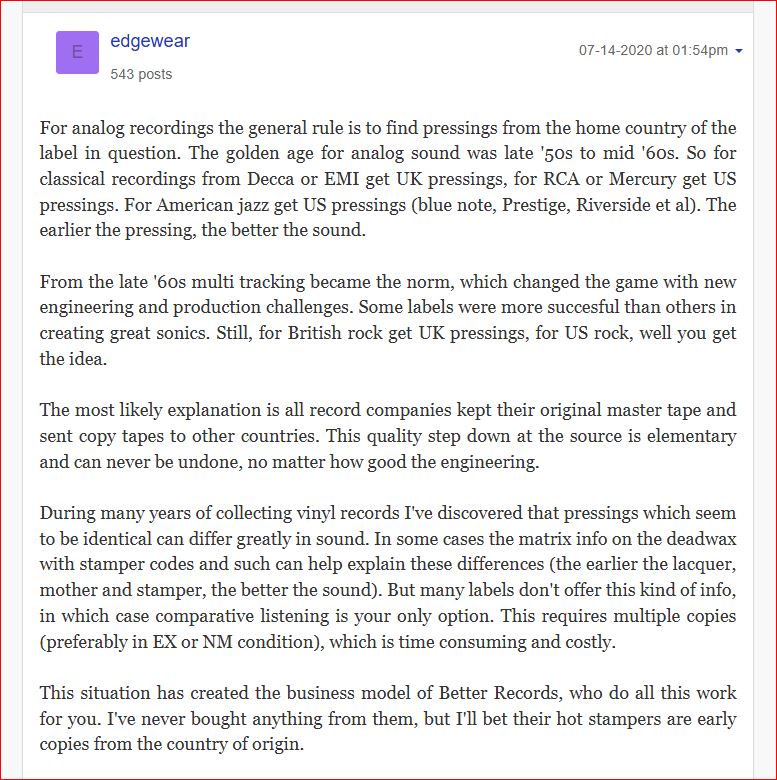
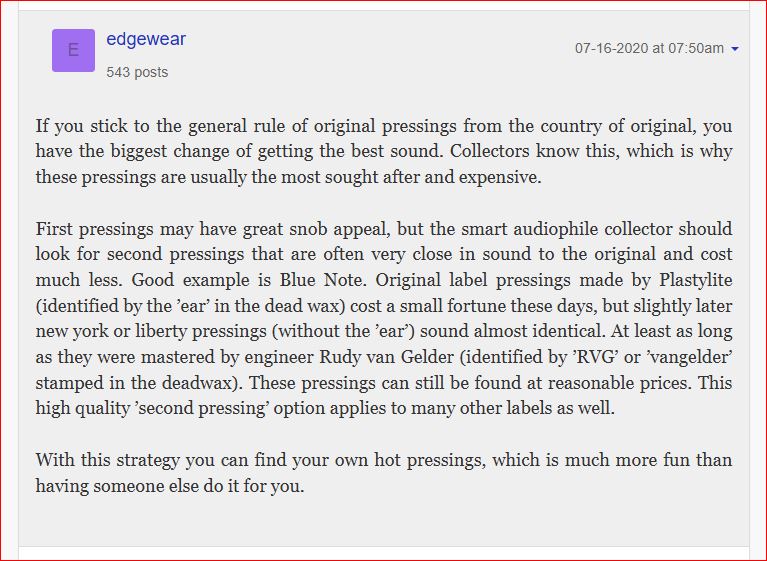
Let me be clear: conventional wisdom applied to collecting higher quality vintage vinyl pressings will be right more often than it is wrong. If it were the other way around, it would not be wisdom, it would be folly.

The person who applies the kind of advice you see described below will surely end up with a decent collection of records, records which will no doubt be better sounding than if he were buying records randomly.

As we said, conventional wisdom generally gets more records right than wrong. More right than wrong, yes, but plenty wrong just the same. That is the subject of this commentary.

Mr. edgewear does us a huge favor by laying out a great many of the most popular tenets of record collecting advice in the two posts below. (I probably found his post on the Steve Hoffman forum discussion of Hot Stampers. It goes on for days.)

I plan to follow up on some of these assertions in greater detail. (Please note that “assertions” is the most accurate description of the information Mr. edgewear provides, as there is simply no effort made to provide evidence of any kind to back up his pronouncements, the standard operating procedure for the internet.)

Let’s look closer at some of the most likely results if someone were to follow the advice offered above.

(more…)

Two Approaches to Finding Better Records (and One of Them Actually Works!)

Skeptical Thinking Is Key to Finding Better Sounding Records

If you want to believe the press releases, the hype, the liner notes, the reviews (which are rarely more than the worst kind of malpractice in our opinion) and all the rest of it, that’s your business.

Good luck with that approach; you’re going to need it. When you reach the dead end that more than likely awaits you, come see us.

After 35 38 years in the record business there is a good chance we will still be around.

Our approach, on the other hand, revolves around cleaning and playing as many records as we can get our hands on, and then judging them on their merits and nothing but their merits, calling them as we see them as best we can, without fear or favor.

Our judgments may turn out to be wrong. Tomorrow we may find a better sounding pressing than the one we sell you today. It doesn’t happen very often, but it does happen.

We don’t know it all and we’ve never pretended that we did. All knowledge is provisional. We may not be the smartest guys in the room, but we’re sure as hell smart enough to know that much.

If somehow we did know it all, there would not be a hundred entries in our live and learn section.

We regularly learn from our mistakes and we hope you do too.

But we learn things from the records we play not by reading about them, but by playing them. Our experiments, conducted using the shootout process we’ve painstakingly developed and refined over the course of the last twenty years, produces all the data we need: the winners, the losers, and the ranking for all the records in-between.

We’ve learned to ignore everything but the sound of the records we’ve actually played on our reference system.

What, of any real value, could someone possibly tell us about a record that we’ve played for ourselves?

(more…)

The Planets – Can You Imagine Sound this Bad from a TAS List Super Disc?

Hot Stamper Classical and Orchestral Pressings Available Now

We can, we played it.

Or, to be more correct, we played them. Two pressings, each with one good side and one very bad side.


UPDATE 2025

Take all of this with a very large grain of salt. In the course of doing more shootouts for the Mehta Planets, we’ve played quite a number of different pressings and now believe — believe being the operative word — we know which are the best stampers.

It is very unlikely that any Dutch pressing would be competitive with the best UK-pressed copies cut by Harry Fisher.

For those of you who just want a good sounding copy of The Planets to play and enjoy, our favorite by far is Previn’s reading on EMI from 1974.

We know of no better performance, and we much prefer the dramatically more natural sound quality.

The Mehta recording, like much of what he recorded for Decca in those days, is a multi-miked mess, the kind we grew out of (for the most part) a long time ago. (More of the multi-miked records we’ve auditioned, of varying quality to be sure, can be found here.)


Our old commentary (please excuse the heavy-handed caps):

This 2-pack from many years ago (ten fifteen perhaps), described below, boasts White Hot Stamper sound on side two for the Mehta Planets. Yes, it IS possible. Side two shows you what this record is actually capable of — big WHOMP, no SMEAR, super SPACIOUS, DYNAMIC, with an EXTENDED top.

It beat every London pressing we threw at it, coming out on top for our shootout. Folks, we 100% guarantee that whatever pressing you have of this performance, this copy will trounce it.

But side one of this London original British pressing was awful.

We wrote it off as NFG after about a minute; that’s all we could take of the bright, hard-sounding brass of War.

If you collect Super Discs based on their catalog numbers and labels and preferred countries of manufacture, you are in big trouble when it comes time to play the damn things.

That approach doesn’t work for sound and never did.

If your stereo is any good, this is not news to you. The proof? The first disc in this 2-pack is Dutch. It earned a Super Hot grade in our blind test, beating every British copy we played against it save one. Side two however was recessed, dark and lifeless. Another NFG side, but the perfect complement to our White Hot British side two!

(more…)