Performers

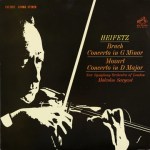
Bruch & Mozart Violin Concertos / Heifetz in 2010

Years ago we wrote:

This is a very old review, probably from the early 2010s, so take it for what it’s worth. I suspect we could find a much better sounding copy of the album today than we could back then, before we had the cleaning systems and playback equipment we do now.

All that turned out to be true.

In 2024 we did another shootout for the album, our first in more than ten years! I am happy to say the sound was a knockout on the best copies, some of the finest violin concerto sound we have ever heard.

Live and learn is our motto, and progress in audio is a feature, not a bug, of record collecting at the most advanced levels. (“Advanced” is a code word for having little to no interest in any remastered pressing marketed to the audiophile community. If you want to avoid the worst of them, we are happy to help you do that.)

Our comments from 2010:

(more…)

Destination Stereo – A Living Stereo Demo Disc

Hot Stamper Pressings of Living Stereo Titles Available Now

Your Destination — Stereo!

“Your passport to great music in new sound by the world’s greatest artists.”

This review was written about ten years ago.

This reasonably quiet RCA Shaded Dog LP has DEMONSTRATION QUALITY SOUND on BOTH sides. It is without a doubt THE best sounding copy we have ever heard*.

Side one is White Hot, with some of the best 1959 Living Stereo we’ve ever heard. Explosive dynamics, HUGE space and size, with unerringly correct tonality, this is a Demo Disc like no other.

When “in-the-know” audiophiles discuss three-dimensionality, soundstaging and depth, they should be talking about a record that sounds like this.

Shockingly real – proof positive that the cutting systems of the day are capable of much better sound than many might think. 

(We admit that we have made the mistake of wrongthink in this regard.)

This record is designed to show off the Living Stereo sound at its best and it succeeds magnificently. The full range of colors of the orchestra are here presented with remarkable clarity, dynamic contrast, spaciousness, sweetness, and timbral accuracy.

If you want to demonstrate to a novice listener why modern recordings are unsatisfactory, all you have to do is play this record for them. No CD ever sounded like this.

Just play Gnomus to hear The Power of the Orchestra, Living Stereo style.

The fourth and fifth movements of Capriccio Espagnol, the second track on side one, sound superb, CLEARLY better here than on the Shaded Dog pressings of the original album we played about a year ago (which were terrible and never made it to the site. Great performance but bad mastering of what obviously was a very good master tape).

You can also hear the Living Stereo sound especially well on the excerpt from “The Fourth of July” performed by Morton Gould. It’s one of the best sounding tracks here.

I don’t think the RCA engineers can cut this record much better — it has all the Living Stereo magic one could ask for, as well as the bass and dynamics that are missing from so many other vintage Golden Age records.

This is as good as it gets, folks.

(more…)

Brahms / Piano Concerto No. 1 – What to Listen For

Hot Stamper Pressings of of the Music of Brahms Available Now

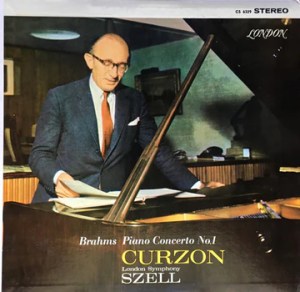
Our general notes for the recording seen below explain why the typical copy in our shootout fell short.

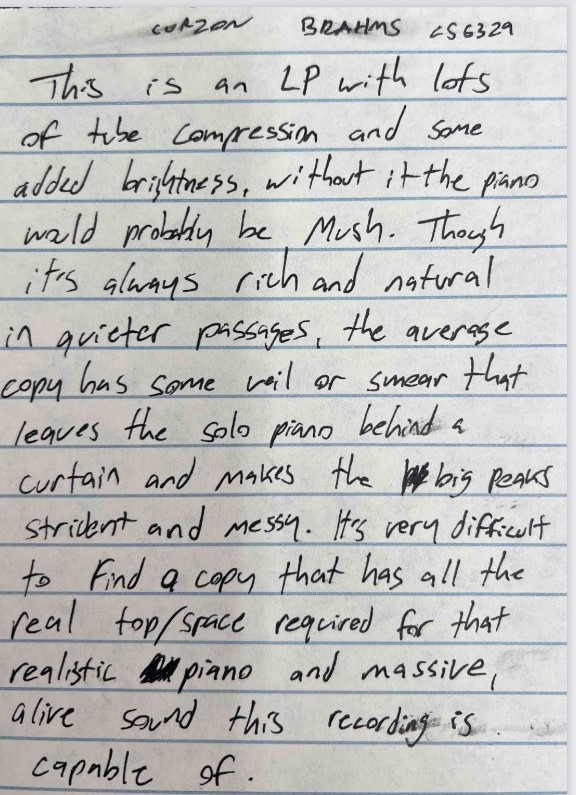
This is an LP with lots of tube compression, and some added brightness.

Without the added brightness, the piano would probably be mud.

The added brightness and compression results in a piano that always sounds rich and natural in the quieter passages.

The average copy also has some veiling or smearing that make the solo piano parts sound like they are coming fom behind a curtain. On these copies, the big peaks can often get strident and very messy.

It’s difficult to find a copy that has all the top end extension and space required to reproduce both a realistic piano and the massive live sound the orchestra is capable of.


All of which adds up to a difficult shootout in which relatively few copies had the sound we were looking for.

Production and Enginneering

(more…)

Mussorgsky / Pictures at an Exhibition (Piano Version) / Ashkenazy

More of the Music of Mussorgsky

  • A superb early London stereo pressing of our favorite solo piano performance of Mussorgsky’s masterful suite, with Double Plus (A++) sound from the first note to the last
  • The weight and warmth of side one’s recording from Kingsway Hall is faithfully captured in all its beauty on this very disc
  • The orchestral performance of the work is squeezed onto the second side of the record, and that is just not going to work with a 30-minute-long piece of music — the sound is compressed and bass-shy

(more…)

Letter of the Week – “What I experienced was how emotionally heavy and complex this music is.”

More of the Music of Jean Sibelius (1865-1957)

More Hot Stamper Pressings Featuring the Violin

Our good customer Aaron wrote to tell of us his experience playing some copies of Heifetz’s recording of the Sibelius Violin Concerto. He already had a plain Hot Stamper pressing, probably a Red Seal reissue.

He started off his first email to me by saying this:

The striking difference between the white hot and the hot stamper is in how much the emotional character of the music comes through. Even though the instruments sound more immediate and organic on the white hot, the overall tone is darker and more anguished. The difference isn’t so much in the technical details, like the size of the soundstage, but rather, in the realism of the instruments, and the aggregate effect of that on the emotional impact of the music.

I replied:

Reading between the lines a bit, the Shaded Dog seems to be tonally a bit darker, but I hope that it should sound more tonally correct, as most of the time the later pressings are thinner and less real sounding. I think that’s what you are saying, but I wanted to make sure.

Tom,

In terms of the tone, what I can tell you is that the cello was absolutely chilling and sounded lifelike to me. The violin is rich without being shrill.

What I experienced was how emotionally heavy and complex this music is. Sure, there’s moments of dizzying ecstacy in it, but so much is aching and sad. I don’t want anybody to think I’m saying the white hot is muffled. It’s wonderfully transparent and realistic, and that shows off the melancholy in the music, creating a darker mood / color palette, even though I didn’t experience a darker tone.

Nicely put.

After Aaron had spent another week with the work, he had arrived at a much deeper understanding of the music and the sound:

I’ve now spent a lot of time with the Heifetz Sibelius WHS, the regular hot stamper, and a couple other copies I was able to find at my local shops over the years for $5-$12 each.

You know that before I commit to keeping a white hot stamper, I like to make full use of your 30-day money-back guarantee. By the time I’m splurging for a WHS, it’s usually an album I’ve already got several copies of. Sometimes, one spin is all it takes for me to be able to tell the WHS is delivering the goods. Rumours and Thriller were like this.

Other times, I’ve got to really listen, and carefully do my own shootout to be sure I want to keep it.

This time’s no different. I’m keeping the white hot of the Sibelius, and I’ll be returning the regular hot stamper. It was a more tricky shootout than some others. I can cut to the chase like this – for $5 you can hear Heifetz’s wonderful recording of the Sibelius Violin Concerto. For $495 more, you can hear a violin sound like a violin.

It’s crazy what my stereo can do now with violin and vocals, two particularly egregious weak spots before I got the Tri-Planar. I’m going a little nuts here. Some records I had cast off as having groove wear actually sound perfectly lovely. I guess female vocals was particularly challenging for my old tonearm to track. I took your blog’s advice and purchased some Beethoven string quarets (Julliard and Quartetto Italiano) that are just magnificent. I’ve no doubt proper hot stampers would beat them, but you gotta start somewhere.

Thanks Tom.

Aaron,

Experiencing the illusion of a “realistic” violin floating dead center between your speakers is indeed something that only the highest quality equipment can pull off, and we are glad your Triplanar arm is helping to deliver that magical sound to you.

I struggled with Shaded Dog pressings of Heifetz’s recordings for years back in the 90s. I couldn’t clean them right until the Walker fluids and better machines came along, and I couldn’t play them right until my turntable, arm, cartridge, setup, vibration control and who knows what else had gone through a great many changes.

Now it is obvious to me just how good these recordings can be. I had this to say about a favorite violin concerto not long ago:

This is truly The Perfect Turntable setup disc. When your VTA, azimuth, tracking weight and anti-skate are correct, this is the record that will make it clear to you that your efforts have paid off.

What to listen for you ask? With the proper adjustment the harmonics of the strings will sound extended and correct, neither hyped up nor dull; the wood body of the instrument will be more audibly “woody”; the fingering at the neck will be noticeable but will not call attention to itself in an unnatural way. In other words, as you adjust your setup, the violin will sound more and more right.

And you can’t really know how right it can sound until you go through hours of experimentation with all the forces that affect the way the needle rides the groove. Without precise VTA adjustment there is almost no way this record will do everything it’s capable of doing. There will be hardness, smear, sourness, thinness — something will be off somewhere. With total control over your arm and cartridge setup, these problems will all but vanish. (Depending on the quality of the equipment of course.)

We harp on all aspects of reproduction for a reason. When you have done the work, records like this are nothing less than GLORIOUS.

More recently I wrote about the completely unnatural violin tone found on the Heavy Vinyl reissues of Scheherazade. Both suffered greatly from their mastering engineers’ predilection for overly-smooth, overly-rich sound, a sound that apparently not many audiophiles found as bothersome as I did.

(more…)
Prokofiev / Piano Concerto No. 3 / Cliburn

More of the music of Sergei Prokofiev (1891-1953)

Reviews and Commentaries for the Music of Sergei Prokofiev

  • An early Shaded Dog pressing of these wonderful performances by pianist Van Cliburn and the Chicago Symphony Orchestra under the direction of Walter Hendl, here with INSANELY GOOD Shootout Winning Triple Plus (A+++) Living Stereo sound from first note to last
  • Both of these sides boast full brass and an especially clear, solid, present piano, one with practically no trace of vintage analog tube smear
  • Most of the Van Cliburn recordings for RCA that we’ve played over the years did not sound very good to us, which is why you haven’t seen one our site since 2005 (!)
  • Back in the days when the TAS Super Disc List meant something, this record was on it and deservedly so
  • To read the 60-odd reviews and commentaries we’ve written for piano concertos, please click here
  • The best sounding piano concerto records that we’ve auditioned to date can be found here

(more…)

Tchaikovsky / Paganini – Violin Concertos / Campoli

More of the music of Peter Ilyich Tchaikovsky (1840-1893)

More of the music of Niccolo Paganini (1782-1840)

  • A vintage Decca pressing of these superb concertos with stunning Nearly Triple Plus (A++ to A+++) sound on both sides, just shy of our Shootout Winner – fairly quiet vinyl too
  • This copy (only the second to hit the site in two years) showed us the balance of clarity and sweetness we were looking for in the violin – not many recordings from this era can do that
  • Campoli brings his warmth, feeling, and technical precision to these classical masterpieces
  • Some old record collectors (like me) say classical recording quality ain’t what it used to be – here’s the proof
  • Our favorite performance of the Tchaikovsky is still the RCA with Heifetz, but the best copies of this record are not far behind
  • With the wonderful Paganini-Kreisler piece on side two, this record comes very highly recommended

The second work on side two, Kreisler’s reworking of the first movement of the Paganini Concerto No. 1, is hard to fault. Pull up some youtube videos to see just how amazing and exciting it is.

A true demo disc violin recording.

And better than the original London pressing we had of the recording – the reissue is actually tubier, with none of the dryness you sometimes hear on London discs, and very dynamic.

(We know a thing or two about Decca recordings with dry strings. We took a deep dive into the subject here.)

Higher-rez and more present too. (more…)

Shaded Dogs with 12s Stampers Are Not the Way to Go on LSC 2566

Hot Stamper Pressings of the Music of Edvard Grieg Available Now

One set of stampers for the Shaded Dogs we played in our most recent shootout sounded consistently subpar, 12s/12s.

The sound was blary on both sides. (More records with blary sound can be found here.)

Although the Shaded Dog originals with the right stampers will always win our shootouts, the White Dog reissues still sound quite good to us, just not as good.

This Shaded Dog might be passable on an old school audio system, but it was too unpleasant to be played on the high quality modern equipment we use.

There are quite a number of other vintage classical releases that we’ve run into over the years with similar shortcomings. For fans of vintage Living Stereo pressings, here are some to avoid.

Some audiophiles may be impressed by the average Shaded Dog pressing, but I can assure you that we here at Better Records are decidedly not of that persuasion.

Something in the range of five to ten per cent of the major label Golden Age recordings we play will eventually make it to the site. The vast majority just don’t sound all that good to us. (Many have second- and third-rate performances and those get tossed without ever making it to a shootout.)

(more…)

Schubert – The Trout Quintet / Curzon / Vienna Octet

More of the music of Franz Schubert (1797-1828)

More Classical Recordings Featuring the Violin

  • With two outstanding sides earning solid Double Plus (A++) grades, this vintage London LP was one of the better copies we played in our recent shootout
  • It’s simply bigger, more transparent, less distorted, more three-dimensional and more REAL than much of what we played – this is music you cannot help but be drawn into
  • It’s also fairly quiet at Mint Minus Minus, a grade that even our most well-cared-for vintage classical titles have trouble playing at
  • The cello does not have that “fat” sound some audiophiles seem to like – Decca knew more about recording chamber music in 1958 than practically any of the audiophile labels that would come along later, the ones that managed to make a mess of the very idea of audiophile quality sound. (You know who I mean.)
  • There are about 150 orchestral recordings we’ve awarded the honor of offering the Best Performances with the Highest Quality Sound, and this record certainly deserve a place on that list.

The piano and the strings have that Golden Age Tubey Magical sound we love. It’s been years since I’ve had the opportunity to play this record. Most copies are just too beat up to bother with, so I was glad to find a number in minty condition.

Now what I hear in this recording is sound that is absolutely free from any top end boost, much the way live music is. There’s plenty of tape hiss and air; the highs aren’t rolled off, they’re just not boosted the way they normally are in a recording. (more…)

Brahms – Piano Concerto No. 1 / Curzon

More of the Music of Johannes Brahms

  • Incredible sound throughout this early London pressing of Curzon and the LSO’s dynamic performance, with a STUNNING Shootout Winning Triple Plus (A+++) side two mated to a solid Double Plus (A++) side one
  • It’s also fairly quiet at Mint Minus Minus, a grade that even our most well-cared-for vintage classical titles have trouble playing at
  • Both sides boast full brass and an especially clear, solid, present piano, one with practically no trace of smear — the right combination of richness and clarity is what allows the best pressings of this album to sound like live music
  • With huge amounts of hall space, weight and energy, this is a Demo Disc by any standard
  • Some old record collectors (like me) say classical recording quality ain’t what it used to be – here’s all the proof anyone with two working ears and top quality audiophile equipment would need to make that case
  • Speakers Corner did a creditable job remastering the record back in the early days of Heavy Vinyl, but one thing you can be sure of: theirs won’t hold a candle to the Hot Stamper pressings we are offering here

(more…)