_Composers – Beethoven

Beethoven / Haydn / The Heifetz-Piatigorsky Concerts

Hot Stamper Pressings Featuring the Violin

Reviews and Commentaries for Recordings Featuring Jascha Heifetz

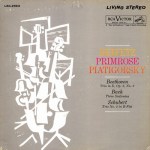
This is a lovely sounding pressing of cello and violin, with smooth, natural, tonally-correct sound and correctly-sized instruments, something you don’t hear often on recordings with Heifetz. They tend to have huge violins and small orchestras.

In these chamber works perhaps the engineers had an easier time of getting it right.

The sound is transparent, spacious and three-dimensional in the best Living Stereo tradition.

If you love the sound of violin and cello, played by virtuosi of the highest order, this is the record for you.

Side One

Beethoven: Piano Trio, Op. 1, No. 1

Side Two

Haydn: Divertimento for Cello and Orchestra 
Rozsa: Tema con Variazioni


This is an older classical/orchestral review

Most of the older reviews you see are for records that did not go through the shootout process, the revolutionary approach to finding better sounding pressings we started developing in the early 2000s and have since turned into a veritable science.

(more…)

Beethoven / Violin Concerto / Heifetz – On an Outstanding White Dog Pressing

More of the music of Ludwig van Beethoven (1770-1827)

More Recordings Featuring the Violin

  • Our outstanding vintage pressing of this brilliant Living Stereo recording — from 1956! — boasts solid Double Plus (A++) sound throughout
  • It’s also fairly quiet at Mint Minus Minus, a grade that even our most well-cared-for vintage classical titles have trouble playing at
  • Heifetz’s violin is immediate, real and lively here – you are in the presence of greatness with this recording
  • The orchestra is wide, tall, spacious, rich and tubey, yet the dynamics and transparency are first rate
  • White Dogs and Shaded Dogs can both sound quite good on this title – just avoid the Red Seals and later pressings if you are looking for the best sound

The reproduction of the violin here is superb — harmonically rich, natural, clean, clear, resolving. What sets the truly killer pressings apart is the depth, width and three-dimensional quality of the sound, as well as the fact that they become less congested in the louder passages and don’t get shrill or blary.

The best copies display a Tubey Magical richness — especially evident in the basses and celli — that is to die for.

Big space, a solid bottom, and plenty of dynamic energy are strongly in evidence throughout. Little smear, exceptional resolution, transparency, tremendous dynamics, a violin that is present and solid — the best copies take the sound of the recording right to the limits of what we thought possible.

Heifetz is a fiery player. On a good pressing such as this one, you will hear all the detail of his bowing without being overpowered by it. As we listened we became completely immersed in the music on the record, transfixed by the remarkable virtuosity he brings to such a difficult and demanding work. (more…)

Side One of Ritual Fire Dance Had Tubey Colorations Missing from Side Two

Hot Stamper Pressings of Vintage Columbia Albums Available Now

An undiscovered gem from 1967 on the 360 Columbia label.

Side two of this record blew our minds with its White Hot Stamper sound.

Musically and sonically this record is nothing short of wonderful.

Who knew? You could play fifty vintage piano recordings and not find one as good as this.

Tchaikovsky, Liszt, Beethoven, Debussy, Mozart — these shorter pieces and excerpts were composed by those with the greatest gift for melody, men who’ve produced works that have stood the test of time, enchanting audiences over the centuries with works of such beauty and charm.

Here at Better Records we have never been fans of Columbia classical LPs. Years ago we noted that:

Columbia classical recordings have a tendency to be shrill, upper-midrangy, glary and hard sounding. The upper mids are often nasally and pinched; the strings and brass will screech and blare at you in the worst way. If Columbia’s goal was to drive the audiophile classical music lover screaming from the room (or, more realistically, induce a strong desire to call it a day record-playing wise), most of the time one would have to grant they’ve succeeded brilliantly. Occasionally they fail. When they do we call those pressings Hot Stampers.

To be clear, the fault more often than not has to be in the mastering, not the recording. We’ve raved about so many great copies of titles in the past, only to find that the next three or four LPs we pick up of the very same titles sound just godawful. There are some amazing Bernstein recordings out there, but the the amount of work it takes to find the one that sounds good is overwhelming — how can such great recordings be regularly mastered so poorly?

Side One

A++, with a huge, rich, sweet, natural sounding piano. The more you listen, the more apparent it becomes that, as natural as it may seem at first blush, there are still some old school tubey colorations that make the sound not quite as lifelike and real as one might wish.

And the confirmation of that finding comes as soon as you flip the record over.

(more…)

This Is How Wrong We Were about Shaded Dogs and Red Seals

Hot Stamper Pressings Featuring the Violin Available Now

UPDATE 2024

This old (2010) and embarrassing commentary shows just how wrong we were about the sound of various pressings of this Living Stereo title, LSC 2377.

We much prefer the Shaded Dog pressings these days, as can be seen from our most recent listing.

To see our available Hot Stamper pressings of the work, please click here. For more reviews and commentaries, please click here.

Back in 2010 we liked reissue pressings of Living Stereo recordings a lot more than we do now. Only the advent of top quality cleaning equipment and much improved playback made it possible for us to reproduce the early Shaded Dogs in all their glory.

When my system was darker and less revealing, a lot of records that were mastered to be cleaner and brighter sounded great to me. Records like RCA Red Seal pressings, some OJC jazz titles, and lots of other bad records that I used to like were a good complement to my system back in those days.

Now, not so much. When we encourage our readers to get good sound so they can recognize and acquire good records, it’s because we learned that lesson again and again the hard way, by getting lots of great recordings wrong.


Here is our mistaken commentary from 2010:

The Shaded Dog original RCA pressings are the best, right?

Not in our experience. We think that’s just another record myth.


Turns out we were wrong about that. The early pressings win all our shootouts these days. In the case of LSC 2377, the conventional wisdom which holds that the original pressings will most likely have better sound than the vintage reissues turns out to be right.


(more…)

Our Old Prediction for LSC 2563 Came True

Hot Stamper Pressings that Feature the Violin

Many years ago we wrote:

This is a very old review and it’s doubtful we would not prefer the right Shaded Dog pressing these days.

That turned out to be the case, as we had two late-label 70s Red Seal pressings in the shootout we just did and only one of them was even passable.

A few things about the new pressings and the old commentary caught my eye.

First off, 3s is a fairly low number. The Shaded Dogs that win the shootout must be lower, which means they are either 1s or 2s. Not much to choose from there!

Secondly, the commentary you see below goes into great detail regarding what each piece found on the pressing was doing right and wrong.

It makes us sound like we knew what we were talking about when it came to this specific Red Seal pressing of the album we had played.

I assure you that we did not.

On the web I come across lots of reviews for audiophile pressings in which the writers go on for page after page about how much better the new Heavy Vinyl pressing is compared to the old record the reviewer owns.

This is no longer hard for me to understand. They are simply as lost as I used to be.

(more…)

Beethoven / ‘Appassionata’ – Kamiya

More of the music of Ludwig van Beethoven (1770-1827)

More Direct-to-Disc Recordings

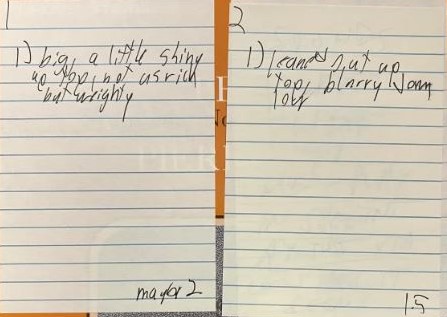
  • This rare and wonderful TAS-approved Japanese import LP boasts INSANELY GOOD Shootout Winning Triple Plus (A+++) Demo Disc sound on both sides
  • You will have a hard time finding a better recording of the piano than this – it’s one of the all time great Direct-to-Discs
  • It’s simply bigger, more transparent, less distorted, more three-dimensional and more REAL than all of what we played
  • A famous resident of the TAS list, this album offers excellent music, performed with feeling, and recorded properly, the best of all possible worlds for us audiophiles
  • A friend of ours tells me that Kamiya plays this piece exactly the way Horowitz did, and that’s probably a good thing – good luck finding a Horowitz recording that sounds like this

(more…)

Beethoven’s Symphony No. 4 – The Classic Pressing Can Have Very Good Sound

More of the music of Ludwig van Beethoven (1770-1827)
Somehow we managed to have a Classic Records pressing on hand to play in our most recent shootout for the Beethoven Symphony No. 4.

We knew all the way back in 1997 that Classic had done a good job with the record — we recommended it as one of the best Classic Records pressings in our catalogs at the time — but we sure didn’t expect it to do as well as it did, earning 2 pluses on one side and close to that on the other.

Years ago we wrote:

Here is the kind of sound that Classic Records could not ignore, even though the original was only ever made available as part of RCA’s budget reissue series, Victrola.

Don’t let its budget status fool you — this pressing puts to shame most of what came out on the full price Living Stereo label. (And handily beats any Classic Records reissue ever made.)

The top and bottom are wrong to varying degrees on both sides of the Classic, as you can see from our notes, which read:

(more…)

Dorati and Mercury Did Not Produce a Good Sounding Eroica

More of the Music of Ludwig van Beethoven

The sound of this 1959 Mercury recording was unacceptable. SR 90011 was crude and shrill. It seems that many early Mercury recordings suffer from these shortcomings.

Our favorite Beethoven 3rd for sound and performance is the one Solti recorded for Decca in 1959.

1959 just happens to be one of the truly great years for quality analog recordings, as can be seen from this amazing group of albums, all was recorded or released that year.

This Mercury might be passable on an old school system, but it was too unpleasant to be played on the high quality modern equipment we use.

There are quite a number of others that we’ve run into over the years with similar shortcomings. Here they are, broken down by label.

  • London/Decca records with weak sound or performances
  • Mercury records with weak sound or performances
  • RCA records with weak sound or performances

Have You Noticed…

If you’re a fan of Mercury Living Presence records — and what right-thinking audiophile wouldn’t be? — have you noticed that many of them, this one for example, don’t sound very good?

If you’re an audiophile with good equipment, you should have.

But did you? Or did you buy into the hype surrounding these rare pressings and just ignore the problems with the sound?

There is plenty of hype surrounding the hundreds of Heavy Vinyl pressings currently in print. I read a lot about how wonderful their sound is, but when I actually play them, I rarely find them to be any better than mediocre, and most of them are downright awful.

It seems as if the audiophile public has bought completely into the hype for these modern Heavy Vinyl pressings. Audiophiles have too often made the mistake of approaching these records without the slightest trace of skepticism. How could so many be fooled so badly? Surely some of these people have good enough equipment to allow them to hear how bad these records sound.

I would say Mercury’s track record during the ’50s and ’60s is a pretty good one, offering (potentially) excellent sound for roughly one out of every three titles or so.

But that means that odds are there would be a lot of dogs in their catalog. This is definitely one of them.

To see the 50+ Living Presence classical titles we’ve reviewed to date, click here.

(more…)

Don’t Waste Your Money on this Living Stereo with Munch from 1962

More of the Music of Franz Schubert

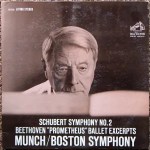
Some audiophiles buy albums based on their labels. For example, this Shaded Dog pressing of LSC 2522 from the Golden Age of RCA Living Stereo might appeal to a certain kind of audiophile who seeks out clean copies LSCs on the original label.

More than that, he might limit himself to the most sought-after 1S Indianapolis pressings. Hooray! What could be better?

However, many records from this era simply do not sound good, and this is one of them. We have never heard a good sounding copy of LSC 2522, and we’ve played plenty of them over the decades that we’ve been auditioning Golden Age Classical records for sale.

This Shaded Dog might be passable on an old school system, but it was too unpleasant to be played on the high quality modern equipment we use.

There are quite a number of other records that we’ve run into over the years with similar shortcomings. Here are some of them, a very small fraction of what we’ve played, broken down by label.

  • London/Decca records with weak sound or performances
  • Mercury records with weak sound or performances
  • RCA records with weak sound or performances, including many on the coveted Shaded Dog label

(more…)

Beethoven / Septet / Members of the Vienna Octet

More of the music of Ludwig van Beethoven

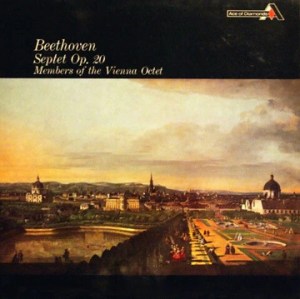
  • With excellent Double Plus (A++) grades on both sides, the sound on this import pressing is classic Decca from 1959 – rich, smooth and completely free of the hi-fi-ish qualities some audiophiles seem to admire by the likes of Reference, Telarc, Wilson and the like
  • This record was cut by real Decca engineers — in 1969 they certainly still knew what they were doing
  • Both sides are full, rich, spacious, big and present, with very little smear and a very healthy dose of Tubey Magic
  • We’ve been raving about this album forever, first on Blueback and on UK Stereo Treasury, and now on Ace of Diamonds – all three can be superb
  • Although the London and Decca originals will always win our shootouts, the reissues still sound quite good to us, just not as good, and that can even include the lowly Stereo Treasury pressing, which had exactly the same stamper numbers as the Ace of Diamonds pressing you see here
  • When you hear how good this record sounds, you may have a hard time believing that it’s a budget reissue from the late-’60s, but that’s precisely what it is
  • 1960 was a great year for classical recordings – other Must Own orchestral releases can be found here.

We normally do not put as much effort into finding top quality pressings of chamber music as we do for the large orchestral works favored by audiophiles (or at least the audiophiles who are willing to spend the money to buy our records), works such as Scheherazade and The Planets. However, if more of them sounded as good as this one we would be more than happy to do just that. (more…)