obsess

The albums you see here played an important role in helping me improve my stereo, some of them starting as far back as the mid-’70s.

By the 2000s, we had a heavily-treated, dedicated room, and later still a custom built studio. The challenges posed by these recordings were instrumental in helping us make improvements in every aspect of playback.

The better the stereo got, the more these records showed us just how amazing the right pressings (we call them Hot Stampers) could sound.

Having played so many copies of these albums for so many years, I credit them with teaching me most what I know about records and equipment.

Relax, Stare into the Middle Distance and Listen to the Players as a Group

Hot Stamper Direct-to-Discs Available Now

Many years ago we had discussed the polarity issues associated with this record:

According to the liner notes, this album has its polarity reversed. They tell you straight out to reverse the positive and negative at the speaker terminals for the best “transient response and spatial clarity.”

That out of phase quality is as plain as the nose on your face when you know what to listen for. There’s an unpleasant hardness and hollowness to the midrange, a lack of depth, and an off-putting opaque quality to the sound. The top gets dull and the bass gets weird and wonky.

With our EAR 324p phono stage, the click of a button reverses the polarity. I can’t tell you how handy it is to have such a tool at your disposal. Checking the polarity for Discovered Again couldn’t have been easier.

But get this: most side ones are NOT out of polarity. How about them apples! We could not have been more shocked. Here is the most famous reversed polarity audiophile recording in the history of the world — or maybe just the history of our world — and it turns out most copies are not reversed on side one at all.

Findings from a Few Years Back

I did not do the shootout for the album, but I wanted to check on the polarity just to hear it for myself. I must admit I had to go back and forth a number of times, using my favorite song on the album and an old Demo track from back in my earliest days in audio, the mid- to late-70s: Keep Your Eye On The Sparrow.

(more…)

Check Out the Huge Chorus of The Ark

Hot Stamper Pressings of Albums with Huge Choruses

Listen to the chorus on the first track, The Ark. On the best copies, it really gets loud without becoming harsh or shrill. So many popular albums have choruses (and guitar solos) that are not much louder, and sometimes not even as loud, as the verses, which rob the songs of their drama.

This recording has the potential to give you a dramatic, powerful, loud chorus and it’s a thrill when you find a pressing that delivers on that promise.

One way we know to listen for these volume changes is that we actually play our records good and loud. When a dynamic recording such as this comes along, we have to watch our levels, otherwise, the chorus will overwhelm the system and room.

When playing this copy, be sure to set the level for the chorus of the first track. Everything should play just fine once that setting is correct, as the artist intended.

The double-tracked vocals on Whatever’s Written in Your Heart are a good test for transparency, resolution and Tubey Magic. There should clearly be two voices heard. The richness and the clarity of the best pressings make it possible to have it all.

(more…)

The Planets – Testing with Mars and Saturn

More of the music of Gustav Holst (1874-1934)

Mars on the first side and Saturn on the second present serious challenges to any recordings of the work you may own, especially if you own the overrated Mehta recording on the TAS List.

Generally speaking, the White Hot copies stand apart from the pack with more top end extension, and/or more lower end weight. Our notes will typically say “extended highs and lows,” and those are hard to come by, on any record.

Let’s get to the specifics of the two movements we feel are the best test for The Planets as a whole.

The War Test — Side One

War, the first movement, has the string players “bouncing” their bows upside down to create the effect you hear. It’s not fingers plucking the strings; it’s the wood of the bows bouncing on the strings. The quality of that technique is so obvious and correct sounding on the good copies and so blurry and indistinct on the bad ones that you could almost judge the whole first side by that sound alone. When it’s right it’s really right. 

And of course the players are spread out wider and the soundfield is so much more transparent when these types of sonic qualities are brought out. This bouncing bow test makes it easy to separate the better copies from the also-rans when it comes to smear, resolution, transparency and the like.

The Saturn Test — Side Two

(more…)

Listening for Harmonically Correct Acoustic Guitars on America’s Debut

Hot Stamper Pressings of the Music of America Available Now

The guitars on this record are a true test of stereo fidelity. As it says below, most of the pressings of this record do not get the guitars to sound right. They often sound veiled and dull, and on a copy with a bit too much top end they will have an unnatural hi-fi-ish sparkle.

This kind of sparkle can be heard on many records Mobile Fidelity made in the ’70s and ’80s. Tea for the Tillerman, Sundown, Year of the Cat, Finger Paintings, Byrd at the Gate, Quarter Moon in a 10 Cent Town — the list of MoFis with sparkling acoustic guitars would be very long indeed, and these are just the records with prominent acoustic guitars!

Three Roses and Rainy Day

The key song on side one that we use to test is Three Roses. There are three sonically-separated individuals each playing six string acoustic guitars, and when this side is cut right the guitars sound just gorgeous: sweet, with all their harmonic structures intact. (It’s also my favorite song on side one.)

The real test on side two is the song Rainy Day. Lots of guitars, and when the close-miked descending guitar figure comes in after the first few couplets, if it’s too bright, you’re going to know it. This song is the hardest one to cut and almost never sounds right. Some copies are cut JUST RIGHT. The vocals are breathy, the guitars are full-bodied, and the overall sound is airy, open, and spacious.

(more…)

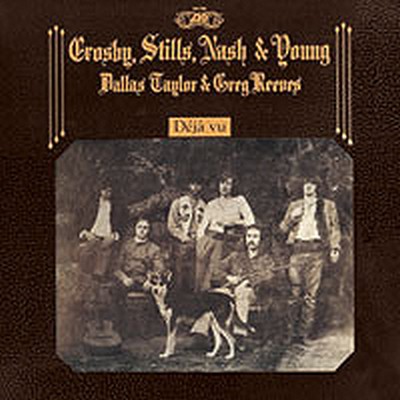
Listening in Depth to Deja Vu

Hot Stamper Pressings of the Music of Crosby, Stills, Nash and (Sometimes) Young

DEJA VU is an album we admit to being obsessed with — just look at the number of commentaries we’ve written about it. It’s yet another in the long list of rock and pop records that really come alive on big speakers at loud levels .

One obvious reason that our turn up your volume is such a good test is that the louder the problem, the harder it is to ignore.

Presenting another entry in our extensive listening in depth series with advice on what to listen for as you critically evaluate your copy of Deja Vu. Here are some albums on our site you can buy with similar track by track breakdowns.

Side One

Carry On

This song is a great test for the quality of the vocals. If you can get through the first part of the song with little to no strain in the voices, you’re on the right track.

The bass on this track always lacks a measure of definition, but you’ll know by track three if your bass is solid enough to set the foundation this music requires to really get going. Carry On has a huge number of overdubs, so it will never have very high resolution, but on a Hot Stamper copy like this one it can sound wonderful.

Teach Your Children 
Almost Cut My Hair

One of the key test tracks we use for side one, this is the only time Crosby, Stills, Nash & Young actually sounds like a rock and roll band. According to Stephen Barncard this was recorded live in the studio. It sure sounds like it. The amount of energy the band generates on this track exceeds all the energy of the first album put together.

The reason this track presents such a tough test is that it has to be mastered perfectly in order to make you want to turn it up as loud as your stereo will play. This song is not for sipping wine and smoking cigars. It positively cries out to be played at serious volume levels on monstrously large speakers. Nothing else will do justice to the power of the band’s one and only live performance.

(more…)

Wish You Were Here – An Overview

Hot Stamper Pressings of the Music of Pink Floyd Available Now

We have added some helpful title specific advice at the bottom of the listing for those of you want to find your own Hot Stamper pressing.

This is the perfect example of everything we look for in a recording here at Better Records: it’s dynamic, present, transparent, rich, full-bodied, super low-distortion, sweet — good copies of this record have exactly what we need to make us audiophiles forget what our stereos are doing and focus instead on what the musicians are doing.

For those of you who aren’t familiar with the album, Pink Floyd managed to record one of the most amazing sounding records in the history of rock music. The song Wish You Were Here starts out with radio noise and other sound effects, then suddenly an acoustic guitar appears, floating in the middle of your living room between the speakers, clear as a bell and as real as you have ever heard. It’s obviously an “effect,” but for us audiophiles it’s pure ear candy.   

Shine on You Crazy Diamond, Pts. 1-5

Right from the dynamic intro you can tell this is going to be a wild ride. David Gilmour’s haunting guitar line that comes cutting from out of the abyss should be warm with tons of room for his phasers to do their phasing.

After the band comes in and the vocals begin (listen for the man chuckling in the left channel) you should pay attention to the balance of the mix. Most copies tend to be very midrangy which can make the guitars aggressive and harsh, often times taking emphasis away from the vocals. The good copies have lots of transparency and allow everything to sit in their respectively places. This is probably most noticeable during the saxophone solo.

The tenor that starts off this section needs to be breathy, full-bodied, and sitting delicately in the center of your speakers. It does NOT need be be honky and hard sounding without any top extension. As the solo slowly crescendos, notice the guitar line spread across the soundstage that actually bookends the saxophone. The more dynamic copies really let you hear the intricacy and delicacy of his picking that foreshadows the time signature shift about to come.

When the time does change to 6/4, the saxophone player changes to alto, totally changing the sound of the solo! You can clearly hear on the better copies that he is further away from the mic than during the previous section, but if you listen closely, it sounds as though he is moving on and off axis. Whether this is part of his mic technique or him just dancin’ and groovin’ to the music, we may never know. I certainly hope for the latter.

Other Pressings

Most copies of the CBS Half-Speed lack deep bass, and for that matter bass in general.

They’re also consistently brighter. The upper mids and highs call attention to themselves at every turn. When you switch back to a good domestic copy or import, you might not notice as much detail, but everything will sound correct and balanced: less like a recording and more like music.

Phony highs cause listener fatigue for the same reason that bright CDs get tiresome.

Just listen to the sax break on side one. If your pressing is too bright that sax will tear your head off.

The Seventies – What a Decade!

Tubey Magical acoustic guitar reproduction is superb on the better copies of this recording. Simply phenomenal amounts of Tubey Magic can be heard on every strum, along with richness, body and harmonic coherency that have all but disappeared from modern recordings (and especially from modern remasterings).

Big Production Tubey Magical British Prog Rock just doesn’t get much better than Wish You Were Here.

A Big Speaker Record

Let’s face it, this is a big speaker recording. It requires a pair of speakers that can move air with authority below 250 cycles and play at loud levels. If you don’t own speakers that can do that, this record will never really sound the way it should.

It demands to be played loud. It simply cannot come to life the way the producers, engineers and artists involved intended if you play it at moderate levels.

Obsessed? You Better Believe It

Wish You Were Here is yet another record we admit to being obsessed with.

Currently we have identified about 150 that fit that description, so if you have some spare time, check them out.

(more…)

A Big Group of Musicians Needs Big Speakers to Sound This Big

Hot Stamper Percussion Records Available Now

At times this record really sounds like what it is: a bunch of guys in a big room beating the hell out of their drums and singing at the the top of their lungs. You gotta give RVG credit for capturing so much of that energy on tape and transferring that energy onto a slab of vinyl.

Of course this assumes that the record in question actually does have the energy of the best copies. It’s also hard to know who or what is to blame when it doesn’t, since even the good stampers sound mediocre most of the time. Bad vinyl, worn out stampers, poor pressing cycle, it could be practically anything.

Fingers is one of our all time favorite records, a real Desert Island Disc to be sure. I’ve been playing this album for more than thirty years and it just keeps getting better and better. Truthfully, I have to admit it’s the only Airto record I like. I can’t stand Dafos, and most of the other Airto titles leave me cold.

I think a lot of the credit for the brilliance of this album has to go to the Fattoruso brothers, who play keyboards, drums, and take part in the large vocal groupings that sing along with Airto. 

(more…)

The Carmen Ballet – As Tough a Test Disc As Any We Know

Hot Stamper Pressings of the Music of Georges Bizet Available Now
If I had only one record to bring to someone’s house in order to evaluate their equipment, a killer copy of this Bizet-Shchedrin record would certainly be at the top of my list. (Here are some others.)

If you can make this record sound the way it should, your stereo is cookin’.

If you are having problems, this record will show them to you in short order.

Many copies are bright in the upper-midrange, sounding as nasally and artificial as a bad Mercury or London. Many lack weight down low. The lower strings and heavier percussion play a crucial role in balancing out the upper strings and lighter percussion, so without enough going on down low, the sound skews upwards in an artificial way.

If your copy has either of these problems don’t use it to set up or tweak anything in your system.

Use one of our Hot Stampers, the hotter the better.

The sound of the best copies is rich, full-bodied, incredibly spacious, and exceptionally extended up top. There is a prodigious amount of musical information spread across the soundstage, much of it difficult to reproduce. Musicians are banging on so many different percussive devices (often at the back of the stage, exactly where they should be) that getting each one’s sonic character to clearly come through is a challenge. And when you’ve met it, a thrill.

If you’ve done your homework with VTA, Azimuth, Anti-Skate and Tracking Weight, this is the record that will make clear just how much you’ve accomplished.

The recording has tremendous transients and dynamics. Be prepared to have trouble tracking it. In that respect it’s a prime candidate for table, cartridge and system tweaking.

If you have the kind of big system that a record like this demands, when you drop the needle on the best of our Hot Stamper pressings, you are going to hear some amazing sound.

(more…)

Carlos Santana Knows: Louder Is Better

santasanta_1401s

Hot Stamper Pressings of the Music of Santana Available Now

UPDATE 2026

The commentary below refers to an experience I had playing the album on my Legacy Whisper speakers in the late-90s. I moved into a house in the early 2000s and it took me until about 2005 to get the sound back to the level I had achieved in the 90s. Fortunately for me, my employees and all our Hot Stamper fans, by the mid-2000s we were really cookin’, with dramatic improvements to the sound occurring at a furious clip.


This album needs to be played loud. I mean really loud. Years ago I used to demonstrate how important it was to have the level up good and high on the song Waiting.

Back in the mid-90s, I had somehow lucked into my first shockingly good Hot Stamper copy.

As a demonstration of what the Legacy Whisper system and its 8 fifteen inch woofer/midrange drivers could do, I would play the first minute or so of the track at a pretty good level. There’s lots of ambience, there’s a couple of guys who shout things out from way back in the studio, there’s a substantial amount of deep bass, and the whole recording has a natural smooth quality to it, which is precisely what allows you to play it at loud volumes.

Then I would turn it up a notch, say about 2-3 DB. I would announce to my friends that this is probably louder than you will ever play this record, but listen to what happens when you do. The soundstage gets wider and deeper, all those guys that shout can be heard more clearly, you start to really feel that deep bass, and when the song gets going, it really gets going. The energy of the music would jump to another level.

Then I would turn it up another 3 DB or so. At this point I would say that “this is how loud it should be played.” All the effects I mentioned earlier would become even more pronounced — wider, deeper, more clear, more powerful. The record was actually starting to sound like live music in my living room.

But of course, I was showing off a system that few could afford and that nobody in his right mind would put out in the middle of his living room. You would need a custom sound room, and a big one at that, to fit such a massive speaker and be able to turn it up.

(more…)

Listening in Depth to John Barleycorn Must Die

The toughest test on side two is the first track, Stranger to Himself.

Getting the voices right is practically impossible. If the voices are full, smooth, yet breathy and clear, you have that rare copy that actually gets the midrange right. Not many do.

Side One

Glad

The last portion of this track has some really interesting percussion and organ effects. Traffic were trying to break out of the standard pop song format by letting this song wander into psychedelic territory for a few minutes at the end. It’s now become my favorite part of the song.

The reason you want to pay close attention to this part is because it helps you to judge the transparency, immediacy, and top end extension for the whole side. It should be amazingly clear and open-sounding. On too many pressings, the percussion instruments are blurred and lost in the mix. On a Hot Stamper copy they’ll be right in front of you, allowing you to appreciate the interplay among the musicians as they contributed their various parts.

Freedom Rider

You’ll need lots of top end extension for this song to sound right. On many copies the double tracked flute solo in the middle of the song will be aggressive and irritating, but on a Hot Stamper pressing, the flutes will sound airy and breathy with a reasonably good sustain.

Empty Pages

The quality of the voice is what really sets the best copies apart. Winwood is much more present on the better copies. He’s recessed on most and that’s just not where he needs to be for the song to work musically. He needs to be right up front, surrounded by the air and ambience of the studio. The transparency found on the better copies will give you precisely that.

Side Two

Stranger to Himself

John Barleycorn

The acoustic guitars that open up this song are absolute perfection on the best copies — this is the sound of Tubey Magical analog at its best.

This is the real test for side two.

The acoustic guitars should sound rich and sweet. You’ll notice at the beginning of the song that they are a little dull. The last thing in the world you want to do, however, is to brighten them up, because when you do that, as some mastering engineers have in the past, the harmony vocals and the percussion and the tambourine become much too bright later on in the song.

You have to strike a balance between all the elements. That means Steve’s voice at the beginning needs to be a little reserved so that the harmony vocals later on will come in right.

(more…)