mon-2026

Tusk on Japanese Vinyl Without the Sub-Generation Japanese Mastering

Hot Stamper Pressings of the Music of Fleetwood Mac Available Now

This Capitol-mastered, Japanese-pressed LP has excellent sound on the first two sides and SUPERB sound on sides three and four. I doubt you’ve ever heard the title track rock like this.

We dug up a few Japanese copies of Tusk that were mastered at Capitol by Ken Perry. Because they were made from the real tapes, these don’t have the typical smeary, sub-generation sound associated with Japanese pressings. We found that the best Japanese copies could hold their own with the best domestics on sides one and two, and could win outright on sides three and four.

We almost never like records that, although pressed in Japan, were not recorded in Japan. This is one of the exceptions because the mastering was done by the real mastering engineer, Ken Perry, using the real tape, here in America.

There are also some excellent direct to disc albums that were recorded here in the states and subsequently pressed in Japan.

(more…)

Brain Salad Surgery on Shout Heavy Vinyl

Hot Stamper Pressings of the Music of Emerson, Lake and Palmer Available Now

If you’re a fan of Emerson, Lake and Palmer’s fifth album, and you know, or at least suspect, that the British original pressings are more than likely to be better sounding than most, you might find yourself in a bit of a quandary, pocketbook-wise.

Early British pressings in audiophile playing condition aren’t easy to find, and they don’t tend to be cheap when you do find them.

Ah, but there is a fairly cheap and exceptionally easy solution: just buy the Shout Heavy Vinyl reissue from 2008.

It says it’s made from the master tape, it has a replica of the original packaging, and even comes with a poster.

What could go wrong?

The sound could be shit — NFG in our shorthand — that’s what could go wrong.

  • The top end could be overly-textured, tizzy and hot, the kind that constantly calls attention to itself.
  • The bass could be smeary and thick.
  • And the overall presentation of the music could be veiled and recessed.

Alas, the money you thought you were saving buying this potentially wonderful flat, quiet pressing made from the master tapes ends up flushed down the tubes. Now what?

Now you have to do what you should have done to begin with: find yourself a real British pressing.

(more…)

On Tons Of Sobs, the Domestic Pressings Just Don’t Make the Cut These Days

Hot Stamper Pressings of British Blues Rock Albums Available Now

Years ago — in 2011 to be exact — we wrote the following in a listing for a very good sounding domestic pressing:

Solid bass, present vocals, plenty of energy — the only thing missing here is the Tubey Magical richness and sweetness that only the British originals (in our experience) have, and in spades by the way.

But try to find one. Over the last two or three years I think we’ve managed to get hold of exactly one clean copy.

Fast forward a number of years and we’ve only had a few since then. I have seen the original Pink Label British pressing of this album sell on the web for more than 1000 dollars, which might explain why we rarely have them.

But if you want to hear this record in all of its glory, the UK Island pressings are the only game in town.

Both Pink and Sunray labels sound good, just make sure they are from the UK.

And don’t buy any later label pressing from any country if you want the best sound.

(more…)

Is It Possible to Find Out Who Mastered the Japanese Thrillers?

Hot Stamper Pressings of the Music of Michael Jackson Available Now

A letter we received not long ago made the point that the Japanese pressing of Thriller the owner had been listening to for years, even decades, fell well short of the mark set by the sound of the White Hot Stamper pressing he now owned.

To think, I spent all those years playing and re-playing a record that was bright and edgy, none the wiser to matrix numbers and pressing variations.

I agreed, saying that I myself learned the hard way, having wasted some of my own money on them. that Japanese pressings were almost always a crock, writing:

Most Japanese pressings cater to what a mid-fi system would need to sound good and a hi-fi system would find ruinous. They are almost always made from dubbed tapes, which are then brightened up in the mastering phase since that is the sound that appeals to the Japanese market for some reason unknown to me. Old school audio equipment — horn speakers and vintage tube electronics — would be my guess.

A fellow who saw an opening to set me straight and take me down a peg, all without having to learn how to use that pesky shift key on his computer, left the following comment in that post:

the japanese pressings were mastered by BG. the only difference being the quality of the material. nice try though, snakeoil salesman.

I immediately went to battle stations. I doubted whether Bernie Grundman has mastered any pressings for the Japanese market, but I couldn’t say for sure. It’s a question that had never come up. We ourselves had discovered a very good sounding pressing of Tusk that was mastered by Ken Perry and pressed in Japan, so I knew it was possible that the original mastering engineer could have sent metalwork to Japan for the Japanese to produce properly-mastered records for their market.

Fortunately, Discogs makes checking such things fairly easy. I went right up to the listing for Thriller and clicked on all the Japanese original pressings to see if there was any evidence to show that he had mastered them.

Bernie Grundman’s name was credited on the back cover as the mastering engineer, but I didn’t put much stock in that. I assumed that he did not master the album for their market, since that is hugely impractical. I surmised that removing his credit would have badly defaced the jacket, something I doubted the Japanese would have found acceptable. They seem to be very particular about these things.

Sure enough, here is what the stampers look like for the typical Japanese pressing that supposedly would have been mastered by BG:

There are about half a dozen original Japanese pressings for the album on Discogs and all the stamper listings look like the one above.

If you know anything about records, you know that these markings could not have been created by Bernie Grundman’s mastering operation here in the states.

(more…)

Exile on Main Street – A Good Test for Grit and Grain

More reviews and commentaries for the music of The Rolling Stones

The best copies will tend to have the qualities we discuss below, and the more abundant these qualities are on any given pressing, the higher its grade will be.

Yes, it is a science, an empirical one, which can only be carried out by the use of strict protocols and controls, but it sure ain’t rocket science.

All you need is the system, the room, the records, the time and the will to do the painstaking critical listening required to carry out the task.

It can be done, but you could spend a lifetime meeting audiophiles of the vinyl persuasion and never run into a single one who has made the effort more than a handful of times.

To be honest, shootouts are a bitch. If you aren’t getting paid to do them the way we are, finding the motivation to devote the time and energy required to do them right — not to mention the piles of copies of each record you will need — is daunting to say the least.

So, back to the question: what to listen for? (more…)

Does Your Pressing of Death and Transfiguration Have These Shortcomings?

More of the Music of Richard Strauss

Many of the later pressings of CS 6211 were not competitive with the earlier pressings, something we had no idea was true until we actually did the shootout.

This is why we do our shootouts with every kind of pressing we can find that has any hope of sounding good to us.

(This is of course something that cannot be predicted with much certainty. What we are saying is simply that we do not expect the German, Dutch, Japanese and such like pressings from other countries outside the UK to do well because they have almost never done well in the past, not for Decca recordings anyway.)

The notes on the left in the box are for the copies that did not do as well as our best copies.

If your copy of the album has any of the shortcomings we mention, and you would like a better pressing to play, rest assured we will have something for you down the road, as this is our favorite for both performance and sound.

Stamper Information

The stampers of the pressings that consistently came in last in our shootout had the mastering marking of L, which signifies the work of George Bettyes. He has done good work in the past, but odds are that any pressing of this title mastered by L is going to be inferior to those that are not.

Our advice: stick with E and G.

As is sometimes the case, there is one and only one set of stamper numbers that consistently wins our shootouts for CS 6211.  Here are some of the others we’ve discovered through the shootout process.

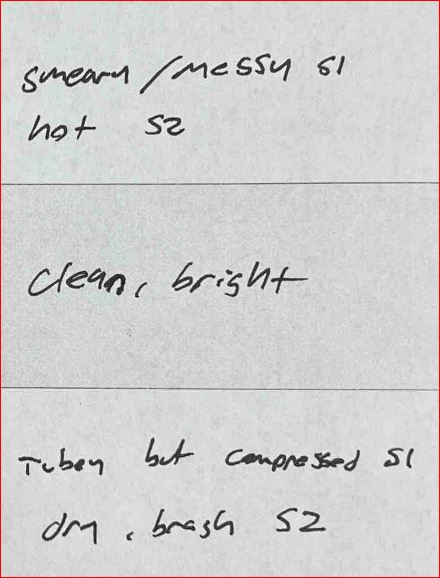
Our notes for an exceptionally good sounding copy from the last shootout can be seen below.

(more…)

Domestic Pressings of Clear Spot? Forget ‘Em!

Hot Stamper Pressings of the Music of Captain Beefheart Available Now

We did this shootout many years ago, so many years ago that I cannot find a record of it.

I remember we thought the German pressings were perhaps a bit boosted on both ends and not as natural sounding as the domestic pressings.

After a multitude of improvements in our cleaning and playback, we would agree with our previous understanding that the German pressings are often wrong, but now we also know how right the right ones can be.

It turns out tha some German pressings are not particularly good, another piece of the puzzle that fell into place during our most recent shootout, as painful as that turned out to be considering the money wasted on them.

Did we have the bad German stamper pressings last time around? Who knows?

The producer, Ted Templeman, (Doobie Brothers, James Taylor) brought his mainstream talents to bear on this music, and when the Captain’s free-form tendencies smashed into Templeman’s conservatism, the result was this musical supernova — out there, but not too far out there.

(Play Trout Mask Replica sometime if you miss that feeling from your old hippie days of being on acid. With that music, drugs are entirely superfluous.)

I don’t know how many audiophiles like Captain Beefheart, probably not too many, but if you’re ever going to try one of his albums, this is the place to start: his masterpiece.

(more…)

Avoid M Stampers and Imports If You Want the Best Sound on Tapestry

Hot Stamper Pressings of the Music of Carole King Available Now

The domestic pressings with the stampers shown below, and others similar to them, have not done well in our shootouts for years now. If you own a copy with these stampers, or ones like them, the good news is that we can get you a much better sounding copy of Tapestry than you have ever heard. It won’t be cheap, but we can guarantee that it will be very, very good.

Stamper numbers are not the be-all and end-all in the world of records, a subject we discuss below, but after hearing too many copies with these stampers and decidedly mediocre sound, from now on we are going to focus our attention on the stampers that do well and leave copies with these markings sitting in the bins.

Note that the last listing is for an early UK import. I have no idea how that record got into the shootout. The chances of an import doing well up against Bernie Grundman’s brilliant mastering — from back in the good old days of the 60s, 70s and 80s when he was actually doing brilliant mastering work — is so close to zero it can’t be calculated.

Sometimes we take long shots, hoping to learn something new. In this case, we learned what we already know. Yes, there are still some audiophiles who buy imports of a record like this hoping to find better sound. I can’t imagine what kind of system it would take to hide the bright, dubby sound of the UK pressing we played, but judging from some of the foolishness I read on the Hoffman forum and others of its ilk, I know there must be plenty of them out there.
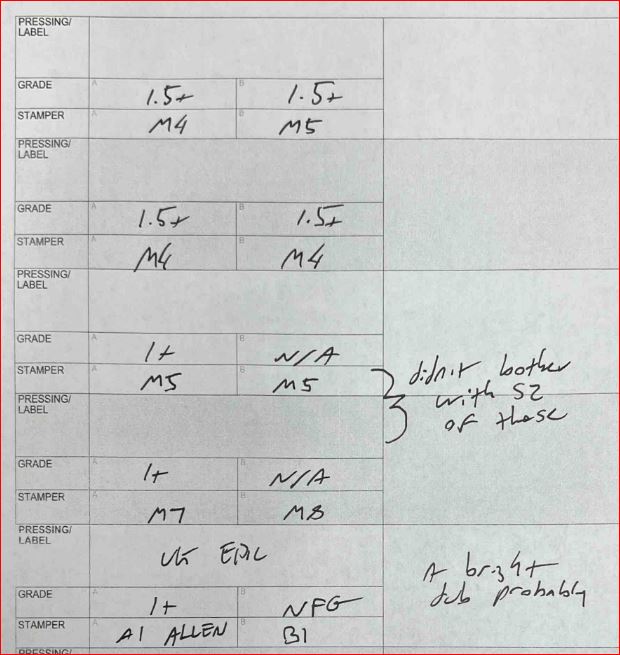
Monarch is responsible for the mediocre-at-best sound of the pressings with the stampers you see above. We tend to like Monarch pressings as a rule, but sometimes they mess up, and they messed up Tapestry compared to others who pressed the record.

We liked all the other copies with other stampers better than than these, which just goes to show you can never know how good it can get until it gets that good. That is what shootouts allow us to do.

Playing close to twenty copies of Tapestry in a shootout allows us to grade Tapestry on a scale, with the M stampers filling out most of the bottom and the other stampers — wouldn’t you like to know which ones! — occupying the middle and the top of the distribution. 

This is what the forum posters fail to understand. They think they have a Hot Stamper when what they actually have (maybe!) is a good sounding record. They don’t know how amazing the record can sound — so much more amazing than the one they own, probably — so they assume they have something good, maybe even the best.

They probably do not, but who really knows? The shootout would supply the data they need to support their conclusions, and since they could not be bothered to conduct one, they have no data to back up their opinions.

The “probably” you see in the above two sentences is there for a good reason. We make a point of being clear about what we can know and we cannot know, and we cannot know what a record sounds like until we play it.

This is obviously true for those of us who try to listen as critically as possible, but we also know that it is just as important to think about records the right way.

(more…)
These Are Just Some of the Stampers to Avoid on Catch Bull at Four

More of the Music of Cat Stevens

The domestic pressings of Catch Bull at Four with the stampers shown below, and others similar to them, have not done well in our shootouts for years now. If you own a copy with these stampers, or ones like them, the good news is that we can get you a much better sounding copy of Catch Bull at Four than you have ever heard.

Stamper numbers are not the be-all and end-all in the world of records, a subject we discuss below, but after hearing too many copies with these stampers and decidedly mediocre sound, from now on we are going to focus our attention on the stampers that do well and leave copies with these markings sitting in the bins.

When it comes to stampers, labels, mastering credits, country of origin and the like, we make a point of revealing very little of this information on the site, for a number of good reasons we discuss here.

The idea that the stampers are entirely responsible for the quality of any given record’s sound is a mistaken idea, and a rather convenient one when you stop to think about it. Audiophiles, like most everybody else on this planet, want answers.

(more…)

The UK Imports of On the Third Day Are Made from Dubs

Hot Stamper Pressings of the Music of The Electric Light Orchestra Available Now

It’s obvious, or should be, that the British vinyl pressings are made from sub-generation copy tapes.

The imports make it sound as if someone threw a blanket over your speakers.

We know this because we had a bunch of them cleaned up for our shootout many years ago and they all sucked.

We tend to buy Electric Light Orchestra records on import vinyl; those are the ones that have proven themselves to have the best sound.

Most of the domestic pressings of their albums sound as though they were mastered from dub tapes.

But On The Third Day is proof that this is not always the case, just as Siren proves that the best Roxy Music albums are not always British.

(more…)