*Shootout Advice

If you would like to acquire better sounding pressings, please consideer taking our advice for conducting your own record shootouts, the only reliable way we know of to find them.

If you have five or ten copies of a record and play them over and over against each other, the process itself teaches you what’s right and what’s wrong with the sound of the album.

Once your ears are completely tuned to what the best pressings do well that the others do not do as well, using a few specific passages of music, it will quickly become obvious how well any given pressing reproduces those passages.

It may be a lot of work, but it sure ain’t rocket science, and we’ve never contended it was. From the start we’ve explained how to go about finding Hot Stampers for yourself. If you follow our lead, the quality of your collection is almost certain to improve.

Heretics and True Believers Clash on the Battlefield in Cyberspace, Part Two

More Letters from Customers and Critics Alike

Part one of this conversation can be found here. [Some bolding and such added.]

Hi, Tom,

Are there other great sounding stereos out there? I’m sure there are. Just as there are great sounding records still to be found out in the wild.

But, the stereo I’ve built by rapidly copying what you did painstakingly over decades is giving me better sound from recorded music than I’ve encountered almost anywhere else, including on far more expensive systems. It’s also more honest, direct, and revealing than stereos usually are.

First, I trusted you on records, and you were right. Then, I trusted you on stereos, and you were right again.

As for how people can find great sounding records. I expressed three pieces of the advice I’ve come to realize are true. All controversial enough, apparently, to get a thread shut down.

First, they can buy records from you.

If they don’t yield sound commensurate with price, just return the darned thing. A couple Better Records a year will probably build somebody a better-sounding vinyl collection than the same amount of money dumped in a shop or on Discogs. Tom, I have never encountered a disappointed *customer* of yours.

Second, don’t ascribe to hard and fast rules.

No, it is not true that all records from a given pressing house or mastering engineer are the definitive versions. There are better-sounding copies sitting in bins at used shops. Not all of them, but some, and they are often cheaper. This is a reality that is hard to find online, because it turns out it is hard to state it online.

Third, if you want to find great-sounding records on your own, plan to buy lots of copies of a particular title.

Avoid original pressings – those are not guaranteed to sound better, and they come at a premium.

[I take issue with this idea, see below.]

Play them all, pick your favorite (one, in my experience, is likely to stand out). Then, hope that your local shop takes returns, or that you are able to unload them on Discogs. Might somebody save themselves some money doing it this way, compared to buying a record from you? Maybe? But then, if they decide to “check their work” by buying a record from you, yours is going to sound better.

When I offered this advice on that forum, I got told I was wrong. Instead, those guys have a formula that works for them. I’d say it’s a formula for ending up with Pretty Good Records. First, you search the forums to find the deadwax for a copy that somebody has commented is THE one to have.

They usually don’t mention what type of equipment they have, or how many other copies of that record they’ve heard, or even what in particular about it sounds good. For me, going after pressings recommended online has never been a reliable way to find a great-sounding record.

And, when I get a Better Record, I check to see if it is a stamper that’s already known to sound good. Almost always, there’s no mention of it anywhere. Second piece of accepted wisdom on the forums: NM always sounds better than VG+. Here’s something I said that seemed to really piss people off: Good-sounding records got played a lot. Somebody really took me to task for suggesting that I had purchased from you a copy of a record I love that would probably grade VG+ based on the appearance of its surfaces, but that was delivering sound so good, I had zero desire to hunt for another copy, even the same deadwax in NM condition. Sure, I’d buy it if I ever came across it, but I would not expect it to sound better than the copy I already had. So, even among a group of seasoned vinyl listeners that understand certain truths they still seem to live by certain principles in collecting records that simply do not work consistently.

I’ve spent a lot of time blaming myself for the money and time I wasted on pretty-good records, played on a pretty-good stereo. I trusted the magazines and the salesmen. I don’t think they were being disingenuous; I just think they didn’t know any better. I trusted the splashy websites, the satisfied customer reviews, the youtube gushes, and the forum posters. This many people can’t all be wrong. They must know what they are talking about. And, I wasn’t hearing any other information.

Now I know why I wasn’t hearing any countervailing views – they get deleted. For somebody who wants to attain better sound, there’s your shop, and more importantly, your blog. I know the vast majority of people who come across either of these will dismiss them outright. Their loss. A few will return, and be better off for it – even, financially.

The most painful accusation I encountered on the forum was that I am doing people a disservice by leading them to spend their money and not get anything in return. It hurt to read that. Of course, I would never want to do that. To anybody who becomes your customer because I said they should give it a try, I’d give them the same advice you gave me early on: Take it slow. Once you discover how good these records can sound, there’s a real urge to start snapping them up. Instead, just take it slow. Enjoy each one. Better Records isn’t going anywhere.

(more…)

A Short Primer on Some of the Qualities We’re Listening For

Record Shootouts Are Tricky – Here Are Some of the Lessons We’ve Learned

For our last Hot Stamper pressing of Shepherd Moons, we noted:

This may not be our favorite music in the world, but it’s hard to argue with sound as good as this.

We went on to add:

The sound here is airy, open, spacious, and transparent, as well as tonally correct, clear and present.

Those are the qualities of our shootout winning pressings that we found to be the most compelling.

But is that everything we were listening for? Of course not.

So precisely what are the criteria by which a record like Shepard Moons should be judged?

Pretty much the ones we discuss in most of our Hot Stamper listings:

  • energy,
  • vocal presence,
  • frequency extension (on both ends),
  • transparency,
  • harmonic textures (freedom from smear is key),
  • rhythmic drive,
  • tonal correctness,
  • fullness,
  • size,
  • space, and
  • Tubey Magic.

When we can get all, or almost all, of the qualities above to come together on any given side, we provisionally award it a grade of “contender.”

Once we’ve been through all our copies on one side, we then play the best of the best against each other and arrive at a winner for that side.

Repeat the process for the other side and the shootout is officially over. All that’s left is to see how the sides matched up.

It may not be rocket science, but it is a science of a kind, one with strict protocols that we’ve developed over the course of many years to insure that the results we arrive at are as accurate as we can make them.

The result of all our work speaks for itself. We guarantee you have never heard this music — really, any music — sound better than it does on one of our Hot Stamper pressings, or your money back.

(more…)

Your Shootout Questions Answered – Part Two

Hot Stamper Pressings of the Music of The Beatles Available Now

Robert Brook wrote to me recently with some questions about shootouts.

I answered most of them in Part One of this commentary. Here are the questions he posed that remain to be answered.

[I]f you put a shootout together of [redacted stamper] pressings and whatever else you like, does every copy in the shootout grade at least A++ / A++? Are the right stampers that reliable?

I guess I’ve always assumed that even if you put together a shootout with this or any other title, and even if you only include pressings that have won or placed high in the past, at least a couple of them would end up graded no higher than A+ or A+ to A++.

And if that is correct, wouldn’t it be worth buying more UK TML’s to see if any emerge that could win a shootout?

With Revolver, for instance, why not just do shootouts with [the best stampers] if those are the ones that win the shootouts? Why even bother with [later pressings]?

Robert,

First Question

If I may paraphrase, you’re asking, “do the right stampers always get good grades?”

(more…)

Learning the Record, Any Record

More of the Music of the Traveling Wilburys

Many of the pressings we played of Volume One suffered from too much compression and a phony hi-fi-ish quality on the vocals. We knew there had to be better sounding copies out there somewhere, so we kept dropping the needle on every pressing we could get our hands on until we found one. Here is how we described a killer copy we ran into during that process.

We heard a lot of copies with a spitty, gritty top end, but this one is smooth like butter.

Side two is nearly as good but doesn’t have quiet the same energy factor. It’s still dramatically better than most copies out there.

Now that we’ve discovered these Hot Stampers, the sound is finally where we want it to be. Until this week, we were convinced that these songs sounded better on the radio. (That’s what tons of compression and FM bass boost will do for you.)

Learning the Record

For our recent shootout we had at our disposal a variety of pressings we thought would have the potential for Hot Stamper sound. We cleaned them carefully, then unplugged everything in the house we could, warmed up the system, Talisman’d it, found the right VTA for our Triplanar arm (by ear of course) and proceeded to spend the next hour or so playing copy after copy on side one, after which we repeated the process for side two.

(more…)

A Simple Listening Test Makes It Easy to Judge Pressings of Scheherazade

Hot Stamper Orchestral Pressings Available Now

The Classic reissue of LSC 2446, as well as the Analogue Productions version from 2013 (the original 33 is the only one I have played, mastered by Ryan Smith at Sterling), are both disasters for many reasons, but they do have one specific failing that is easy to recognize.

Both pressings are worth further discussion and analysis because they provide an easy test that can show you how wrong they are.

When reading the commentary below, keep in mind that what is bad about the Classic Records reissue from 1995 is what is bad about the Analogue Productions remaster put out many years later.

As I noted for some of the Classic Heifetz titles a while back, for all I know the CDs for his Living Stereo recordings may have better sound. That’s probably the first place to go, considering Classic’s rather poor track record regarding the remastering of his music.

Case in point: The Living Stereo CDs I own (both the CD and the SACD) of Scheherazade are dramatically better than the awful Classic Records pressing of it.

Audiophiles who don’t notice what is wrong with the Classic pressing need to get hold of a nice RCA White Dog pressing to see just how poorly the Classic stacks up. (They could even find one that’s not so nice and listen through the surface noise. The difference would still be obvious.)


UPDATE 2025

It has been many years since a White Dog pressing won a shootout. In our last listing for a Hot Stamper White Dog pressing in 2024, we noted:

Now that we know which stampers have the potential to win our shootouts, the right Shaded Dog originals have lately been coming out on top, although the White Dog pressings can still sound quite good, just not as good.

No White Dog earned a higher grade than 2+, and none of the three WD pressings we had on hand earned 2+ on both sides.

Our notes for the various sides of the WD pressings read: “a bit brash, sometimes squawky, dry and bright,” and the like.

Those of you looking for the best sound should stick to the Shaded Dog label originals. They are rich and lush in a way that the WD reissues in our experience never are. I used to swear by the WD reissues, but I see now how wrong I was. My judgments were colored by a darker, less revealing stereo than the one we use now, and that makes all the difference in the world.


Back to LSC 2446

The solo violin in the left channel at the opening of the first movement should be all it takes to hear what is wrong with the modern remastered pressings.

Anyone has ever attended a classical music concert will have no trouble recognizing that the violin on any of the Heavy Vinyl pressings, including the Analogue Productions pressing, is completely wrong and sounds nothing like a violin in a concert hall would ever sound.

And I mean ever.

No matter where you might be sitting.

No matter how good or bad the hall’s acoustics.

The violin on these Heavy Vinyl pressings is dark, it’s veiled, and it’s overly rich, as well as lacking in overtones.

Solo violins in live performance never sound like that.

They are clear, clean and present. You have no trouble at all “seeing” them, no matter where you sit.

(more…)

Listening For the Spirit and Enthusiasm of the Musicians

Hot Stamper Pressings of Revolver Available Now

The discussion below, brought about by a Hot Stamper shootout we conducted for Revolver quite a number of years ago (2007!), touches on many issues near and dear to us here at Better Records.

Some of the things we learned about Revolver all those years ago are important to our Hot Stamper shootouts to this very day, including, but not limited to:

  • Pressing variations,
  • System upgrades,
  • Dead wax secrets,

and the quality we prize most in a recording:

  • LIFE, or, if you prefer, energy.

At the end of the commentary we of course take the opportunity to bash the MoFi pressing of the album, a regular feature of our Beatles Hot Stamper shootouts. We’re not saying the MoFi Beatles records are bad; in the overall scheme of things they are mostly pretty decent. What we are saying is that, with our help, you can do a helluva lot better.

Our help doesn’t come cheap, as anyone on our mailing list will tell you. You may have to pay a lot, but with us you get what you pay for, and we gladly back up that claim with a 100% money back guarantee for every Hot Stamper pressing we sell.


The Story of Revolver, Dateline October 2007

(Incidentally, 2007 turns out to have been a milestone year for us here at Better Records.)

White Hot Stampers for Revolver are finally HERE! Let the celebrations begin! Seriously, this is a very special day for us here at Better Records. The Toughest Nut to Crack in the Beatles’ catalog has officially been cracked. Yowza!

(more…)

The Said and the Unsaid – The Firebird on Mercury

Hot Stamper Pressings of the Music of Igor Stravinsky Available Now

For our shootout years ago of The Firebird we had three minty, potentially hot copies of the Mercury with Dorati, as well as our noisy ref. (We have a noisy reference copy for just about every major title now. We have been doing these shootouts for a very long time. After thirty years in the record business we have accumulated a World Class collection of great sounding records that are just too noisy to sell.)


UPDATE 2024 

This is no longer true. Our customers seem to be able to put up with surface noise on the records we offer if the price is low enough. Not actually low, just low enough. We have a section for records with condition issues, and there are 175 entries in it as of today, which turns out to be more than a quarter of all the Hot Stamper pressings on the site as a matter of fact.


We had one FR pressing and two of the later pressings with the lighter label, the ones that most often come with Philips M2 stampers. This is how we described the winner:

So clear and ALIVE. Transparent, with huge hall space extending wall to wall and floor to ceiling. Zero compression.

Lifelike, immediate, front row center sound like few records you have ever heard.

Rich, sweet strings, especially for a Mercury. This side really gets quiet in places, a sure sign that all the dynamics of the master tape were protected in the mastering of this copy.

What we didn’t say — and what we never say in the listings — is what the second tier copies didn’t do as well as the shootout winner.

We used to. When you read the older entries, most of the time they mention the shortcomings that caused one side or another to be downgraded by some amount, usually something like a half to a full plus.

Not all the top end, not all the bass, not as present, slightly smeary, slightly congested — the list of potential faults for any given pressing is long indeed. These are all the problems we listen for and it’s the rare copy that doesn’t suffer from one or more of them.

We decided years ago that it was better just to let you hear the two sides of the record for yourself and make your own judgments about the sound, rather than make clear to you what areas we felt needed improvement.

Consider this example. If on our system the bass was lacking compared to the very best, perhaps on your system the bass was fine, not an issue, good enough. Without the top copy to compare yours to, how would you know how much better the bass could possibly be?

A classic case of “compared to what?

Shootouts are the only way to answer that question, which, as we never tire of saying, is THE most important question in all of audio. This is why we do shootouts, and why you must do them too, if owning the highest quality pressings is important to you.

Click on the following link to see more records for which we’ve detailed the strengths and weaknesses of a specific copy.

What We Heard on The Firebird

With all that in mind, only the Triple Plus (A+++) copy, as described above, did everything right.

There were two Double Plus (A++) copies, and each of them fell short in different ways.

(more…)

The Warm Moods – The Reissue Is So Good, How Can the Original Be Better?

Our review from years ago for the Discovery reissue of The Warm Moods can be found below.

We loved the sound, so much so that we found it hard to fault.

Imagine our surprise when we discoverd that that the original was clearly better.

Much better. At least a full grade better.

When we did the shootout again, a rare (in stereo anyway) original Reprise showed us just how wrong we were.

The best original pressing we found took the sound of The Warm Moods to another level, and a pretty high one at that.

It’s yet another example in which the most important question in all of audio had been overlooked: compared to what?

Who knew the recording could sound any better than the wonderful Discovery pressing we’d played?

(more…)

Beware of Fooling Yourself with Pseudo Shootouts

Record Shootouts Are Tricky – Here Are Some of the Lessons We’ve Learned

We encourage any audiophile who wants to improve the quality of his record collection to start doing his own shootouts.

Freeing up an afternoon to sit down with a pile of cleaned copies of a favorite LP (you won’t make it through any other kind) and playing them one after another is by far the best way to learn about records and their mysterious pressing variations.

Be sure to take extensive notes.

Shootouts are a great deal of work if you do them right.

If you have just a few pressings on hand and don’t bother to clean them carefully, or follow rigorous testing protocols, that kind of shootout anyone can do. We would not consider that a real shootout.

Art Dudley illustrates this approach, but you could pick any reviewer you like — none of them have ever undertaken a shootout worthy of the name to our knowledge.

With only a few records to play – a woefully inadequate sample size — you probably won’t learn much of value and, worse, you are unlikely to find a top copy, although you may be tempted to convince yourself that you have.


Further Reading

Hot Stamper Note Taking – Here Is What You Need to Know

Basic Concepts and Realities Explained 

Finding Hot Stampers is all about doing shootouts for as many different pressings of the same title as you can lay your hands on, the more the merrier.

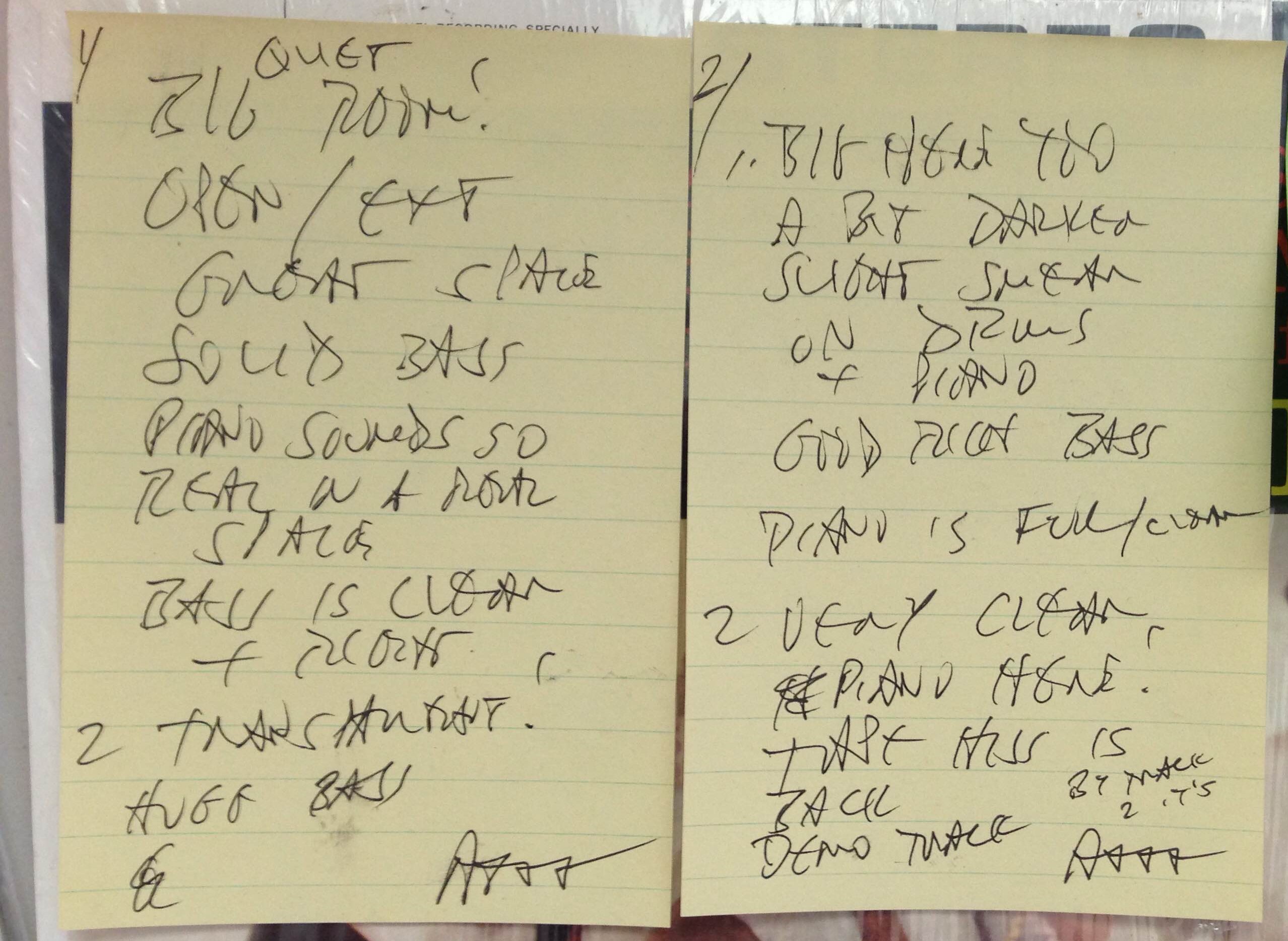
The kind of notes we take can be seen below. 4×6 Post-its work great for this purpose, using one per side.

We go through thousands of them every year.

Without specific notes on your records about exactly what you heard as you played them, you cannot possibly keep track of which pressings have the qualities you were listening for, and to what degree.

Extensive notes like the ones you see below are a must.

Other reviews with post-its can be found here.

We also make every effort to be very specific about the shortcomings of the audiophile pressings we review, which is why we started to reproduce our notes for their reviews when they are available.


(more…)