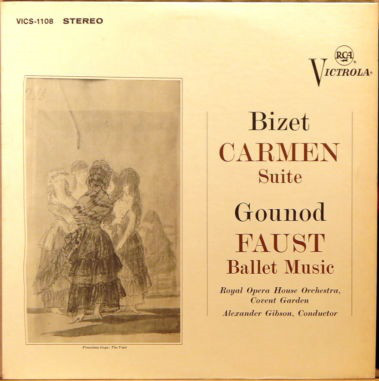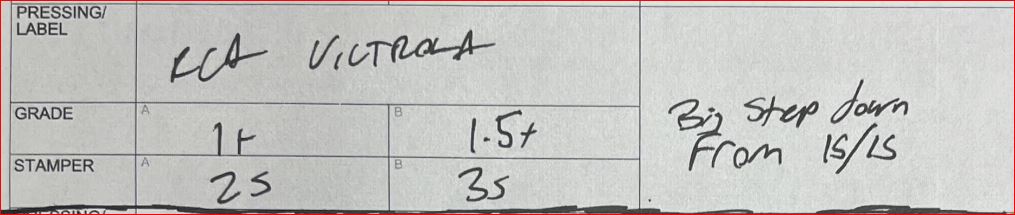
Label Advice

Some of the titles listed here have better sound on labels that many record collectors would probably not assume would be the best.

Other titles have inferior sound based on the labels we’ve identified in these listings.

Keep in mind that all the practical advice you see here is based solely on the numerous experiments we’ve run and the data we’ve collected from them.

Remembering the Glorious Sound of Tubes

Hot Stamper Pressings of the Music of Hall and Oates Available Now

This record has the sound of TUBES. I’m sure it was recorded with transistors, judging by the fact that it was made after most recording studios had abandoned that “antiquated” technology, but there may be a reason why they were able to achieve such success with the new transistor equipment when, in the decades to come, they would produce nothing but one failure after another.

In other words, I have a theory.

They remember what things sounded like when they had tubes. Modern engineers appear to have forgotten that sound. They seem to have no reference for Tubey Magic. If they use tubes in their mastering chains, they sure don’t sound the way vintage tube-mastered records tend to sound.

Transistor Audio Equipment with Plenty of Tubey Magic

A similar syndrome was then operating with the home audio equipment manufacturers as well. Early transistor gear by the likes of Marantz, McIntosh and Sherwood, just to name three I happen to be familiar with, still retained much of the smooth, rich, natural, sweet, grain-free sound of the better tube equipment of the day.

I once owned a wonderful Sherwood receiver that you would swear had tubes in it. In fact it was simply an unusually well-designed transistor unit. Anyone listening to it would never know that it was solid state. It has none of the “sound” we associate with solid state, thank goodness.

Very low power, 15 watts a channel. No wonder it sounded so good.

Stick with the 4 Digit Originals (SD 7269)

If you’re looking for a big production pop record that jumps out of your speakers, is full of TUBEY MAGIC, and has consistently good music, look no further. Until I picked up one of these nice originals, I had no idea how good this record could sound. For an early ’70s multi-track pop recording, this is about as good as it gets (AGAIG as we like to say). It’s rich, sweet, open, natural, smooth most of the time — in short, it’s got all the stuff we audiophiles LOVE.   

(more…)

Do The Original Domestic KC Pressings Always Beat the Later PC LPs?

Hot Stamper Pressings of Psychedelic Rock Recordings Available Now

Here is our description for the Super Hot (2+) copy that is currently on the site:

One of the most important records in my growth as an audiophile from 1971 to the present – my stereo was forced to evolve in order to play this kind of big production rock at the loud levels that the album needs in order to work its magic.

No matter how many times you play it, you will most likely hear – or at least gain more of an appreciation for – something new in the exceptionally dense, sophisticated soundfield Chris Kimsey creates for these songs.

And each time you make an improvement in the quality of your playback, this is the album that will show you exactly what you have just accomplished.


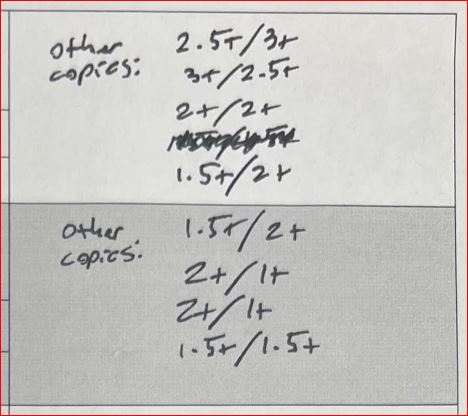
Overall, the best performers in our most recent shootout were UK pressings. They ranged in sound from the 3/3 Shootout Winning pressing (not shown) to the lowest graded British copy which earned grades of 1.5+/2+ (at the bottom of the top box).
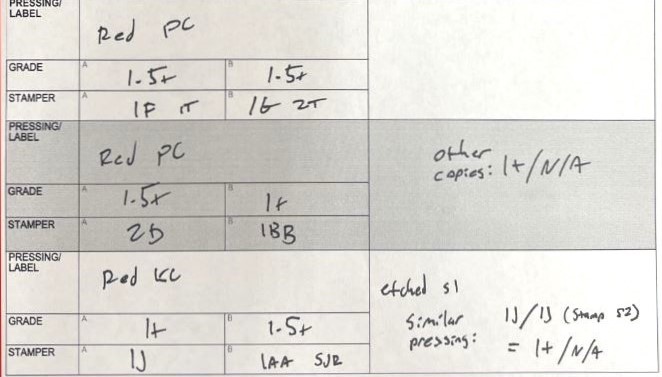
On the left is a portion of the breakdown, minus the actual stamper numbers that earned the highest grades (for obvious reasons.)

We had six UK pressings, all with the same stampers — the five you see graded and the one hidden to the left that actually won the shootout. (Three sides earned White Hot Stamper grades, an unusual outcome and a good one for the bottom line.)

Note that with the “right stampers” you could have ended up with an incredible Demo Disc (copy #1) or just a very good sounding copy on side two mated to a passable side one (copy #6).

Finding six clean UK pressings is, as you can well imagine, neither cheap nor easy. We probably bought close to twice that many to end up with six that we’re in something close to audiophile playing condition.

As you can see from the grades, two of them were clearly inferior to the other four. In the case of this title, a small sample size could have been very misleading. Fortunately for us, we spent the money and the time it takes to track down a good-sized batch of UK pressings in order to avoid that possibility.

Next come the better domestic pressings. There was a 2+/2+ that outscored all the other domestic pressings, and four others that came in behind it, all with the same stampers.

Of the five copies that had those stampers, two had side two’s that scored sub-Hot Stamper grades, which marked them as unsaleable. (Perhaps we will offer them as one-sided records since their side one’s are so good.)

KC VS PC

We rarely have good luck with PC reissue copies when the originals come with the KC prefix, rarely meaning we find a PC winner maybe once out of every ten titles we play.

(more…)

When All the Stampers Are the Same, What’s a Mother to Do?

Hot Stamper Pressings of Blue Note Albums Available Now
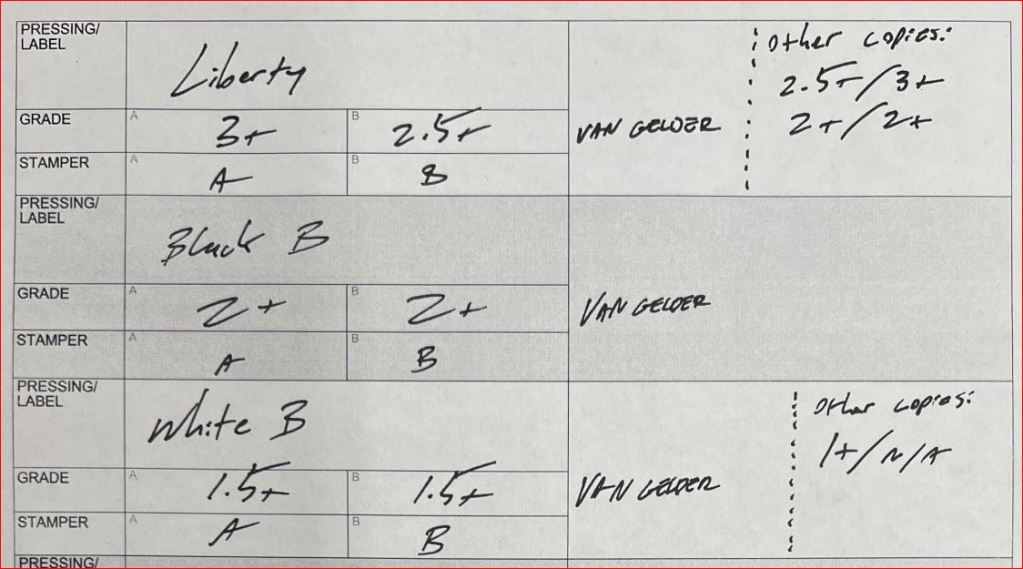
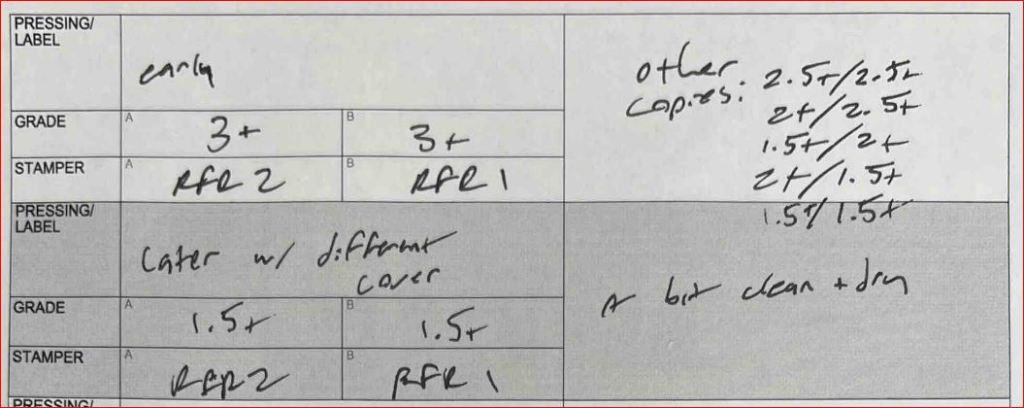
What happens when all the stampers are A and B and every one of them is cut by Rudy Van Gelder?

This is precisely the problem we were faced with on the mystery Blue Note album whose stampers can be seen below.

It’s not Cornbread — those are really hard to find! We did a shootout last year and hope to have another one coming before long, but most of what we buy ends up going back to the seller for noise issues, so it may be a while before we can get it going.

In the meantime, whatever you do, don’t waste your money on the Tone Poets reissue — it’s ridiculously bad.

What information can you rely on when trying to find the best sounding pressings?

The stamper numbers are no help.

And you can’t look for the VAN GELDER stamp in the deadwax since they all have it.

Of course, now that we’ve done the shootout, we know to buy the Liberty label pressings, but that could hardly have been predicted beforehand. Plenty of later labels beat the early label pressings on Blue Note’s albums.

But readers of this blog surely know that we are being facetious when we say we faced a lack of stamper information with the title above.

We have no way of knowing what the label is for any copy that is playing on our turntable, so how could the stamper information possibly matter, ever, under any circumstances?

We judge records by their sound quality, then grade them on that single metric, ignoring all others.

Only later do we learn which labels and stamper numbers correspond with which sonic grades, assuming they actually correspond at all. (Some don’t.)

If you are buying certain pressings because they have earlier labels, rather than pressings with later labels, predicated on the theory that the earlier labels should have better sound, this blog will be a godsend — because it will prove to you that the approach you are taking is not a particularly good one.

You are only fooling yourself if you think it is. It might work more often than not, but do you really want to be wrong about four records out of ten? Forty out of a hundred. Four hundred out of a thousand? With no way of knowing which group — good or bad — any given title happens to fall into?

A record collection of a thousand records is a decent sized collection. But with four hundred titles having second-rate or worse sound? Nobody wants that.

Buying originals is just not a good way to insure your collection will have top quality sound. Fortunately we know of a way that does.

(more…)

Jazz Giant and Tube Versus Transistor Tradeoffs

Hot Stamper Pressings of Contemporary Jazz Albums Available Now

In a commentary from more than ten years ago we weighed the tradeoffs in the sound of the originals versus the reissues.

This superb sounding original Black Label Contemporary pressing of Benny Carter’s swingin’ jazz quartet is the very definition of a top jazz stereo recording from the late ’50s recorded and mastered through an All Tube Chain.

There’s good extension on the top end for an early pressing, with TONS of what you would most expect: Tubey Magic and Richness. If that’s what you’re looking for, this copy has got it!

We prefer the later pressings in most ways, but this record does something that no later pressing we have ever played can do — get Benny’s trumpet to sound uncannily REAL.

If you want to demonstrate to your skeptical audiophile friends what no CD (or modern remastered record) can begin to do, play side two of this copy for them. They may be in for quite a shock.

The sound of the muted trumpet on side two is out of this world. 

It’s exactly the sonic signature of good tube equipment — making some elements of a recording sound shockingly real.

(more…)

These Stampers Can Be Good, But They Sure Don’t Win Shootouts

Hot Stamper Pressings of Classic Rock Albums Available Now

This is how we described a recent Hot Stamper pressing that we put up on the site:

Surprisingly rich and full-bodied, particularly on side one, the best copies really ROCK with big bass and punchy drums – just the right Alice Cooper sound.

The beloved title track remains the most-performed song in his concert history, and the presence on this copy will put the band right there in your listening room.

Yet another impossible-to-find record — impossible to find in clean condition, with good sound — has made it to the site, and those of you who are fans should scoop it up. It takes us about four years to find enough copies to do this shootout.

We had poor luck with the second and third label copies on this AC title. It seems that, unlike so many records we play, the originals are the only way to go on School’s Out.

The stampers you see above belong to a Green Label early pressing. It earned good, not great Hot Stamper grades.

1.5+ is four grades down from the top copy. That’s a steep dropoff as far as we’re concerned. 1.5+ only hints at how good the best copies can sound.

To see more records that earned the 1.5+ grade, please click here. (Incidentally, some of them are even on Heavy Vinyl. The better modern pressings have sometimes, if rarely, been known to earn Hot Stamper grades, and one shocked the hell out of us by actually winning a shootout. Wouldn’t you like to know which one!)

For those who might be interested, there’s more on our grading scale here.

(more…)

Music of Old Russia – We Give Up

Hot Stamper Pressings Featuring the Violin Available Now

UPDATE 2026

This is an album we can no longer find a suitably large supply of clean, early stereo pressings in order to do a proper shootout. It’s a great title, but it turns out it’s just too much work to get anything going for it, so we tagged it as a never again record.

It’s possible we could do it again, but not likely since it’s almost always too noisy to sell, even after a good cleaning,

The bottom line: we see no other option other than to give up on it for now. We love both the music and sound and encourage you to find a nice copy for yourself.

For best results, stick to the Blue Label stereo pressings. There are two, but only one of them sounds good, so if you get a bad one, find one with the same label and different stamper markings.


Our Original Listing from 2011

White Hot Stamper sound on side one – the Tubey Magic is off the scale. Milstein is brilliant on these shorter violin works, 7 in all.

This rare, hard to find original Blue Angel stereo pressing has exquisite sound. As we noted in our listing for Milstein’s Saint-Saens Third, it is the rare Heifetz album on Shaded Dog (or any other label) that could hope to compete with it.

We would rank this Angel pressing with the best of Rabin and Milstein on Capitol, as well as the wonderful Ricci and Campoli discs on London/Decca.

The transparency of both sides lets you “see” the orchestra clearly, without sacrificing richness or weight.

What a record! What a performance from the incomparable Nathan Milstein. 

TAS List? Feh!

Definitely side one, and probably even side two of this copy put most of the TAS Super Discs to shame. I would venture to say that there’s a very good chance that you have never heard a violin-led orchestral recording as good as this one.

It’s clearly superior to most of what I take to be the pressings that audiophiles cherish for their putatively superior sonics. (Don’t even bring up that crap that Classic Records pressed of the Heifetz RCAs. They may have impressed the critics and the man-in-the-street audiophile but they sure didn’t do much for us.)


UPDATE #2

Actually, one of them did. Ah, but which one?! Stay tuned to find out.


The fact that this wonderful sound has been found on a lowly domestic Angel pressing is, to me, the icing on the cake.

Side One

Music of Rachmaninoff, Mussorgsky, Glazounov and Tchaikovsky

Huge space, super transparent and awesomely dynamic, this side is killer in every way. The sound is as rich and tubey as any Ricci record on London, and that means VERY rich and tubey. I could not find anything to fault in the sound. Superb in every way.

Side Two

Music of Tchaikovsky-Glazounov and Rimsky-Korsakov

Rich and smooth, with good space, but not quite all the phenomenal transparency of side one. Very musical this way, and the music is sublime.

Side One

Rachmaninoff – Vocalise
Moussorgsky-Rachmanminoff – Hopak
Glazounov – Meditation
Tchaikovsky – Valse Scherzo

Side Two

Tchaikovsky-Glazounov – Meditation
Tchaikovsky-Glazounov – Scherzo
Rimsky-Korsakov – Fantasy on Russian Themes


How Good Are the UK Original Unboxed Deccas of Satanic Majesties?

Hot Stamper Pressings of the Music of The Rolling Stones Available Now

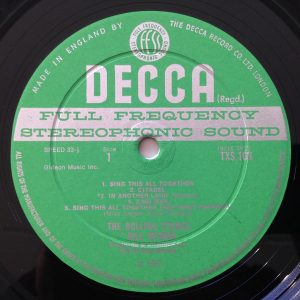
How good are the original Unboxed Deccas on Satanic Majesties?

They can be very good.

But they are never as good as the right later pressings with the Decca in a box label, the ones produced from about 1970 on.

The Unboxed Decca pressing earned a Super Hot Stamper grade (A++). The later pressing, with the right stamper, showed us just how good the album can sound.

Since the originals are pricey and hard to find, and, as a rule, noisier than the later pressings, we don’t pick them up unless we find them for cheap, which rarely happens. They have not won any shootouts, and that is very unlikely to change.

There is one set of stampers for this album that always wins, and those stampers are not found on the early label.

(more…)

Sure, 1s Wins, But Why Does 2s Do So Much Worse?

Hot Stamper Living Stereo Classical and Orchestral Titles Available Now

Below you will see a section of the stamper sheet for a shootout we did recently.

Keep in mind that, as usual, the album you see pictured is not the record we did the shootout for.

In the case of this mystery record, the 1s stamper was by far the best, with the Plum Label copies having later stampers (2s) earning a sub-Hot Stamper grade on side one.

The 1+ grade found on this side one means it’s simply not very good, the kind of sound we consider to be no better than passable, We do offer records with 1+ grades as Hot Stamper pressings.

What would be the point? You can find them on your own. The world is full of mediocre records. They sit in the bins of every record store you walk into and make up the bulk of record collections of both audiophiles and music lovers alike.

How Come?

Since, as we discovered recently, 1s wins, and wins handily, why does 2s/3s do so much worse?

I could guess, but that would violate our policy against pretending to know what cannot be known.

Something in the range of five to ten per cent of the major label Golden Age recordings we play will eventually make it to the site. The vast majority just don’t sound all that good to us. (Many have second- and third-rate performances and those get tossed without ever making it to a shootout.)

(more…)

Never Buy Any LP with this Columbia Label If You’re Looking for Good Sound

Columbia Pressings with Hot Stampers Available Now

If you are looking for good sound that is. I cannot remember ever playing a record with this later label that sounded any better than passable, and most of them are just plain awful.

We play mediocre-to-bad sounding pressings so that you don’t have to, a public service from your record-loving friends at Better Records.

You can find this one in our hall of shame, along with others that — in our opinion — are best avoided by audiophiles looking for hi-fidelity sound. Some of these records may have passable sonics, but we found the music less than compelling.  These are also records you can safely avoid.


UPDATE 2025

We have two new lists for those who would like to know which Columbia label pressings win shootouts — one for 6-Eye winners and one for 360 Label winners.

(more…)

Bernie Finds the Right Sound for The Genius After Hours

charlgeniusHot Stamper Pressings of Titles that Sound Better in Mono Available Now

This commentary from ten years ago has been updated with the latest information from the shootout we did in 2025.


Proof positive that there is nothing wrong with remastering vintage recordings if you know what you’re doing. These sessions from 1956 (left off of an album that Allmusic liked a whole lot less than this one) were remastered in 1985 and the sound — on the better copies mind you — is correct from top to bottom.

The highest compliment I can pay a pressing such as this is that it doesn’t sound like a modern remastered record.

It sounds like a very high quality mono jazz record from the 50s or 60s.

Unlike modern recuts, it doesn’t sound EQ’d in any way.

It doesn’t lack ambience the way modern records do.

It sounds musical and natural the way modern records rarely do.

If not for the fairly quiet vinyl, you would never know it’s not a vintage record. The only originals we had to play against it were too noisy and worn to evaluate critically. They sounded full, but dark and dull and somewhat opaque.


UPDATE 2025

The originals on the Atlantic Plum and Red Label are not the way to go on this album. Our shootout notes below make that clear. Take our friendly and helpful advice and avoid them.

(more…)