Music Genres – Commentaries

A Night at the Opera Is a DCC Disaster

Hot Stamper Pressings of the Music of Queen Available Now

Sonic Grade: F

The DCC pressing of Night at the Opera is a hopeless mess, one of the worst titles that Kevin Gray and Steve Hoffman ever ruined.

Murky, opaque and compressed: yes, we can agree it has never been an especially good sounding record on anything but the most difficult to find UK pressings [and we know exactly which ones those are now, which only makes this record sound even worse in comparison], but does it deserve this kind of mastering disrespect?

Isn’t the idea to try and FIX what is wrong, rather than to make it worse?

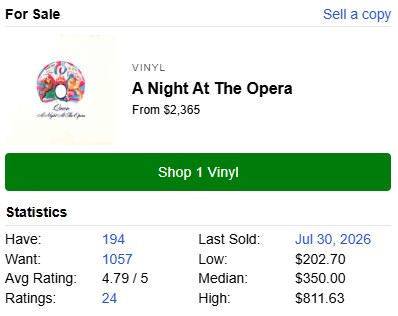
At collector prices no less. Don’t waste your money like the folks on Discogs did.

It’s true that our Shootout Winning pressings sell for much more than the $811.63 someone paid, but keep in mind that we are selling you an amazing sounding record for that kind of dough, not a copy made for the mid-fi collector market, one that will spend very little of its time sitting on a turntable platter or having a needle tracing its grooves. (That would hurt the collector value, don’t you know.)

Instead it will no doubt get filed away on a shelf next to others of its kin, perhaps even in a special DCC section, organized in numerical order!
Is it the worst version of the album ever made?
(more…)

Dialing in the Anti-Skate with Massed Strings

Hot Stamper Pressings of Orchestral Spectaculars Available Now

I once adjusted my anti-skate while playing this very album, at the time dialing it in to what I thought was a “T.” 

Over the years I’ve found that the best test for fine anti-skate adjustment is massed strings, and not just at the end of a side but right at the part of the record in which the anti-skate has been engaged. This will vary with different arms.

When you have all the rosiny texture, the high-end harmonic extension, the least shrillness and the widest and deepest staging, you are there — assuming that tracking weight, azimuth and VTA are correct as well.

Four variables to mess with admittedly is a bitch, but having the right record to test with is absolutely critical as well. Maybe we should call it five variables.

And if I only had one record to bring to someone’s house in order to evaluate their equipment, this would certainly be a top choice. If you can make this record sound the way it should, your stereo is cookin’. If you are having problems, this record will show them to you in short order.

(more…)

It Took Us Until 2012 to Finally Beat the Audiophile Pressing We Swore By

Hot Stamper Pressings of the Music of Supertramp Available Now

UPDATED 2026

We have not had very good luck with domestic pressings of this album for quite a few years now. The German pressings are also not very good, earning at most 1.5+ and more often than not a lower grade. (Hey, we had to be sure.)

The Canadian audiophile pressings are comparable, 1.5+ or close to it, not good enough to bother with when the right UK pressings are so much better.

The listing below is from 2012. Since that time we have been able to find and play a great many British pressings of the album, and they always win our shootouts now.

But the domestic pressings can also do very well, just not well enough to win shootouts these days, a clear case of live and learn.


Our Understanding from 2012

TWO AMAZING SIDES, including an A+++ SIDE ONE! It’s not the A&M Half Speed, and it’s not a British pressing either. It’s domestic folks, your standard plain-as-day A&M pressing, and we’re as shocked as you are. Hearing this copy (as well as an amazing Brit; they can be every bit as good, in their own way of course) was a THRILL, a thrill that’s a step up in “thrillingness” over our previous favorite pressing, the A&M Half Speed. [!]

(more…)

We Was Wrong about Our Best Black Label Copy Back in the Day

Hot Stamper Pressings of Pop and Jazz Vocals Available Now

UPDATE 2025

Turns out the Black Label early pressings actually are the best sounding. In 2025 we discovered we were wrong when we said we were wrong back in 2015.

And as far as we can tell, unlike anyone reviewing records for audiophiles writing (or speaking) these days, we have no problem admitting to it. Admitting to our mistakes is significant for many reasons, but the two that immediately come to mind are these:

  • It is a hallmark of progress in audio. Assuming your new findings are true, you are better at your job than you used to be.
  • More importantly, it is the secret of our success. How can you learn anything when you already know it all?

We write about how regular shootouts are and always will be the best way to improve the sound quality of your collection.

What we don’t say much about is how any music-loving audiophile could ever find the time to do this work. Where would the time come from to do multiple shootouts over many years, or the time to find the records, or the money it takes to buy them these days, when ever record ever pressed seems to command a collector price.

God knows we’re no angels in this regard. We do it for the simple reason that it’s our job to do shootouts year in and year out for the same records again and again. There will never be a time when everyone who wants a better sounding Abbey Road already has a good-enough sounding Abbey Road. The best copies are never short of buyers. The prices may change but the demand only goes in one direction: up.

We are not in the position of having a choice and choosing to do the right thing.

Applying the lesson of Adam Smith’s invisible hand, we are set up to do what needs to be done in order to run a business devoted to pleasing our customers. Millions of other business owners could say exactly the same. If for some reason their businesses aren’t set up properly, or run properly, or don’t offer goods at a price their customers are willing to pay, as day folllows night they will surely not be in business for long.

(more…)

Yes, The Best Plum and Orange Pressing Will Win Every Shootout

Hot Stamper Pressings of Prog Rock Albums Available Now

Our rare, original Plum and Orange UK original here put every other pressing to shame. This is some of the best High Production Value rock music of the ’70s, thanks to the band and a Mr Eddie Offord.

If you’ve ever heard one of our Yes Album Hot Stampers, you’ll know what to expect here – HUGE and POWERFUL sound.

Although the UK first label originals will always win our shootouts, the early UK reissues on the Red and Green label can still sound quite good on the right pressing.

Skip all domestic copies of this album, as well as the domestic pressings on the second label of their first album. They are clearly made from dubbed tapes.

Amazing Acoustic Guitars

Acoustic guitar reproduction is superb on the better copies of this recording. The harmonic coherency, the richness, the body and the phenomenal amounts of Tubey Magic can be heard on every strum.

(more…)

Smooth or Detailed, Which Is the Right Sound for Jackson Browne’s Debut?

The real trick with this album is striking the right balance between richness and presence.

A White Hot Stamper from years back made me change my mind about this recording.

I used to think it was dull, but I was wrong. I used to think that even the best copies of this recording sounded rolled off on the top end. I no longer believe that to be true. On the best pressings the top end is correct for this music.

It took the right pressing to show me the error of my ways.

Side one of that copy was rich and full and sweet as can be. Playing side two I noticed more transparency and clarity, especially in the guitars and voices. It seemed to have correct highs, highs that were a little soft on the first side.

But the more I listened, the less I liked it. It started to sound more like a record and less like music. Going back and forth between sides one and two, it was obvious that side one had less clarity because it had the kind of richness and fullness that made all the musicians and their instruments sound real in a way that wasn’t happening on side two.

Side two had clarity, it had transparency, but it kept reminding me that it was a recording.

Side one allowed me to forget that I was playing a record.

When the music started, my attention was completely focused on the songwriting and the performing. Aspects of the recording were lost in my enjoyment of the music. I kept thinking what a great album this is, not what a great recording it is. That tells me that both the recording engineer and the mastering engineer did their jobs right. They created a sound that best served this music.

I think if an audiophile label had produced a version of this album that sounded like side two, most audiophiles would love it. They would hear detail that they’d never heard before. (It’s my belief that the original Asylum master tape has been lost, so the details of which we speak can be heard on these good originals and nowhere else.)

But, fooled into listening for details in the music rather than the music as a whole, they would never know how RIGHT the album can really sound.

The best of our Hot Stampers are the ones that have the right sound for this music.

“Traction in the Rain”

Hot Stamper Pressings of the Music of David Crosby Available Now

I discovered If Only I Could Remember My Name sometime in the 90s, probably from reading about it in The Absolute Sound. When I was in my twenties and buying records regularly, the album was already out of print; I know because I went looking for it an nobody seemed to stock it.

The (awful sounding) Super Saver came out in 1975 and probably was deleted before long due to a lack of demand.

Once I had heard the record, it quickly became a go-to Test and Demo Disc, mostly for the song Traction in the Rain. The autoharp on that track is one of the most amazing things I have ever heard, on any album. The exceptional resolution and harmonic coherency of the multiple electrostatic arrays I was using for the mids and highs of my speaker system were perfectly suited to reproduce that instrument, as well as the complete track with Crosby’s delicate, breathy vocal being another key element to the sound.

I listened intently for the notes that got louder and softer as the autoharp was strummed. The more different each note sounded, the more micro-dynamics I knew I was reproducing. I tweaked and tested my system for months, even years with this track. (Nowadays I might put it on the list of records that sound so good they’re not actually ideal for testing, but that’s another story for another day.)

I didn’t know enough to buy other copies and compare them to mine. I just knew it was a great sounding record that I could blow people’s minds with as a big speaker demo disc.

(more…)

The Concert Sinatra and The Big Sound We Love

sinatconce_1011_1310577590

Hot Stamper Pressings of the Music of Frank Sinatra Available Now

UPDATE 2026

This commentary about what to listen for on Sinatra’s 1963 album The Concert Sinatra was originally posted in 2015.


There may be a touch of smear (you can most easily hear it in the strings) but the sound is so RICH and Tubey Magical that you will barely be aware of it. Your attention should be focused on the superb feel the man has for this music.

One thing to pay special attention to, especially if you have other copies of the album, is that Sinatra’s voice on both sides of this pressing always sounds natural even at its loudest.

There is no strain or hardness.

That, among many other things, is what separates the best copies from the also-rans (and, of course, all the reissues, which tend to have gritty, harsh vocals which quickly get unbearably edgy in the louder parts).

(more…)

Revolutions in Audio Can Make a Huge Difference on Problematic Recordings

UPDATE 2026

In 2008 we did our first big shootout for Life Beyond L.A. which allowed us to discover a copy with sound quality we had simply never heard for the album, the kind of sound we had no idea could exist until we heard it.

In 2005 we had attempted the same shootout and abandoned it. The difference between the best domestic pressings and the Nautilus Half-Speed were not big enough to justify the price we would have had to charge for the best copies.

We probably owned an exceptionally good sounding pressing of the Nautilus, something we also had no way of knowing, but the main problem we faced in 2005 was an inferior approach to record cleaning and playback equipment that was not up to the task.

Our ability to do shootouts advanced dramatically from 2005 to 2007.

Life Beyond L.A. is just one example of a shootout that couldn’t be done in 2005 but ended up being a smashing success in 2008.

Our Commentary from 2008

This White Hot Stamper pressing of Life Beyond L.A. from some years ago had the kind of sound you would never expect to find in the grooves of this album. It was a THRILL to hear it, especially at the volumes at which we were playing the record.

The transparency and openness were off the charts, unmatched by any other copy in our shootout. We’re big fans of this band here at Better Records — we love their take on complex, big production arty rock.

It’s also yet another example of the value of taking part in the myriad revolutions in audio.

If you never want your prized but sonically-challenged records to sound any better than they do right now, this minute, don’t bother to learn how to clean them better, play them back better or improve the acoustics of your room.

(more…)

Fandango! Is Yet Another Hoffman/Gray Mediocrity

Hot Stamper Pressings of the Music of ZZ Top Available Now

Warner Brothers remastered Fandango in 2008, so we took some domestic pressings and put them up against their Heavy Vinyl LP.

The results were mixed; most of our original pressings were lackluster, many were noisy, and we just weren’t hearing anything with the sound we thought deserved to be called a Hot Stamper.

We shelved the project for another day.

In the interim we kept buying domestic pressings — originals and reissues — in the hopes that something good would come our way.

Fast forward to 2015. We drop the needle on a random pressing and finally — finally — hear a copy that rocks like we knew a ZZ Top album should. With that LP as a benchmark, we got a shootout up and running and the result is the record you see here.

How did the WB remaster fare once we had some truly Hot Stamper pressings to play against it?

Not well. It’s tonally correct, with a real top and bottom, something that a substantial number of copies cannot claim to be.

But the sound is stuck behind the speakers, veiled, and sorely lacking in energy and excitement.

The transparency is of course compromised on all these new reissues, and without transparency and resolution, much of the audience participation on the first side is lost.

I won’t say the new pressing is boring.

Let’s just say it’s a lot more boring than it should be. (more…)