Mastering Commentaries

Piano Works of Debussy & Ravel – This Is How to Make a Good Audiophile Record

Hot Stamper Pressings Engineered by Robert Ludwig Available Now

A lovely solo piano recording from Athena, which is certainly not a label we have ever associated with good sound. Just the opposite in fact.

But they did a great job on this album (or at least I thought so many years ago when I last played it. For purposes of this commentary, let’s assume the sound still holds up).

This is how to make a good audiophile record.

Yes, there is such a thing. They may be rare but they do exist. We have a few of them for sale as a matter of fact.

Take a good tape, hire someone who knows his way around a normal-speed cutting lathe (with 5800+ credits on Discogs, I would hope he knows what he’s doing) as well as classical music (he cut a huge number of records for Nonesuch back in the day), press it on good vinyl and let the audiophiles of the world enjoy it.

The Connoisseur Society original may in fact be better, but where are you going to find one?

Robert, Bernie and Doug – An Honest Comparison

In another listing for an audiophile record that Robert Ludwig cut, we noted:

I suspect that if Ludwig hadn’t stopped cutting records years ago, we would not be complaining nearly as much about the questionable sound of the modern Heavy Vinyl pressings currently inundating the market.

Bernie and Doug really started letting the record lovers of the world down, beginning as far back as the 90s. See here and here.

(more…)

We Don’t Offer Domestic Pressings of Pour Down Like Silver for One Very Simple Reason

Hot Stamper Pressings of the Music of Richard Thompson Available Now

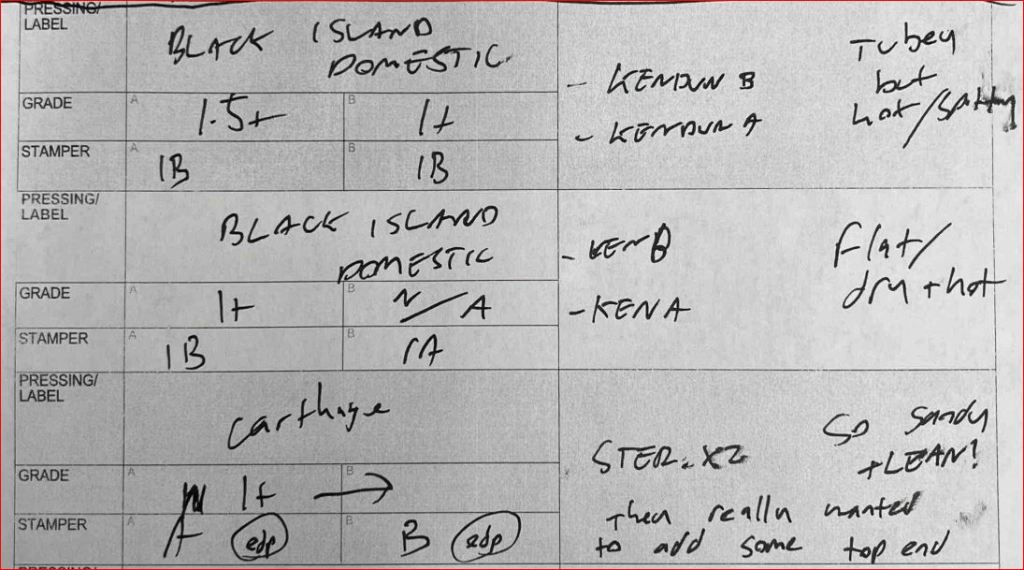
In spite of the fact that the domestic pressings of this Richard and Linda Thompson classic from 1974 were mastered by the likes of Kendun and Sterling — two of the greatest mastering houses of all time, — they have never impressed us with their sound quality.

The biggest problems with this record would be obvious to even the casual listener: gritty, spitty vocals; lack of richness; bright tonality; lack of bass; no real space or transparency, etc.

The domestic Island pressings did not do nearly as well in our shootout as the best Island imports, no surprise there as the early UK records were mastered by one of our favorite engineers.

Avoid the Carthage pressings mastered by Sterling. They came in last in our shootout.

The domestic breakdown follows:

Black Island Domestic #1

  • Tubey but hot and spitty.

Black Island Domestic #2

  • Flat, dry and hot (glary or bright)

Carthage Domestic recut from 1983, Sterling on both sides

  • So sandy and lean! They really wanted to add some top end (!)

Defending the Indefensible

(more…)

Turning Master Tapes into Mud Pies – The Magic of the Electric Recording Company

Hot Stamper Pressings of Psychedelic Rock Recordings Available Now

UPDATE 2026

This commentary originally came out in 2023 I believe. The comments section at the end is a bit of a hoot. Man, there sure are some real wackos in the world of audio.


““It’s magical what they’re doing, recreating these old records,” Fremer said as he swapped out more Electric Recording discs.”

Swapped them out? Anyone with an ounce of respect for Love’s music would have tossed them into the nearest trash bin.

We did a shootout for Love’s Forever Changes earlier this year, and it was our good luck to get hold of a copy of the Electric Recording Company’s pressing of the album in order to see how it would fare against our Gold Label Stereo original LPs.

As you can see from the notes, to say that we could hardly believe what we were hearing clearly understates the depth of our befuddlement.

We simply have no context for a record that sounds as bad as this record sounds. We’ve never heard anything like it, and we’ve played a lot of records in the 37 years we’ve been in business. After critically auditioning thousands upon thousands of pressings in our shootouts, all day every day for the last twenty years, we’ve worn out scores of cartridges and even our Triplanar tonearm.

But this is new ground for us. A quick recap:

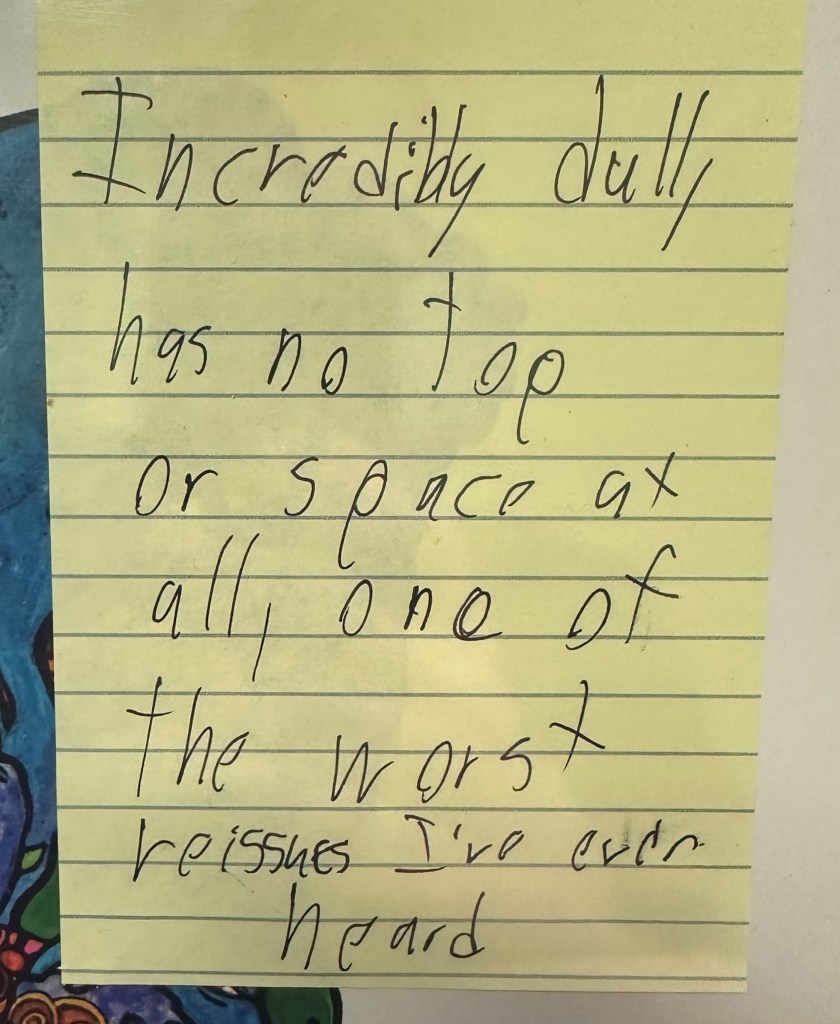
  • Incredibly dull,
  • Has no top or space at all,
  • One of the worst reissues I’ve ever heard.

You get the picture. What more needs be said? Last year I wrote the following:

Pete Hutchison of The Electric Recording Company makes some of the worst sounding records I have ever played in my life.

If you play me one of his awful records, and don’t tell me who made it, I can judge the record on its merits, the way we judge all records. We test records blindly for precisely this reason. We let the record tell us how well it was made, what it does right and wrong relative to other pressings of the same album, comparing apples to apples.

His records tell me he loves the sound of the murkiest, muddiest vintage tube equipment ever made, and wants every record he produces to have that sound.

In my book that is an egregious case of My-Fi, not Hi-Fi. We wrote about it here.

It’s astonishing to me that anyone takes this guy seriously.

In the Washington Post video, we did a little comparison on camera for two pressings of Quiet Kenny, a record I will have more to say about in Part Two of this commentary. Here is Geoff Edgers’ description in the article of how it all went down.

(more…)

Graham Nash’s Wild Tales and Their Mysteries Many and Deep

Hot Stamper Pressings of the Music of Graham Nash Available Now

What hurts so many pressings of this album is a generally lifeless quality and a lack of presence in the midrange.

Were the stampers a bit worn for those copies, or no good to start with, or was it bad vinyl that couldn’t hold the energy of the stamper, or perhaps some stampers just weren’t cut right?

Maybe it’s something as simple as the pressing plates going out of alignment at some point in the cycle?

Don’t ask us. We sure don’t know. And one thing we’ve learned over the years is not to pretend to.

These are record mysteries, and they are mysteries that will always be mysteries, if for no other reason than the number of production variables hopelessly intertwined at the moment of a pressing’s creation can never be teased apart no matter how smart you are.

As we never tire of saying, thinking is really not much help with regard to finding better sounding records.

Not surprisingly, we’ve found that cleaning and playing them seems to work fairly well.

Those two things work fairly well because nothing else works at all.

(more…)

MoFi Mastering Variations – Will the Real Sgt. Pepper Please Stand Up?

Hot Stamper Pressings of the Music of The Beatles Available Now

Sgt. Pepper can be a pretty good sounding MoFi when it’s mastered by the right guy.

Say what?

Yes, dear reader, this album was mastered by two different engineers at Mobile Fidelity, and one of them, based on experiments we carried out years ago, did a much better job than the other.

This copy, which is far more rare by the way, has the better mastering — much less top end boost was added. As an aside, I used to like the other version better, but as I’ve gotten older and wiser, I realize that this pressing is superior, being noticeably less phony sounding.

It sounds much more like a good Parlophone and less like the typical Mobile Fidelity album.

(more…)

You’ll Be Crying When You Get This Record on Your Turntable

Hot Stamper Pressings of the Music of Linda Ronstadt Available Now

UPDATE 2026

This review was most likely written when the record came out, circa 2008 I’m guessing. The intro is of course new for 2026.


You’re looking at one of the worst sounding audiophile releases in recent memory, a remastering disaster that has no reason to exist other than to satisfy the needs of the mid-fi collector market for numbered, limited editions on premium vinyl, perhaps so that they can be sold at a later date for a profit (discogs average price today: $62.50.)

This is a label that should have gone under decades ago but, with a nod to Frank Zappa channeling Edgar Varese, refuses to die.

Like this guy, this guy and far too many others, they are making money hand over fist at the expense of audiophiles who have yet to get very far — anywhere, really — in audio. (I know whereof I speak. I was one of those guys and you couldn’t tell me anything back then.)

We go to great pains to lay out the problems with these records in detail, but what good does reading about their problems do if the systems playing these records iare not only hiding their flaws, but making up for some of their weaknesses. The junk pressings these collectors are buying practically guarantee they will never manage to put together a system that can show them what is really on their records.

Regardless of what kind of equipment they own, if this crap is sounding good to them, which it seems to be based on the comments section I make the mistake of reading on Discogs from time to time, nothing we say can possibly interfere with them buying more of it.

(more…)

3s Can Have Amazingly Good Sound, or 3s Can Have Mediocre Sound

Hot Stamper Pressings of Living Stereo Recordings Available Now

But how can you tell which 3s copies sound amazing and which 3s copies don’t?

Below you will see the stamper sheet for a shootout we did not long ago.

A lot of our stamper sheets look like this one, close to half I would guess.

As you can see, the stampers and the sound are all over the map. This is not the least bit unusual in our experience. It’s simply the nature of records — they tend to come off the press with very different sound depending on factors that no one seems to understand very well, not even us!

Note that the album you see pictured is not the record we did the shootout for.

(more…)

Cat Stevens Part 2 – Is This the Truest Tillerman of Them All?

If you haven’t read Part 1 of this story, please click here.

Back to our real story. I listened to my good original pressing. I call it White Hot at least!

Then I put the new pressing on the table, set the SDS for 45 RPM, and got the volume just right. I proceeded to carefully adjust the VTA by ear, going up and down with the arm until the sound was right, which is simply standard operating procedure for every record we audition.

These are my actual notes for But I Might Die Tonight.

This is what I heard as the song worked its way through the various sections, in real time.  The first thing I heard at the start was Zero Tubey Magic for the first verse. One of the last things I heard at the end was No Real Space. Space is what you hear at the end for the big piano and drums finish.

Let’s take it line by line. First up:

Zero Tubey Magic

I didn’t hear much Tubey Magic on the new pressing. The best early pressings — domestic A&M Browns, Pink or Sunray UK Islands — often have simply phenomenal amounts of the stuff. It’s a hallmark of the recording.

If a new pressing comes along without it, that’s a problem. I guess that George Marino‘s cutting system at Sterling could probably do some things well, but it sure doesn’t seem to be able get the sound of tubes right. His 33 RPM cutting had no Tubey Magic, and this one has no Tubey Magic. If I had hired him to cut a record for me and it came out sounding like this, I would find somebody else to cut records for me.

He’s dead now, rest in peace. I would doubt that anyone at Sterling has a better cutting system, and therefore no one should expect any records that have been mastered there to sound very good.

Vocal Is Clear, Clean and Dry

This is the sound you sometimes get with modern, super-clean transistor cutting equipment. It’s low distortion, like a CD is low distortion. We don’t think we should have to put up with dry vocals on records when the good pressings we have been playing all our lives have noticeably richer vocals.

Not rich like Dream With Dean, nothing is that rich, but rich and full-bodied the way the good pressings of this album always make them sound.

(more…)

How Paul and Judy Finally Turned Me Against DCC

Hot Stamper Pressings of the Music of Paul Simon Available Now

When I finally got around to comparing the two, I remember being taken aback by how much better my original Artisan pressing sounded than the supposedly superior DCC, the one pressed at high quality Heavy Vinyl at RTI to the most exacting standards possible, yada, yada, yada.

What finally turned me completely against DCC were the awful Paul Simon solo albums they remastered.  Two were released, two I had as unreleased test pressings, and all of them were clearly and markedly inferior to the good original pressings I had owned.

So much for believing in DCC.

Since that time we have learned that placing your faith in any record label or cutting operation is a mistake.

You have to play the records to know how they sound.

Nothing else works, and nothing else can work.

(more…)

If It’s Made from the Real Master Tape, Shouldn’t Blue Sound Better than This?

Hot Stamper Pressings of the Music of Joni Mitchell Available Now

UPDATE 2026

I wrote the commentary you see below way back in 2006. I wanted to give our customers an incentive to critically listen to the new Rhino pressing of Blue, a Heavy Vinyl reissue we actually gave out for free with every Hot Stamper of the album we sold.

We wanted our customers to try and answer the question I had posed in my review as to what aspect of the sound was improved in the new pressing, relative to the vintage copy they would have just purchased from us.

For those of you who have been reading our commentaries about modern remasterings, you know that rarely do we find any area of their sound that could be considered in any way “improved.”

As you will see from our commentary below, no less a personage than Michael Fremer had said at the time that the Rhino pressing “has far greater presence and physicality and is more immediate, dynamic, detailed and especially transparent.”

As hard as it may be to believe, I actually agreed with him about one of those qualities.

I’ve broken down his list below. If you have one of our Hot Stampers and the Rhino reissue, play them back to back and try to hear what is better about the reissue. Which of the following does it have more of compared to even the best vintage pressings?

  • More presence,
  • More physicality (whatever that is),
  • More immediacy,
  • More dynamics.
  • More detail,
  • More transparency

I had posed this question on the blog over the course of many years and never got anything approaching a serious answer.

I was going to reveal what quality I thought it was at some point, but I have since decided that it is better left for the reader to figure out for himself rather than have me tell him. What do you learn from being given an answer? Nothing, or next to nothing, so why do it?

Similarly, the Heavy Vinyl Led Zeppelin II and Brothers in Arms reissues are very good sounding records, with obvious shortcomings which I had hoped my readers would be able to spot and write to me about. None have to date, or at least none have told me what they are, which works out to be more or less the same thing.

I will have a great deal more to say on this subject down the road, one that is critically important for audiophiles regardless of their experience. For now let me leave you with what Steve Hoffman had to say about the work he did on Blue. (You can find the quote on Joni Mitchell’s website.)

This is a really wonderful album; Joni just laid it all out there for the world to hear. Brave, especially back in the day & I feel that this new version is the true giant killer.

Unlike the original 1970’s pressings, this new version was mastered without ANY added compression whatsoever, making it a true problem child in cutting (of our own making) but I wouldn’t have it any other way. After many spoiled lacquer masters and one too many Altoids, it was finished to everybody’s satisfaction.

The effort was worth it. The ebb and flow of the music is totally intact. Parts were cut, plated and pressed at Record Tech (RTI) and the actual 1971 Reprise master tape (as recorded and mixed at A&M Recording Studios) was used in disk cutting, bypassing the usual/”EQ’d and Compressed Cutting Master” completely.

Unlike the DCC, most of the songs on this vinyl version were cut without ANY equalization at all so this will be the closest you will ever be able to get to the sound of the true master tape of Blue. It was exciting to work on and I’m sure it will please y’all.

Steve Hoffman, mastering engineer

(more…)