Doing Shootouts

If you would like to acquire better sounding pressings, please consideer taking our advice for conducting your own record shootouts, the only reliable way we know of to find them.

If you have five or ten copies of a record and play them over and over against each other, the process itself teaches you what’s right and what’s wrong with the sound of the album.

Once your ears are completely tuned to what the best pressings do well that the others do not do as well, using a few specific passages of music, it will quickly become obvious how well any given pressing reproduces those passages.

It may be a lot of work, but it sure ain’t rocket science, and we’ve never contended it was. From the start we’ve explained how to go about finding Hot Stampers for yourself. If you follow our lead, the quality of your collection is almost certain to improve.

The Warm Moods – The Reissue Is So Good, How Can the Original Be Better?

Our review from years ago for the Discovery reissue of The Warm Moods can be found below.

We loved the sound, so much so that we found it hard to fault.

Imagine our surprise when we discoverd that that the original was clearly better.

Much better. At least a full grade better.

When we did the shootout again, a rare (in stereo anyway) original Reprise showed us just how wrong we were.

The best original pressing we found took the sound of The Warm Moods to another level, and a pretty high one at that.

It’s yet another example in which the most important question in all of audio had been overlooked: compared to what?

Who knew the recording could sound any better than the wonderful Discovery pressing we’d played?

(more…)

Beware of Fooling Yourself with Pseudo Shootouts

Record Shootouts Are Tricky – Here Are Some of the Lessons We’ve Learned

We encourage any audiophile who wants to improve the quality of his record collection to start doing his own shootouts.

Freeing up an afternoon to sit down with a pile of cleaned copies of a favorite LP (you won’t make it through any other kind) and playing them one after another is by far the best way to learn about records and their mysterious pressing variations.

Be sure to take extensive notes.

Shootouts are a great deal of work if you do them right.

If you have just a few pressings on hand and don’t bother to clean them carefully, or follow rigorous testing protocols, that kind of shootout anyone can do. We would not consider that a real shootout.

Art Dudley illustrates this approach, but you could pick any reviewer you like — none of them have ever undertaken a shootout worthy of the name to our knowledge.

With only a few records to play – a woefully inadequate sample size — you probably won’t learn much of value and, worse, you are unlikely to find a top copy, although you may be tempted to convince yourself that you have.


Further Reading

Hot Stamper Note Taking – Here Is What You Need to Know

Basic Concepts and Realities Explained 

Finding Hot Stampers is all about doing shootouts for as many different pressings of the same title as you can lay your hands on, the more the merrier.

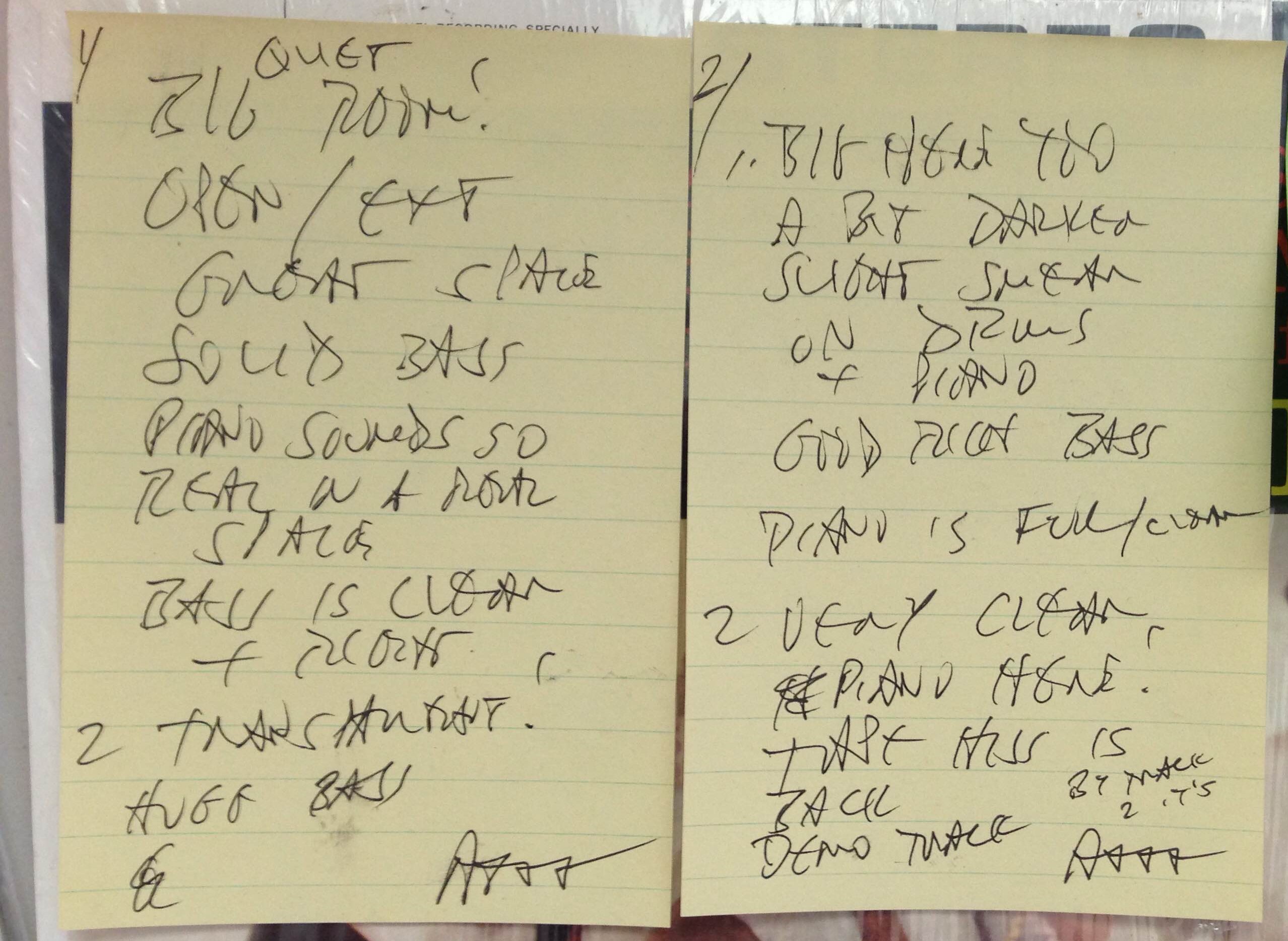
The kind of notes we take can be seen below. 4×6 Post-its work great for this purpose, using one per side. We go through thousands of them every year.

Without specific notes on your records about exactly what you heard as you played them, you cannot possibly keep track of which pressings have the qualities you were listening for, and to what degree.

Extensive notes like the ones you see below are a must. Here is what I had to say about a copy of Rubber Soul.

Other reviews with post-its can be found here.

We also make every effort to be very specific about the shortcomings of the audiophile pressings we review, which is why we started to reproduce our notes for their reviews when they are available.


(more…)

Tell Us More About “Hot Stampers”

More Straight Answers to Your Hot Stamper Questions

Many of the basic questions concerning Hot Stampers, including our grading system, 2-packs, coupons, the mailing list, as well as more general ordering and payment information, can be found in our FAQ on our website.

The links below deal specifically with the kinds of issues that potential customers, as well as skeptics and forum posters (god bless ’em!) have raised with us over the years.

We think sitting down to play a Hot Stamper pressing is the best way to appreciate its superior sound, in the same way that hearing a vintage LP played back on a top quality audio system is the best way to appreciate the superiority of analog.

If you want to skip all that and just buy a record or two in order to hear what you’ve been missing, click here.

To expand on the basics discussed above, you might want to check out some of these next:

  1. How can I find my own Hot Stamper pressings?
  2. Do I already have some Hot Stamper pressings in my collection?

(more…)

The Original Pressings of The Beatles Albums Are the Best Sounding, Right?

beatles help labelHot Stamper Pressings of the Music of The Beatles Available Now

No, they are most definitely not. At least the ones on the label you see pictured are not (with the exceptions noted below).

We think it’s just another example of mistaken audiophile thinking.

Back in 2005 we compared the MFSL pressing of Help to a British Parlophone copy of the Help album and were — mistakenly, as you may have already surmised — impressed by the MoFi. We wrote:

Mobile Fidelity did a GREAT JOB with Help!. Help! is a famously dull sounding record. I don’t know of a single original pressing that has the top end mastered properly. Mobile Fidelity restored the highs that are missing from most copies.

The source of the error in our commentary above is in this sentence, see if you can spot it:

I don’t know of a single original pressing that has the top end mastered properly.

Did you figure it out? If you’ve spent any time on this blog you did.

Original pressing?

Is that the standard?

Why? Who said so? Where is it written?

(more…)

An Extraordinary Recording of the Beethoven Septet – This Is Why You Must Do Shootouts

Hot Stamper Pressings of the Music ofBeethoven Available Now

My first note on side one is “HTF” — Hard To Fault, for the sound was both rich and sweet, with easily recognized, unerringly correct timbres for all seven of the instruments which are heard in the work. The legendary 1959 Decca Tree microphone setup had worked its magic once again.

And, as good as it was, we were surprised to discover that side two was actually even better! The sound was more spacious and more transparent; we asked ourselves, how is this even possible?

Hard to believe but side two had the sound that was TRULY Hard To Fault.

This is precisely what careful shootouts and critical listening are all about.

If you like Heavy Vinyl, what exactly is your frame of reference? How many good early pressings could you possibly own, and how were they cleaned?

Without the best pressings around to compare, Heavy Vinyl can sound fine. It’s only when you have something better that its faults come into focus. (We, of course, have something much, much better, and we like to call them Hot Stampers!)

Side One

A++, so good, yet in comparison to side two we realized that it was not as present, spacious and transparent as it SEEMED.

Side Two

A+++, White Hot!

Ah, here was the sound we didn’t know we were missing. So big and open, with space for every player, each clearly laid out across the stage. This is Hi-Fi at its best.

(more…)