Performers

Szeryng Plays the Music of Fritz Kreisler

More Recordings Featuring the Violin

  • Boasting solid Double Plus (A++) sound or BETTER throughout, this early pressing (one of only a handful of copies to ever hit the site) will be very hard to beat
  • The violin is so sweet and present, so rich, natural and real, you will forget you’re listening to a record at all
  • This recording is not your typical dry, bright, nasaly, upper-midrangy Merc – the sound is rich and smooth like a good London, with a big stage and lovely transparency
  • We are happy to report that the vinyl is reasonably quiet for a vintage Plum Label Mercury stereo pressing too, with no marks that play (something that could not be said of our Shootout Winner, alas)

(more…)

Sibelius – Violin Concerto / Heifetz / Hendl

Hot Stamper Pressings Featuring the Violin

xxx

  • Solid Double Plus (A++) or BETTER Living Stereo sonics from 1960 bring to life this fiery performance from Heifetz in his prime on this early Shaded Dog pressing
  • It’s also fairly quiet at Mint Minus Minus, a grade that even our most well-cared-for vintage classical titles have trouble playing at
  • It’s some of the best sound we have ever heard for the work, right up there with Ricci’s on Decca/London
  • The nothing-less-than-breathtaking performance by Heifetz may raise this one to the rank of ‘first among equals’ for those of you who prize immediacy and energy in your violin recordings
  • If you have one of our killer Hot Stampers of the Beethoven or Tchaikovsky violin concertos, you know exactly the sound I am talking about
  • “In the easier and looser concerto forms invented by Mendelssohn and Schumann I have not met a more original, a more masterly, and a more exhilarating work than the Sibelius violin concerto.”
  • Here is a link to more records like this one containing some of our favorite orchestral performances with top quality sound
  • 1960 was a great years for classical recordings – other Must Own Orchestral releases can be found here.

Early Shaded Dog pressings of Heifetz’s records rarely survived in audiophile playing condition. Top quality early pressings in clean condition come our way at most a few times a year, which means shootouts for them get done infrequently. There are hundreds, even thousands, of clean, vintage classical pressings sitting in our stockroom waiting for a few more copies to come our way so that we can finally do a shootout. These things cannot be rushed.

As for the sound, it’s practically impossible to find the richly textured, natural string tone offered here on anything but the vintage pressings produced in the 50s and 60s. Record making may be a lost art, but as long as we have these wonderful vintage pressings to play, it’s an art that is not being lost on us.

(more…)

Debussy & Ravel – A Tale of Two Top Copies

Hot Stamper Pressings of the Music of Claude Debussy Available Now

Hot Stamper Pressings of the Music of Maurice Ravel Available Now

In 2024 we did a shootout for this recording of quartets, LSC 2413, our first in 19 years.

For the shootout winning pressing, we wrote the following:

Juilliard String Quartet’s performance of these wonderful classical works appears on the site for only the second time ever, here with INSANELY GOOD Shootout Winning Triple Plus (A+++) grades on both sides of this original Shaded Dog pressing.

Having just played some killer copies of Death and the Maiden, we’re tempted to say that this Debussy record has the potential for even better sound — it’s richer and sweeter, but every bit as real and immediate as any chamber recording we know of.

Here are the notes for the actual record we played. Side one really blew our minds, earning a grade of at least 3+.
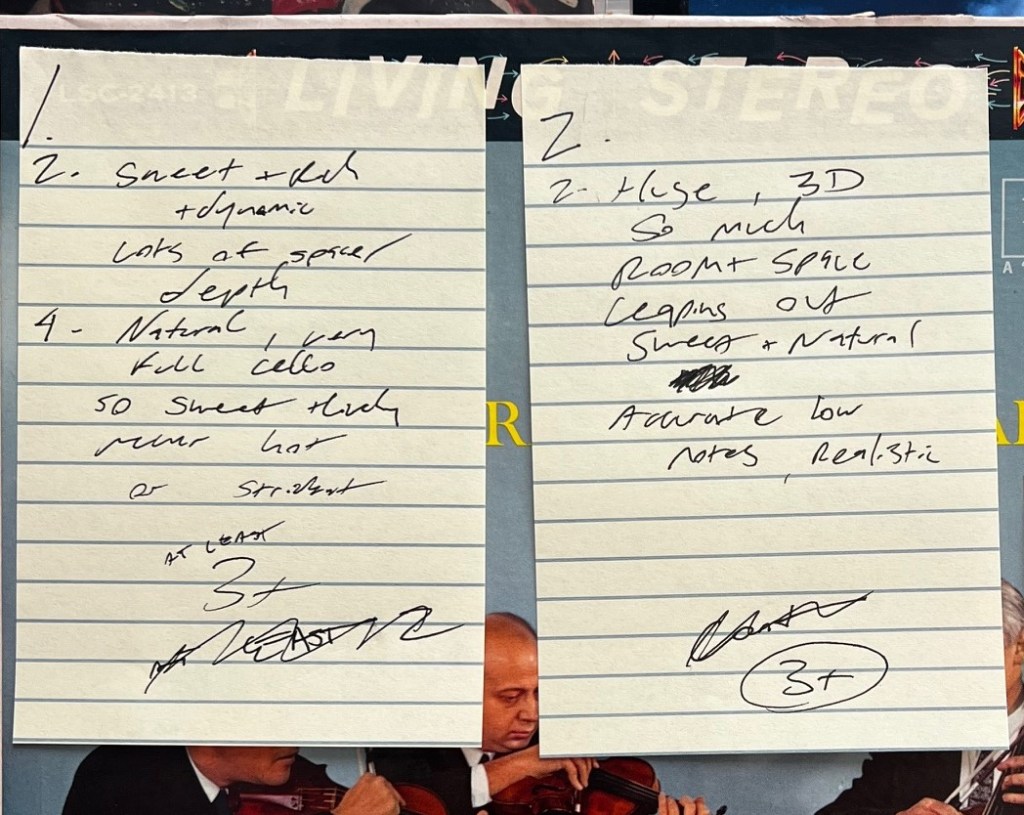
The second place finisher may not have been quite as good on side one, but it was still so good that it had no problem earning the full three pluses. It had the same stampers as the copy above by the way.

Side two however lacked the space of the very best pressings we played, and we marked it down one half plus for that shortcoming. Although it was “so tubey and 3-D” it did not have “all the space but not hot at all and natural and sweet.”

It’s very unlikely that the person who bought this copy would feel there was any problem with side two. We had two killer side two’s to play against each other back to back, and that’s about the only way these kinds of very subtle differences can be recognized, assuming you have a system that can resolve the space of the recording at an extremely high level to begin with.

The big rooms with high ceilings that systems like those require are not usually found in listening rooms that have not been custom built.

More on this wonderful record:

The Living Stereo sound here is Tubey Magical, lively and clear, with the kind of transparency that puts living, breathing musicians right in your listening room in the way that only the best vintage vinyl pressings can.

Lewis Layton engineered this recording (along with Ed Begley) and he nailed it, perfectly capturing the rich, textured sheen on the strings, the hallmark of Living Stereo sound in the 50s and 60s.

He recorded both the Schubert (LSC 2378) mentioned above and this wonderful Debussy/Ravel record for RCA in 1960 — it would be quite the understatement to say he had a gift for recordings of this kind.


Another superb recording from the 60s, brought to you by your vinyl-loving friends at Better Records.

It’s an exceptional Living Stereo all analog recording from 1960 – nothing else sounds like it.

When you’ve played as many Living Stereo titles as we have (250+ and counting), you’re bound to run into this kind of Demo Disc sound from time to time – it’s what makes record collecting fun.

It’s an amazing find, the kind of record we live for here at Better Records.

(more…)

White Dogs or Shaded Dogs on the Brahms Piano Concerto No. 2?

Hot Stamper Pressings of Living Stereo Titles Available Now

UPDATE 2024

The review you see below is quite old. We no longer agree with the statement we made back then that the White Dog pressings are better sounding than the Shaded Dogs.

In our recent shootout, the first one I can remember since 2005 — that was 20 years ago! — the White Dogs did not do nearly as well as the Shaded Dogs we played.


This White Dog pressing is the best sounding copy I’ve ever heard, much better than the earlier pressings. The piano doesn’t break up like it does on those, especially in the second movement.

Finally the piano sounds right – solid and with the correct overtones. It goes without saying that this is an exceptionally good performance as well.

One of the best of the Cliburn recordings which, as you may know, are rarely any good, the worst of them being LSC 2252 and the best of them being, probably, LSC 2507.

Seems we got some of this one wrong. Live and learn is our motto, with mea culpa running a close second.

It’s possible that our mistaken judgment about the superiority of the White Dog pressings in 2005 was mostly the result of sample sizes that were much too small. However, I was operating as a one man band back when I was doing all the classical shootouts, so my chances of getting the wrong answer were fairly high, a reality I have documented on this blog in some detail.

I also was not able to clean the records under comparison very well, a problem that has been solved — and then some — by a great many improvements in techniques, machinery and fluids over the last twenty years.

What we could do back then and what we can do now, after twenty years of constant improvement, are as different as night and day, a subject we write about quite a bit under the heading of audio progress.

I’ve also made a habit of admitting my mistakes in the hopes that other audiophile reviewers would consider following suit. To my knowledge this has yet to happen, but hope springs eternal!

(more…)

Brahms – Sonatas for Cello and Piano / Starker / Sebok

More of the music of Johannes Brahms

  • Starker and Sebok’s virtuoso performances, here with rich, dynamic, and tubey Double Plus (A++) sound throughout this original Plum Label Mercury pressing
  • Both of these sides are big, full-bodied, clean and clear, with a wonderfully present and solid piano, and plenty of 3D space around it
  • The cello is present and immediate, with sound that is remarkably textured, full and harmonically natural

(more…)

Bizet / Saint-Saens / Carmen Fantaisie / Introduction And Rondo Capriccioso / Ricci

More of the Music of Georges Bizet

  • You’ll find solid Double Plus (A++) sound throughout this early London LP
  • This is a spectacular recording, and one of the Greatest Violin Showpiece Albums of All Time
  • It is certainly a record that belongs in every right-thinking audiophile’s collection. If you’re on our site and taking the time to read this, that probably means you
  • Ruggiero Ricci is superb throughout – we know of no better performance of these works than those found on this very record
  • Some old record collectors (like me) say classical recording quality ain’t what it used to be – here’s all the proof anyone with two working ears and top quality audiophile equipment needs to make the case

Ricci’s playing of the Bizet-Sarasate Carmen Fantasie is out of this world. There is no greater performance on record, in my opinion, and few works that have as much audiophile appeal.

The Average Copy

When you play a copy of this record and hear a smeared, veiled violin, don’t be too surprised. This is not the least bit unusual, in fact it’s pretty much par for the course. The soundstage may be huge, spacious and 3-D. It is on most copies.

But what good is a record of violin showpieces if the violin doesn’t sound right?

Sides One and Two

These two sides can show you how good the violin — and the whole orchestra — can sound. They’re tonally correct from top to bottom, transparent and sweet.

These pieces are less about the “violin-in-your-lap” effect and more about the violin as an integrated member of the orchestra.

These sides had plenty of a quality that goes a long way in the world of classical music. As we went through the various copies, we noticed that the sound on the best sides was especially relaxed. (Compare that to the typical Classic Records Heavy Vinyl pressing, which, on the relaxation scale of one to ten, rates a lot closer to one than it does to ten. Between one and two, probably.)

Once you spot the relaxed copies, you find they tend to do every other thing well, and that’s what it takes to score top grades in shootouts — doing everything well.

(more…)

Now That’s the Way a Piano Should Sound!

On the best copies the rich texture of the strings is out of this world — you will have a very hard time finding a DG with better string tone.

The best pressings of this recording have none of the shortcomings of the average DG: it’s not hard, shrill, or sour.

DG made plenty of good records in the 50s and 60s, then proceeded to fall apart, like most labels did. This is one of their finest. It proves conclusively that at one time — 1962 to be exact — they clearly knew exactly what they were doing.

Without question this is a phenomenal piano recording in every way.

I don’t know of another recording of the work that gets the sound of the piano better. On the better copies, the percussive quality of the instrument really comes through.

It’s amazing how many piano recordings have poorly-miked pianos.

These bad sounding pianos are either too distant, lack proper reproduction of the lower registers, or somehow smear the pounding of the keys into a blurry mess.

Are they badly recorded?

Or perhaps it is a mastering issue?

Maybe a pressing issue?

To be honest, it’s probably all three.

Lately we have been writing quite a bit about how good pianos are for testing your system, room, tweaks, electricity and all the rest, not to mention turntable setup and adjustment.

  • We like our pianos to sound natural (however one chooses to define the term)
  • We like them to be solidly weighted
  • We like them to be free of smear, a quality that is rarely mentioned in the audiophile reviews we read

Other records that we have found to be good for testing and improving your playback can be found here.

(more…)

Skip the Living Stereo of Rachmaninoff’s Piano Concerto No. 2 with Cliburn

Hot Stamper Pressings of Living Stereo Recordings Available Now

We recently dropped the needle on a copy of LSC 2601 — the first one we’ve played in years — and found a great deal to fault in the sound. Our copy with 3s/3s stampers was awful sounding.

Rachmaninoff’s Piano Concerto No. 2 is a wonderful piano concerto, one that belongs in any serious record collection, but the sound on the pressing we played was definitely not up to our standards.

The piano was cranky, the overall sound a dry mess overall. It just sounded much too much like an old record.

A Shaded Dog pressing such as this might be passable on an old school audio system, but it was too unpleasant to be played on the high quality (mostly) modern equipment we use.

There are quite a number of other vintage classical releases that we’ve run into over the years with similar shortcomings. For fans of vintage Living Stereo pressings, here are some to avoid.

(more…)

Van Cliburn’s Live Rachmaninoff Piano Concerto No. 3 Can Be Very Good But…

Hot Stamper Pressings of the Music of Rachmaninoff Available Now
The Shaded Dog pressings of Van Cliburn’s live performance of Rachmaninoff’s Piano Concerto No. 3 (LSC 2355) we’ve played recently tend to have very good sound.

The problem is that the famous Byron Janis recording of the work for Mercury (SR 90283) has the potential for amazingly good sound.

For a recent shootout winning copy, we had this to say:

The sound is rich and natural, with lovely transparency and virtually no smear to the strings, horns or piano. What an amazing recording! What an amazing piece of music.

The recording is explosively dynamic and on this copy, the sound was positively jumping out of the speakers. In addition, the brass and strings are full-bodied, with practically no stridency, an unusual feat the Mercury engineers seem to have accomplished while in Russia.

Big, rich sound can sometimes present problems for piano recordings. You want to hear the percussive qualities of the instrument, but few copies pull off that trick without sounding thin. This one showed us a piano that was both clear and full-bodied.

With huge amounts of hall space, weight and energy, this is Demo Disco quality sound by any standard. Once the needle has dropped you will quickly forget about the sound (and all the money you paid to get it) and simply find yourself in the presence of some of the greatest musicians of their generation, captured on the greatest analog recordings of all time.

The RCA recording, good as it is, is simply not in the same league as the better pressings of the Mercury.

For that reason we do not feel the need to offer any copies of the Living Stereo record to our customers.

(more…)

Mozart – Sinfonia Concertante / Duo in G Major / Oistrakh

More of the Music of Mozart

  • These sublime works for violin and viola debut on the site with INSANELY GOOD Shootout Winning Triple Plus (A+++) grades throughout this vintage London pressing
  • Here are just a few of the things we had to say about this amazing copy in our notes: “sweet and transparent and dynamic violin”…”lively and lush and tubey”…”very roomy and 3D”…”great texture”
  • These sides are doing everything right – they’re rich, clear, undistorted, open, spacious, and have depth and transparency to rival the best recordings you may have heard
  • The texture and harmonic overtones of the strings are perfection – as we listened we became completely immersed in the music on the record, transfixed by the remarkable virtuosity father and son bring to the piecesFor those of you who keep track of such things, we would like to point out that no Decca pressing did better than “good” in our shootout
  • The early London pressings are the only ones we played with the sonic goods befitting such an extraordinary recording, a reality that many audiophiles would do well to wrap their heads around

(more…)