
Month: July 2025

The Who – Who Are You

More of the Music of The Who

  • With solid Double Plus (A++) grades on both sides, this vintage UK import is doing just about everything right – exceptionally quiet vinyl too
  • This copy has the Glyn Johns big, bold sound we’ve come to expect from this famous producer/engineer
  • Forget the domestic pressings, forget the DD Labs Half-Speed, forget whatever lame reissues have come or will come down the pike – if you want to hear this album right, a Hot Stamper British pressing is the only way to go
  • The title song sounds great on this outstanding copy – the dynamic power of the recording comes through loud and clear
  • If you’re a fan of The Who, and what audiophile wouldn’t be?, this album from 1978 belongs in your collection

Big, tubey and rockin’, this copy has The Who sound we know from Who’s Next so well. Huge and spacious, with lovely three-dimensional depth, the sound has that patented “live in the studio” quality that Johns’s practically trademarked. Breathy vocals and great life and presence to every instrument — this is the way to hear it!

This copy has the Glyn Johns Who sound we’ve come to expect from one of the most famous producer/artist collaborations in the history of rock music. (I would argue Johns’s work with the Stones is even more legendary.)

This is certainly not the equal of the beyond brilliant Who’s Next — what is? It’s an undisputed Masterpiece — but the best songs here are certainly in that league. The title track is one I used to demo my system with twenty years ago and, with a copy like this, would be happy to again.

(more…)

I Couldn’t Learn Much Until I Figured Out How to Train My Ears

Developing Your Critical Listening Skills Is Key to Finding Better Records

It’s amazing how far you can get in this hobby if you’re obsessive enough and driven enough.

To achieve real success you must be willing to devote huge amounts of time, money and effort to the pursuit of better home audio.

You will really go far if you’re willing to let your ears, not your brain, inform your understanding and appreciation of the sound of the various pressings you play.

If we thought like most audiophiles — that money buys good sound and original pressings are usually the best — we would currently be very unlikely to have a business selling a million dollars or more worth of Hot Stampers every year.

Conventional thinking and wrong-headed thinking would have prevented us from achieving the progress we’ve made over the last twenty years, and they will surely impede your progress too.

(Be sure to avoid these kinds of records while you are at it. They’re nothing but a dead end.)

However, if you choose to follow our approach, you are very likely to be amazed at the positive changes that will come your way.

Training Your Ears

Of course, we should note that it helps to have a dedicated full-time staff doing shootouts, including a full-time record cleaning person. All of the members of the listening panel were musicians with already well-trained ears when we hired them. From the start they had no trouble appreciating the differences between pressings.

I, on the other hand, am not a musician. Over the years I simply tried to get my stereo to sound more like live music. As it improved over the years, it allowed me to hear more and more of what was really on my records. I slowly gained the skills I needed to do the kind of critical listening comparisons that are currently the heart of our business. Let me be the first to admit it was slow going for about the first twenty years.

It has been my experience that most audiophiles are in that same non-musician boat. The problem seems to be that stereos are not nearly as good at teaching these skills as musical instruments are.

Unless you are of an experimental mind and are willing to devote a great deal of your time and money to the audio game, you are unlikely to develop the skills necessary to critically evaluate recordings at the highest level.

Unfortunately, playing into this vicious cycle, those same critical listening skills are the very ones you need to make your stereo revealing enough so that even subtle differences between pressings become not just clear, but obvious.

Better ears lead to better stereos, but bad stereos make it hard to develop better ears.

That’s why I made so many mistakes and learned so little in my first twenty years as an audiophile.

Although we make plenty of mistakes, we think of ourselves as experts when it comes to evaluating the sound of records and stereo equipment. (Experts make mistakes, they just make fewer of them.)

But the practical consequences of these findings are that few audiophiles can ever hope to acquire expert critical listening skills. It takes too much time and it takes too much work. Most people are in this hobby for fun. They already have a job. They don’t need another one.

Perhaps there’s another, better way to look at it. Most people are not going to become scratch golfers, but they can still get better at the game. There is a balance to be achieved between working hard to improve your skills and having fun at the same time.

(more…)

Neil Young – Harvest Moon

More of the Music of Neil Young

  • With solid Double Plus (A++) grades from top to bottom, this vintage import pressing is doing just about everything right – remarkably quiet vinyl too
  • Full-bodied, big, rich and solid, this album has the kind of analog sound we did not expect to find, but were pleasantly surprised, thank goodness
  • Turn this one up good and loud (which you can do when the sound is this good) and you’ll have a living, breathing Neil Young standing right in front of you
  • Problems in the vinyl are sometimes the nature of the beast with these vintage LPs – there simply is no way around them if the superior sound of vintage analog is important to you
  • “Harvest Moon manages to be sentimental without being sappy, wistful without being nostalgic… a beautiful album that proudly displays scars, heartaches, and love.”

(more…)

Houses of the Holy on Classic Records Heavy Vinyl

We can describe the sound of this miserable Bernie Grundman remaster in two words: ridiculously bright.

Honestly, what more do you need to know? It’s almost as bad as the Zep II he cut, and that record is an abomination.

Is it the worst version of the album ever made? Hard to imagine it would have much competition.

(Oh but it does – this misbegotten series out of Japan will do nicely to illustrate how brighter is not necessarily better, it’s just brighter.)

Over the years we have done many Led Zeppelin shootouts, often including the Classic Heavy Vinyl pressings for comparison purposes. After all, these Classic LPs are what many — perhaps most — audiophiles consider superior to other pressings.

We sure don’t, but everybody else seems to. You will find very few critics of the Classic Zeps LPs outside of those who write for this blog, and even we used to recommend three of the Zep titles on Classic: Led Zeppelin I, IV and Presence.

Wrong on all counts.

We don’t actually like any of them now, although the first album is still by far the best of the bunch.

(more…)

For Your Pleasure Is That and a Lot More

Robert Brook runs a blog called The Broken Record, with a subtitle explaining that the aim of his blog is to serve as:
A GUIDE FOR THE DEDICATED ANALOG AUDIOPHILE

FOR YOUR PLEASURE is THAT and MORE

In 1975, after reading a rave review for Siren, their fifth album in Rolling Stone, I took the plunge, bought a copy at my local Tower Records and instantly fell in love with it. I was 21 at the time and that album completely knocked me out. I had never heard anything like it. I knew nothing about the band or their style of music, now known as Art Rock, but it quickly became my favorite genre, and still is.

Naturally I proceeded to work my way through their earlier catalog, which was quite an adventure. It takes scores of plays to understand where the band is coming from on the early albums and what it is they’re trying to accomplish. I spent years trying to get into For Your Pleasure (the lesser of the two albums with Eno in the band), but eventually I wrapped my head around it and learned to enjoy what it has to offer.

The first three albums are by far the band’s best sounding.

Now I listen to each of the first five releases on a regular basis, as well as Avalon, Viva! Roxy Music, a few later albums and many of the Ferry solo releases. It’s probably true that I play Roxy Music and Roxy Music-adjacent albums more than those of any other band. That might have something to do with the fact that even after more than fifty years, this band’s music never seems to get old.

Robert is correct when he points out that Roxy’s early work does not seem to find much favor with the record buying public these days, not even with audiophiles who, one would think, would be attracted to the phenomenal recording quality of the early albums.

As a lifelong fan I have put Better Records’ substantial resources to work in order to find, clean and play as many Roxy Music albums as we can find willing buyers for. There turn out to be fewer buyers than I would have liked, to be sure, but enough to keep their albums on the site and potentially create some new fans, which should be a lot easier now that we know which are the best sounding pressings for all their albums.

(more…)

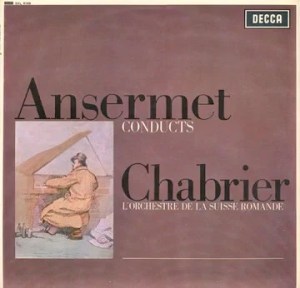
Chabrier / Orchestral Music – Ansermet (Decca)

More of the Music of Emmanual Chabrier

  • This superb Chabrier album containing one of our two favorite performances of the España Rhapsody boasts INCREDIBLE Shootout Winning Triple Plus (A+++) sound on side two mated with outstanding Double Plus (A++) sound on side one
  • This spectacular Demo Disc recording is big, clear, rich, dynamic, transparent and energetic – HERE is the sound we love
  • All the energy and power of Chabrier’s remarkable orchestration, thanks to the brilliant engineering of Roy Wallace
  • Ansermet’s Chabrier disc has long been a favorite of ours here at Better Records – this copy will show you why

If you want a classical record to TEST your system, if you want a classical record to DEMO your system, you will have a hard time finding a better pressing than this very copy.

Who can resist these sublime orchestral works? To quote an infamous (around here) label, they are an audiophile’s dream come true.

So clear and clean, and spread out on such a huge stage, either one or both of these sides will serve you well as your go-to reference disc for Orchestral Reproduction.

Listen for the waves of sound in Espana — only the best copies bring out the energy and power of Chabrier’s remarkable orchestration.

(more…)

Face Value with Hugh Padgham’s Big Drum Sound

Hot Stamper Pressings of the Music of Phil Collins Available Now

There may be some hope for Hello, I Must Be Going! (1982), but Phil’s third album, 1985’s No Jacket Required, sounds digital and way too heavily processed.

I suppose not many albums from 1985 weren’t, but it’s still an unfortunate development for us audiophile types who might’ve wanted to enjoy these albums but are just not able to get past the ridiculously bad sound. (If we ever do a listing for it, you can be sure it will go right into our hall of shame.)

The recording of Face Value is still analog and the quality is excellent, thanks to hugely talented engineer and producer Hugh Padgham (Peter Gabriel, Genesis, The Police, Yes, Emerson, Lake & Palmer, etc.)

On the best copies, the sound is nothing short of superb.

Check out Phil’s take on Tomorrow Never Knows for some heavily reverbed vocal effects, complete with a slew of backwards psychedelic sounds. If anybody can play the weirdly syncopated rhythms of TNK, it’s Phil Collins.

Whomp!

Until we heard some of the better copies, we were never able to appreciate just how important bass definition and weight are to the sound of this record. When the bass is wooly or thin, as it is on so many copies — not clear, not deep, not full enough — it throws the rest of the mix off.

When the bass is huge and powerful, the music itself becomes huge and powerful.

The copies with the big bottom end are the only ones that really make you sit up and take notice of just how big the sound is. The best Hot Stamper pressings will be Demo Discs for bass on big speakers at loud levels. Here are some others you may enjoy reading about.

After moving into our new custom-built studio and spending a few months optimizing the room treatments, we now have even more transparency in the mids and highs, while improving the whomp factor (the formula goes like this: deep bass + mid bass + speed + dynamics + energy = whomp) at the listening position.

There’s always tons of bass being produced when you have three 12′ woofers firing away, but getting the bass out of the corners and into the center of the room is one of the toughest tricks in all of audio.

Transparency Is Key

Phil’s lead and harmony vocals are both breathy and present on the best copies, with natural, not hyped-up, texture, and harmonics. This is especially important for the love songs.

The many ballads on the album — This Must Be Love and If Leaving Me Is Easy are two of our favorites — don’t work unless the sound is intimate and immediate.

Only the best pressings have the high-resolution, full-bodied sound that allows both the rockers and the ballads to sound their best.

If you’re a fan of big drums in a big room, with jump out of the speakers sound, this is the album for you.

(more…)

Handel / Water Music – Leppard

More of the Music of George Frederick Handel

  • An original Philips import pressing with KILLER Shootout Winning Triple Plus (A+++) sound or close to it from first note to last – exceptionally quiet vinyl too
  • This copy was simply bigger, more transparent, with more clarity and clearly layered depth to the orchestra than practically all others copies we played
  • Shockingly airy and warm, this is the kind of sound that makes it easy to fall in love with an oft-heard piece such as The Water Music
  • Note how far back the trumpets are in the hall, yet they are still clear, tonally correct and not smeared – that’s the sound one hears in a live performance (and too rarely on a record)
  • This is close to the best combination of performance and sound that we know of, and let me tell you, we’ve played an awful lot of pressing of this music over the last thirty years, none of which do what the better pressings of this recording can do
  • This recording should be part of any serious classical music collection. Others that belong in that category can be found here.
  • There are about 150 orchestral recordings we’ve found to offer the best performances with the finest in audiophile sound, and this record certainly deserve a place on that list.

The performance by the English Chamber Orchestra under the direction of Raymond Leppard is currently my favorite, owing in large part to the fact that it has the kind of sound I find the most natural and enjoyable.

In a way this may not be quite fair to other equally well-known, well-respected performances. We went through an elimination round for the work a while back, winnowing the recordings down to those that had the best sound, regardless of performance — perhaps some of the discarded records had even better performances than Leppard’s. At this late stage who can say?

We audiophiles want the music we play to sound its best, a requirement which more often than not involves compromises of one kind or another. We are happy to report that that does not appear to be the case with The Water Music (keeping in mind the caveat above). (more…)

English Settlement – A Sonic Tour de Force

More of the Music of XTC

This is an AMAZINGLY well-recorded album, with huge amounts of open studio space and that Tubey Magical, rich, fat, dense British Rock Sound. That sound isn’t easy to reproduce, but this copy absolutely nails it. Nothing else in our shootout came close to it!

If you have big speakers and the room to play them, this is quite the sonic tour de force. Credit Hugh Padgham, producer and engineer, who’s worked with the likes of Peter Gabriel, Genesis, The Police, Yes and Emerson, Lake and Palmer. Those bands make the kind of music that make good use of Padgham trademark sound: wall-to-wall, deep, layered, smooth, rich and stuffed to the gills. XTC with Padgham’s help have here produced a real steamroller of an album in English Settlement.

The big hit on this album is one that most audiophiles will probably know: Senses Working Overtime. Even over the radio you can hear how dense the production is. Imagine what it sounds like on an original British pressing with Hot Stampers, played on a modern audiophile rig. We can tell you: IT ROCKS. (more…)

Professional Record Cleaning Using Two Machines, Powerful Enzymes and Plenty of Elbow Grease

Proper Record Cleaning Can Help You Find Your Own Hot Stamper Pressings

Many of our customers have asked us about our cleaning regimen.

Well, we’ve finally sat ourselves down and wrote out the bulk of it, with only one step not included for the simple reason that by itself it is responsible for a sonic improvement of roughly half a plus, sometimes more. It is a fact, reported by a great many of our customers, that Hot Stamper pressings almost always sound better than other copies even when they share the exact same stamper numbers.

Our approach has been refined many times over the last twenty-five years. At some point we had to admit that nothing we did differently made any difference to the sound quality of the records we had cleaned, so we stopped experimenting.

The instructions below detail the methods, fluids and hardware we have been using to clean the records that go in our shootouts since 2010 or so. (For an extensive list of tips and tricks you may find useful, click here.)

You will need two machines, one for scrubbing and rinsing, using the various fluids we recommend, and another machine with a vacuum arm (threaded or unthreaded) to remove the fluids from the record.

As for the second vacuum machine, we have an Odyssey brand machine (no longer made), but Keith Monks was making a similar machine in the 70s — I know because in 1976 I paid to have my fifty favorite records cleaned on one. (Someday I will post a picture of the customer KMAL sleeve they put the cleaned record in, with a number of boxes, 25?, to be checked off each time the record was played, so that you would know when the record would need to be cleaned again.)

There are a number of Keith Monks machines made for the consumer market which we may have to buy one day when our current Odyssey gives up the ghost. (We have gone through two and have another one headed our way. It’s been money well spent; it would be hard to imagine the business running without these machines or others of the same design. The sound of every record cleaned on this kind of machine is improved, even when just cleaned with water!)

(more…)