1971-all

How Do the The Mastering Lab Pressings of Sticky Fingers Sound?

Hot Stamper Pressing of the Music of The Rolling Stones Available Now

A listing for an early domestic Hot Stamper pressing for Sticky Fingers will typically be introduced like this:

If you have never heard one of our Hot Stamper pressings of the album, you (probably) cannot begin to appreciate just how amazing the sound is.

A landmark Glyn Johns / Andy Johns recording, our favorite by the Stones, a Top 100 Title (of course) and 5 stars on Allmusic (ditto).

After hearing so much buzz about it, we finally broke down and ordered a German TML pressing about a year ago. Having played scores of phenomenally good sounding copies of the album over the past fifteen or so years, we were very skeptical that anyone could cut the record better than the mastering engineers who inscribed Rolling Stones Records into the dead wax on the early pressings. (I could find no mastering engineers credited.)

Well, the results were not good. As we suspected would be the case, we were not impressed in the least with what The Mastering Lab — one of the greatest independent cutting houses of all time, mind you — had wrought.

Their version is not really even good enough to charge money for. It might have earned a grade of One Plus, just under the threshold for a Hot Stamper that we would put on the site these days. Decent, but not much more than that.

Wait, There’s More

We subsequently learned that it is the British TML pressings that are supposed to be the best.

So we got one of those in, an A3/B4 copy.

Better, but good enough? Barely.

Here are the notes for the copy we played. For those who have trouble reading our writing, I have transcribed the notes as follows:

Side One

Track one:

Weighty, a bit veiled or smeary. Backing vox kinda lost.

Track three:

Very full, rockin’ but not the sparkle/space.

Kinda compressed.

Not as huge.

Side Two

Track two:

Not as rich, clear.

A bit pushy/dry vox.

No real space.

Thick drums

Track one:

This works better.

A bit hard, but full and lively.

This Sound?

Is this the sound audiophiles are raving about?

(more…)

Your Shootout Questions Answered – Part One

Hot Stamper Pressing of the Music of The Rolling Stones Available Now

Robert Brook wrote to me recently with some questions.

Hi Tom,

I read your recent post about Sticky Fingers and the European TML reissues you included in shootouts.

It raised a question for me that I’ve been wanting to ask you for a while now.

The fact that the UK TML earned an A+ to A++ grade and that, with just a one copy sample, you wouldn’t consider that pressing to have shootout winning potential, suggests to me that the US pressings you favor will grade at A++ or higher.

In other words, if you put a shootout together of [redacted stamper] pressings and whatever else you like, does every copy in the shootout grade at least A++ / A++? Are the right stampers that reliable?

I guess I’ve always assumed that even if you put together a shootout with this or any other title, and even if you only include pressings that have won or placed high in the past, at least a couple of them would end up graded no higher than A+ or A+ to A++.

And if that is correct, wouldn’t it be worth buying more UK TML’s to see if any emerge that could win a shootout?

With Revolver, for instance, why not just do shootouts with [redacted numbers] if those are the ones that win the shootouts? Why even bother with [later pressings]?

Robert,

All good questions! I could go on for days with this kind of inside baseball stuff. I’ve been living it full time for more than twenty years, and it obviously interests you because you are actually trying to hone your shootout skills and figure out how many of what pressings you need to get one going, etc., etc.

Not many others are doing what you are doing in a serious way, so how helpful anyone will find this information is hard to know. Under the circumstances, I should have kept my answers shorter rather than longer but I could not resist going into more detail than might have been advisable. Feel free to skim if you like.

Why not put more TML pressings into shootouts?

If they had pressed plenty of them and they’d ended up sitting in record bins all over town for twenty bucks a pop, we could get a bunch in and see if we could figure which stampers, if any, are able to reach the Super Hot stamper level.

(more…)

“KEV” Didn’t Have a Clue How to Master Teaser and the Firecat

Hot Stamper Pressings of the Music of Cat Stevens Available Now

In 2025, in preparation for a new shootout, we ordered a copy of Teaser from overseas that supposedly had the right stampers — we know what they are and we are only interested in copies with the right ones — and were sent this “KEV” pressing by accident.

Accident is right — whoever KEV is, he sure has no business mastering records if the one we played is anything to go by.

Discogs has an entry for it, current price around $10. (Apparently the word got out about the sound of this miserable pressing.)

  • This release is the pink ring Island Label. No Sterling etchings. (KEV) in matrix.
  • Side 1 has 9514 hashed out and 9154 etched above
  • Matrix / Runout (A-side runout. etched): ILPS 9154A-1K 1 KEV B
  • Matrix / Runout (B-side runout. etched): ILPS 9154B-1K 1 KEV B

Our notes read:

  • Loud, congested and hot.
  • Big, wonky bass.
  • Opaque and so compressed that it pumps.

And the best line of all:

  • Not too different sounding from the 2021 remaster that’s on Spotify. (!)

I looked up that 2021 release, mastered at Abbey Road Studios, and it appears they remixed it for some reason, as those who work at Abbey Road are wont to do, the result of which seems to be one disaster after another.

(more…)

What Track Here Would Be Right at Home on David Crosby’s First Album?

Hot Stamper Pressings of the Music of Graham Nash Available Now

Our last shootout for this album took place in 2021. I wish we could keep the record in stock but finding the right stampers these days is not easy.

Still, as a favorite album of mine, I listen to the album regularly, just not on vinyl. Both the standard CD and the cassette I have sound right to me, sounding very much like the original record.

Recently I was playing the album and heard a song that sounded an awful lot like it might have been produced by the same team that recorded David Crosby’s first album, If Only I Could Remember My Name.

If you’re up for it, listen to the Crosby, then play the Nash and see if you can spot it. Feel free to leave your impressions in the comments section below.

Digging Deeper

Songs for Beginners is one of those albums that made me want to dig deeper into audio. After every improvement I managed to make to the system, Songs for Beginners would be one of the records that I would play (at very high volume) to see what changes I had brought about.

All the best changes — the ones I kept — always made the album sound better than I had last heard it. Over the course of decades the sound became amazingly good, a true Demo Disc that belonged in the company of Tea for the Tillerman or Dark Side of the Moon.

Back in the 70s and the 80s, not so much later as I had found plenty of other tough test discs by then, it helped me dramatically improve the playback quality of my system, which, to be honest, had a very long way to go, although I sure didn’t know that at the time. I thought it sounded great.

Early on in the history of our track by track breakdowns, written in order to aid listeners in testing their stereos and the other copies of the record they might own, we did a breakdown for the album which you can read here.

If you can’t find a nice original, whatever you do, don’t buy the awful Classic Records pressing of the album. They ruined it.

(more…)

Letter of the Week – “The extra deep bass and dynamics to the drums on Who’s Next vs my new one was particularly eye opening!”

Hot Stamper Pressings of the Music of The Who Available Now

One of our good customers had this to say about a Hot Stamper copy of Who’s Next he bought a while back:

Tom,

Meeting Robert [Robert Brook] has energized me to upgrade my vinyl rig to a MC with a nicer table. (Currently I use a VPI Traveler with Clearaudio Artist v2).  Robert also showed me how my supposedly fancy new 180g “audiophile” pressings can often be used to wipe the floor by vintage pressings. 

The extra deep bass and dynamics to the drums on his copy of Who’s Next vs my new one was particularly eye opening!

Robert Brook does indeed have some good records to play on his much better sounding rig. His blog is definitely worth reading on that score. Here is a link.

I’ve purchased a VPI Classic 3se with the 3d arm, and I’m led to believe that the Dynavector is a great match for it.  A friend of a friend has this exact set up and is very happy with it. Robert says you also use a Dynavector for your record shootouts.

Yes, the 17dx is at the heart of our system’s accuracy. Most cartridges would have put us out of business long ago with their wacky EQ, the opposite of what we need to do out job. We talked about it here.

Thanks for your letter,

(more…)

Jump Into the Fire with Harry Nilsson

Hot Stamper Pressings of the Music of Harry Nilsson Available Now

This commentary was written more than ten years ago.


Jump Into The Fire is one of the best tests we use for side two.

Copies that are too smooth make the “just bass and drums” intro sound thick and smeared.

Too bright and the vocals will tear your head off.

The “just right” copies rock from the start and never get too far out of control, even when Harry does. The best we can hope for is that the loudest vocal parts stay tolerable. Believe me, it is not that easy to find a copy that’s listenable all the way through, not at the high volume I play the record at anyway!

Again, with Nilsson screaming at the top of his lungs, you better have a good copy to get through this track, and even then it’s a bit of a problem.

A tough test for the old stereo, that’s for sure. Make sure your equipment is tuned up and the electricity is good before you get anywhere near a pressing of this album.

Big production pop like this is hard to pull off. Harry did an amazing job, but the recording is not perfect judging by the dozen or so copies I played this week and the scores I’ve suffered through before.

Let’s face it: Jump Into The Fire will never be smooth and sweet; neither will Down on side one. But other tracks on this album have Demo Disc quality sound, and, of course, the music is to die for.

Side One

Gotta Get Up

A tough one right off the bat. If you have an aggressive sounding copy, you’ll know it pretty quick!

Driving Along (more…)

Artisan Let Us Down on These Early Green Label Pressings

Hot Stamper Pressings of the Music of James Taylor Available Now

Our most recent Shootout Winner was a very special copy indeed:

A wonderful copy of JT’s classic followup to Sweet Baby James with KILLER Shootout Winning Triple Plus (A+++) grades or close to them on both sides.

This early Green Label pressing demonstrates the Tubey Magical midrange that modern records almost never reproduce. The sound of most of the tracks on the better pressings is raw, real and exceptionally unprocessed.

The only pressings we put in shootouts these days are cut at Artisan, on transistor equipment we should note, but the kind of transistor gear that, to the best of our knowledge, no longer exists — the kind that transforms the Tubey Magic found on the tape into Tubey Magical grooves on the record.

Bernie Grundman used to have equipment like that back in 1971. The evidence is there for all to hear on records like this one. Oddly enough the two titles have remarkably similiar qualities.

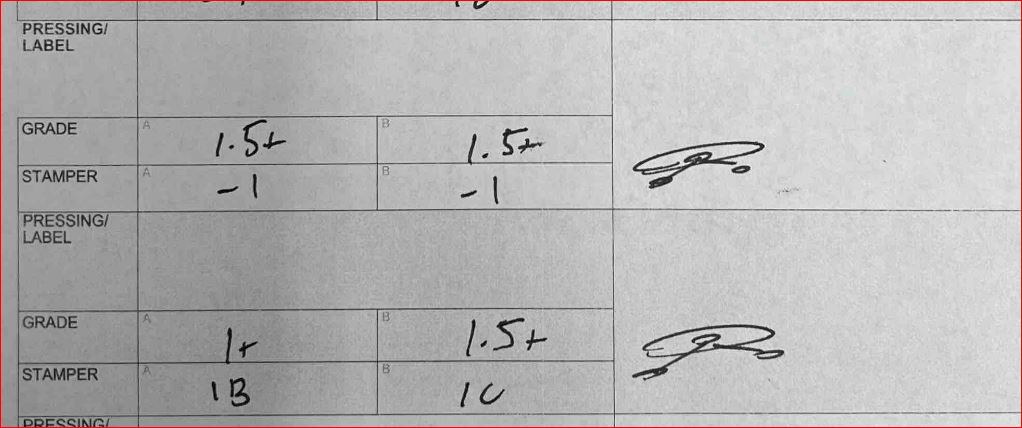
But not all Artisan cuttings are equal, as our stamper sheet from the shootout makes clear.

-1/-1 earned 1.5+ Hot Stamper grades, which means the sound is good, not great.

1.5+ is four grades down from the top copy. That’s a steep dropoff as far as we’re concerned. 1.5+ only hints at how good a recording Mudslide Slim can be on the best vintage Green Label Artisan-cut pressings. (For those who might be interested, there’s more on our grading scale here.)

1B/1C, the worst pressing from our shootout, is what we would consider passable. It’s not a bad sounding record, but it’s not good enough to qualify as a Hot Stamper.

The world is full of records that sound like the 1B/1C cutting of Mud Slide.

(more…)

Just Say No to The Yes Album on Rhino

Hot Stamper Pressings of the Music of Yes Available Now

You can find this one in our audiophile record hall of shame, along with almost 300 others that, in our opinion, make a mockery of the term “audiophile record.”

Is it the worst version ever?

Hard to imagine it would have much competition. The CD I own is dramatically better sounding, and it can probably be had for ten bucks or less. (Make sure Joe Gastwirt had nothing to do with whatever version you buy. His stuff is usually no-noised garbage.)

That notorious hack Ron McMaster strikes again.

Rhino Records bills their releases as pressed on “180 gram High Performance Vinyl.” However, if they are using performance to refer to sound quality, we have found the performance of their vinyl to be quite low, lower than the average copy one might stumble upon in the used record bins.

The CD versions of most of the LP titles they released early on are far better sounding than the lifeless, flat, pinched, so-called audiophile pressings they produced starting around 2000.

The mastering engineer for this junk title actually has the nerve to feature his name in the ads for the records. He should be run out of town, not promoted as a keeper of the faith and defender of the virtues of “vinyl.” If this is what vinyl sounds like I’d would have switched to CD years ago.

And the amazing thing is, as bad as these records are, there are people who like them. I’ve read postings on the internet from people who say the sound on these records is just fine. It’s sad.

Their Grateful Dead titles sound as bad as the cheapest Super Saver reissue copies I have ever heard. And those are terrible!

(more…)

Do The Original Domestic KC Pressings Always Beat the Later PC LPs?

Hot Stamper Pressings of Psychedelic Rock Recordings Available Now

Here is our description for the Super Hot (2+) copy that is currently on the site:

One of the most important records in my growth as an audiophile from 1971 to the present – my stereo was forced to evolve in order to play this kind of big production rock at the loud levels that the album needs in order to work its magic.

No matter how many times you play it, you will most likely hear – or at least gain more of an appreciation for – something new in the exceptionally dense, sophisticated soundfield Chris Kimsey creates for these songs.

And each time you make an improvement in the quality of your playback, this is the album that will show you exactly what you have just accomplished.


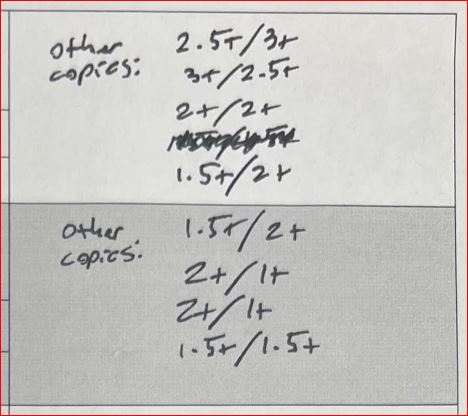
Overall, the best performers in our most recent shootout were UK pressings. They ranged in sound from the 3/3 Shootout Winning pressing (not shown) to the lowest graded British copy which earned grades of 1.5+/2+ (at the bottom of the top box).
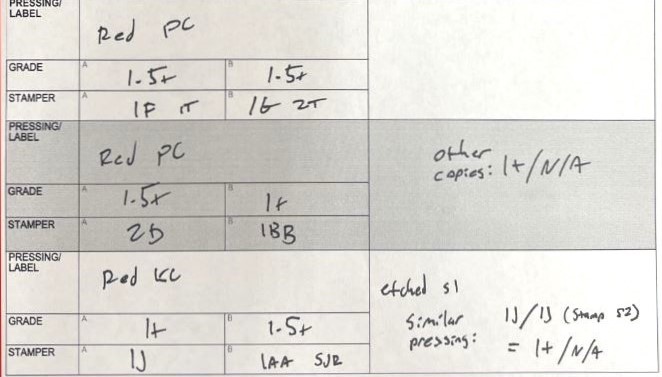
On the left is a portion of the breakdown, minus the actual stamper numbers that earned the highest grades (for obvious reasons.)

We had six UK pressings, all with the same stampers — the five you see graded and the one hidden to the left that actually won the shootout. (Three sides earned White Hot Stamper grades, an unusual outcome and a good one for the bottom line.)

Note that with the “right stampers” you could have ended up with an incredible Demo Disc (copy #1) or just a very good sounding copy on side two mated to a passable side one (copy #6).

Finding six clean UK pressings is, as you can well imagine, neither cheap nor easy. We probably bought close to twice that many to end up with six that we’re in something close to audiophile playing condition.

As you can see from the grades, two of them were clearly inferior to the other four. In the case of this title, a small sample size could have been very misleading. Fortunately for us, we spent the money and the time it takes to track down a good-sized batch of UK pressings in order to avoid that possibility.

Next come the better domestic pressings. There was a 2+/2+ that outscored all the other domestic pressings, and four others that came in behind it, all with the same stampers.

Of the five copies that had those stampers, two had side two’s that scored sub-Hot Stamper grades, which marked them as unsaleable. (Perhaps we will offer them as one-sided records since their side one’s are so good.)

KC VS PC

We rarely have good luck with PC reissue copies when the originals come with the KC prefix, rarely meaning we find a PC winner maybe once out of every ten titles we play.

(more…)

Monk’s Music on Riverside 9242 Didn’t Make the Grade

Hot Stamper Pressings of the Music of Thelonious Monk Available Now

The Riverside 9242 pressing of Monk’s Music we played recently was very much not to our liking.

In fact, every copy of this record we have ever played sounded terrible. The early pressings sounded bad and the OJC sounded bad.

We give up. We’re cutting our losses. We love Monk, but why on earth would we keep throwing money down this rathole? Our notes for this copy read:

  • Dry (more records with dry sound can be found here), and
  • Bright (more records with bright sound can be found here),
  • Overall grade: No Good

Some reviewers of the audiophile persuasion prefer to review only records that sound good to them and ignore the rest. We think this does the audiophile community a disservice.

Like Consumer Reports, we like to test things. They test toasters, we test records. We put them through their paces and let the chips fall where they may.

They want to find out if the things they are testing offer the consumer good quality and value.

We want to find out if the records we are testing offer the audiophile good sound and music.

It takes a dedicated group of people and a healthy budget to carry out these kinds of tests in large numbers.

No other record dealers, record reviewers or record collectors could possibly have auditioned more than a small fraction of the records that we’ve played. We’ve been looking for the best sounding pressings of the recordings that have stood the test of time for decades. Now, with a staff of ten or more, we can buy, clean and play records at a scale that would be unimaginable for any single person to attempt.

That puts us in a unique position to help audiophiles looking for the highest quality pressings.

Yes, we have the resources, the staff and the budget. More importantly, we came up with a much scientifically reliable approach.

(more…)