
1.5+

The Heavy Vinyl as well as the vintage pressings linked here earned a sonic grade of 1.5+ on at least one side. To put that in perspective, our minimum grade for an entry level Hot Stamper pressing on the site is 1.5+ on both sides.

Avoid M Stampers and Imports If You Want the Best Sound on Tapestry

Hot Stamper Pressings of the Music of Carole King Available Now

The domestic pressings with the stampers shown below, and others similar to them, have not done well in our shootouts for years now. If you own a copy with these stampers, or ones like them, the good news is that we can get you a much better sounding copy of Tapestry than you have ever heard. It won’t be cheap, but we can guarantee that it will be very, very good.

Stamper numbers are not the be-all and end-all in the world of records, a subject we discuss below, but after hearing too many copies with these stampers and decidedly mediocre sound, from now on we are going to focus our attention on the stampers that do well and leave copies with these markings sitting in the bins.

Note that the last listing is for an early UK import. I have no idea how that record got into the shootout. The chances of an import doing well up against Bernie Grundman’s brilliant mastering — from back in the good old days of the 60s, 70s and 80s when he was actually doing brilliant mastering work — is so close to zero it can’t be calculated.

Sometimes we take long shots, hoping to learn something new. In this case, we learned what we already know. Yes, there are still some audiophiles who buy imports of a record like this hoping to find better sound. I can’t imagine what kind of system it would take to hide the bright, dubby sound of the UK pressing we played, but judging from some of the foolishness I read on the Hoffman forum and others of its ilk, I know there must be plenty of them out there.
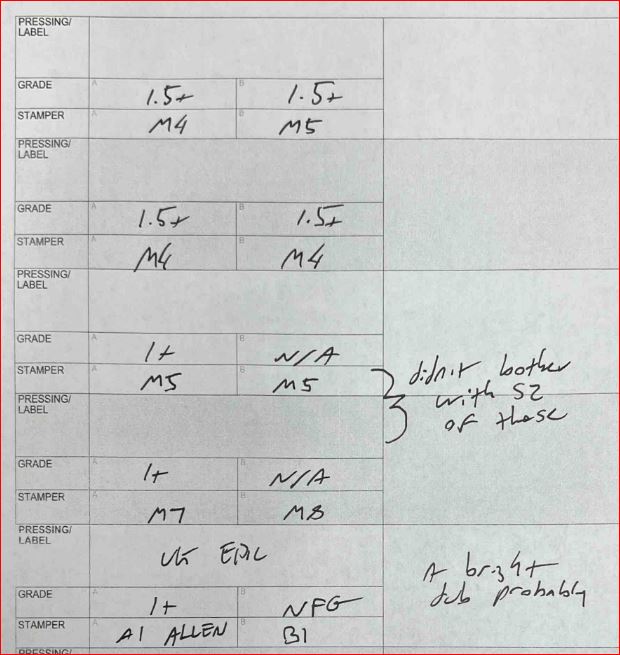
Monarch is responsible for the mediocre-at-best sound of the pressings with the stampers you see above. We tend to like Monarch pressings as a rule, but sometimes they mess up, and they messed up Tapestry compared to others who pressed the record.

We liked all the other copies with other stampers better than than these, which just goes to show you can never know how good it can get until it gets that good. That is what shootouts allow us to do.

Playing close to twenty copies of Tapestry in a shootout allows us to grade Tapestry on a scale, with the M stampers filling out most of the bottom and the other stampers — wouldn’t you like to know which ones! — occupying the middle and the top of the distribution. 

This is what the forum posters fail to understand. They think they have a Hot Stamper when what they actually have (maybe!) is a good sounding record. They don’t know how amazing the record can sound — so much more amazing than the one they own, probably — so they assume they have something good, maybe even the best.

They probably do not, but who really knows? The shootout would supply the data they need to support their conclusions, and since they could not be bothered to conduct one, they have no data to back up their opinions.

The “probably” you see in the above two sentences is there for a good reason. We make a point of being clear about what we can know and we cannot know, and we cannot know what a record sounds like until we play it.

This is obviously true for those of us who try to listen as critically as possible, but we also know that it is just as important to think about records the right way.

(more…)

Our Old Prediction for LSC 2563 Came True

Hot Stamper Pressings that Feature the Violin

Many years ago we wrote:

This is a very old review and it’s doubtful we would not prefer the right Shaded Dog pressing these days.

That turned out to be the case, as we had two late-label 70s Red Seal pressings in the shootout we just did and only one of them was even passable.

A few things about the new pressings and the old commentary caught my eye.

First off, 3s is a fairly low number. The Shaded Dogs that win the shootout must be lower, which means they are either 1s or 2s. Not much to choose from there!

Secondly, the commentary you see below goes into great detail regarding what each piece found on the pressing was doing right and wrong.

It makes us sound like we knew what we were talking about when it came to this specific Red Seal pressing of the album we had played.

I assure you that we did not.

On the web I come across lots of reviews for audiophile pressings in which the writers go on for page after page about how much better the new Heavy Vinyl pressing is compared to the old record the reviewer owns.

This is no longer hard for me to understand. They are simply as lost as I used to be.

(more…)

These Are Just Some of the Stampers to Avoid on Catch Bull at Four

More of the Music of Cat Stevens

The domestic pressings of Catch Bull at Four with the stampers shown below, and others similar to them, have not done well in our shootouts for years now. If you own a copy with these stampers, or ones like them, the good news is that we can get you a much better sounding copy of Catch Bull at Four than you have ever heard.

Stamper numbers are not the be-all and end-all in the world of records, a subject we discuss below, but after hearing too many copies with these stampers and decidedly mediocre sound, from now on we are going to focus our attention on the stampers that do well and leave copies with these markings sitting in the bins.

When it comes to stampers, labels, mastering credits, country of origin and the like, we make a point of revealing very little of this information on the site, for a number of good reasons we discuss here.

The idea that the stampers are entirely responsible for the quality of any given record’s sound is a mistaken idea, and a rather convenient one when you stop to think about it. Audiophiles, like most everybody else on this planet, want answers.

(more…)

The Classic Pressing of Beethoven’s 4th Can Have Very Good Sound

More of the music of Ludwig van Beethoven
Somehow we managed to have a Classic Records pressing on hand to play in our most recent shootout for the Beethoven Symphony No. 4.

We knew all the way back in 1997 that Classic had done a good job with the record — we recommended it as one of the best Classic Records pressings in our catalogs at the time — but we sure didn’t expect it to do as well as it did, earning 2 pluses on one side and close to that on the other.

Years ago we wrote:

Here is the kind of sound that Classic Records could not ignore, even though the original was only ever made available as part of RCA’s budget reissue series, Victrola.

Don’t let its budget status fool you — this pressing puts to shame most of what came out on the full price Living Stereo label. (And handily beats any Classic Records reissue ever made.)

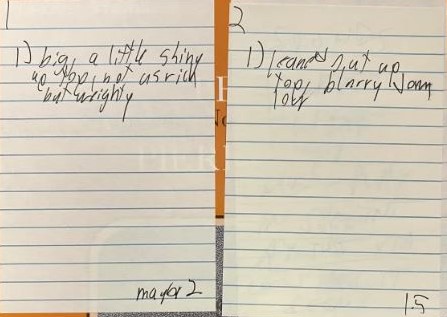
The top and bottom are wrong to varying degrees on both sides of the Classic, as you can see from our notes, which read:

(more…)

Jimmy Page Remasters a Classic

Hot Stamper Pressings of the Music of Led Zeppelin Available Now

The more appropriate title for this commentary might be The Two Game, in honor of The Blue Game we created way back in 2007.

That year was indeed a watershed in the history of Better Records. It was the year we officially gave up on Heavy Vinyl, having come to the conclusion that the modern remastered LP was a lost cause. One thick slab of vinyl after another was ordered up and placed on our turntable, where it lay half-dead until someone took it off and relieved us of our misery.

Signs of improvement were nowhere to be found. A slough of dubious pressings released in the fifteen years since then have only confirmed the wisdom of our decision. It seems we got out just in time!

Fittingly, it was actually Blue that finally tipped the scales.

Geoff Edgers, the writer for the Washington Post investigating the world of audiophiles, visited me in 2021 to hear what this crazy Hot Stamper thing was all about. [1]

He brought with him a number of records to hear on our reference system, including the 2014 remaster of Led Zeppelin II (excellent), the remaster of Brothers in Arms that Chris Bellman cut, released in 2021 (also excellent, review to come), and last and definitely least, the pricey Craft Recordings remaster by Bernie Grundman of Lush Life (astonishingly bad, review coming).

That last one will cost you a couple of hundred dollars minimum, but you should save your money. It’s not worth a plugged nickel if good sound is what you are after. If you like being the only one on your block with a limited edition pressing, then I suppose you can tell your audiophile friends you own one and that it looks nice on the shelf. Whatever you do, don’t play it.

Retirement Changed My Plans

I’ve been meaning to write about Page’s version of the second Zeppelin album for more than a year. The more times I played the album, and the longer I thought about it, the more remarkable the sound of the record seemed to me, remarkable in the sense that some very interesting things were going on in the sound that would be worth writing about for the benefit of our customers and readers.

But then I retired and had lots of other things to do in order to get out of California. The review would have to wait.

In 2021 and for some time thereafter, I was so impressed with the sound that I considered buying a dozen, cleaning them up and doing a shootout with them. The sound was good enough to qualify as a Hot Stamper, probably in the range of 1.5+, which is what we would typically call good, not great sound.

Still, worlds better than the truly awful sounding audiophile pressings we’ve been reviewing over the last couple of years.

I actually did buy a second copy, had it cleaned and played it against the first one we bought. It sounded virtually identical. Whatever the differences, they were minor, although if I’d bought ten copies, I suspect that the differences between the best and the worst would have been significant, but that’s really only a guess.

(Many years ago, back in 2008 I think, we had done a shootout using a Heavy Vinyl title, Sting’s Mercury Falling. We have not done many since, for the simple reason that we know of no Heavy Vinyl pressings with sound good enough to be considered Hot Stampers.)


UPDATE 2025

Actually we now know of one, which proves it can be done!)


The guys who do the listening now and I all agreed about what the new version was doing, right and wrong. [2]

I wanted to talk about the good and the bad in depth because I thought I knew what was going on with the sound that nobody else would outside of our little group of three. I felt I had unlocked its secrets, secrets no one, to my knowledge, had discussed or examined. (If you know of a good review, please send it my way. I have yet to read a good one.)

The Hot Stamper Remaster

We don’t list albums with One Plus grades anymore, but in this case we could make the argument — and back it up! — that the best pressings of Page’s version are better than any reissue ever made. No audiophile version is any good, that’s for sure. We’ve played them and reviewed them and put them where they belong, in our audiophile hall of shame. [3]

Our latest thinking is that we will give one of the Page remasters to our customers for free when they buy one of our Hot Stamper pressings, so that they can compare the two for themselves. This is currently our policy.

(more…)

Offenbach / Gaite Parisienne / Dorati

More of the Music of Jacques Offenbach

This lovely Mercury Golden Import LP not only has Super Hot Stamper sound on side one, which is where Gaite Parisienne can be found, but it also boasts one of the greatest performances of the piece ever recorded. 

Dorati is surely The Man when it comes to energy, drive and dynamic excitement with this venerable warhorse. He and his Minneapolis Symphony play the hell out of this boisterous music, and luckily for us audiophiles, the Mercury engineers give us Demonstration Quality Sound to go with it.

The original Mercury release of this record (sr 90016) is a shrill piece of trash, as is the Mercury Wing pressing. So many of the early Mercurys were poorly mastered it seems.
We audiophiles must wait for reissues (either by Mercury or in this case by Philips once they had bought Mercury) to show us how good the sound of a particular recording might actually be. [Not sure I would agree with most of that now in 2022.]

Of course what you really need is the right copy to know ultimately how good the recording can be, and to find it you might have to clean and play ten LPs, or more. That’s where we come in.

(more…)

Rock On – Side to Side Differences Described

More of the Music of Humble Pie

UPDATE 2026

These are the notes from our first shootout winner back in 2009.


This record is the very definition of TUBEY MAGIC. The sound is so rich and sweet it will make you want to take all your CDs and dump them in the trash, if you haven’t done so already.  

This is the sound WE LOVE here at Better Records, assuming the pressing in question still maintains some degree of presence, immediacy and transparency. Records like this can easily get thick and muddy; think of the typically dull Who’s Next or Sticky Fingers and you’ll know exactly what I mean. (more…)