_Composers – Mussorgsky

Rimsky-Korsakoff, Saint-Saens, Prokofieff – Destination Stereo

More Classical and Orchestral Recordings

  • Boasting two STUNNING Shootout Winning Triple Plus (A+++) Living Stereo sides, this original Shaded Dog pressing is the BEST we have ever heard
  • It’s also fairly quiet at Mint Minus Minus, a grade that even our most well-cared-for vintage classical titles have trouble playing at
  • Explosive dynamics, huge space and size, unerringly correct tonality, this is a Demo Disc like no other
  • Shockingly real – proof positive that the cutting systems of the day are capable of much better sound than some audiophiles might think – if more evidence of that fact is what you’re after, see here and here
  • It has all the Living Stereo magic one could ask for, as well as the bass and dynamics that are missing from other Golden Age records
  • If you’re a fan of orchestral showpieces such as these, this Living Stereo from 1959 belongs in your collection.

This record is designed to show off the Living Stereo sound at its best and it succeeds magnificently. The full range of colors of the orchestra are presented here with remarkable clarity, dynamic contrast, spaciousness, sweetness, and timbral accuracy.

If you want to demonstrate to a novice listener why modern recordings are unsatisfactory, all you have to do is play this record for them. No CD ever sounded like this.

Just play “Gnomus” to hear The Power of the Orchestra, Living Stereo style.

The fourth and fifth movements of “Capriccio Espagnol,” the second track on side one, sound superb, clearly better here than on the Shaded Dog pressings we played a few years ago (which were terrible and never made it to the site. Great performance but bad mastering of what obviously was a very good master tape).

You can also hear the Living Stereo sound especially well on the excerpt from “The Fourth of July” performed by Morton Gould. It’s one of the best sounding tracks here.

When “in-the-know” audiophiles discuss three-dimensionalitysoundstaging and depth, they should be talking about a record that sounds like this.

(more…)

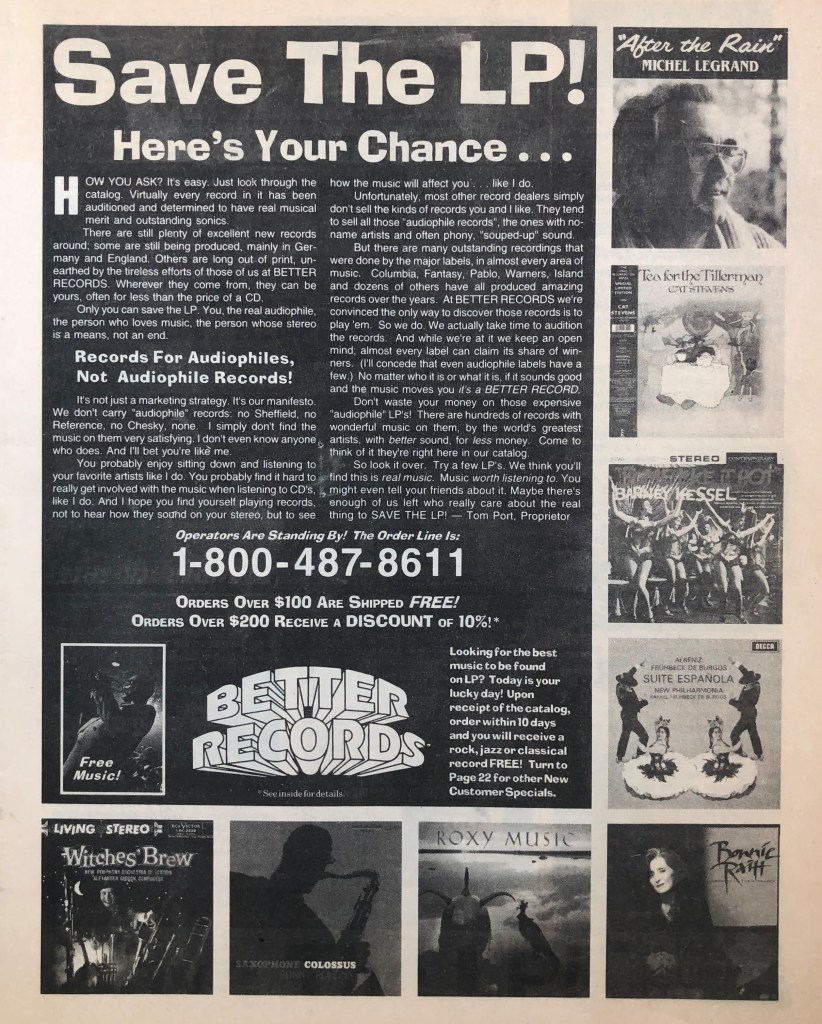
Witches’ Brew on Classic Records and How Crazy Wrong I Was, Part One

Hot Stamper Living Stereo Orchestral Titles Available Now

Well below the reproduction of the front page of our old catalog you will find the review I wrote in 2007 for the Classic Records’ Heavy Vinyl pressing of Witches’ Brew.

Clearly I did not care for it in the least. In fact, I thought it was one of the worst reissues I’d ever heard, so aggressive, boosted and unnatural it defied understanding that anyone could ever play such a record and not notice how wrong it sounded.

Now when I think about the Classic Records reissue of Witches’ Brew and its awful sound, it’s obviously a modern remastering I could not possibly have liked.

However, in preparing to move to Georgia in 2022, I found myself digging through some old catalogs from the early Nineties. Something I read in one of them chilled me to the bone.

There it was in black and white: my rave review for the Classic Records pressing of Witches’ Brew.

It’s actually on the front page of the catalog, along with at least one other record that I would be mortified to sell today: the OJC pressing of Saxophone Colossus.

(As soon as I find my review in the old catalog for Saxophone Colossus, I will post it. I can hardly believe I wrote it, but I did. I wrote all my catalogs back then. My lack of competence and the guilt associated with my lack of expertise at the time is undeniable. It obviously would be foolish and wrong of me to try to deny any of it, so I don’t.)

Below you will find a commentary from 2007 detailing the shortcomings of the Classic.

I sure had a lot of nice things to say about it in 1994.

I thought my stereo was awesome back then, but it was not nearly as awesome as I thought it was. It was better than any system I had heard in a stereo salon, audio show or friend’s house, but that has to be seen as a pretty low bar, and it may even be lower now than it was back then.

I’ve written a bit about the limitations of my 90s system here.

The Dunning-Kruger effect is real, and I clearly suffered from it.

In 1994 I had been a fairly dedicated audiophile for more than twenty years, and a strongly opiniated audiophile record dealer, one who took pride in curating his vinyl offerings right from the start of the business in 1987.

I thought I knew what I was talking about. Looking back it’s clear I had a lot to learn.

(more…)

Liszt / Smetana / Mussorgsky – Les Préludes / The Moldau / Night On Bald Mountain / Dorati

More of the music of Franz Liszt (1811-1886)

More Recordings on Mercury

  • Boasting superb Double Plus (A++) sound throughout, this original copy will show you just how good the Mercury engineers were back in those days
  • Dorati breathes life into these concert hall favorites as only he can, and the Mercury engineers (Fine and Eberenz) capture the excitement on tape as only they can
  • We have a preference for Dorati’s recordings with the London Symphony Orchestra, and a record like this will show you exactly why we do
  • The exciting sound of Mercury lives on through the vintage disc they made all those years ago – you can forget the idea that anybody will come along and produce sound of this quality
  • If you’re a fan of orchestral showpieces such as these, this LP from 1960 belongs in your collection

(more…)

Mussorgsky et al. / Night On Bare Mountain / Solti

More of the music of Modest Mussorgsky (1839-1881)

Hot Stamper Pressings of Orchestral Spectaculars Available Now

  • This vintage London pressing of these Russian Orchestral Showpieces earned STUNNING Shootout Winning Triple Plus (A+++) grades or close to them on both sides
  • Big and dynamic as all get out – the work is performed with a speed and precision that will make your jaw drop
  • Tons of energy, loads of rich detail and texture, superb transparency and excellent clarity – the very definition of DEMO DISC sound
  • Solti is clearly the man for this music – he’s on fire with this fiery material

Don’t go looking for the Tubey Magic of an earlier era. What you get instead is super-low distortion, full-bandwidth sound with deep powerful bass and more transparency than most later Londons.

(more…)

Destination Stereo – A Living Stereo Demo Disc

Hot Stamper Pressings of Living Stereo Titles Available Now

Your Destination — Stereo!

“Your passport to great music in new sound by the world’s greatest artists.”

This review was written about ten years ago.

This reasonably quiet RCA Shaded Dog LP has DEMONSTRATION QUALITY SOUND on BOTH sides. It is without a doubt THE best sounding copy we have ever heard*.

Side one is White Hot, with some of the best 1959 Living Stereo we’ve ever heard. Explosive dynamics, HUGE space and size, with unerringly correct tonality, this is a Demo Disc like no other.

When “in-the-know” audiophiles discuss three-dimensionalitysoundstaging and depth, they should be talking about a record that sounds like this.

Shockingly real – proof positive that the cutting systems of the day are capable of much better sound than many might think. 

(We admit that we have made the mistake of wrongthink in this regard.)

This record is designed to show off the Living Stereo sound at its best and it succeeds magnificently. The full range of colors of the orchestra are here presented with remarkable clarity, dynamic contrast, spaciousness, sweetness, and timbral accuracy.

If you want to demonstrate to a novice listener why modern recordings are unsatisfactory, all you have to do is play this record for them. No CD ever sounded like this.

Just play Gnomus to hear The Power of the Orchestra, Living Stereo style.

The fourth and fifth movements of Capriccio Espagnol, the second track on side one, sound superb, CLEARLY better here than on the Shaded Dog pressings of the original album we played about a year ago (which were terrible and never made it to the site. Great performance but bad mastering of what obviously was a very good master tape).

You can also hear the Living Stereo sound especially well on the excerpt from “The Fourth of July” performed by Morton Gould. It’s one of the best sounding tracks here.

I don’t think the RCA engineers can cut this record much better — it has all the Living Stereo magic one could ask for, as well as the bass and dynamics that are missing from so many other vintage Golden Age records.

This is as good as it gets, folks.

(more…)

Mussorgsky-Ravel / Pictures at an Exhibition / Reiner

  • For fans of Reiner’s performance from 1958, we here present a Shaded Dog pressing of this TAS Super Disc, here with outstanding Double Plus (A++) sound from start to finish
  • It’s also fairly quiet at Mint Minus Minus, a grade that even our most well-cared-for vintage classical titles have trouble playing at
  • Both of these sides are remarkably open and natural in the best Living Stereo tradition, with rich lower strings that have little Golden Age smear.
  • Spacious, rich and smooth – only vintage analog seems capable of reproducing all three of these qualities without sacrificing resolution, staging, imaging or presence

(more…)

Mussorgsky / Pictures at an Exhibition (Piano Version) / Ashkenazy

More of the music of Modest Mussorgsky (1839-1881)

  • A superb early London stereo pressing of our favorite solo piano performance of Mussorgsky’s masterful suite, with Double Plus (A++) sound from the first note to the last
  • The weight and warmth of side one’s recording from Kingsway Hall is faithfully captured in all its beauty on this very disc
  • The orchestral performance of the work is squeezed onto the second side of the record, and that is just not going to work with a 30-minute-long piece of music — the sound is compressed and bass-shy

(more…)

Did We Get The Power of the Orchestra Wrong, or Are These Just Bad Stampers?

Hot Stamper Pressings of Living Stereo Recordings Available Now

In 2007, we wrote the following review for The Power of the Orchestra, VCS 2659:

DEMO DISC QUALITY ORCHESTRAL SOUND like you will not believe. We put two top copies together to bring you the ultimate-sounding Pictures At An Exhibition. Folks, it doesn’t get any better than this for huge orchestral dynamics and energy.

I confess I badly misjudged this record over the course of the last few years. I remember liking it in the early ’90s; at that time it was the only Golden Age recording of Pictures whose performance moved me. I never liked the famous Reiner, LSC 2201, and Ansermet’s performance on London also lacks drive and coherency in my opinion.

I then went on to extoll the many virtues of the recording, making special mention of the brass, dynamics and bass, which you can read about here.

More recently we played a copy of VCS 2659 in one of our regular Pictures at an Exhibition shootouts and were not the least bit impressed by it.

Side One:

Steely and opaque, not that good.

Side Two:

Strings are not very [unintelligible, might be bright], not much weight.

In other words, it just sounded like an old record.

(more…)

Tchaikovsky, Rachmaninoff, et al. / Music of Old Russia / Milstein

Hot Stamper Pressings Featuring the Violin

  • Music of Old Russia finally returns to the site on this rare, hard to find original Blue Angel Stereo pressing with two INSANELY GOOD Shootout Winning Triple Plus (A+++) sides
  • To call this title hard to find with the right stampers is quite an understatement — our last shootout for the album took place in 2013 (!)
  • Both of these sides are remarkably transparent, with huge amounts of space around the players, the unmistakable sonic hallmark of the properly mastered, properly pressed vintage analog LP
  • This is one of the better violin showpiece albums we have ever offered on the site

This rare, hard to find original Blue Angel stereo pressing has exquisite sound. As we noted in our listing for Milstein’s Saint-Saens Third, it is the rare Heifetz album on Shaded Dog that can compete with it.

We would rank this Angel recording/pressing with the best of Rabin and Milstein on Capitol, as well as the wonderful Ricci and Campoli discs on London/Decca.

The transparency of both sides lets you “see” the orchestra clearly, without sacrificing richness or weight.

What a record! What a performance from Nathan Milstein.

(more…)

Big Speakers and Loud Levels Bring Out the Power of the Orchestra

Hot Stamper LPs that Sound Their Best on Big Speakers at Loud Levels

The darker brass instruments like tubas, trombones and french horns are superb here. Other Golden Age recordings of the work, as enjoyable as they may be in other respects, do not fully reproduce the weighty quality of the brass, probably due to limiting, poor eq, poor miking, or some combination of the three.

The brass on this record has a power like practically no other.

It’s also tonally correct. It’s not aggressive. It’s not irritating. It’s just immediate and powerful the way the real thing is when you hear it live. That’s what really caught my ear when I first played the recording.

There is a blast of brass at the end of Catacombs that is so big and real, it makes you forget you’re listening to a recording. You hear every brass instrument, full size, full weight. I still remember the night I was playing the album, good and loud of course, when that part of the work played through. The power of it was truly startling.

Back then I had the Legacy Whisper speaker system, the one with eight 15″ woofers. They moved air like nobody’s business. If you want to reproduce the power of the trombone, the loudest instrument in the orchestra, they’re the speaker that can do it.

Some of Ansermet’s recordings with the Suisse Romande are absolutely the best I’ve ever heard. It was a magical combination of the right hall, the right engineers, the right orchestra and the right technology — the pure tube ANALOG technology of the 50s and 60s!

Dynamics

Another thing this recording has going for it is dynamic power. This is a dynamic piece of music. Few recordings I have ever heard have the dynamic contrasts that this one does. It really gets loud when it needs to. The best pressings sound completely uncompressed. Although I’m sure there has to be compression of one kind or another, the listener is rarely made aware of it.

Dynamics such as these are thrilling. They let the music come alive.

(more…)