wrong-country

Harry Moss Cut These UK Stampers for Hey Jude – How Did He Go So Wrong?

Hot Stamper Pressings of the Music of The Beatles Available Now

Now with a couple of shootouts for both Hey Jude and the 1967-1970 compilation album under our belts, our main listening guy thinks the versions of the overlapping songs on Hey Jude are a little more fun.

He said that, all things being equal, the best pressings of Hey Jude might be a little more exciting while the best pressings of The Blue Album are a little more polite.

Here is how we described a recent shootout winning copy:

An amazing 10-song compilation from 1970 of some of the band’s biggest and best hits – “Can’t Buy Me Love,” “Paperback Writer,” “Lady Madonna,” and the iconic title track among them.

Longtime customers know that we had never been able to offer this title up until 2022 – it took us twenty years to figure out what the right pressings are, and believe me, we had to go through a lot of crap to find them.

If you know the album at all, you know how bad it sounds on the average copy, and my guess is you just gave up on the idea of finding good sound for these songs, which is more or less the way we felt too, but we finally found what we were looking for, and here it is.
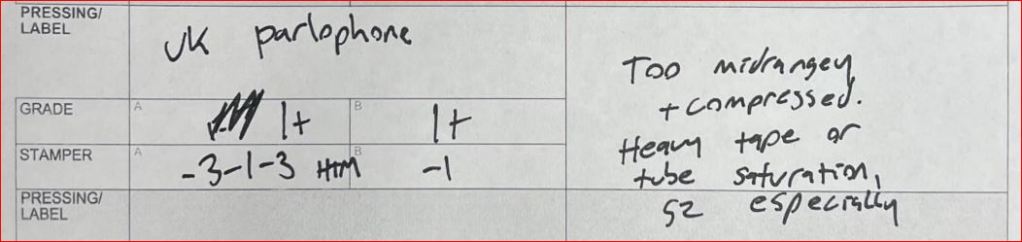
However, some stampers are disappointing as you can see from this section of the stamper sheet we compiled for the shootout.

Harry T. Moss, the man with the initials HTM you see above, is the Parlophone/Apple engineer who cut many of the greatest sounding Beatles albums ever made (and plenty of not-so-great sounding ones, which is why you either need to do your own shootouts or have us do them for you).

Seems at though at least some of the work he did for the Hey Jude album is not his best. We awarded both sides a sub-Hot Stamper grade of 1+, which means the sound is passable at best, even after a good cleaning. (Without a good cleaning it would probably not even earn that one plus.)

We do not sell records with 1+ grades; you can find those on your own. The world is full of them.

Our notes for this pressing read:

  • Too midrangey and compressed
  • Heavy tape or tube saturation, side two especially

Your only other option for hearing some of this music with top quality sound is on the 1967-1970 compilation album, the Hot Stamper pressings of which have only recently been discovered.
(more…)

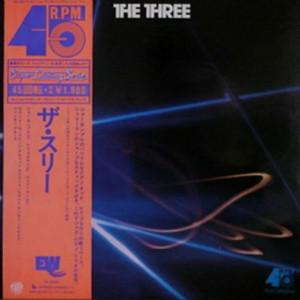
The Three at 45 RPM Has Energy Like No Recording We’ve Ever Heard

Hot Stamper Pressings Featuring Shelly Manne Available Now

When it comes to blockbuster sound that jumps out of the speakers, the wind is at your back with The Three because this is one seriously well-recorded album. If this record doesn’t wake up your stereo, nothing will.

We call it a “blockbuster” because it does not sound very much like a jazz trio performing in a club or some such venue.

But where is the harm in that? It’s not trying to.

What it’s trying to be is huge and powerful in your home. Everything has been carefully and artificially placed in the soundfield. Shelly Manne’s cymbals are placed as far left and as far right as possible on the “stage,” making him the longest-armed drummer to have ever sat behind a kit.

The drum solo on side two is full of energy and so dynamic. Why aren’t more drum kits recorded this well?

Check out the pictures inside the fold-open cover to see all the mics that were used on the drums. That’s where that wall-to-wall, floor-to-ceiling sound comes from.

It’s a phenomenal big speaker jazz Demo Disc.

Play this one as loud as you can. The louder you play it, the better it sounds.

Speaking of Energy

The transients found on this recording are uncannily lifelike. Listen for the huge amounts of kinetic energy produced when Shelly whacks the hell out of his cymbals.

This is a quality no one seems to be writing about, other than us of course, but what could possibly be more important? On this record, the more energetic copies took the players’ performances to a level beyond all expectations. It is positively shocking how lively and dynamic the best copies of this record are.

I know of no other jazz recording with this combination of sonic and musical energy.

(more…)

Talk About Getting the Sound Wrong – What Was Decca Thinking?

Hot Stamper Pressings of the Music of The Rolling Stones Available Now

Even though we know that the UK Decca pressings have not done well in our shootouts for more years than I care to remember, if we see one for cheap locally you know we’re going to buy it and get it another chance at the brass ring no matter how many times it’s failed in the past.

As you can see from our shootout notes, the Decca import has once again let us down.

It’s bright, with no warmth or weight. It’s not musical like the London pressings with the right stampers are.

If a certain kind of audiophile were to play this record, the kind of audiophile who might be given to simplistic conclusions based on insufficiently small sets of data — which, in our experience, pretty much covers the entire audiophile record collector community, including, if not especially, the so-called expert reviewers — the conclusion such a person might reach is that Beggars Banquet is just not very well recorded.

If Decca pressings don’t sound good, what on earth would?

Or, to put it another way, if Decca, the label that the Stones recorded this album for, can’t figure out how to make Beggars sound its best, why would we assume that any other company could?

We would, naturally, assume that Decca did the best they could with the tape and the mediocre quality of the sound you hear — 1+/1.5+ is pretty much our definition of mediocre — is all there is.

The Option that Is Almost Always Wrong

Worse — if a new Heavy Vinyl pressing of the album came out with even halfway-decent sound, then it would prove beyond a doubt that some modern mastering engineer had finally figured out how to get Beggars to sound right.

But of course it would prove no such thing.

If all you have to guide you is conventional collector wisdom, then the one thing you can be sure of is that the Decca pressing from the UK should have better sound than any other, especially any record made in the states.

But it doesn’t. It’s possible I suppose – we haven’t played every pressing ever made – but it sure is unlikely based on the evidence presented to our ears over the course of the last twenty to thirty years or so.

If you would like to hear Beggars Banquet sound right, and have the hundreds of dollars we charge for a copy that is guaranteed to sound right or your money back, click on the link. It’s rare that we have one in stock, but you never know.

(more…)

Unlike the First Three Albums, on Security You Can Forget the Brits

Hot Stamper Pressings of the Music of Peter Gabriel Available Now

The basics notes here were written in 2009, about the time we finished our album by album auditions of his early catalog.

On this title, forget the Brits. Every British pressing we played was badly smeared and veiled.

This took us somewhat by surprise because we happen to like the British PG pressings, but remember, So on British vinyl is awful too, so it’s clear (to us anyway) that the later PG records are bad on British vinyl and the early ones are better.

We are limiting our comments here to albums up through So. Anything after that is more or less terra incognita for us simply because we don’t care for the music he was making after 1986.

Plays Live, from 1983, takes the dark, overly-rich, overly-thick and way-too-smooth sonics of Security and lathers it over the material he had previouly recorded up through then. Some of it works well enough I suppose, but in my experience it usually isn’t long before the monotony of this approach grows tiresome.

What We Listened For

The best copies have sonic qualities that are not the least bit difficult to recognize:

  • Presence, putting PG front and center;
  • Dynamics, both micro and macro;
  • Energy, allowing the rhythmic elements to bring out the life in the music;
  • Transparency, so that we hear all the way to the back of the studio (where some of the many musicians that play in the densest parts no doubt had to stand); and
  • Ambience, the air that surrounds all the players and what instruments they played.

And of course we played the album VERY LOUD, as loud as we could. It’s the only way to get the massive druming to sound right.

The Music

This is one of the most important records in the Peter Gabriel canon, groundbreaking and influential on so many levels. The entire album is a wonderful journey; anyone with a pop-prog bend will enjoy the ride. Just turn the volume up good and loud, turn off your mind, relax and float along with PG and the band. You’re in good hands.

I’ve listened to this one more than other PG albums with the only exception being his second release, the one produced by Robert Fripp. That one is still clearly my favorite of the lot. I play it to this day and have never tired of it since I bought it way back in 1978.

Naturally, I would have originally picked up the domestic pressing, which is clearly made from a dub tape, but in 1978 what did I know about master tapes and imported pressings?

I was still a big Mobile Fidelity fan at that time, which is a simple way of saying that it’s clear that I had a very long way to go in this hobby and a great deal left to learn!

Nothing Peter Gabriel released after So did much for me so I resigned myself to the first five albums. Five excellent albums from one artist is plenty in my book.

If you like the albums after So, to each his own and more power to you. It’s my opinion that their appeal is limited, such that doing a shootout for them is not likely to be in the cards.

(more…)

Letter of the Week – “I have been listening to a first pressing Decca, but your copy made it sound egregiously insipid.”

Hot Stamper Pressing of the Music of The Rolling Stones Available Now

One of our good customers had this to say about some Hot Stampers he purchased recently:

Hey Tom, 

This LET IT BLEED is a gorgeous monster. Everything just jumps off the page, so to speak. I have been listening to a first pressing Decca, which I have owned for years, but your copy made it sound egregiously insipid. As I kept turning up the volume, the room seemed to be nodding its head and egging me on to keep increasing it. I never reached the point where too much was too much. Great copy.

The Mahavishnu EMERALD was brilliant. It brought out all the exciting dimensions of my system. The exquisite strings floated above the musical melee which tattooed its obligato deliriously across its raucous underbelly. The sound reached out like tongues of flame making the speakers completely disappear in their rocking wake.

This is an amazing record that projects and dances the music in every direction and then some. Everything is alive. So completely alive. A real treat. A great recording that tells me my system is completely responsive.

Phil

Phil,

We’ve known for a very long time — since roughly 2005 — what an awful pressing the original mono Decca is of the album.

When we last heard one, it did not evn pass the laugh test, and we never bought another.

Even the original Decca stereo pressings of the album are not that good, and at the prices being charged these days, a very poor choice if you want the best sound.

(more…)

Tusk on Japanese Vinyl Without the Sub-Generation Japanese Mastering

Hot Stamper Pressings of the Music of Fleetwood Mac Available Now

This Capitol-mastered, Japanese-pressed LP has excellent sound on the first two sides and SUPERB sound on sides three and four. I doubt you’ve ever heard the title track rock like this.

We dug up a few Japanese copies of Tusk that were mastered at Capitol by Ken Perry. Because they were made from the real tapes, these don’t have the typical smeary, sub-generation sound associated with Japanese pressings. We found that the best Japanese copies could hold their own with the best domestics on sides one and two, and could win outright on sides three and four.

We almost never like records that, although pressed in Japan, were not recorded in Japan. This is one of the exceptions because the mastering was done by the real mastering engineer, Ken Perry, using the real tape, here in America.

There are also some excellent direct to disc albums that were recorded here in the states and subsequently pressed in Japan.

(more…)

Listening in Depth to So

Hot Stamper Pressings of So Available Now

With a digital recording such as this, the margin for mastering error is very slim. Most copies just aren’t worth the vinyl they’re pressed on. They can sound harsh, gritty, grainy, edgy, and thin. We love this music and we know there are great copies out there, so we keep picking these up. More often than not, we’re left cold.

This is a digital recording, and most of the time it is BRIGHT, SPITTY and GRAINY like a typical digital recording, which plays right into our prejudices. After hearing a bad copy, what audiophile wouldn’t conclude that all copies will have these bad qualities? After all, it’s digital. It can’t be fixed simply by putting it on vinyl.

Ah, but that’s where the logic breaks down.

Proper mastering can ameliorate many if not most of a recording’s sins. When we say Hot Stampers, we are talking about high quality mastering doing exactly that.

Side One

Red Rain

Peter Gabriel’s soaring vocals here are a great test for transparency, especially during the last minute of the song when they really become more intimate, present, delicate and breathy.

Sledgehammer

Not unlike “Red Rain,” the flute intro here is a solid test for transparency and texture. But this moment passes quickly to make room for the huge horns that fire up the biggest hit on this album. The trumpets should have weight, dynamics, and texture. If they are smeary, blary or lifeless, you probably are listening to the typically compressed, low-resolution copy. (Side note: listen for the chatter before the singing begins – is someone talking on the phone? Last minute instructions from Peter? If you can figure out what they are saying we’ll give you this record for free!)

Don’t be alarmed at the veiled sound of the first two bars of vocals – it’s just the recording talking. When the verse comes in full swing, you’ll probably notice a little bit of spit, which is unavoidable here, especially on the super-sibilant “steam train” or “blue sky back”. However, the good copies make this problem non-offensive, and actually beneficial to the life of the music. The spit should not sound gritty or grainy; if it has a somewhat silky quality that’s a very good sign. But it has to be there if your copy is to have any life or presence in the midrange.

The backup singers that come in at the end of the first chorus should be subtle yet still present and clear. Also, pay attention to the reintroduction of the horns at the beginning of the second verse. The dynamic here is extremely important. The last note of their phrases should really swell up and make you appreciate what those guys are doing. (Maybe it’s Peter talking in the background, reminding the horn players not to forget to do that little dynamic trick.) (more…)

Exile on Main Street – A Good Test for Grit and Grain

More reviews and commentaries for the music of The Rolling Stones

The best copies will tend to have the qualities we discuss below, and the more abundant these qualities are on any given pressing, the higher its grade will be.

Yes, it is a science, an empirical one, which can only be carried out by the use of strict protocols and controls, but it sure ain’t rocket science.

All you need is the system, the room, the records, the time and the will to do the painstaking critical listening required to carry out the task.

It can be done, but you could spend a lifetime meeting audiophiles of the vinyl persuasion and never run into a single one who has made the effort more than a handful of times.

To be honest, shootouts are a bitch. If you aren’t getting paid to do them the way we are, finding the motivation to devote the time and energy required to do them right — not to mention the piles of copies of each record you will need — is daunting to say the least.

So, back to the question: what to listen for? (more…)

The Drums and Cymbals Are Key to the Best Pressings of Presence

Hot Stamper Pressings of Led Zeppelin’s Albums Available Now

The drum sound on the best copies is punchy and huge, with prodigious amounts of studio space swirling around Bonham’s kit.

There’s real resonance to the toms, not the standard overdamped sound of a studio kit, which gives them a lively, realistic, natural quality that you rarely hear outside of Zep records.

And the cymbals crash and splash just like real cymbals do, which is yet another sound you rarely hear outside of the best Zep pressings. (The best copies of Zep IV have crashing cymbals on Black Dog and Rock and Roll like few records in the history of rock.)

We just finished a massive shootout for this album and were reminded just how hard this album rocks. Achilles Last Stand, For Your Life and Nobody’s Fault But Mine are all KILLER on a Hot Stamper pressing like this one. After cleaning and playing a pile of copies we are pleased to report that the best of them are full of The Real Zep Magic. The average LP may not be much of a thrill but our Hot Stampers sure are, with all the energy, dynamics, whomp, and presence (pun only slightly intended) you could hope for.

That is EXACTLY the kind of sound we love here at Better Records.

Hey Man, Turn It Up!

We’re hoping this copy ends up in the hands of someone who will play it good and loud because that’s the way it was meant to be heard. It’s the only way the mix works, which is a sure sign that that is clearly how the artists intended their records to be played.

Turn up the volume and play the midsection of For Your Life on side one or the entire Nobody’s Fault But Mine on side two to hear Zep rockin’ out in their prime.

Nobody did it better than these four guys. If you have Hot Stampers of their albums, you have some of the best sounding rock and roll records ever made, records that sound the way Zep wanted you to hear them as long as you play them at good loud levels.

(more…)

Domestic Pressings of Clear Spot? Forget ‘Em!

Hot Stamper Pressings of the Music of Captain Beefheart Available Now

We did this shootout many years ago, so many years ago that I cannot find a record of it.

I remember we thought the German pressings were perhaps a bit boosted on both ends and not as natural sounding as the domestic pressings.

After a multitude of improvements in our cleaning and playback, we would agree with our previous understanding that the German pressings are often wrong, but now we also know how right the right ones can be.

It turns out tha some German pressings are not particularly good, another piece of the puzzle that fell into place during our most recent shootout, as painful as that turned out to be considering the money wasted on them.

Did we have the bad German stamper pressings last time around? Who knows?

The producer, Ted Templeman, (Doobie Brothers, James Taylor) brought his mainstream talents to bear on this music, and when the Captain’s free-form tendencies smashed into Templeman’s conservatism, the result was this musical supernova — out there, but not too far out there.

(Play Trout Mask Replica sometime if you miss that feeling from your old hippie days of being on acid. With that music, drugs are entirely superfluous.)

I don’t know how many audiophiles like Captain Beefheart, probably not too many, but if you’re ever going to try one of his albums, this is the place to start: his masterpiece.

(more…)