piano-trio

Andre Previn & His Pals – West Side Story

Contemporary Jazz Records Available Now

Reviews and Commentaries for Contemporary Jazz
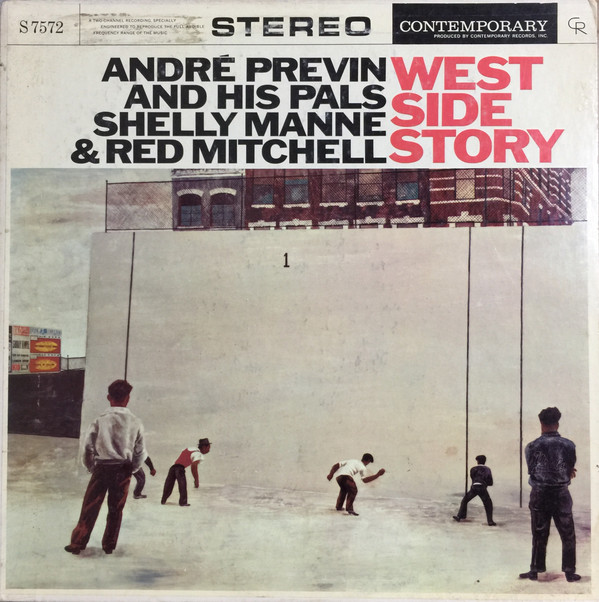
  • Previn’s stellar piano trio finally returns to the site with jazzy interpretations of the best songs from West Side Story, with STUNNING Shootout Winning Triple Plus (A+++) sound throughout
  • You win shootouts with this kind of All Tube Analog sound – warm, natural, lively and clear, with solid support down low, a nicely extended top and a huge three-dimensional soundfield
  • We had pressings on the black label, on the green label, and on the yellow label, and the person who ends up with this fantastic copy will know for sure which label sounds best, because he will be the owner of the best sounding copy
  • Andre Previn and his friends take eight classic tunes from West Side Story – it would be hard to imagine having better material to work with in a jazz setting
  • 4 stars: “The last of a series of showtune albums recorded by the trio finds the all-star group focusing on the music of West Side Story… As usual, the melodies are treated respectfully yet swingingly, and Andre Previn in particular excels in this setting. Recommended.”

One of Previn’s best piano trio records, this album was recorded in 1959 by Roy DuNann while at the height of his engineering powers.

The two Must Owns from his many sessions at Contemporary are this album and Bells Are Ringing. We are not aware of any of his jazz piano albums on other labels being much better than passable and most are not worth picking up at any price. Believe me, we’ve tried. The one exception I can think of is Four to Go on Columbia. It’s pretty good. Not in the same league as his Contemporary recordings by a long shot, but better than most of his output from the ’60s.

For both the albums mentioned above the Black Label originals in stereo are the best way to go, but finding them in clean audiophile playing condition is no walk in the park, which is the main reason it takes us about four years to do a shootout for either title.

The Piano Is Key

On the best copies of the album, the sound of the piano is solid, full-bodied, with both weight and warmth, just like the real thing. The copies of the album with a piano that sounded lean or hard always ended up having problems with the other instruments as well. (This should not be surprising; the piano was designed to be the single instrument most capable of reproducing the sound of an entire orchestra.)

(more…)

Bill Evans – Trio ’64

More Bill Evans

More Jazz Piano Recordings

  • Trio 64 is finally back on the site after a two year hiatus, here with INCREDIBLE Shootout Winning Triple Plus (A+++) sound or close to it throughout this original Stereo Verve pressing
  • Bob Simpson engineered along with Val Valentin, two of the greats in our world – these guys are responsible for an awful lot of our favorite audiophile quality recordings
  • Both of these sides are Tubey Magical yet clear, with plenty of performance energy and a lovely musical quality that’s noticeably missing from many of the copies we’ve played over the years (and no doubt the Heavy Vinyl pressing)
  • The vinyl on these early Verve pressings is the problem – it’s exceedingly hard to find them in audiophile playing condition
  • 4 stars: “Evans’ nimble and emphatic syncopation is not only ably supported, but framed by [bassist Gary] Peacock’s expressive runs and [drummer Paul] Motian’s acute sense of timing. “A Sleeping Bee” is one of the collection’s most endearing selections as the groove playfully scintillates surrounding some hauntingly poignant chord changes [while] “Always” captures a similar effervescence as the instrumentalists ebb and flow in synchronicity.
  • If you’re a fan of Bill Evans, this is a Must Own trio release from 1964. The complete list of titles from 1964 that we’ve reviewed to date can be found here.

(more…)

Hampton Hawes – All Night Session, Vol. 3

More Hampton Hawes

More Contemporary Label Jazz Recordings

  • Exceptional Demo Disc Sound on this STUNNING Contemporary Stereo LP boasting top grades on both sides
  • This is a textbook example of Contemporary sound at its best, with Tubey Magic, richness, sweetness, dead-on timbres from top to bottom thanks to the engineering brilliance of Roy DuNann and producer Lester Keonig
  • The last of three albums of material recorded by Hawes, guitarist Jim Hall, bassist Red Mitchell, and drummer Eldridge “Bruz” Freeman on the night of November 12 and into the morning of November 13, 1956
  • 4 1/2 stars: “…contains three spontaneously improvised variations on the blues, one very cool extended rendition of Duke Ellington’s ‘Do Nothin’ ‘Till You Hear from Me’ and a strikingly handsome treatment of Harold Arlen’s ‘Between the Devil and the Deep Blue Sea.’ The briskly paced ‘Blues #4’ is especially progressive and exciting.”
  • “It’s hard to put into words how good it feels to play jazz when it’s really swinging…I’ve reached a point where the music fills you up so much emotionally that you feel like shouting hallelujah — like people do in church when they’re converted to God. That’s the way I was feeling the night we recorded All Night Session!” – Hampton Hawes

(more…)

Phineas Newborn, Jr. – A World of Piano!

More Phineas Newborn, Jr.

More Contemporary Label Jazz Recordings

  • One of the most musically impressive jazz piano recordings we’ve played in years – Newborn’s improvisational skills are operating at a very high level
  • The team of Roy DuNann and Howard Holzer insure that everything you want in an Audiophile Quality piano trio recording is here
  • If you don’t have any Phineas Newborn albums in your collection, this is definitely the place to start
  • 5 stars: “Phineas Newborn’s Contemporary debut (he would record six albums over a 15-year period for the label) was made just before physical problems began to interrupt his career…. He performs five jazz standards and three obscurities by jazz composers on this superb recital…”

(more…)

Keeping the Players Together on Jazz Impressions of Black Orpheus

guarajazzi_wtlf_1406113104

Hot Stamper Pressings of Jazz Recordings Featuring the Piano

Another in our series of listening exercises here discussing the importance of transparency, ambience and resolution.

The arrangement of the players is straightforward, with the bass hard left, drums hard right (with leakage well to the left on the cymbals, but that’s another story), and Guaraldi on piano in the center. (The first track of side two reverses this arrangement; why, I have no idea.)

Here’s the crazy thing about this recording: The best copies really connect up — tie together — the space each of the players is in. I heard it during the shootout, and I can’t recall if it actually happened more than once or twice, but I know I heard it. They are all live, they are all on the same soundstage, but on most copies you would hardly know it.

They sound like they are playing in booths, the ambience never extending very far in any direction. The best copies have so much ambience that one player’s space extends all the way to the edge of the other player’s space. The effect, though rare, is nothing less than magical.

The piano is solid, mostly clear and not hard. Not many copies present the piano this way — correctly in other words. The amazing snare of Colin Bailey in the right channel is LIVELY and fun like you’ve never heard before.

There is no sacrifice in fullness, richness or Tubey Magic in the presentation, and that is the right sound for this music.

No Breakup on the Piano

I would be willing to bet that 90% or more of all the early pressings still in playable condition have some breakup on the piano. The old arms and carts of the day simply could not track the groove the way modern arms and carts can, and ended up damaging the record.

We are happy to report that this copy has no breakup on the piano at all.

The best copies bring out the contribution of the bass player better, the bass being essential to the rhythm of the music. On some, the bass is so tight and note-like you can see right into the soundstage and practically watch Monte Budwig play.


Further Reading

Midnight Sugar on Two 45 RPM Discs

More Jazz Recordings Featuring the Piano

We haven’t played a copy of this record in years, but back in the day we liked it, so let’s call it a “B” with the caveat that the older the review, the more likely we are to have changed our minds.

The following notes were added in 2023. The original review can be seen just below them.

We should point out that the original Japanese pressings are clearly better sounding than any of the Super-Cut Analogue Disks that were pressed at RTI, regardless of the cutting speed.

I remember auditioning the 33 RPM recut that had been done in 1995. I was a big fan of the album in those days, and I had at least one and maybe more than one authentic Japanese pressings of the album in my collection. I still own the Three Blind Mice CDs of a number of titles as well.

It was no contest, the early pressings were obviously better in every way. I was selling heavy vinyl back then, and that’s what I had to sell, so I raved about the sound of the RTI-pressed reissues and sold plenty of them. I never bothered to point out that they were not as good as the originals. They were good and that was pretty much all I was going to say about them.

The authentic Japanese pressings were expensive to buy and very hard to find. Although they were better sounding, anyone buying the new pressings was likely to be happy with them, and that was good enough for the business model of Better Records at the time.

What accounts for the fall-off in sound quality from the earlier pressings to the reissues, remastered in Japan and then pressed at RTI, is anyone’s guess.

Some of that reduction results from the substandard sound that virtually all RTI pressings tend to have, a subject we discussed in some detail in this commentary from years back.

(more…)

Hampton Hawes – All Night Session, Vol. 2

More Hampton Hawes

More Jazz Recordings on Contemporary

  • These sides are doing everything right – they’re rich, clear, undistorted, open, spacious, and have jazz quartet energy to rival the best recordings you may have heard
  • Tubey Magic, richness, sweetness, dead-on timbres from top to bottom – this is a textbook example of Contemporary sound at its best, thanks to the engineering brilliance of Roy DuNann and producer Lester Koenig
  • The second of three albums of material recorded by Hawes, guitarist Jim Hall, bassist Red Mitchell, and drummer Eldridge “Bruz” Freeman on the night of November 12 and into the morning of November 13, 1956
  • 4 1/2 stars: “Although Hampton Hawes spontaneously created five original tunes at this extraordinarily inspired date, everything on Vol. 2 comes directly out of the standard bop musician’s working repertoire.”
  • “It’s hard to put into words how good it feels to play jazz when it’s really swinging…I’ve reached a point where the music fills you up so much emotionally that you feel like shouting hallelujah — like people do in church when they’re converted to God. That’s the way I was feeling the night we recorded All Night Session!” – Hampton Hawes
  • If you’re a fan of jazz piano trios playing live-in-the-studio, this Contemporary from 1958 surely deserves a place in your collection.

(more…)

Count Basie / Kansas City 3 – For The Second Time

More Count Basie

More Jazz Recordings Featuring the Piano

  • A KILLER piano trio recording with superb sound on both sides of this original Pablo LP
  • It’s bigger, richer, more Tubey Magical, and has more extension on both ends of the spectrum than most other copies we played
  • A different, more compact sound for Basie, joined here as he is by two of the most sympathetic sidemen in jazz: Ray Brown on bass and Louis Bellson on drums
  • “[T]he main joy of this set is hearing Basie stretch out on such numbers as ‘If I Could Be with You,’ ‘On the Sunny Side of the Street’ and ‘The One I Love,’ tunes he did not play much with his orchestra in this later period.”
  • Steer clear of the OJC of this title – it’s thin and opaque, the opposite of the sound you want

It’s a joy to hear Basie perform as a frontman, stretching out on tunes that were no doubt dear to him. Veterans of hundreds of sessions, Ray Brown and Louis Bellson are just as interesting as Basie, high praise.

Recorded by the legendary engineer Ed Greene (Stan Getz/Charlie Byrd – Jazz Samba) — that accounts for the exceptional sound.

Naturally we pick up all the Pablo Basie titles we can get our hands on these days, having had very good luck with a great many of them. When we dropped the needle on a copy of this one a few years back we were amazed at the sound. My post-it, still on the record, reads “SUPERB DEMO DISC.” It certainly is.

This album was part of a series of smaller ensemble recordings under the heading of Kansas City that Pablo undertook with Basie later in his career. Basie had recorded a piano trio record with the same gents the year before For the First Time and must have enjoyed himself enough to give it another go.

The best copies are big and rich, and present you with a solid, weight, clear piano like few piano trio recordings you have ever heard.

(more…)

Hampton Hawes – Vol 2: The Trio

More Hampton Hawes

More Contemporary Label Jazz Recordings

This Triple Plus (+++) pressing from ’55/’56 mono tapes is EVERYTHING that’s good about mono. The size, the weight, the solidity, the clarity, the energy, the rhythmic drive – it’s all here and more.

This killer pressing has the best sound and the best music we have ever heard on any Hampton Hawes album.

There is nothing to fault in the sound of side one of this pressing, and side two was nearly as good – what a record!

Both sides are Tubey Magical, rich, open, spacious and tonally correct. We’ve never heard the record sound better, and that’s coming from someone who’s been playing the album since the ’80s.

These guys are playing live in the studio and you can really feel their presence on every track — assuming you have a copy that sounds like this one.

Based on what I’m hearing my feeling is that most of the natural, full-bodied, smooth, sweet sound of the album is on the master tape, and that all that was needed to transfer that vintage sound correctly onto vinyl disc was simply to thread up the tape on a high quality machine and hit play.

The fact that nobody seems to be able to make an especially good sounding record these days — certainly not as good sounding as this one — tells me that in fact I’m wrong to think that such an approach would work. Somebody should have been able to figure out how to do it by now. In our experience that is simply not the case today, and has not been for many years, if not decades.

(more…)

Robert Brook Digs Deep and “Gets” Down to Earth

Hot Stamper Pressings of Jazz Featuring the Piano

Robert Brook has a blog which he calls

A GUIDE FOR THE DEDICATED ANALOG AUDIOPHILE

Below is a link to the review he has written for a record we had very much enjoyed while doing the shootout for it a few years back, Down to Earth.

Lately we have been writing quite a bit about how pianos are exceptionally good for testing your system, room, tweaks, electricity and all the rest, not to mention turntable setup and adjustment.

DIGGING DEEP Into The Ramsey Lewis Trio’s DOWN TO EARTH

Other records that we have found to be good for testing and improving your playback can be found here.

(more…)