Passable Sound

Another Unimpressive Reissue Pressing of Coltrane’s Music — What Is Going On?

Hot Stamper Pressings of the Music of John Coltrane Available Now

We had an early Blue Label Prestige mono pressing that was not as awful as the original Yellow Label mono we played, but it’s not very good either. Our grade for a record that earns one plus on both sides is passable.

Which means you could listen to it, maybe even enjoy it, but you would have no idea just how well Rudy Van Gelder recorded the sessions in 1958 that went into the making of the album, which as you know was not compiled for release until 1962.

As you can see from the notes above, it was crude, smeary and thick. We don’t sell records that sound like that.

I can’t say that most modern remastered records are crude, although some of them are, but a great many we’ve played are smeary, and almost all of them are thick — that is, lacking in transparency — to some degree. That last quality — a lack of transparency — may be the most irritating of all, a subject we discuss here.

(A great many records we’ve auditioned over the years are good for testing transparency. Those wanting to improve this aspect of their playback should consider making use of them.

(more…)

Bruch & Mozart Violin Concertos – Were We Wrong?

Living Stereo Orchestral Titles Available Now

Many years ago we wrote the following review for LSC 2472:

Superb sound. The violin is wonderful on both sides. The Mozart is absolutely gorgeous; the best I’ve ever heard it.

The orchestra on the Bruch side gets a little congested in the louder passages, which is typical for records of this era.

Laredo plays these pieces beautifully. The Bruch is an especially romantic work and his violin sings sweetly and with deep emotion throughout. The Mozart is more spritely and he plays it with the light touch it requires. You will have a hard time finding a better violin concerto record. This ranks with the best of them.


UPDATE 2024

More recently we got in a nice 1S/1S pressing that sounded thick and dark, even after a good cleaning.

Were we wrong years ago? Hard to say. That copy from many years ago is gone.

Three things to always keep in mind when a pressing doesn’t sound like we remember it did, or think it should:

(more…)

Sorry, This Album of String Quartets Is Not As Good As We Thought

Hot Stamper Pressings of the Music of Claude Debussy Available Now

Hot Stamper Pressings of the Music of Maurice Ravel Available Now

UPDATE 2024

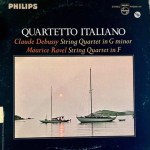
About ten years ago we were under the impression that the domestic Philips pressing you see pictured had exceptionally good sound, sound that would be difficult to beat.

Well, that just goes to show how little we knew about the sound of the various recordings of this music back then.

We needed to do a lot more homework, and the reason we started playing other recordings of these two string quartets is simply that the Philips record we liked so much was too hard to find on the domestic pressing.

The imports could be found, sure, but they sounded like a lot of Philips pressings — overly smooth, smeary, lifeless, recessed and veiled, like the Golden Imports Philips had made in the 70s. It was in those bad old days of the early 70s that Philips set about ruining the sound of phenomenally good Mercury master tapes. They should never be forgiven for it.

I bought one and fell in love with it, for both its music and its sound, a classic case of me not having any idea what I was missing.

How clueless was I? I was almost as clueless as the guy who thought the MoFi pressing of Star Wars and Close Encounters was a true audiophile Demo Disc. As foolish a MoFi fan as I was in the late-70s, even I knew was a piece of phony junk that record was.

Now there are dozens of outfits that make it their business to ruin phenomenally good master tapes by dint of their incompetent remastering, a story we never tire of telling.

Breaking Through

The key to our breakthrough was the rediscovery of a record we had played many years before, all the way back in 2005, and had simply lost track of in the ensuing years: LSC 2413. (It’s easy to lose track of rare Shaded Dogs. They’re not usually sitting in the bins of your local record store. Out of sight, out of mind.)

The best pressings of LSC 2413 are dramatically better sounding, and the performances are equal to or better than any we know.

Recently we finally got hold of another copy of the rare Philips pressing above and found to our dismay that the sound was not nearly as good as we remember it from our shootout years ago. The copy that came in was flat and badly lacked the presence and Tubey Magic of the Shaded Dog pressings we played of the RCA.

As the best of the RCA pressings demonstrate beyond all doubt, 1960 was a great year for classical and orchestral recordings. (What the shameful modern masterng engineers operating today do to such wonderful recordings is another thing altogether.)

(more…)

French Overtures with Ansermet Had One Awfully Good Sounding Side in 2009

Hot Stamper Pressings of the Music of Jacques Offenbach Available Now

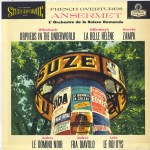
Reviewed back in 2009 in our pre-shootout days.

This Minty London Blueback LP has a WONDERFUL Tubey Magical Super Hot Stamper side one.

I have never heard this music sound better. Of course Ansermet is exactly the right conductor for these light and colorful orchestral pieces; the performances are uniformly superb.

But as audiophiles we want to make sure the sound is what it should be, and here side one does not disappoint. The string tone is perfection. I defy anyone to find a Heavy Vinyl reissue with string tone even remotely as good. In my experience there is simply no such record.

With vintage classical records there are always trade-offs of course. Here the loudest passages suffer from some mild compressor distortion, so common on these early pressings. A small price to pay for sound this lovely I say.

The Zampa overture by Herold is probably the best sound on the album — it’s gorgeous!

Side two is not quite as good. We rated it A Plus, with real weight and energy but a bit too much compression and distorton in the loud passages to be completely satisfying.


UPDATE 2025

Nowadays we would never list a record for sale as a Hot Stamper pressing with a grade of 1+ on either side.

And, more importantly, the grades we awarded these two sides were just estimates.

We did not put this copy in a shootout with a batch of similar pressings.

We played the record, liked what we heard on side one, liked what we heard on side two a bit less, and offered it to our customers with the description of the strengths and weaknesses you read about.

We could not have begun to conduct a shootout for this early London. Back in those days we simply could not find enough copies of such a rare title to make such a thing happen.

As for the compressor distortion on side one that we heard, it’s entirely possible that with better cleaning and better playback that the distortion we thought we heard would disappear. Blaming the record is rarely the ideal approach for making progress in audio.

(more…)

A Scheherazade that Lacks Power in the Brass and Richness in the Lower Strings? No Thanks

Hot Stamper Pressings of the Music of Rimsky-Korsakov Available Now

One of the most dynamic Scheherazade‘s on record. The brass really blasts through in this recording. 

Of course the question is how does this recording stack up to the famous Reiner. Well, I’ll tell you.

The Minneapolis Symphony Orchestra is not in the same league with the CSO, that’s well known. Dorati may be every bit as talented as Reiner, but he doesn’t have the players at his disposal capable of pulling off demanding material such as this.

But the orchestra acquits itself well here. The first violinist is quite good. That’s not the problem.

What lets the side down is the Mercury recording team, who fail to adequately present the weight of the orchestra in the lower midrange and below. One thing I noticed recently when playing an original LSC 2446 was how rich and powerful the sound was in the lower strings and in the brass relative to later pressings of the same title and other recordings of the work.

That opening movement of Scheherazade needs power down there and the Mercury simply doesn’t have enough of that power to qualify it as one of the top sounding Mercs.

(more…)

Is CTFR-1 Dark and Congested, or Flat and Bright?

Hot Stamper Pressings of Mercury Classical Records Available Now

For Mercury classical and orchestral recordings, the original RFR-1 pressings on the plum label are the way to go, right? 

In some cases, yes. The first pressings of Mercury albums often win our shootouts.

And for both sides of a copy to win a shootout, like our gold promo seen in the stamper sheet below, everything about the pressing must be right. We call records that win their shootout, earning 3+ grades on both sides, Top Shelf pressings. They are rare and special enough to have a section of their own on the site (which, as of this writing, has all of 19 records in it.)

What we find to be interesting about this specific shootout, however, is that we had two later pressings, both with the same stampers, and they sounded markedly different from each other. (Note that the stamper numbers you see below belong to a different album than the one shown above.)

If a collector were to tell you that that the CTFR pressings tend to be dark and congested, and you owned one with the exact same stampers, CTFR-1, you might be inclined to agree with this person.

But if you were the owner of the copy we played that was flat and bright, again, with CTFR-1 in the dead wax of both sides, you would think this person was 1.) Out of his mind, or, 2.) Deaf as a post, or, 3.) The owner of some very inaccurate playback equipment.

He could be all three, but in this case, an unusual one to be sure, his copy of the album doesn’t tell you anything about the sound of your copy of the album. They could match, or they could be completely different. Some records are like that. Not all that many, but definitely some.

Sample Sizes and One Man Bands

Those of us who play a variety of pressings of the same album know how easy it is to draw mistaken conclusions about records. CTFR-1 on this title is the perfect example of a record whose stampers don’t tell you much about its sound. (Even RFR-1 on side one of one copy was no better than “good,” quite a long ways from the best.)

(more…)

A Disappointing OJC of Swinging With The Mastersounds

Hot Stamper Pressings of Top Quality Jazz Recordings Available Now
UPDATE 2025

We did a shootout for this Mastersounds title many years ago. It didn’t sell very well so we decided to give it a rest for a while, something in the range of a decade or so.

Recently we got another couple of copies in, including their other album we used to like on OJC, A Date with the Mastersounds, and found none of the copies we played to be nearly as impressive as we thought they were back in the day. Some quick notes:

  • A Date with the Mastersounds

Vibes are dry and glassy. Not much Tubey Magic.

  • Swinging With The Mastersounds

Rich but veiled sound. Just OK, not great.

With that said, we still like the music, so if you see one of these pressings for cheap and you like vibes-based jazz from the 50s, pick it up and discover the music of The Mastersounds for yourself.

(more…)

We Forgot How Mediocre the Originals of A Winter Romance Are

Hot Stamper Pressings of the Music of Dean Martin Available Now

We gave a couple of early pressings another chance and they blew it!

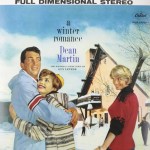
The copies we sell as Hot Stampers are the reissues from the 60s. Here is what we had to say about a copy we posted for sale recently:

With a voice that is relaxed, smooth and warm, Dino is the perfect guy to sing these songs.

The sound of this reissue is far better than any of the originals we played, which mostly weren’t very good. Which just goes to prove (once again) that in the world of vinyl, the idea that the original will have the best sound is a pernicious falsehood.

Rich, sweet, full of ambience, dead on correct tonality, and wonderfully breathy vocals – everything that we listen for in a great record is here.

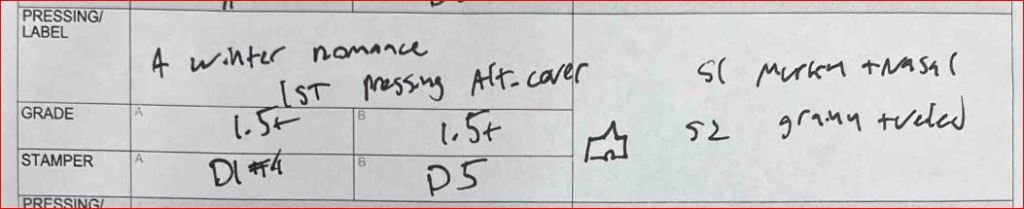
To back that up with actual stamper sheet evidence, here are the grades for the two early pressings we put in our shootout. We’d heard the originals before and never liked them, but sometimes if a particular presssing is cheap and easy to find, we give it another chance.

I think we’re done with the originals now though. They’ve let us down too many times.

Who wants to hear Dean Martin’s gorgeous baritone sounding lean, dry and recessed, or, alternately, murky, nasal, grainy and veiled?

If I didn’t know better I would suspect these originals were modern reissues. This kind of crap sound is all over the Heavy Vinyl records we play, although nobody but us ever seems to notice.

The Point Is

This serves to make a very important point that is near and dear to our hearts:

(more…)

The 2013 OJC of Brilliant Corners Has a Problem Many OJCs Do

Hot Stamper Pressings of Top Quality Jazz Recordings Available Now

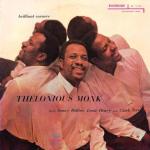
Brilliant corners on the 2013 OJC pressing is not a bad record. At $20, roughly the price they sell for on Discogs, you are getting a decent LP for your money, which is not the case with a lot of what’s produced these days, the worst of which can be found here.

The sound is nice and meaty, which is all to the good, but where this pressing falls apart is in the area of transparency, as in, there isn’t much.

In simple language, it is opaque.

This is a very common shortcoming of the new OJC pressings. When they manage to get the tonality right — which is about  half the time — they still come across as crude and underwhelming. They require too much effort from the listener to become involved and stay that way.

If you see this OJC pressing in your local record store, and you don’t have a good CD player (a dirty little secret: the standard CD is likely to be better sounding). buy it for cheap, but don’t pay much money for it. You may find that, after a spin or two, playing it is more trouble than it’s worth.

(more…)

None of the Living Stereos with Reiner Conducting Was Better than Passable

Hot Stamper Pressings of Living Stereo Titles Available Now

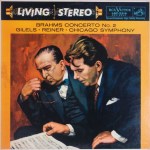
For a cover this beautifully rendered, you would think the sound of the Shaded Dog pressings of LSC 2219 would be something special.

Unfortunately, as we were preparing our shootout for the work we did not find that to be the case.

We dropped the needle on some copies and judged that the grades would be roughly in the range of 1+. Some copies might be a bit better, some might be a bit worse, but most of them would have sound that was merely passable, even after a good cleaning. (Without a good cleaning, most would probably not even earn that single plus.)

We do not sell records with 1+ grades. You should have no trouble finding those on your own. The world is full of them. They’re what most audiophiles call “good sounding records.”

Our favorite Brahms Second Piano Concerto for sound and performance is LSC 2581. It was recorded for RCA only a few years later in 1962.

The average Shaded Dog may be better than the average classical record, but that certainly doesn’t mean it has any claim to audiophile sound. We’ve played bad early RCA pressings by the hundreds. Now, with the help of this blog, we can point some of them out to the record lovers who are looking for top quality sound and don’t care that much about the label.

(more…)